
Lea Jacobs sheds new light on an old master in “John Ford At Work”
The UW Professor Emeritus’ new book on the storied American director coincides with a five-film UW Cinematheque series this spring.
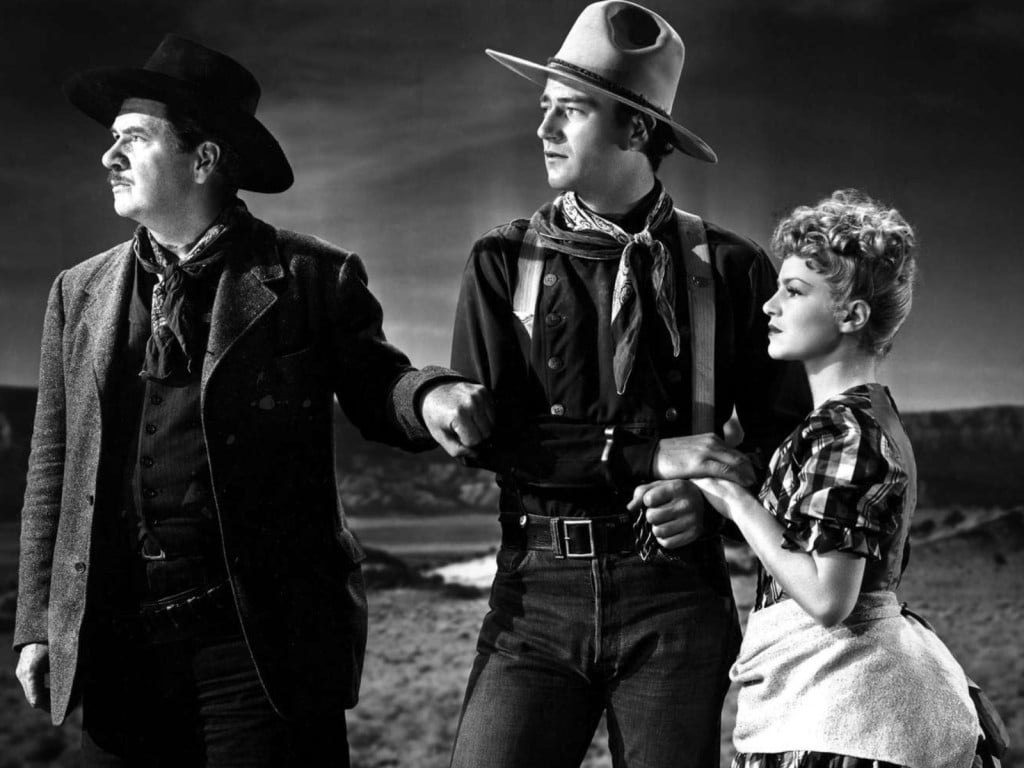
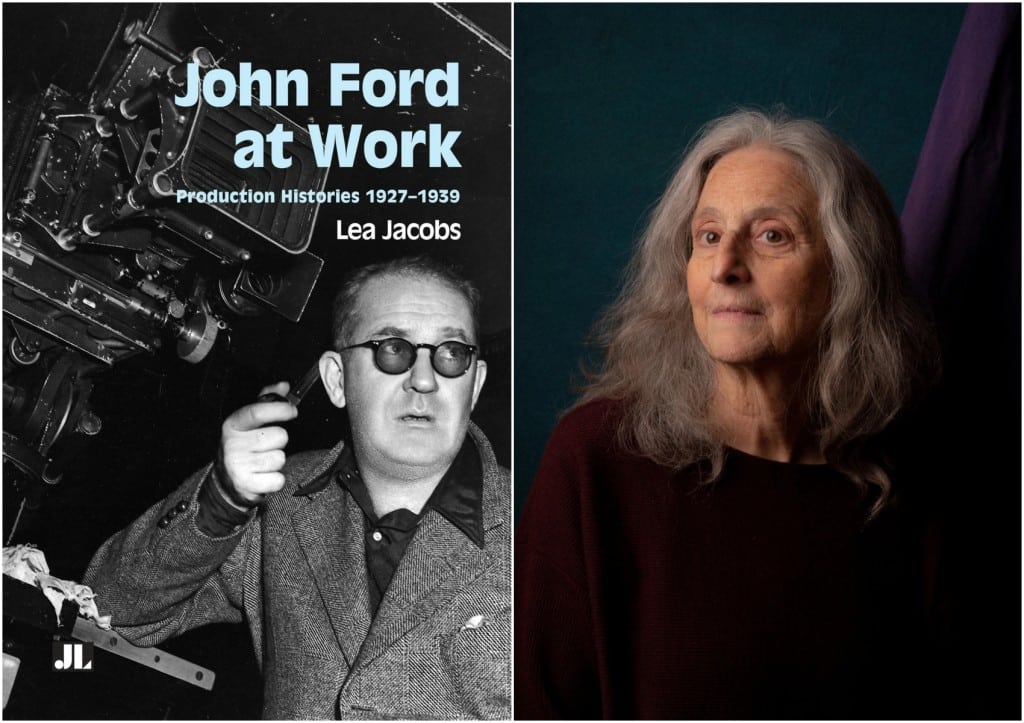
This March and April, the UW Cinematheque is featuring a new series on the work of legendary American film director John Ford in the 1930s, in conjunction with the publication of John Ford At Work: Production Histories 1927–1939. Professor Lea Jacobs, who wrote this new book, out now with Indiana University Press, is also giving short presentations after each screening. The titles in the series—five in all, three of which are on rare 35mm prints—were curated by Director of Programming Jim Healy, Director of the Cinematheque Jeff Smith, and Professor Jacobs herself.
Ford first came into the limelight when Arrowsmith (1931) was nominated for four Academy Awards, and then his Liam O’Flaherty adaptation, The Informer (1935), swept the Oscars just four years later. One often hears of The Grapes Of Wrath (1940), How Green Was My Valley (1941), My Darling Clementine (1946), The Searchers (1956), and The Man Who Shot Liberty Valance (1962) whenever his name comes up, but in fact his “early, pre-Stagecoach (1939)” work rank among his very best alongside the “true masters of the male action film” Howard Hawks, Raoul Walsh, and William Wellman.
The Cinematheque programme featured Air Mail (1932), The Informer, and The Prisoner Of Shark Island (1936) on March 6, 13, and 20, respectively, and will feature two of his most acclaimed, Stagecoach and Young Mr. Lincoln (1939), on April 17 and 24. As is typical of ’30s action films, each of these has its own share of boyish humor and dramatic brutality, and walks between an unsentimental camaraderie, an acrid attention to day-to-day, process-oriented detail, and a self-effacing heart of gold.
Air Mail has an amazing physicality to the immense risks and dangers of what is basically a vocational boy-scout fantasy—to fly up in 50 inches of snow and boundless thick fog, where violent crashes are a common sight, just for the love of the job. In a remarkable aerial stunt sequence, Pat O’Brien terrorizes the crew by flying straight into them through an open air hangar.
The Informer dresses 1920s Dublin in dazzling Expressionistic low lighting, with sinister fog work invading every corner. Victor McLaglen, as a reluctant traitor to the Irish revolutionary cause and a compulsive liar, shambles around like a barely-held-together stagecoach on jury-rigged wheels, raggedly but forcefully scrambling together the pieces of a tragic anti-hero who, with all his bottle-happy oafishness, pays a most human price for having to survive.
The Prisoner Of Shark Island, about a fictionalized miscarriage of justice, patiently builds fingers to the bone through painstaking, heart-wrenching details into an extraordinary and grimy prison escape and an unconquerable plague, with a distinctly ’30s eschewing of a loud score and obvious effects. It’s one man’s word against a country’s blind fury, a justice system’s cruelty and cowardice, and a landscape’s insurmountable hostility, where you have no other way to turn without leaving all hopes of a dignity behind.
Stagecoach is the most sheerly enjoyable film in the line-up. The insensitive portrayal of Native Americans is to be regretted unconditionally, but it’s also Ford’s most unpretentious and most refreshingly simple Western, full of big-hearted humor and high-spirited chivalry among a diverse melting pot of the Wild West. “Just about every good Western made since 1939 has imitated Stagecoach or has learned something from it,” Pauline Kael once wrote. You will not want to miss John Wayne’s iconic rifle-spinning holler.
Young Mr. Lincoln is the most graceful. Instead of throwing his weight around a hunk of marble and a mess of books, Ford served his subject with his throat cleared and his head lowered: with a master’s restraint, out comes a masterwork’s clarity—no flair, no trick, just a plain, dark backcountry fellow harping away at his “Turkey in the Straw.” It is as much about the honesty, modesty, and virile integrity of an upright figure as it is about the showmanship and artifice that make his uprightness possible and believable. Henry Fonda, as old Abe Lincoln himself, nails down the long-limbed, bib-and-brace angularity in the seamless ease of his gait. He has the mark of a true Hollywood star: he transcends the self-consciousness of his delivery, and fulfills the promise of artifice.
This series of screenings wouldn’t have been possible without Professor Jacobs, who retired from teaching in 2022. During her time as a professor at UW–Madison, one of her most popular courses was “John Ford and the Classical Hollywood Cinema.” Her new book on Ford, based on a wealth of now-inaccessible studio files and a decade of research, is at once rich in behind-the-scenes details, rigorous in her frame-by-frame analyses, and readable with a strong, articulate voice that paints a vivid historical picture and a line of thinking to guide the readers through the many, many elements at work in the films’ making. She gets right down to brass tacks behind each image—what went into them, what new advances in composition and depth aided Ford and his cinematographers, how their stylistic experimentations in sound and film print technology lent to the overall texture, what Ford had in mind when he cast his roles, etc.—with a clear sense of where to take her analysis.
I had the privilege to talk to Professor Jacobs on the chilly Wednesday morning of March 11, and she is equally sharp and passionate in person. She keeps the focus on her subject and rarely brings herself into it, showing tremendous professional dedication.
Tone Madison: First, I want to ask you about your relationship to John Ford and his movies. What drew you to them? What do you love the most about them? Which ones are your favorites?
Lea Jacobs: It’s not very easy for me to pick a favorite. My favorite of his comedies is The Quiet Man (1952). Of the dramas, I think the best of them is They Were Expendable (1945), which is not a film that is much talked about. I like his Westerns fine! But I’ll take They Were Expendable over The Searchers any day, which is not a canonical position at all. Not that The Searchers isn’t a good movie, but if I have to pick. That’s how much I like it.
What drew me to Ford? Well, I’m a historian of the Hollywood studio system. I mean that’s what I study, and I use primary documents, which is something that, until recently, was very hard to do. So, I’m part of the generation that said, “Okay, let’s not just interview stars, talk about who’s sleeping with who on set. Let’s actually try and figure out how the system works, and sometimes look at boring documents.” I can tell you a lot about the economics, the technology, or actually how the films were made. So, on one hand, I’m fascinated by the studio system up to about 1960, how it worked, how it evolved over time. But on the other hand, I just love certain films that, as you say, speak to me, and Ford is high on that list.
Tone Madison: Ford movies left an imprint on American culture and identity, and where American cultural self-image is always shifting, so one can imagine how these movies likewise lose their relevance and urgency over time. What compelled you to write about him now? Is it that his reputation has evolved, perhaps waned, in recent years?
Lea Jacobs: I don’t think I was worried about that, frankly. I’m a historian, so I am interested in the past. It could just be that our best American movies are behind us. Even if people are not watching Ford today, they’re seeing Steven Spielberg movies, and movies by Martin Scorsese, by directors who were influenced by him. I don’t think his influence has waned among directors. He’s a director’s director.
But that was not why I chose to do it. My interest is in the films, and in what they tell us about Hollywood, as a mode of production. People should wake up and realize how great he is, but that’s their problem, not mine. Ford’s reputation is secure, where it matters. But I do think his films are in some ways harder to understand.
For example, Ford early on was very interested in the movement to reclaim American folk music, and he collected folk records, knew about Alan Lomax and his students’ work. But people don’t know those tunes now. So, for example, the famous ending of My Darling Clementine, where—well, in Ford’s version—Wyatt Earp doesn’t kiss Clem before he leaves. He just shakes her hand, gets on this horse and rides off to the West. But the music is “Oh My Darling, Clementine,” so he’s counting on you to get that title, and [studio executive and producer Darryl F.] Zanuck told him, ‘Stop being cute, they have to kiss.’ Even then, people weren’t as involved with music as they had been. Ford came from a culture where people sang the Protestant hymns—even though he was a Catholic, he knew them—and he expects you to know that music. Well, it’s completely gone. When I taught Ford, I made my class sing, because you have to know the songs! They were part of what’s going on in movies.
Tone Madison: Your tone of voice in the book is not at all passive, and not always objective. For example, you write in chapter three that the casting choice of Pat O’Brien as Duke, the self-absorbed womanizer and the best pilot of the bunch, in Air Mail was “an intelligent one.”
What informed your general methodology and the way in which you approached your research? What’s your general line of thinking and reasoning when you get your hands on first-hand materials? And what are some of the rules or principles you set for yourself? For example, how much criticism and value judgment do you allow in an analytical work like this one?
Lea Jacobs: First of all, if I give an opinion, which I do in the book, I try to make it clear that it’s my opinion and explain why I have it, as opposed to what I know to be a fact. There’s facts, there’s speculations—which often have the word “seems” in it, as in “it seems,” because it’s not a fact that I can prove, like I can’t go back to a document and say this. Pat O’Brien had a big film success with the first version of The Front Page (1931) [later remade as His Girl Friday (1940)], where two strong male characters are locked in a professional rivalry. It’s very much like Air Mail. So I was saying, “Look, Ford saw that movie, I think.” That’s not a fact, but my speculation is he picked him precisely because he was thinking along the lines of that film.
One of the things that impelled me to write this book was, after years of teaching Ford, I have found so many mistakes in the secondary literature: things that were often stories started by Ford himself. I’m not saying Ford was a liar. I’m saying he was a filmmaker, and his job was to tell good stories. And I’m a historian, so my job is to tell “what happened,” as best I can. So we have different goals. He wanted to entertain his interviewers, and he wasn’t really concerned. They didn’t question him, and that was not doing him a service, or us a service in my opinion. I like the stories, mind you; “print the legend” and all that. But I really cared about being accurate and doing my research well, and that’s partly because my main source for this book was the 20th Century-Fox studio files—the script files, and the legal files.
When I started this research in 2015, it was huge, and they are now inaccessible. So I really feel privileged to have had that access to those documents, because if you don’t have them, you can’t make them up. You can’t even make guesses. I didn’t see the production files, unfortunately, but I had every script draft; I had production memos, like between Zanuck and Ford; I had legal contracts. I knew exactly where they were in location, and with that and the trade press, I was able to work out the temporal chronology of each film, from the very moment it was first conceived to the end. Obviously there are gaps and everything, but that’s what I tried to work from. I tried to not be bewitched by Ford’s stories and to only put in the book what I knew to be the case.
So, for example, there was a story about making The Informer that Ford started, which said that he first met Liam O’Flaherty in 1932 and bought the rights to the novel, then for two years he was struggling to get it made. Well, this is a good story but it’s not true. Ford didn’t meet O’Flaherty until he came to the U.S. in ’34. O’Flaherty wasn’t in the U.S. in ’32. The evidence for that was pretty overwhelming. So he came in ’34 to Hollywood, and he spent the early months of the year at RKO, where Ford also worked, but there was no evidence that there was any interaction with him.
The first evidence I had that they were together was that Ford and Liam O’Flaherty were reported as being together on Ford’s boat, the Araner, in the waters off Baja California, which is where Ford always went for a fishing trip, to go drink and lay around for a while, after finishing a picture. When he got back, he was scheduled to make The Three Musketeers (1935) at RKO. It was all set up, with his favorite screenwriter, Dudley Nichols, and his least hated producer. It was all set to go, and in fact it was made because it was so set-to-go. But he convinced RKO—and I don’t know how—to let him make The Informer instead. All that happened in the early fall in ’34, and the film went into production in early ’35. That was like a spontaneous thing. It’s interesting to actually know that he hadn’t been fighting for years. That puts the film in a slightly different light, and I think it suggests that Ford was really looking for a vehicle for Victor McLaglen, who he was cultivating as a star.
Tone Madison: Is there any truth to the saying that Ford got McLaglen drunk on set to get him into character in The Informer?
Lea Jacobs: You know, that is a very mean story. Even if it’s true, it’s a mean story. If you look at Victor McLaglen’s performance when he’s supposed to be drunk, he’s doing very complicated things as an actor, in terms of the directions of his look, of the gags he’s pulling off. I think Ford at some point started telling that story because it’s a sly way of taking credit for that performance. It’s a denial of the fact that he did pick it for McLaglen, but it was easier than explaining the complex nature of such a collaboration. Ford may have felt competitive and wanted to assert his ownership of the film, and so he did it by saying, “Oh, I got him drunk.” I mean, maybe he did, but I think McLaglen was enough of a professional that it wouldn’t have made him unable to act.
So it’s an example of how the stories that have come down obscure more interesting things. It’s interesting that Ford took a guy who had been at Fox, who had been playing the same mundane comic sergeant role for years, and envisioned other ways to use him. That shows a brilliant director: he saw something else in the actor. He did that both for his first film for RKO, The Lost Patrol (1934), which also stars Victor McLaglen in a non-comic role—there are comic sergeants, but not Victor McLaglen—and then he put him in this. It’s a very interesting merging of a really tragic character with McLaglen’s comic, drunk sergeant persona. So you could see how he’s doing very interesting things as director, and deserves a lot of credit. But not in the way he claimed!
Tone Madison: Ford was one of the most prolific filmmakers in history. There must’ve been no less than a hundred features that he directed, not counting his war shorts and sporadic TV work. There’s a wealth of titles that could’ve been the focus of your book and the Cinematheque programme. Why not, for example, The Lost Patrol (1934), The Hurricane (1937), The Whole Town’s Talking (1935), Steamboat Round The Bend (1935), or Drums Along The Mohawk (1939)?
Lea Jacobs: Jim Healy and I talked about it a lot, because we both want what I thought would be interesting to talk about, and then there’s what’s available. We wanted to get the best possible prints, and some films, even though the prints exist, they’re not easy to get. So we had to figure out what we could get, and then go from there. And I’m very, very glad that Jim got The Informer on 35mm, which I’ve seen once in a very bad 35mm print, so I’m looking forward to seeing that. And also The Prisoner Of Shark Island, which is very hard to see on 35mm. I mean, I’ve never seen it on 35mm. Jim did an amazing job. We couldn’t get the Will Rogers films, and that’s a huge gap in the programme, because Ford’s main collaborators in this period are not John Wayne and Henry Fonda—they’re 1939, not before then—it’s Victor McLaglen and Will Rogers.
This [book] was part of a projected series, so I do want to go later, at least till The Quiet Man. I don’t know if I’ll live long enough to go beyond that. Things get left out for a lot of reasons. I did write about The Lost Patrol and Steamboat Round The Bend. The Whole Town’s Talking is a Columbia film, and I tried to get into the Columbia archives but I couldn’t. I got into the Fox archives just before they were acquired by Disney in 2019. I don’t think I could get to them now. I mean, they’re businesses, not libraries, so it costs a lot of money to make things available to scholars.
Tone Madison: Bert Glennon, one of Ford’s most trusted cinematographers in the ’30s, is on the back cover of your new book. He did the cinematography for The Prisoner Of Shark Island, The Hurricane, Stagecoach, Young Mr. Lincoln, Drums Along The Mohawk, and after the war, reunited with Ford for Wagon Master (1950) and Rio Grande (1950). What roles did cinematographers like Glennon, Karl Freund, and Joseph August play in Ford’s movies?
Lea Jacobs: It’s a little hard to tell exactly. Their working relationship on set was not documented. It’s clear that Ford was actually quite careful in who he works with, always, in all phases of production. Remember that he met Liam O’Flaherty probably in the summer of ’34, and then, he gave up his vacation to go to Columbia to direct The Whole Town’s Talking, at a moment when they were in shortage of a director. [Howard] Hawks was supposed to direct it and he couldn’t do it, so they had to get somebody last minute to direct this high-budget movie. And Ford stepped in. Why? That’s the question. Why would he give up his vacation? This is my theory: Joe August.
In the early ’30s, the cinematographers Ford worked with the most at Fox were George Schneiderman and Joe August. After George Schneiderman retired, that’s when he started working with Bert Glennon. He worked very closely with a very small set of cinematographers, and they seemed to have had a real collaboration. Bert Glennon would say things like, “Ford tells me what he wants, and he likes to get it on the first take, so I had to be on my toes.” It’s not like Ford was telling them how to light lamp by lamp, but he probably is saying, “I want shadows there, the lights go here.” I’m sure he liked to carry the camera around and position it on set. He would pretend that he hadn’t been thinking about it for days, and then just goes, “The camera goes here!” He once said in an interview that he considers himself a passably good cinematographer!
So Joe August had left Fox to go to Columbia in the early ’30s. All these people, same with McLaglen, were refugees because Fox was falling apart financially during the Depression. Ford was freelancing, and he knew he could get McLaglen because he was also freelancing. He got RKO to agree to let him make The Informer, then he worked for Harry Cohn at Columbia to get Joe August on loan, because he wanted him for The Informer. If you ask me why, I’ll say, “Look at the movie, because without Joe August, that movie would be nothing.” Those are very smart moves. It also shows Ford’s moxie and his independence. He didn’t care that Joe August was under contract to Columbia, so he did Harry Cohn a favor—and this is all speculation, but why would he have gone to direct a film at Columbia? He didn’t go back to Columbia till very, very late in the post-War period. So that’s my theory. The magic of Joe!
Tone Madison: As a professor, one of your most popular courses was “John Ford and the Classical Hollywood Cinema.” Now, John Ford At Work is your first book as Professor Emeritus. As Professor Emeritus, do you miss teaching?
Lea Jacobs: None of my books would’ve been written without teaching. I mean, the teaching and the research are completely intertwined. But teaching is different. It’s hard to explain. When you teach, you’re there, and you’re thinking about the day coming up when you have to give a lecture. So you don’t have the time to like, “Oh, I really need to look into that point.” You’re trying to produce something that will matter to your students, that will excite them, and that will help them watch the film with attention. You’re very focused in the moment. Whereas, when you’re writing a book, especially a book like this one, it draws on a lot of documents. I would never try to put everything I knew about Air Mail into a lecture. I just give people a taste of things. Whereas in the book I’m trying to be really thorough.
But do I miss teaching? Yes and no. I mean, I come from a family of teachers. My father was a college professor, my mother was a second-grade teacher, and I was helping my mother in her classroom from the time I was in high school. So I have been teaching my whole life, I think it would be fair to say. So yes of course, I miss it. But also, it’s an extremely demanding profession when done well. It’s exhausting. I don’t think I could’ve written this book, or propose a sequel, and be teaching at the same time, because the demands of the moment take over. So I have enjoyed being in the slower mode. I think I would like to go back and teach Ford again, or I had a history of animation course I liked to teach. But I also liked having a vacation, and I’ve been teaching so long, it’s nice to drop away from it for at least a while.
Tone Madison: Have you got anything new lined up?
Lea Jacobs: Yes, I’m working on 1940 to 1952 of Ford’s career, the Argosy period, when he had his own independent production company.
We can publish more
“only on Tone Madison” stories —
but only with your support.
Author

Related Articles

“Limerent Pittsburgh” intricately constructs a folkloric affection of place
Artist Anne Ciecko’s 2025 videopoem is a highlight among the 30 selections of this year’s Midwest Video Poetry Fest at ALL on April 4.
Inspiriting radical communal aspirations: an interview with Ben Balcom on “The Phalanx”
The Milwaukee filmmaker’s latest experimental short premieres locally at the Chazen Museum during the 2026 Wisconsin Film Festival on April 12.

Continuity and expressive experimentation in the 2026 Wisconsin Film Festival
Eight writers share their initial insights on the eight-day extravaganza, April 9 through 16, across UW campus and Madison.