
No tomorrow: confronting sobriety with “Groundhog Day”
It’s the commitment itself that matters.
It’s the commitment itself that matters.

This is our newsletter-first column, Microtones. It runs on the site on Fridays, but you can get it in your inbox on Thursdays by signing up for our email newsletter.
New Year’s, and the weeks that follow it, can be a fraught time. It’s when we take stock of what we have (or haven’t) accomplished over the past 12 months, and when we optimistically make goals for the next 12. Some of those goals are modest, like partaking in Dry January. Some are more substantive and life-altering, like quitting drinking altogether. But when I made the decision to get sober—after years of doing my best to avoid it—in November 2022, it wasn’t scenes of midnight countdowns and fireworks but another winter holiday, or, more accurately, winter holiday-affiliated movie that I found solace in: Harold Ramis’ 1993 classic time-loop comedy Groundhog Day, which is screening on 35mm at UW Cinematheque on (appropriately enough) Friday, February 2, at 7 p.m.
As with many typical teenage rites of passage, I was a late bloomer when it came to partying. I didn’t drink at all until my senior year of high school. Then I went to college at a Big 10 school that was also a Midwest writing mecca, where Denis Johnson and Raymond Carver drank themselves to oblivion. It was there I first realized that my social anxiety could be elided by liquor. All it took was a few rounds of beer pong for the alcohol to slip its marionette strings onto my limbs, enacting a burlesque of confidence that felt better than my actual self, though probably didn’t look it. I had my first blackout while studying abroad in Prague. But it was all preparation for when I moved to New York City for grad school, where my drinking “career” began in earnest.
At the start of Groundhog Day, weatherman Phil Connors (played with caustic charm by Bill Murray), if asked, wouldn’t say he needs to improve anything about himself, or that he’s unhappy. But he sees only smallness in the festivities of Punxsutawney, Pennsylvania, and its people, unaware that it’s about to become his entire world. Once he’s caught in the February 2 time loop, the film gets a lot of comedic mileage out of Phil figuring out the rules of his metaphysical conundrum. Many early laughs stem from the sort of bargaining with recklessness familiar to substance abusers. Phil gets in countless accidents, even purposefully fatal ones, only to wake up again unscathed. He can’t permanently die, but it’s hard to say he’s truly living either.
For a long time, I clung to the misguided consolation that I’d never hit the kind of rock bottom shared in AA meetings. Surely my drinking issues weren’t serious enough to warrant a response as all-encompassing as abstinence. It was a little embarrassing, really, how unserious they were. I loved the amber glow that alcohol encased me in, how it turned my boredom with myself into something shimmery, endurable. Why give that up for nothing? Even as my hangovers got worse, and the regrets kept piling up, and friends faded away. Even as my idea of what my life should be slipped further from my grasp.

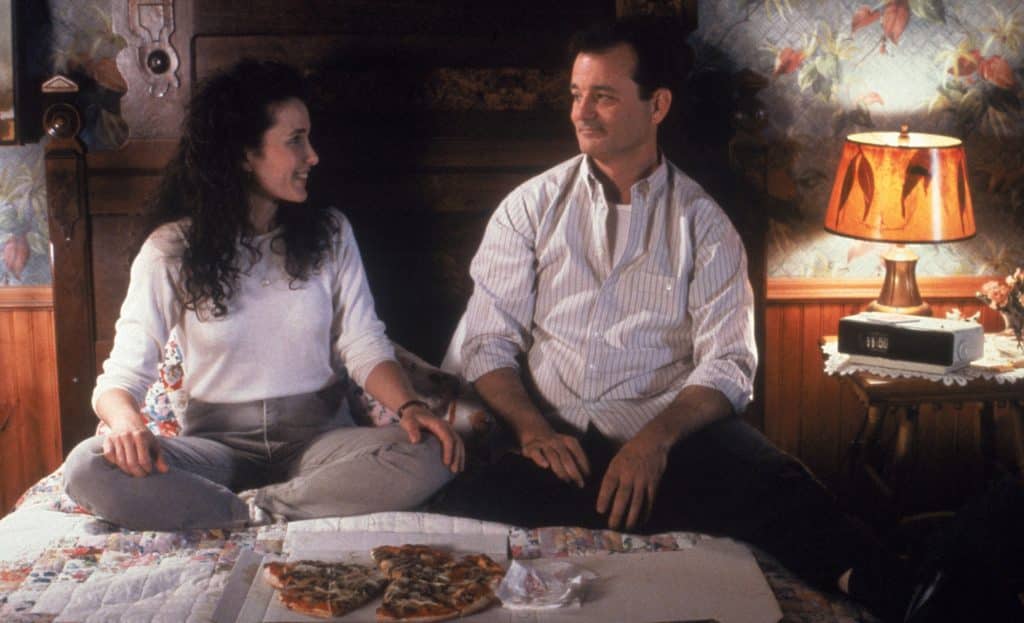
Groundhog Day‘s narrative trick is how it sustains its initial premise without also succumbing to it. Once the film establishes the rules, it then starts to dismantle them. And so eventually Phil concentrates his energy on getting his coworker Rita (Andie MacDowell) to fall in love with him. Bit by bit, he scavenges information about her—her love of poetry and penchant for ordering sweet vermouth, asking her to describe her “perfect guy”—and begins remaking himself in that image. Rita is stuck in the loop without being aware of it, but she can still sense when Phil is being inauthentic. She rejects him repeatedly, and his efforts become more transparently desperate in the process.
Even in my sloppiest moments, I always suspected there would come a point when I needed to stop drinking. But alcohol’s allure is like a Chinese finger trap; the very act of pulling away is often what draws you right back. So I kept at it, even through several big life changes—the publication of my first book, my exodus from New York after 11 years there, and weathering the pandemic alone in Chicago. I finally made it to Madison in May 2022, where I was happy to be close to family again. But it was only so long before my problems caught up with me, particularly in a hard-drinking college town that can be difficult for a newbie to navigate. It wasn’t that I wanted to reinvent myself; I wanted to be a different person entirely. And while alcohol had offered the illusion of such transformation before, the person it was now turning me into was increasingly mortifying.
Is goodness innate or can it be attained? Groundhog Day would say it’s a bit of both; we all have seeds of it, but they need to be nourished. It’s not simply that Phil must become the sort of person with whom Rita might consider spending her life. It’s that he has to become that person while not caring about the outcome. Only then does the spell break. These things take time to figure out, whether you have one go at a life or several. The way out can be as random as the way in. It’s the commitment itself that matters.
My story isn’t unique. The beats are as recognizable now as Groundhog Day is to any habitual moviegoer. But after I decided to give sobriety a serious go, I found comfort in watching it; I saw myself in the film, and it made me feel less alone. We’re all pumping along on our own ellipticals of dependence on something. But it’s crucial to the film’s success that viewers believe Phil won’t forget the things he learned about himself in the loop once he’s freed of it, even if he still struggles in his new life. The past is something we always carry with us; that doesn’t have to carry a stigma. Part of recovery isn’t just seeking forgiveness from others but forgiving yourself. Even after over a year of abstinence, I’m not totally there yet. All I can do is continue taking it one day at a time. Sometimes you see your shadow. Sometimes there’s sun. And sometimes it’s February 3.
We can publish more
“only on Tone Madison” stories —
but only with your support.
Author

Related Articles

Don’t shrink the Common Council and County Board
Madison needs more representation, not less.

Starter homes? No, we need starter apartments
As homeownership continues to be out of reach for too many Madisonians, we should build more owner-occupied, multi-family housing.

Madison needs a wake-up call
The longer we pretend this City is a progressive haven, the more people will be harmed.