
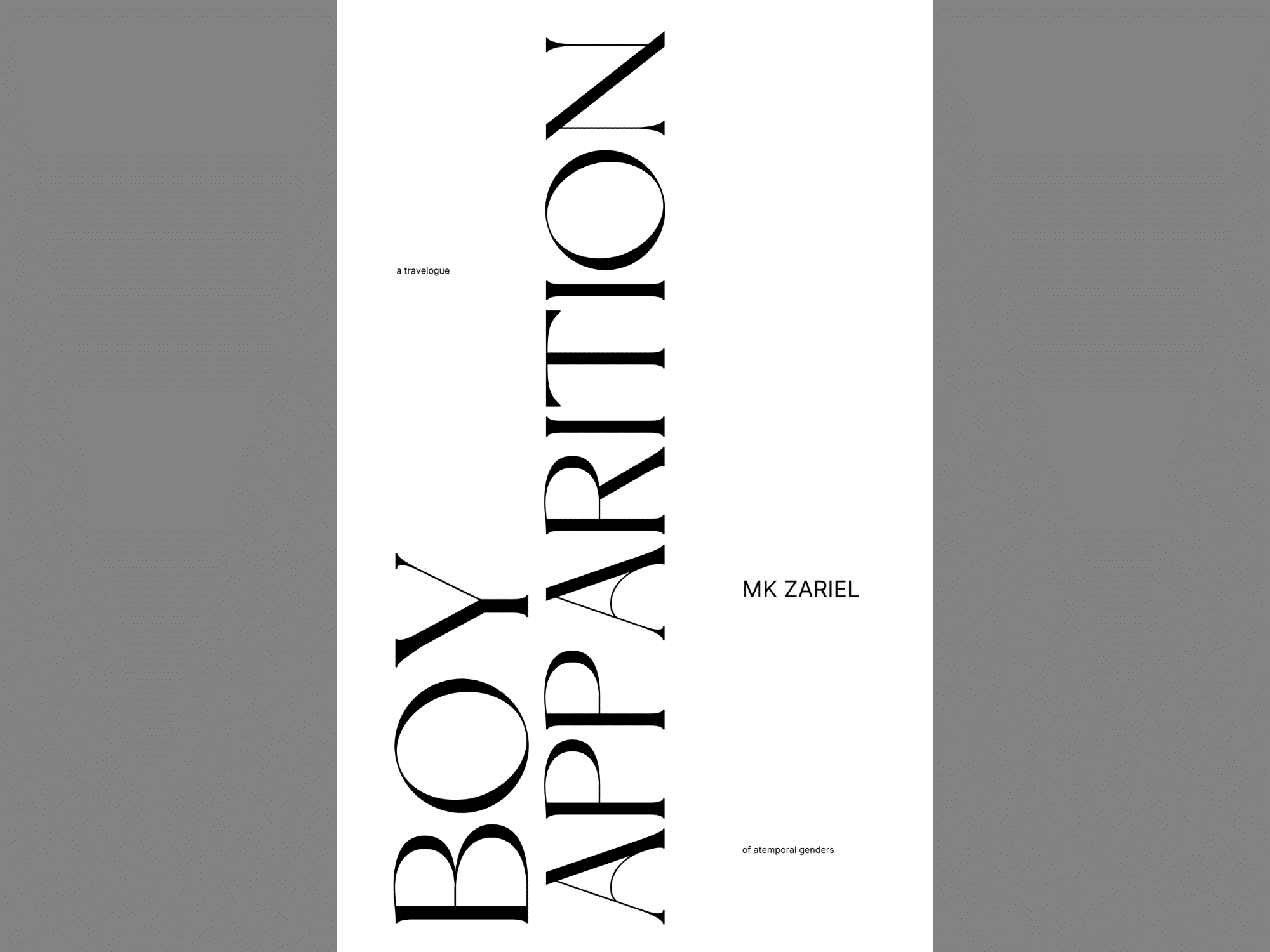
To whom do we own legibility? What does “being legible” strive towards, and how might being granted that legibility constrain us even further? When I sat down with mk zariel (it/its) to talk about its new chapbook, Boy Apparition, zariel told me that “illegibility is the goal.”
“I want people to come out of my readings feeling maybe generatively overwhelmed, maybe transformed, but never like it wasn’t for them,” it explained. Though a seemingly contradictory aspiration for the written word, at the heart of Boy Apparition is the desire to challenge: traditional understandings of Midwestern masculinity, normative constructions of gender (“dear cis people”), the status quo of political queer community (“pride was a riot and we are not”), and how we might take care of each other now, regardless of the promise of a future (“lose you”).
Boy Apparition, which came out last September with Vinegar Press, is a collection that breaks wide open everything we think to be true and provides us with curious and daring alternatives. Humming beneath urgent call outs (and call ins) to fellow organizers and luscious poems that commemorate queer longing is the undercurrent of love that is necessary to keep going. Rooted in the Madison community but wading in the possibilities of atemporality, zariel pushes readers to resist being “so time-bound as to negate itself” and instead, strive for a point during which “we’re free from linearity.”
Over the course of the book’s “fleeting eternity,” zariel deftly switches between references from theorists like Emma Goldman to musical artists like Chappell Roan and Ethel Cain, demonstrating the wide expanse of inspiration we can draw from in order to live queerly. Pulsing with the urgency of a “gender-queer gender-abolishing infinity,” Boy Apparition coaxes us to the edges of our imagination, picking and choosing which parts of this world serve us, and which parts we must create on the way to becoming our truest selves.
In mid-February, I connected with mk over Zoom, in between stops on its book tour, to discuss the importance of poetry in our world-building, challenging gender norms, and how to live in jouissance through queer authenticity.
Tone Madison: I’d love to hear a little bit about your journey as a poet and how Boy Apparition came to be. How did you find poetry, and how did this project come to life?
mk zariel: So I found poetry right after I came out, after taking a poetry workshop at a queer and trans leadership program and realizing that it was a form of art that was accessible to me. Before coming out, my exposure to poetry had only been in school settings, and so I didn’t know all that poetry could be: I thought it had to rhyme and be very structured and formal. I’ve never been one for imposed order, so I just figured it wasn’t for me. But then once I joined queer spaces and got exposed to performance poetry and slam poetry, and free verse and online literary magazines and scene culture and all of these other ways of engaging with poetic expression, I got more into it.
Boy Apparition started when I was 14 and got accepted to be published last year. That was kind of the amalgam of most of my early work and thinking about trans masculine identity and how it rejects linear time and how it engages with linear time. In general, one thing that I’ve grappled with a lot as a transmasculine person is how much to take from cis masculinity and how much to subvert.
I did grow up hearing “toxic masculinity” once in a while, because how can you not if you’re in the Midwest around cis men? I knew that I didn’t want to be the kind of masc-presenting person who felt ashamed to cry in public or in front of other people and engage in political bigotry and generally caused problems. Most of the masc-presenting people I knew were cis. And so while many were feminists, they were not engaging in the kind of masculinity I wanted, and so I wrote Boy Apparition to speculate about what else was possible.
Tone Madison: Your work is obviously influenced by political theory—you name Emma Goldman a few times and seem to be speaking from a leftist politic in general. I’m curious if you could tease out for me the relationship between theory and poetry. What does one afford us that the other does not? Where do they converge?
mk zariel: First of all, just for clarity on my own political standpoint, I consider myself an anarchist. I’m influenced by the queer Bash Back! tendency. I have a lot of love in my heart for egoist anarchism and anarcho-nihilism, and insurrectionary anarchism as a lineage. I don’t necessarily endorse everybody who uses that label, but I certainly resonate with a lot of the theory that uses that label.
I believe that poetry is in some ways a more accessible and more vulnerable extension of theory, and in some ways, a form of theory on its own. When we write poetry, we don’t necessarily need to be in the headspace where we’re reasoning, we’re arguing, we’re proving a point. It’s a space where reality gets to be subjective for a little bit.
I think that the anarchist community needs poetry just as much as it needs formal, prosaic critical theory. We use our anarchist theory to imagine tactics and we use our poetry to share what our lived experiences are, what we’re feeling, what’s happening in our communities. What might be happening in anarchist movements that isn’t public and isn’t part of like the anarchist movements broader PR strategy, in so much as we even have one. It’s more about the lived experiences of organizers.
When I write theory for my blog, Debate Me, Bro, I typically gear it toward educating about anarchism and arguing for anarchism. But then I’m also a human being, and I experience activist burnout sometimes, and that’s when I go to poetry. Because the piece of theory that just says, “Hey, I believe in creating a world that’s moving in the direction of anarchism, and yet I feel burnt out,” would not inspire that many people. But a poem that says that might lead an anarchist community to feel validated about how they’re doing with it.
Tone Madison: I’m sad that I won’t be able to hear you read these poems out loud at an event because there’s such an obvious cadence and rhythm to them, which to me, feels charged by punctuation (the ampersand) and prepositions. Could you talk a little bit about your usage of both and what you’re trying to achieve?
mk zariel: Anyone in my writing circle will know this about me: I’m not a big reviser. I’m not someone who goes over my poems 10, 20 times, trying to change things unless I’m doing it for a specific published project. The main way that I do revise is by reading my poetry aloud, and from there, I tend to get an intuitive sense of what sounds resonant, what might sound awkward, and how it might need to change as a result. When I think about people engaging with my poetry, it’s never in terms of how they might read it in a literary magazine, but in terms of what it’s like to hear it aloud.
My first exposure to poetry was performing in theater, ever since I was in middle school and hearing the connection between theater and poetry and how, really, there’s quite a lot of overlap there. So I’d say that when I use punctuation or repetition or word choice that might come across as filler in a written context, it’s about giving it rhythm and giving people the opportunity to listen and engage when it’s performed aloud. I often find that when I’m in an open mic setting or maybe performing on [a] book tour, it even helps me with my confidence in a poem to have a repeated motif that I can share multiple times, because the momentum builds and my performance anxiety slowly goes [away].
Tone Madison: I love the idea of the performance of poetry and really interacting with the energy of the audience.
mk zariel: I love improvising small changes to poetry on the fly, or engaging in banter before and after a poem. And it also wildly depends on the audience. If the people I’m speaking to are really aware of critical theory, then I’m going to play that up. And if they’re not, I’m going to include an explainer about anarchism before each poem.
Illegibility is the goal, but so is access. I want people to come out of my readings feeling maybe generatively overwhelmed, maybe transformed, but never like it wasn’t for them or like it was maybe elitist or otherwise difficult. So many kids grow up only reading poetry in school and thinking that it’s not for them, it’s for cis white men. I don’t want my readings to ever play into that mindset. Even if something is illegible, even if something is confusing on purpose, which most of my work is, it should never make people feel like they’re locked out of that experience for any reason.
Tone Madison: The subtitle of the chapbook is “a travelogue of atemporal genders,” and the poems in this collection very much have to do with time: the urgencies and limitations of the present, memories of the past, moving towards futures, the grimness of linearity. How do you think about time and temporality as it relates to gender and queerness?
mk zariel: I would say that traditional masculinity or cis masculinity is a lot about being in accordance with linear time, or the idea of linear milestones that people are expected or pressured into dealing with. We’ve all heard [that] you go to high school, you go to college, you get married, you get a job, you have kids, you retire, and then you die. And if you’re not doing that for whatever reason, you’re seen as gay, as trans, as a failure in whatever way. To be trans masculine is to say, “Hey, I might be adopting masculinity. I might have some privilege as a result of that, especially if I pass, but that doesn’t mean that I have to do everything I can to be as close as possible to this linear idea of time that so many people can’t do anyway.”
Maybe, as a trans masculine person, instead of just choosing a career because you feel you have to, you can instead subvert traditional masculinity by engaging in mutual aid work, by organizing, by building community, by having an artistic practice. Maybe, instead of necessarily having to be the partner in a relationship who takes more of a leadership and providing role, maybe, as a trans masculine person, you can [take that] as an opportunity to have that conversation be an open and respectful one. So many times, because I am trans masculine, I’ve seen things that are traditionally masculine and been like, “Why would anyone do that? That harmed me before I transitioned. I’m not just going to start doing it now that I have.”
One of the big ones I think about is what is socially normative around emotion. I’m sure everybody of every gender even has heard someone say “Oh, boys, don’t cry, toughen up. Be a man.” And when you’re trans masculine, you can do that, but you don’t necessarily have to. Intense emotion does subvert linear time. It isn’t necessarily in alignment with what our capitalist hellscape sees as productive, and that’s exactly why it’s crucial to do. I love being in spaces and communities where it’s normalized to be vocal about your emotions and your needs and your boundaries and poetry definitely enables me to do that.
Tone Madison: As much as this collection plays with time, it’s definitely rooted in place. You give some shoutouts to Milwaukee and Madison, and invoke the Midwest heat many times. What, to you, is the relationship between queerness and the Midwest?
mk zariel: I think that being trans in the Midwest is a double-edged sword, because for one, gender roles here, especially around masculinity, can have an inherent self-repression to them.
One of my friends who doesn’t live in the Midwest talks a lot about the idea of Northern collectivity, of how in places that maybe have rougher landscapes, there can be this value put on toughness and plainness and not expressing your needs and not being high maintenance. And there can be a real toxicity to that. At the same time, Midwestern trans communities are small enough that you feel like no matter how your transition is going, you’ll be taken care of and you’ll be supported. The anarchist community takes care of its own. And paradoxically, when there’s a smaller anarchist community in your city, it can be harder to fall through the cracks. Because everyone is in community, and everyone you know is part of the same three affinity groups, like I say in my book.
I’d say that as a result, to be trans in the Midwest, like being trans masculine in general, is about taking this and leaving that. It’s about figuring out what aspects of Northern collectivity you want, and what aspects are toxic. For me, part of my trans experience in the Midwest is like learning for the first time that it’s okay to have preferences, it’s okay to have needs, and it’s okay to advocate for them. Because the gender roles that are just in the air here really say otherwise. If you advocate too much for your needs and you’re femme presenting, then you’re high maintenance, and if you’re masc presenting, then you’re weak. But really, I’d say if you advocate for your needs and you’re trans, you’re neither high maintenance nor weak. You’re a person who knows how to advocate for yourself and others, which is what we need for anarchism to function on any kind of scale.
I think that, for me, the relationship of gender to place is about reclamation. Maybe parts of that Midwestern idea of gender, or the Midwestern tendency towards self repression in general is something to reject. But at the same time, the communities that I’ve built here and the communities I’ve had a privilege to be in have shaped me, and I think to just ignore that would also be doing a disservice to myself, and would paradoxically be self-repressing. So that’s a question I’m engaging with in a lot of my work. What does it mean to come from somewhere where self-repression is the norm and self-repression is valorized, and find a way of doing gender that is actively against self-repression? I hope that when I give readings, that people come out of it feeling like they have less of a need to self-repress and more of the courage to be in community.
Tone Madison: I’m really interested in this idea of jouissance that you mention a few times in your poems. I had to look it up, but from my understanding it is a Lacanian term that means “a complex, intense form of pleasure that goes beyond simple enjoyment to include pain, desire, and self-destruction.” I appreciate its multidimensionality. What is your relationship to jouissance and how do you see it functioning throughout the chapbook?
mk zariel: I would expand the definition of jouissance to include meaningful experiences that take us out of linear time or linear narrative. Personally, I would say for me, the idea of passing would provide some form of pleasure in that I’d have to experience less transphobia and I might deal with less misdirected misogyny or I might, you know, be read as mass presenting in ways that provide privilege, but not passing provides jouissance. Because not only does it mean I’m being authentic, it means that I’m in [the] trans community. It means that I’m not participating in those types of milestones that are so crucial to traditional masculinity, yet so irrelevant if that’s not what you’re doing. I’d say that throughout my chapbook, those are the experiences and the questions that I’m engaging with: What experiences provide us pleasure, and what experiences provide us jouissance and why?
I tend to think that being trans in general is the choice of jouissance over pleasure. To be trans is to decide that you will have meaningful experiences that will disrupt linear time and will make engagement with linear time less possible. And obviously it is possible to assimilate, but assimilating always means giving up some of your authenticity. And to consciously choose not to can be a lot more meaningful than the pleasures that might come from assimilating. To be clear, I think that passing is a personal decision, and it’s 100% neutral. I don’t think that if somebody passes, that means they’re assimilating. And I don’t mean to give that implication. But personally, if I were to try to pass, then that would be subsuming my lesbian masculinity under this kind of guise of cis masculinity that, to me, feels like an extension of patriarchy.
Tone Madison: To me, this book feels very much invested in queer futurity, and is building towards a better alternative for queer folks that we can start enacting now. But it also ends on an ambivalent note. The very last lines of the book are, “and i hope I lose you to queerness / or maybe find you in the future we’ll never / have.” What does a queer future look like for you?
mk zariel: I personally believe that futurism and queer liberation are directly at odds. In general, the idea of a future tends to necessitate some kind of sacrifice towards said future, and that tends to almost imply people assimilating or not transitioning or not living authentically.
I really subscribe to Lee Edelman’s idea that much of futurism stems from reproductive futurism—the idea that everyone needs to have kids, and that’s the ultimate goal of being a human person. And there is some homophobia and some transphobia inherent in that. Obviously, queer and trans people can and do have kids, but it often doesn’t look like the nuclear family arrangement, nor should it because the nuclear family causes so much harm to so many queer and trans folks. Even if one’s parents are extremely supportive, that kind of narrowing down of care does not create trans communities. That does not serve trans communities. So in the vein of Lee Edelman’s theory on this—I’d really suggest the book No Future: Queer Theory And The Death Drive for any readers interested in this—to be queer is to reject reproductive futurism. But that doesn’t necessarily mean not having kids or not taking care of kids, but it does mean rejecting the idea that everyone needs to or that that’s the only way to live a meaningful life, or that if you do, the only way to do so is in a very traditional, heterosexual, cisgender, nuclear family.
So I think that queer liberation does not look like building toward queer futures. It does not look like the idea that one day, when some law is passed, or some protection is passed, or a specific person is in office, then we’ll have queer liberation. It looks like meeting the needs of queer communities now, not later, not in hundreds of years, not necessarily even for the next generation, but for the immediate material and cultural needs of the queer community. That looks like creating trans survival networks; that looks like trans art and culture; that looks like forms of care for youth and everyone else that are communalized and preserve everyone’s autonomy. That looks like having broader ideas of what gender can be, of what masculinity can be, of what it means to present butch, what it means to present masc, and how there can be overlap.
So while I understand a reading of [Edelman’s] book as one that’s invested in queer futurity, I think what it really is invested in is queer temporality and what kind of networks of care we can build in the here and now that don’t require an investment in the future in order to be sustainable.
Tone Madison: To wrap up, could you break down the idea of the “boy apparition” about its relationship to vestige and embodiment?
mk zariel: “Boy apparition” is a line from [the poem] “love letter” that refers to “school girl crushes & boy-apparition-nothings.” I think it means a couple of things. First of all, it’s the idea that traditional masculinity is an apparition. When I was first joining the anarchist movement, I heard the idea that every power structure has an abstraction at the top. For example, the police are given power by the state government, which is then given power by the national government, which is then given power by the Constitution, which is an abstraction. It’s a physical document, but the importance placed on it is only because of the abstract ideas people are holding in their heads about governance. I tend to think that the idea that every power structure has an abstract idea at the top isn’t just about state power, but I also believe that gendered power dynamics are similar. Traditional masculinity only has power because we tend to assume, as a society, that there are no other options.
But that isn’t all it means. I also think that “boy apparition” is about the liminality that one can feel as a trans masculine person. Because if you’re not engaging with linear time, if you’re not engaging with the apparition of traditional masculinity, then you’re treated as another kind of apparition. Because you don’t have a future in the sense of conventional linear time, then suddenly your needs don’t matter. Even in the anti-trans legislation that exists, we see plenty of attacks on trans futurity. For example, trans sport bans make it impossible for plenty of trans people who would otherwise contemplate a career in sports to do so. And I think the only way to push back on trans futurity is to create trans spaces that don’t rely on futurity.
For example, maybe as a community, we aren’t being included in mainstream sports, but we can find ways to enjoy trans embodiment and what the trans body can do that doesn’t rely on that. I even think about this with all the bans on trans people in public space [like] bathrooms and other spaces like that, and obviously all the effort in the world should be made for those to be repealed and changed. But at the same time, it just shows the impetus to create public space that is inherently trans and that is safe for the trans community. We don’t just want inclusion in spaces that were never made for us. We want spaces that our community maintains, that are self-sustaining and futureless. Because what trans people will need in 100 years is not what trans people need currently. It’s because societies change and so do people. And there’s no use in sacrificing trans autonomy now for the possibility of a future where there’s maybe one fewer oppressive law but otherwise it stays the same.