
What will be left, if anything?
The true Midwestern world at unrest.
The true Midwestern world at unrest.

This is our newsletter-first column, Microtones. It runs on the site on Fridays, but you can get it in your inbox on Thursdays by signing up for our email newsletter.
My first year in Madison, in 2022, the lakes froze over after a light rain and left a smooth sheet of ice. You could skate from the Yahara clear across to Starkweather, hemmed in by thin ice where warmer jets of water moved just beneath the surface as river and creek flowed through. A year later, on a hike out to Picnic Point, I saw a man riding his bicycle clear across the settled snow blanketing Mendota, wobbling in high gear under low traction as his tires crunched fresh powder into a makeshift trail. Last year, the myriad waterways never properly froze.
It’s not odd to mourn winter even if it hasn’t fully disappeared. Blustery, snow-heavy winters define the Great Lakes region more than breezy summer nights at a cabin in the Northwoods or muddy springs spent digging leaves out of the gutter. As each year grows less and less consistent (don’t worry, it’s still cold as shit out there), it’s harder to rely on the same signifiers to understand the passing of time. There is no reprieve, however: climate change is bound to devastate even the “climate haven” known as Madison, Wisconsin.
Warm winters and hot summers aren’t the endgame of climate change. Writer Carrie Frye has been documenting the devastation of Hurricane Helene in Asheville, North Carolina. Huge temperature shifts create massive weather events, and as seasons become less predictable and more erratic, the entire country is becoming a target for a Major Weather Event. Who here remembers the Tenney Park flooding of 2018?
When I set out on my winter hikes, I’m looking for ways to ground myself, to breathe the chill deep into my lungs, to hear the crunch of frozen mud beneath my boot. I want to feel the breeze freezing in my nostrils. Once I’m out in the world, living and breathing the outside air, it’s easier to let go of the future and focus on the present moment.
Growing up in rural Minnesota, snow days were a challenge instead of a warning. Even when it wasn’t safe enough to get to school, my brothers and I would bundle ourselves up as best we could and head out into the world. I grew up on 10 acres, just on the edge of farmland, and snow meant the trails cut through the sumac on the hill leading from our house down to the highway were sleddable. For hours we’d take turns belly-flopping down the slope, leaning as best we could to steer down the narrow path and make it all the way to the ditch. When the neighbor’s pond would freeze over, we’d trudge through the woods that connected our yards and dutifully skip across the frozen creek until we got the primo skating surface.
But even without an activity, I loved being outdoors in the winter. With the trees bare and the air so dry you could hear a twig snap from across the fields, there was a dignity in the quiet of it all. True winter is the world at rest. For me, being outdoors in the winter was having access to a secret world where I got to experience every ice-tipped bit of scrub brush.
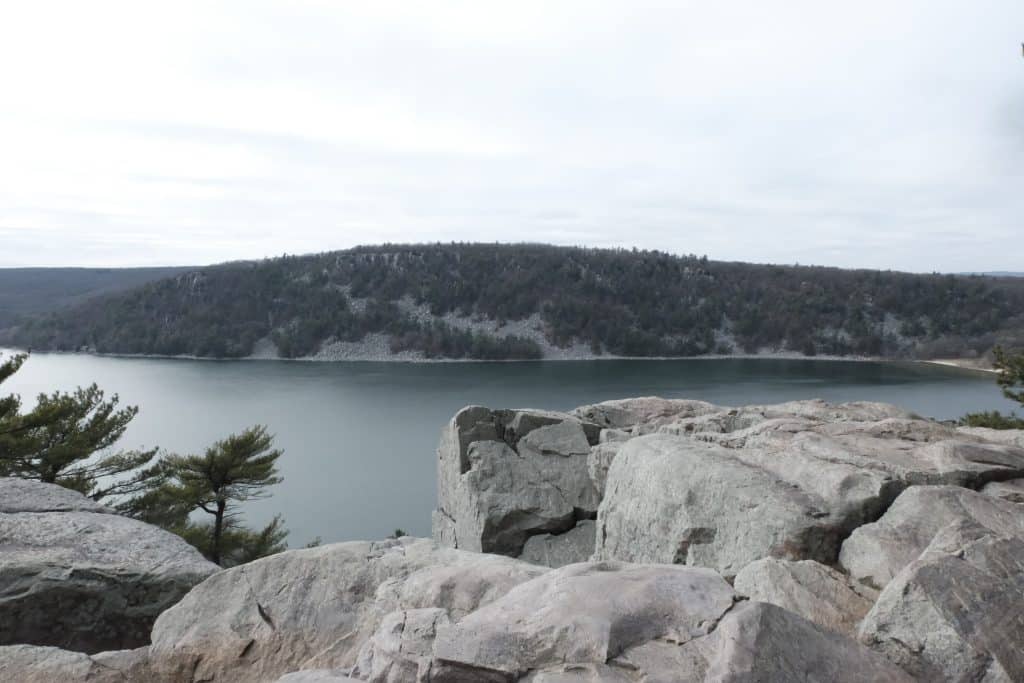
When I’m feeling wistful enough these days, I set out for Devil’s Lake. In the summer it’s a bustling hub for beachgoers and paddle boarders. When the weather drops—especially below 25ºF—Devil’s Lake is desolate. The parking lots are empty, the bathrooms at the pavilion are locked, and even the park rangers drive around in insulated and heated four-wheelers. It’s the perfect place to find solitude.
The hike up the east side bluffs starts with a steep climb up rocky steps. Almost immediately, you’re confronted with expansive views of the lake itself, a deep blue body of water that appears to be sunk between the rock formations. As you climb higher, the trees shift—tall oaks give way to sparse conifers rooted directly into the rock, and eventually you stumble into a pygmy forest of ash and hickory trees, bent and twisted in their stunted growth due to high elevation and sparse nutrients in the soil. Dotted along the trail, you’ll find clearings where the rock juts out of the soil and crags itself into small ridges perfect for a quick sit.
Devil’s Lake is part of the Baraboo Range, where incoming glaciers were halted by all the earth they mashed up into hills. The range is the last barrier before you hit Wisconsin’s Driftless area in the southeast, where rolling hills curve over each other into endless infinity. The bluffs surrounding Devil’s Lake are anything but rolling—the quartzite cliffs are one of the oldest rock outcrops in North America, and large chunks of the hard rock have fractured away over the years leaving craggy lookouts and sharp drop-offs. It’s important to remember the age of everything here when things feel dire. These rocks have been here for a very long time, and they’ll continue to be here after we’re gone.
We can publish more
“only on Tone Madison” stories —
but only with your support.
Author

Related Articles

Police surveillance technology needs proper accountability
Grassroots resistance against Flock cameras are writing the blueprint for comprehensive reform.
Don’t shrink the Common Council and County Board
Madison needs more representation, not less.

Starter homes? No, we need starter apartments
As homeownership continues to be out of reach for too many Madisonians, we should build more owner-occupied, multi-family housing.