
“Welcome To The Dollhouse” cuttingly conveys the social hell of pre-teen years
Todd Solondz’s enduring cringe comedy from 1995 screens on 35mm at UW Cinematheque on October 18.
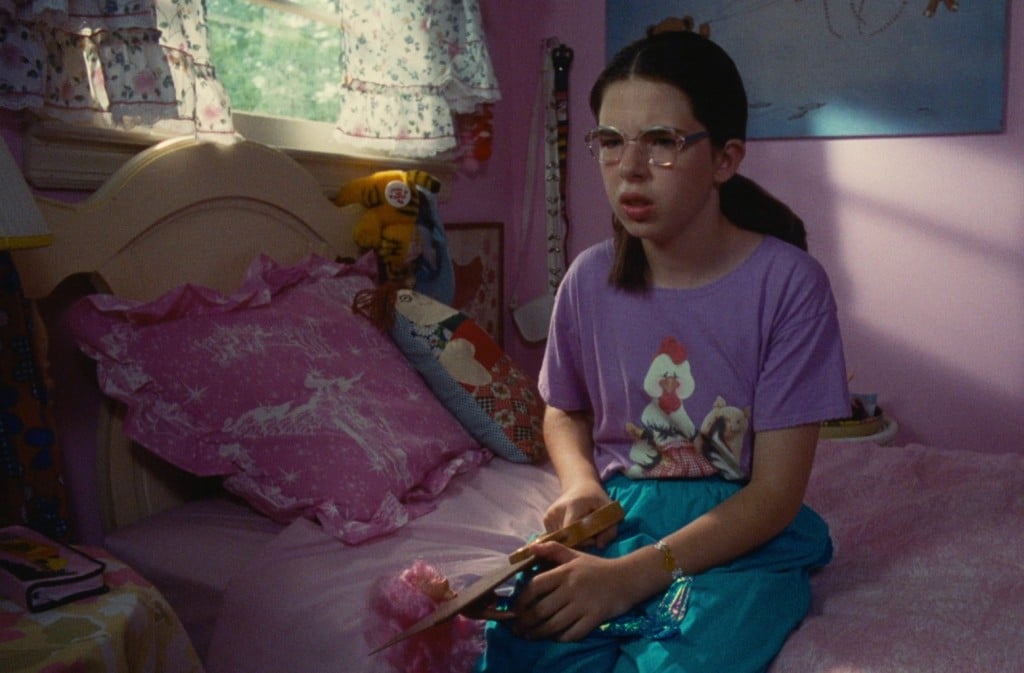
American independent cinema in the latter part of the 1990s may have been preoccupied with the twisty trend of the network narrative—which is now seeing a bit of a resurgence—but the unsentimental and raw representation of adolescence in Todd Solondz’s Welcome To The Dollhouse (1995) is the most poignant and personally enduring work of the era. A cringe comedy about the pitiable middle child, Dawn Wiener (Heather Matarazzo), of a lower middle-class family in the Jersey suburbs, the writer-director essentially fashioned the film as a scathing rebuke of the TV-sanitized superficiality of the teenage experience as seen in The Wonder Years (1988-1993).
The 87-minute film has aged generously in the ever-mutable cultural consciousness, as studio and indie comedies have undergone a radical reshuffling in the past decade. Both mediums of film and television have dramatically skewed darker and into more awkward territory since the turn of the century. UW Cinematheque programmers have picked up on that, not to mention Welcome To The Dollhouse‘s potential to reflect sensibilities that bridge the generational gap between Millennial and Gen Z audiences, with a rare 35mm print plucked from the Wisconsin Center for Film and Theater Research archives. It screens at 4070 Vilas Hall on Saturday, October 18, at 7 p.m.
Nathan Fielder may be the most recognizable personality in the realm of cringe comedy today, but I’d argue that his work as a postmodern parody artist wouldn’t have the resonance or appeal without the template Solondz established here. Last year I was struck by this Q&A pertaining to The Curse (2023-2024), where Fielder fields a question from an audience member who’s struggling with secondhand embarrassment from the show’s situational awkwardness. Fielder irreverently responds by saying that, if they can’t bear those feelings vicariously, “I wonder how [they] can go through life at all, because every interaction is horrendous.”
In the director’s notes included with the Radiance Blu-ray release of Dollhouse, Solondz complements Fielder’s acknowledgment of the uncomfortable mirroring of art and life with a profound piece of ideology: “[Welcome To The Dollhouse] is a comedy, because that is the only way I know how to deal with excruciating torment, and I find something both funny and poignant in the struggle to endure humiliation.”
When I first watched Welcome To The Dollhouse as a 17-year-old video store employee, its causticness upset me. I didn’t like it, and I found myself in a similar place as that member of Fiedler’s audience contemplating “cringiness.” And I wouldn’t blame anyone of that age now who decided to sit this one out, as the eviscerating depiction of 12-year-old Dawn’s experience with bullying at the mercy of Cookie (Christina Brucato) and Brandon (Brendan Sexton III)—and then imitating and becoming the bully herself—hits a nerve.
But in the early-mid 2000s, as I sat with the convincing way that the outcast Dawn, taunted as “Wienerdog,” was realized in the writing and through Matarazzo’s singular, sympathetic performance in her frail vocal tics and hunched body language, I had to be honest with myself in hearing my contradictory worldview through her. “I don’t want anyone to join [the innocently, tragically named ‘Special People Club’]. I want to be popular,” Dawn desperately yearns aloud to the younger neighbor boy, Ralphy (Dimitri DeFresco), who harbors an envious crush on her.
Really, seeing the shy, bespectacled, unfashionably dressed Dawn triggered a kind of trauma response, in knowing that my first reaction was directly related to the same vicious intimidation at her age in comparable circumstances. Entering junior high school as a somewhat sheltered kid without a defined and protective social circle, I was harassed by homophobic cretins for the most pathetically trivial reasons imaginable (for just wearing purple pants one harrowing morning on the gymnasium bleachers before homeroom).
Solondz’s film, and my independent discovery of it, offered a constructive way to process confrontations I couldn’t talk about with anyone or even express in my own amateur poetry that I etched in random lined notebook pages during study hall. While I had instinctively used humor to diffuse distressing moments in my life, it wasn’t until I watched this film that I consciously understood the reason. Call it, as we all do, coming of age. Black comedy as substitute therapy for a late bloomer. The start of my fascination with and gravitation towards cinematic depictions of humiliation. What Solondz said.
But if I’ve made Welcome To The Dollhouse seem too heavy or oppressive for any viewing, it isn’t. At least, not always. Despite Dawn being an unwitting target of on-screen cruelty, which masks a multitude of other emotions and even fearful affection, the film boasts a playful antagonism and a cast of memorable foils to Dawn’s incalcitrance. Her own negligent family includes older brother Mark with a one-track, college-bound mind. He’s portrayed by the late Matthew Faber from my hometown of York, Pennsylvania, which perhaps further magnifies my connection.
And then there’s the callously cool, self-absorbed, and occasionally outright gross Steve Rodgers (Eric Mabius), the unknowing recipient of Dawn’s secret, idealistic infatuation. Mark recruits Steve as the vocalist for his literal garage band in exchange for some tutoring in computer science. Their forced friendship, which resembles more of a business deal, leads to one of the funniest (and, sure, cringiest) musical performances I’ve ever seen on film, in the Wieners’ backyard.
When we choose to watch media that renders the trials and tribulations of adolescence, it’s often with a biased anticipation that they will romanticize and smooth over certain strenuous moments and ugly rites of passage. We problematically want these dramatizations to provide substitute memories for the more complicated and distorted experiences of our actual lives. Solondz’s film snaps us out of that delusion, creating something closer to the mortifying hell of trying and failing to fit in as a pre-teen—the smothering feeling driven by immeasurable or nonexistent peer pressure. It’s not out of bounds to see the existence of the film altering the landscape; sentimental shows like The Wonder Years had morphed into more grounded expressions like Freaks And Geeks (1999-2000) by the end of the ’90s. And that’s to say nothing of the film’s impact more than 20 years later on Bo Burnham’s Eighth Grade (2018).
Welcome To The Dollhouse became the touchstone for Solondz’s entire career as an artist, as he mimicked one particular third-act scene here during an assembly in his incredible, fucked-up masterpiece, Happiness (1998). Solondz would also revisit characters from this locale in subsequent films—one is the bleaker but more oddball, experimentally cast spiritual sequel, Palindromes (2004), which the writer-director entirely self-financed. The Cinematheque is presenting Palindromes the following Saturday, October 25.
We can publish more
“only on Tone Madison” stories —
but only with your support.
Author

Related Articles
Continuity and expressive experimentation in the 2026 Wisconsin Film Festival
Eight writers share their initial insights on the eight-day extravaganza, April 9 through 16, across UW campus and Madison.
The Cardinal Bar’s Cuban film series invites local support for Madison sister city
Cine Cubano bridges interest in Cuban cinema with the cultural exchange and aid mission of the Madison-Camagüey Sister City Association.
Three video artists tap into personal histories in the 150 Artists x 150 Years exhibition
Chele Isaac, Toby Kaufmann-Buhler, and Aaron Granat reveal the creative depths of their works, which are on display through February 28 at Central Library.