
Under a new owner, Spruce Tree Music is both plugged-in and preserved
Nicholas Kehoe opens up about taking over the music and repair shop, and what customers can expect.
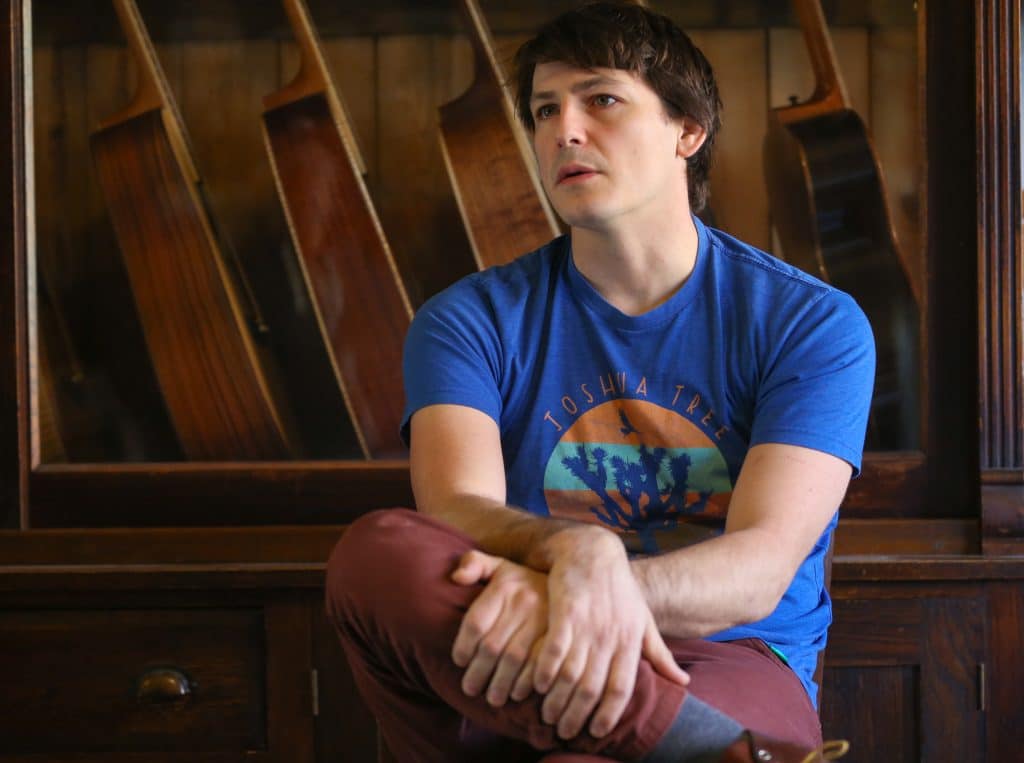
Nicholas Kehoe opens up about taking over the music and repair shop, and what customers can expect.
Nicholas Kehoe was a years-long customer at Spruce Tree Music on East Johnson Street, but he never gave a thought to buying and running the place. Until January. That’s when the 35-year-old guitar builder learned about former owner—and founder—Wil Bremer’s intention to sell the store and retire. At the time, Kehoe was fixing stringed instruments for word-of-mouth customers out of his home. He began to drop by the shop once or twice a week. Before any serious business conversations took place, he made an interesting request of Bremer.
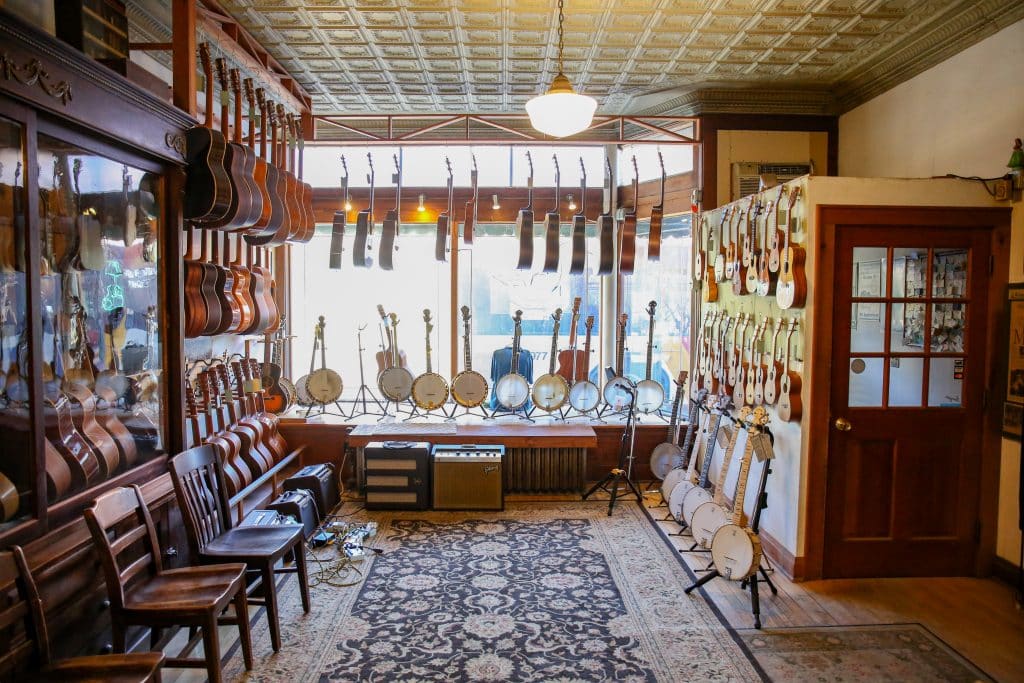
“I just said, ‘Hey do you mind if I just bring in some of my own stuff and do some work in the back so I can just observe how the day-to-day goes?’” Kehoe relays this story to Tone Madison during a mid-October morning, before opening the shop for the day. Sunlight falls through the open window, warmly illuminating rows of equipment, as well as Kehoe himself.
“It was just sort of exploratory, like, let’s just see what this is like,” Kehoe says. There were questions to answer. “What is the average weekend like? What does the traffic look like? What’s happening on repair benches?” Over time, the prospect of buying it became more enticing. By spring, Kehoe started to do the math. “At the end of the day I added numbers and said, ‘well, it seems like a good business decision,’” he recalls. “That’s what made me say, yes, I’m going to do it.”
He took ownership of the store and its 250-plus instrument inventory on June 3.
The informal, months-long residency at the shop was also an opportunity for Kehoe to get to know the shop’s two-member repair staff: Jen Paulson, who’s been at Spruce Tree since 2010, and Doug Craemer-Meihsner, who has worked the back bench for 30 years. The staff staying on is consistent with Kehoe’s desire to maintain and build on the shop’s rich culture and customs.
I tease Kehoe about one of those customs, an odd one, and one that Bremer was known for: talking people out of spending money as often as he talked them into spending it. “Andy,” he once told me, handing back an ailing, old Fender acoustic I wanted him to fix up for my son, “this guitar is like a Bic pen. And it’s about out of ink.” I pleaded with Bremer to do what he could to bring it back to life and he returned it in great condition. Our son plays it to this day. Part of the culture of Spruce Tree is honesty—straight talk that leads to quality repair and sales.
Keeping up the traditions of an independent music store is a lot like keeping an old guitar in good repair. During our conversation, Kehoe mentions one of Spruce Tree’s prized items: a Regal Domino, a rare acoustic guitar from the 1920s. The Domino once rested in a place of honor atop the burnished oak cabinets that house rows of fiddles and mandolins behind plate glass, like an old-time Smithsonian display. Kehoe is refurbishing the guitar and when the subject comes up he rushes over to the bench to fetch it. He returns and holds the guitar in his lap, explaining the instrument’s x-bracing and other mechanical components. But it’s the look on his face that tells the real story. It’s one of responsibility, determination, and genuine care.

The look Kehoe gives also suggests the guitar represents a throughline of Spruce Tree’s ideological sensibilities, particularly an investment in musical history. Bremer’s knowledge on those fronts was an integral part of Spruce Tree’s appeal. Kehoe is keen to continue imparting that type of knowledge to customers, whether new or returning.
They say every old guitar has a story, but so do their owners. Kehoe grew up in Johnson Creek and went to college at UW-Whitewater (where he came to know of Paulson, who taught in the music department). One night at a concert he met a guy who built ukuleles and banjos. They began a correspondence. The more Kehoe learned about building instruments, the more he realized a career in music history was not what he wanted. He enrolled in the violin repair program (violin is his primary instrument) at Minnesota State College Southeast in Red Wing.
It didn’t take long for Kehoe to realize he was more interested in building instruments than repairing them. So he switched to the school’s guitar construction sequence, finished it in 2016, kicked around the Twin Cities for a period of time, then took a job at a small instrument shop in Janesville. After a year there he moved to Madison. At that time, Kehoe split his living between fixing and building guitars at his house and carpentry work. Doing a job on the latter, he bumped into another guitar builder who told him about Bremer’s decision to retire and sell.
Kehoe says it was a surreal and overwhelming feeling keying the front door open for the first time on June 3. It continued that way every day for a month and continues, to some degree, today. “It’s a very cool feeling,” he says. “To assume the history of this place that’s been around now for—this iteration of it—44 years. It’s been a feeling of pretty heavy satisfaction.”
What is Kehoe’s hope for the store and those who enter it? “I hope it’s a place people think of first when they’re looking for something new. That idea of just having a comfortable place to come in and try stuff,” he says. “To me, it was always such a trip to play a mandolin for an hour. Or a banjo or whatever.”
And he wants to keep a feeling of familiarity for customers intact. “People who are maybe longtime customers worry that it’ll change in a way that’s undesirable,” he says. “And from the people I’ve talked to, I think I’ve eased people’s minds on it.” That said, Kehoe points to the display on the floor at his feet in the middle of the front showroom. Exhibit A of putting his own touch on the place: a spray of custom effects pedals.
Kehoe describes the new emphasis on pedals and electronic equipment as a “purely selfish desire.” He gets juiced when he talks about it. “I went to this fretboard summit that the Fretboard Journal puts on,” he says. “And while I was there I saw this guy. This company is called Summer School Electronics, and he’s a teacher that I think started building pedals when he was in lockdown during COVID.” He points to one of the pedals. “And I tried out this one, the Class Reunion, which is a combination of fuzz pedal and overdrive and I was like, wow, it sounded so cool. I love the aesthetic and the design. So I figured it’d be a good first line of effects to bring in.”
What’s the most satisfying part of owning a new-and-used instrument store? “I think there’s two things that are tremendously satisfying,” Kehoe says. “One is it’s always fun when people are coming in and buying their first instrument. Whether it was like I’ve wanted to play guitar for 70 years and I’m coming in to buy my first guitar right now, which I’ve had, or the 11-year-old who’s been renting a violin for two years and now it’s time.”
The other joy comes in the door in the form of an accomplished player. “Somebody who’s been looking at that 1960 Gibson banjo, you know, once every three weeks or something. And the day that they’re finally ready, like, okay, today’s the day. Let’s take it home.” Kehoe pauses and smiles. “I’ve been in both of those positions. So, you know, to be on the end of that to help people find that first instrument, or to be there when they make that [big purchase]. Yeah. It’s awesome.”
We can publish more
“only on Tone Madison” stories —
but only with your support.
Author

Related Articles
Madison acts rivetingly ring in 2026
Five local bands offer new songs and projects, and capture a hopeful feeling in the new year.
Achieving a broader focus through music photojournalism in 2025
The fourth installment of our live music photo essay series centers a more personal vantage point.

Tone Madison’s favorite records of 2025
A celebration of 20 local releases that defined the year.