
It’s a thin line between men and their cocks in “No Fear, No Die”
Claire Denis’ knife-sharp portrait of masculinity from 1990 screens in a new restoration at the Chazen on September 21.
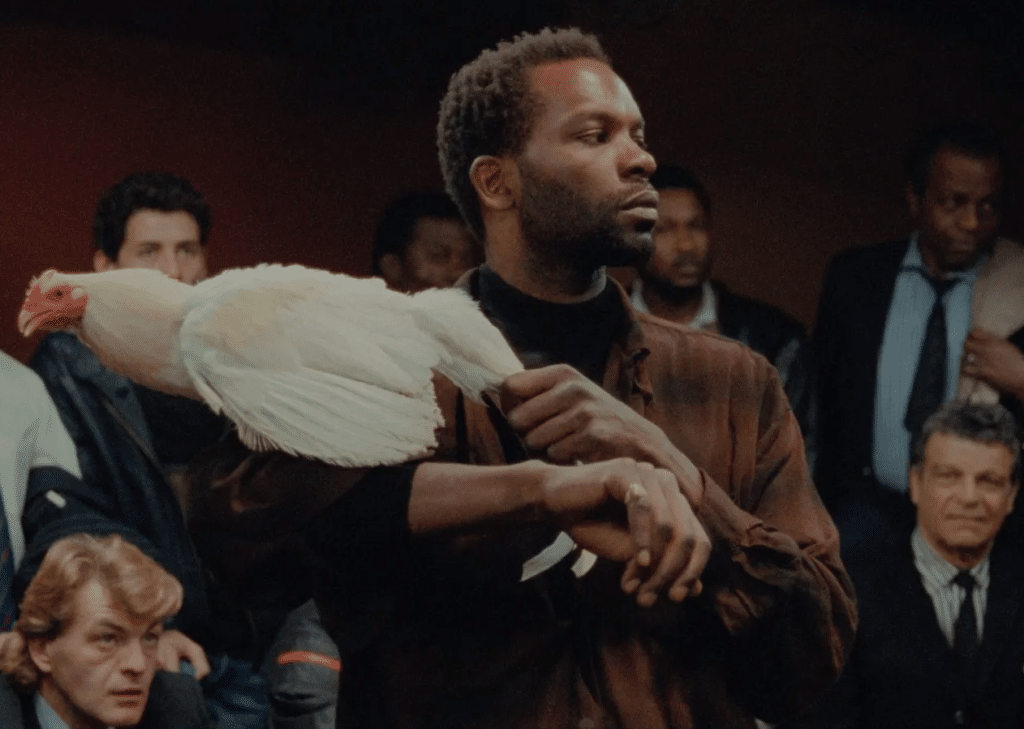
One of the most intriguing developments in the past 40 years of cinema history is that the foremost chronicler of manhood to emerge is a woman. Claire Denis is French, so we can’t claim her as a national treasure. But her global focus means that her work spans well beyond any recognizable borders. A director with a knife-sharp sense of economy, Denis has long been fascinated by how masculinity and post-colonialism intersect, which is evident in work as varied as the legionary drama Beau Travail (1999) and the visceral horrors of Trouble Every Day (2001). In her remarkable second feature No Fear, No Die (1990)—screening at the Chazen Museum of Art in a new 4K restoration on Sunday, September 21, at 2 p.m.—she finds a bracing metaphor for these themes to coalesce around.
It’s unclear when we meet Black immigrants Dah and Jocelyn (Isaach de Bankolé and Alex Descas respectively, both Denis regulars), how long they’ve known one another, or what circumstances initially threw them together. All that matters is the ramshackle team they’ve formed. Their racket is a cockfighting ring in the basement of the Chez Toni restaurant on the outskirts of Paris. Dah, from Benin, handles the business side (and meals), while Jocelyn, from the West Indies, handles the cocks. And they are handled themselves by Ardennes (Jean-Claude Brialy, a favorite of New Wave directors Godard and Truffaut), the white proprietor who oversees the restaurant’s affairs, both legal and less so. Ardennes once knew Jocelyn’s mother, but his treatment of the men is no less exploitative for its paternal overtones. “The subway is full of guys like you,” he hisses at Jocelyn when he steps out of line.
There isn’t much else in the way of plot. Denis is more interested in capturing the rhythms of Dah and Jocelyn’s daily lives, which are often a grind. Far from the bright lights and glamor of the city, the nameless industrial park on the side of the highway where they are provided living quarters is an endless expanse of gray skies and churning smokestacks. They’re forced to sleep in the restaurant basement in a room adjacent to where the birdcages are kept. Jocelyn spends hours training his prize rooster, the titular S’en Fout La Mort (No-Fear-No-Die), twirling him in the air and goading him in circles on the carpet. Denis’ eye and cinematographer Pascal Marti observe these repetitive activities with a scholarly remove that nonetheless illuminates the human physicality behind them. It’s not a huge creative leap to go from these scenes to the sweat-soaked military montages of Beau Travail.
The actual cockfights are stripped of any sensationalism or even excitement. They’re squalid and sleazy and, somewhat mercifully, usually over quickly. Animalistic, de-humanizing language is deployed on both sides. Jocelyn calls the spectators a “pack of dogs” who have no appreciation for the beauty of the creatures whose slaughter they’re frothing over. “Men, cocks… same thing,” Dah also observes in his intimate voiceover narration, in case the audience isn’t making the connection. When Ardennes insists on amping up the carnage by putting steel spurs on the birds, it’s only a matter of time before their venture culminates in tragedy.
Watching No Fear, No Die with several decades of Denis’ films as context, it’s striking to realize how the director emerged on the scene almost fully formed. Her debut Chocolat, which came out two years prior in 1988, was based in part on her own upbringing in French-occupied Cameroon. Shifting her attention to the European continent and the people scraping together an existence at its margins allows her to explore colonialism from an angle both more direct and oblique. The violence men inflict on one another here might operate under the guise of supposed civilization, but the oppressive intent remains. Keep them hungry and keep them fighting, the train of thought goes. Regime and regimen come from the same word, after all.
A last, perhaps obvious, warning: viewers who are particularly sensitive to animal cruelty should tread carefully. While a disclaimer at the end of the film states that no animals were “hurt or mistreated” during its making, that doesn’t make the brutality onscreen any easier to sit through. However simulated, there is bloodshed here. Whether man or fowl, the wounds linger, even for those who manage to survive.
We can publish more
“only on Tone Madison” stories —
but only with your support.
Author

Related Articles

Continuity and expressive experimentation in the 2026 Wisconsin Film Festival
Eight writers share their initial insights on the eight-day extravaganza, April 9 through 16, across UW campus and Madison.
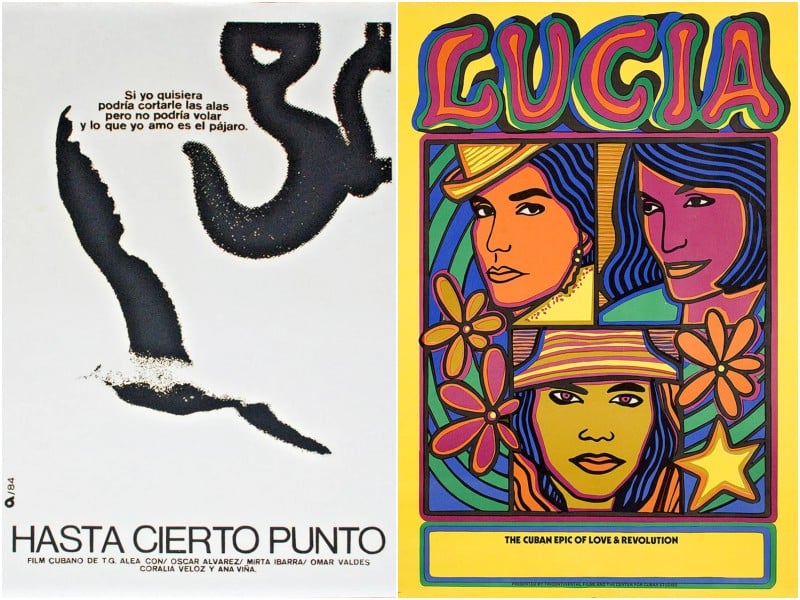
The Cardinal Bar’s Cuban film series invites local support for Madison sister city
Cine Cubano bridges interest in Cuban cinema with the cultural exchange and aid mission of the Madison-Camagüey Sister City Association.
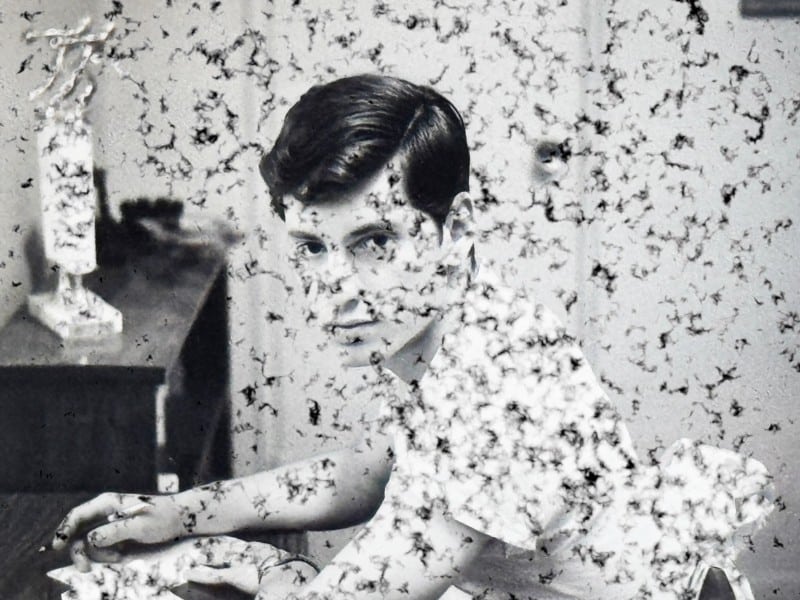
Three video artists tap into personal histories in the 150 Artists x 150 Years exhibition
Chele Isaac, Toby Kaufmann-Buhler, and Aaron Granat reveal the creative depths of their works, which are on display through February 28 at Central Library.