
Starting Wednesday night, Claire Denis’ acclaimed 1999 Melville adaptation will be available to rent through MMoCA’s virtual Spotlight Cinema.
While supplies last, free viewing links will also be available to MMoCA members.
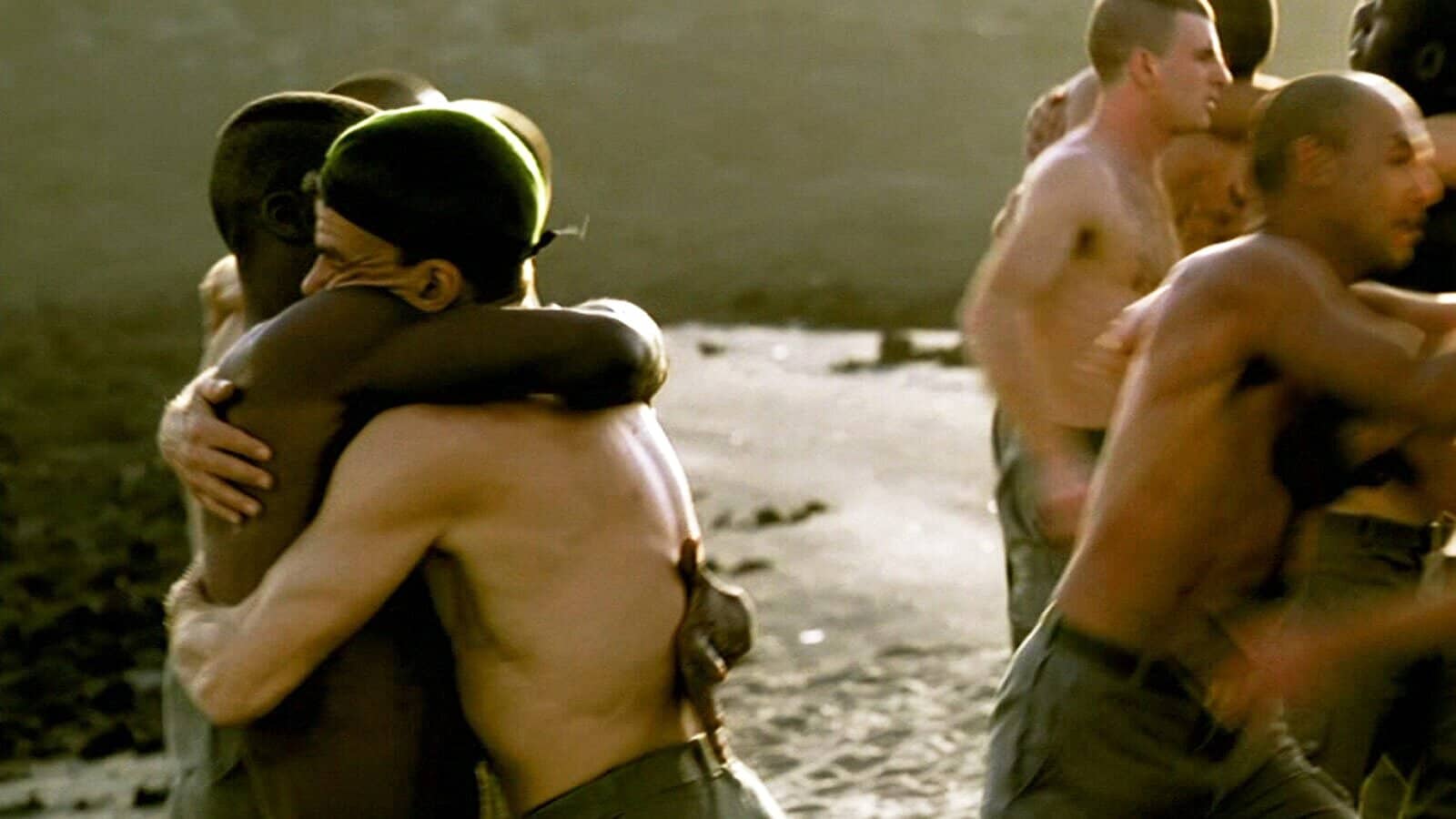
Madison Museum of Contemporary Art’s Spotlight Cinema series kicks off its virtual lineup this year with an exquisite 4K restoration of Claire Denis’ sensuous, enigmatic 1999 art house film Beau travail (French for both “good work” and “beautiful work”). Loosely adapted from Herman Melville’s 1888 novella Billy Budd, Sailor, this mesmerizing visual tone poem centers on an all-male regiment of French Foreign Legionnaires stationed at a remote desert outpost in the former colony of Djibouti, in East Africa. Denis wished to explore not only the experience of being a foreigner in an unfamiliar land but also what it meant to be “a foreigner to oneself,” in her words.
Unfolding in impressionistic flashbacks against the backdrop of a ravishingly stark coastal landscape, the film follows Sergeant Galoup (character actor Denis Lavant) as he recalls his once glorious life leading troops after being dismissed from military service. A repressed, stiffly conventional, and inscrutable figure, he serves under commanding officer Bruno Forestier (Michel Subor), whom he has great respect for. (Subor previously played the same character in Jean-Luc Godard’s Le petit soldat (1963), and Denis imagined her film to be an oblique continuation of Godard’s.) When a young, popular, and handsome new recruit, Gilles Sentain (Grégoire Colin), begins to attract the attention of Commander Forestier, Galoup becomes obsessed with him. Thus, the sergeant descends into a downward spiral of destructive jealousy as he unfairly persecutes the innocent legionnaire and eventually ensures his own ruin.
Beau travail primarily tells the story of this bizarre triangular relationship through bodies and movement rather than words and dialogue. Denis and her longtime cinematographer Agnès Godard meticulously observe the legionnaires’ elaborate military rituals, which were stylized and choreographed by ballet dancer Bernardo Montet. Once described by the critic Stephen Holden as the “cinematic equivalent of a military ballet,” Beau travail imbues the rigorous drills and brutal training exercises with elliptical elegance, entrancing rhythms, and vivid, tactile sensuality. Denis’ film revels in the impenetrable masculine mystique, even as it reveals the absurdity and dehumanization of military life. As Beau travail deliberately downplays the drama’s homoerotic subtext, it searches for something deeper, more elemental, and ultimately elusive in the space between human beings.