
The revolutionary lesbian gaze of “Desert Hearts”
Donna Deitch’s 1985 road-movie romance screens at the Chazen on May 29 as part of Cat Birk’s “Becoming Horse Girl” movie series.

Donna Deitch’s 1985 road-movie romance screens at the Chazen on May 29 as part of Cat Birk’s “Becoming Horse Girl” movie series.
Donna Deitch’s directorial debut, Desert Hearts, released in 1985 and restored by the Criterion Collection in 2017, sent a shockwave through audiences—particularly queer audiences—when it hit theaters. It remains an important historical milestone in LGBTQ cinema.
The film was the passion project of Deitch, who fundraised the $1.5 million budget via an NEA grant, contributions from individual queer people, and even selling her own house. It was the first feature film about lesbians directed by a woman, and also the first to portray lesbians and a lesbian relationship in a positive, non-sensationalized light. It might seem less monumental in this age of comparatively robust LGBTQ film and TV offerings, but the impact of Desert Hearts, particularly on queer women, can’t be understated.
Loosely adapted from the 1964 romance novel Desert Of The Heart by Jane Rule, the plot revolves around the sexual awakening of Vivian Bell (played by Helen Shaver). Bell’s an English professor from New York City who goes to live on a ranch in Nevada in order to establish residency for a quick divorce from her husband. There she meets the younger, free-spirited Cay Rivers (Patricia Charbonneau), a sculptor with a dreamy cowgirl aesthetic. Vivian is disconcerted by how openly Cay shows her interest in her, and the two dance around one another until a final encounter in a hotel room that features one of the better queer sex scenes ever put to film.
While Desert Hearts‘ low budget peaks through in some of the setpieces and shortened scenes, the film’s presentation is refreshingly simple without losing depth. The chemistry between the two leads is palpable, and the refusal of the film to center the hetero or male gaze was and is a refreshing change from the norm. The depiction of lesbian love without resorting to the negative tropes that still sometimes plague media about queer people—like the “bury your gays” trope—remains revolutionary.
It’s a fun and welcome accompaniment to Cat Birk’s my mother is a horse. exhibition at the Chazen Museum of Art. Desert Hearts is the second film in Birk’s “Becoming Horse Girl” movie series there, following Piaffe (2022) earlier this month.
According to the Chazen’s description, Birk’s work features “paintings, silicone surfaces, prints and sculpture in an exploration of how images and objects serve as catalysts of identity formation.” Most significantly, “Birk emphasizes t4t (trans for trans), the vital network of transgender solidarity and mutual aid, in an examination of embodiment and relationships. With references to organizing structures such as the grid, minimalist sculpture and queer politics, Birk presents connections between material objects and intangible social networks.”
At this Wednesday, May 29, screening at 5 p.m., Birk will introduce Desert Hearts and talk briefly about its connection to their exhibit, which they tease in an artist statement by writing that it “captures the rancher chic aesthetic of the horse girl DNA.”
We can publish more
“only on Tone Madison” stories —
but only with your support.
Author
Related Articles
One movie meditation after another: toiling through 2025
Nine writers processed these trying times through cinema, at the theaters and at home.
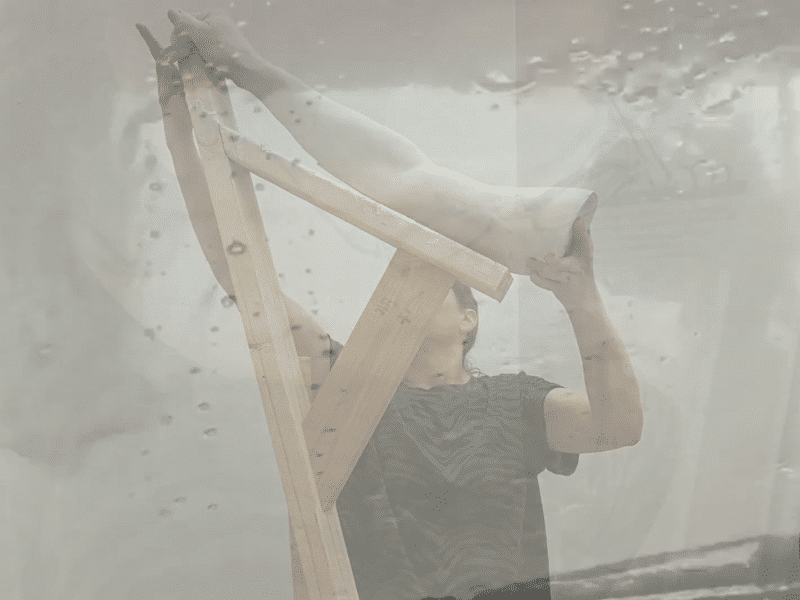
“Liking This Angle” finds artistic inspiration in degrees of the edit
Nicholas R. Wootton’s experimental short, featuring sculptor Christina A. West, premieres at Art Lit Lab as part of Project Projection on January 21.
Evaluating tenderness and depth of family dynamics in “Sentimental Value”
Grant Phipps and Lance Li argue in favor of and against the artistic framework of Joachim Trier’s latest psychological family drama.