
The free-roaming “Vagabond” is a character study as empathy test
Agnès Varda’s powerfully elusive drama from 1985 screens on 35mm at UW Cinematheque on July 10.
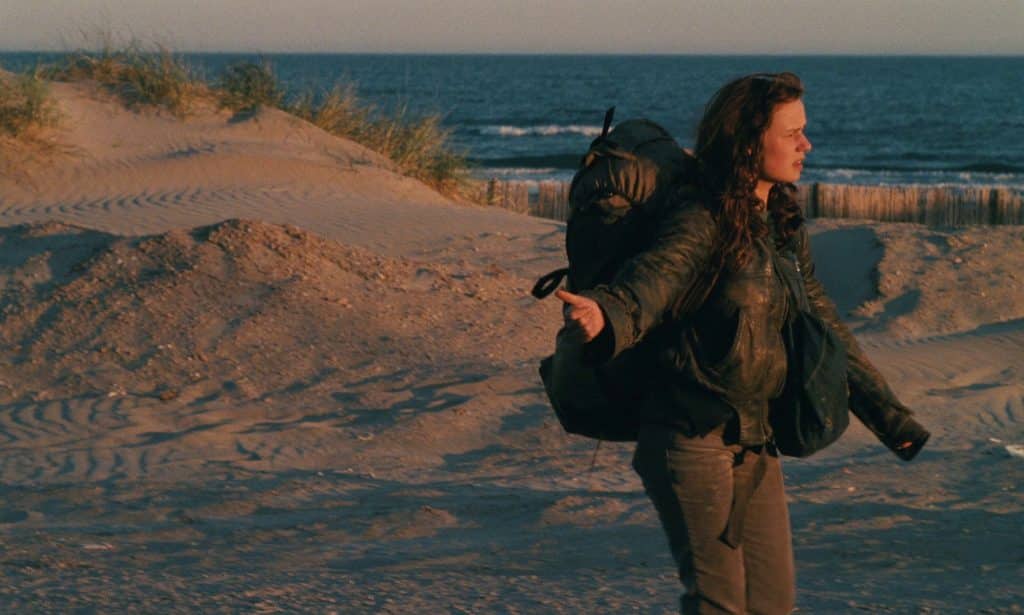
Agnès Varda’s powerfully elusive drama from 1985 screens on 35mm at UW Cinematheque on July 10.
Vagabond (1985) opens on a pastoral landscape that might have been painted by Van Gogh. Cypress trees bend in the wind while a farmer plows a nearby field, sending plumes of dust into the air. For those familiar with the late director Agnès Varda’s documentary work like the two Gleaners films (2000, 2002), this setting won’t come as a surprise. She had always demonstrated a genuine interest in France’s working classes, particularly those who till the earth. But as the opening credits commence, the camera slowly begins to zoom in on this placid scenery, and an unusual suspense builds. What is about to be revealed to us? What does Varda want us to see? The film that follows offers no clear answers, but that only makes its mysteries more enticing.
The film is showing at UW Cinematheque on Wednesday, July 10, at 7 p.m. as part of the campus screening program’s “Thank You, David Bordwell” series honoring the late critic and Jacques Ledoux Professor Emeritus of Film Studies at UW-Madison. It will be presented in a 35mm print, courtesy of the Wisconsin Center for Film and Theater Research, and followed by a video essay of Bordwell discussing Vagabond‘s unique plot which, as he points out, is actually three movies in one—a mystery, a road movie, and a “network narrative.”
The most immediate is a mystery: what Varda is actually guiding us towards in that opening shot is a dead body. It’s the titular vagabond, Mona Bergeron (played by Sandrine Bonnaire), who appears to have fallen into a ditch and frozen in the winter night. The police call it “a natural death.” Varda, though, is not so much interested in actually finding out what happened to her. As far as plot goes, Mona’s end, tragic though it is, is almost incidental. But it’s also not quite right to say Varda is interested in who Mona was, either.
What emerges instead is an uncompromising and defiant collage portrait of a life on the margins, utilizing many of the same talking-head testimonials more conventionally seen in documentaries. People who crossed paths with Mona in Southern France’s Languedoc region muse about a person who was essentially unknowable, and Varda uses these reminiscences as jumping-off points to explore the community that she inadvertently became a part of, if only briefly. One of the most prominent is Yolande, a soft-hearted housemaid to an old woman, whose charity towards Mona eventually results in her being fired. The encounters create a character study as empathy test.
Pointedly, Mona is not the easiest person to like. She’s selfish and stubborn and often takes advantage of people’s kindness. But there’s also something admirable in the ferocity with which she meets her destiny. Mona may not have scruples, but she operates with an integrity that you’ll, as a viewer, find yourself teasing out as much as the other spectators to her life. For many of the women Mona meets, she’s enviable. For many men, she’s pitiable or, worse, a target. Varda’s roving camera, meanwhile, seems to anticipate Mona’s trajectory at every turn.
It’s this formal restlessness, matching its heroine’s itinerancy, that most clearly connects Vagabond to the road movie tradition. But if so, it’s a sneakily subversive and feminist one, as was much of Varda’s work. Regardless of its elusive sense of genre, Vagabond is a rigorous film that demands active engagement. Luckily, Bordwell makes an excellent guide. And, apropos of nothing, if you’ve been wanting to see a female-directed film at the Cinematheque, it’s your one chance this summer.
We can publish more
“only on Tone Madison” stories —
but only with your support.
Author

Related Articles
One movie meditation after another: toiling through 2025
Nine writers processed these trying times through cinema, at the theaters and at home.
“Liking This Angle” finds artistic inspiration in degrees of the edit
Nicholas R. Wootton’s experimental short, featuring sculptor Christina A. West, premieres at Art Lit Lab as part of Project Projection on January 21.
Evaluating tenderness and depth of family dynamics in “Sentimental Value”
Grant Phipps and Lance Li argue in favor of and against the artistic framework of Joachim Trier’s latest psychological family drama.