
Stop spotlighting new films by known abusers
Madison boasts a dynamic movie culture, yet still needs programmers and community voices to facilitate change.

This is our newsletter-first column, Microtones. It runs on the site on Fridays, but you can get it in your inbox on Thursdays by signing up for our email newsletter.
Over a year and a half ago, Tone Madison was the only publication in the Madison area to address UW Cinematheque’s questionable programming decision to include Woody Allen’s Coup De Chance as the premiere screening in an “international discoveries” series. In light of the sexual abuse allegations against Allen (that precipitated other revelations), no one on Cinematheque staff issued a response or a general statement to justify the film’s inclusion in the summer 2024 program, and the free public event went on at 4070 Vilas Hall as planned.
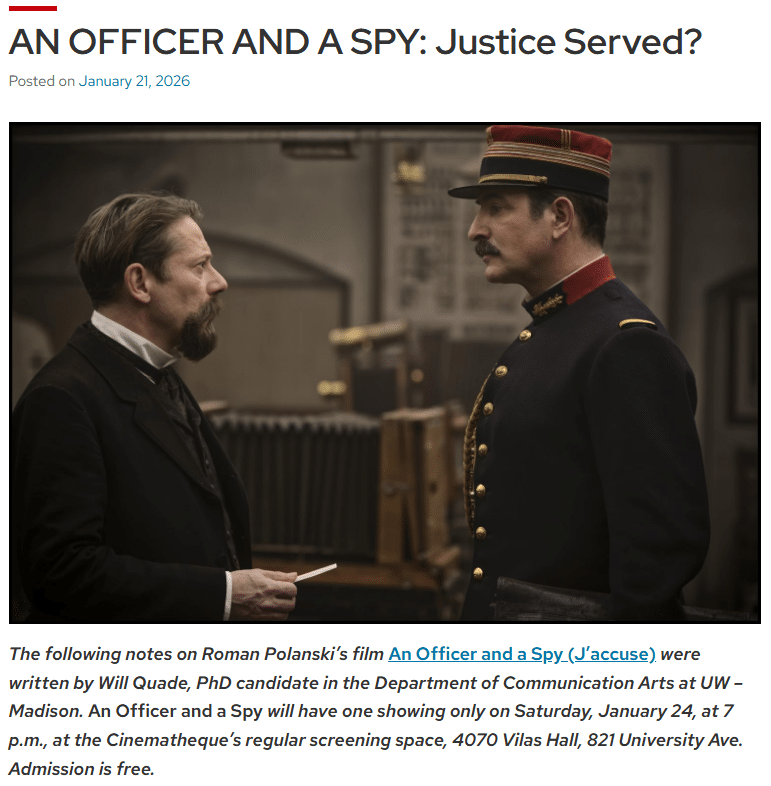
Given that was the case, it’s not altogether surprising to see the same thing recur, with the contentious addition of 2019 political period drama, J’Accuse (An Officer And A Spy) by convicted rapist Roman Polanski, on Cinematheque’s spring 2026 calendar. The January 24 screening choice was backed by a firm essay endorsement by UW PhD candidate Will Quade but no other comments between the January 7 calendar announcement and event date.
The grim U.S. social climate that normalizes the reprehensible and protects pedophiles seems to follow other new films with problematic strings attached that have recently made their way into local commercial cinemas in consecutive weeks. At least Flix Brewhouse at the East Towne Mall appears to be exempt.
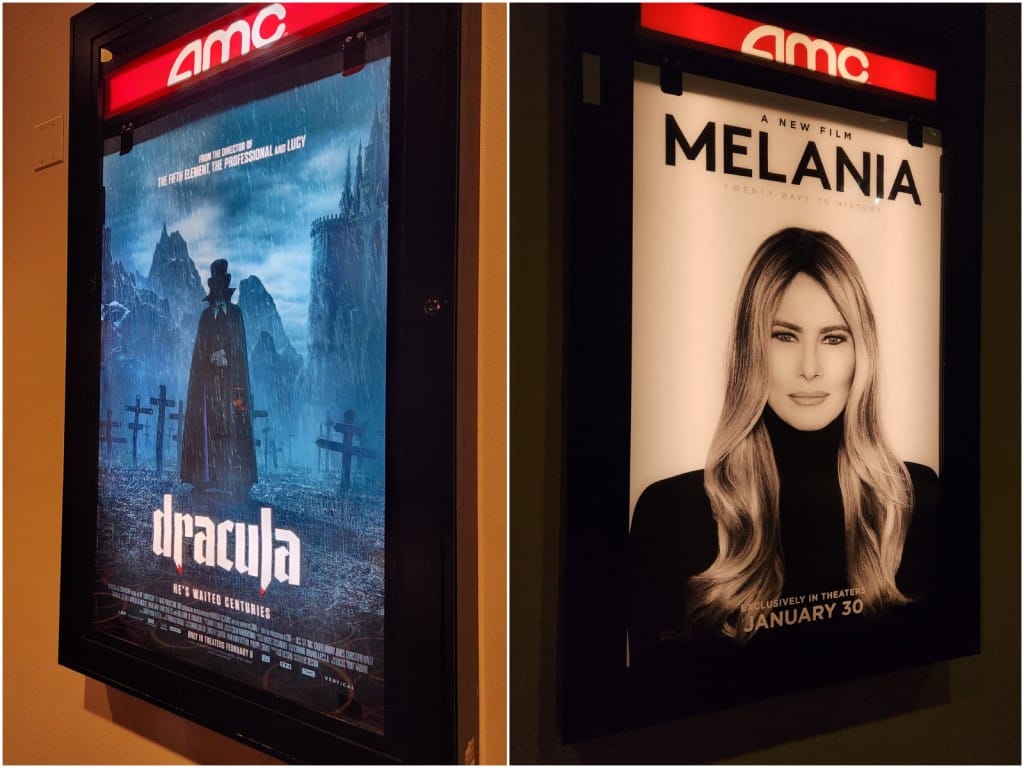
If you visited AMC Fitchburg 18 in January, you may have noticed the monochrome poster in the lobby (now on the exterior wall left of the front entrance) for the Melania Trump documentary by Jeffrey Epstein confidant Brett Ratner. It’s essentially a $40-million corporate bribe from Amazon Metro-Goldwyn-Mayer Studios to the Trump regime, glorifying the day-to-day life of the First Lady. Melania opened there with three or four show times per day starting on January 30, and will continue screenings for at least another week.
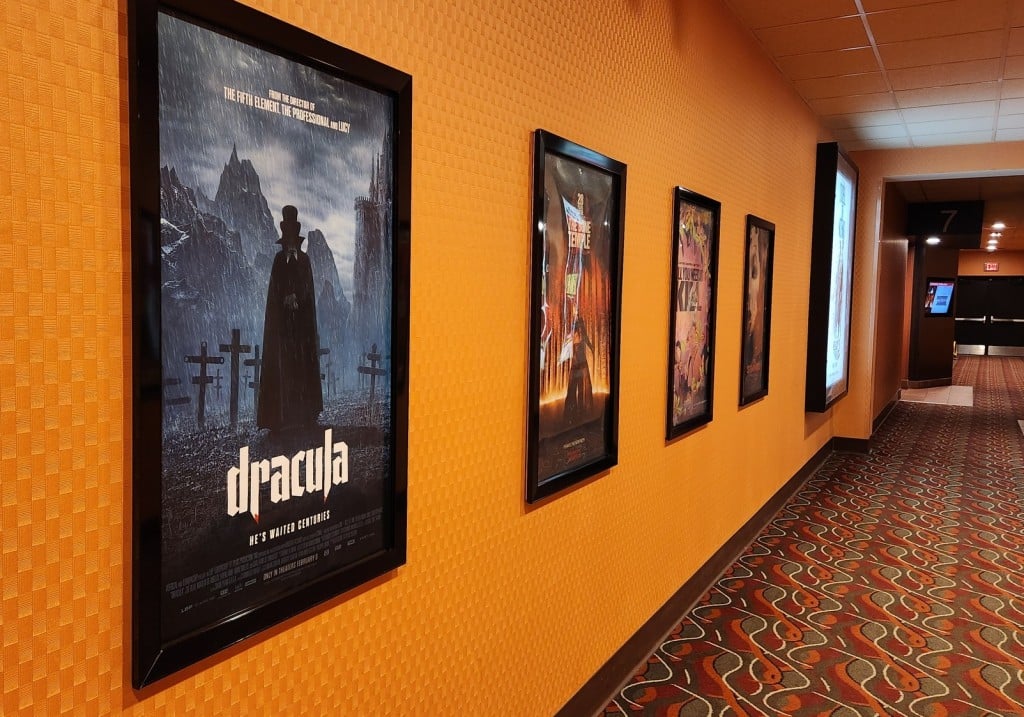
On the opposite wall in the AMC Fitchburg lobby, a poster was also displayed for Dracula, directed by the repeatedly accused sexual predator Luc Besson. From promotional materials, it’s a limp-looking retelling of Bram Stoker’s canonized gothic-horror tale starring Caleb Landry Jones. That film premiered at the theater and at both Marcus Point and Palace on February 6. Considering the fact that Robert Eggers’ reimagining of F.W. Murnau’s Nosferatu (2024) and Radu Jude’s postmodernist Dracula (2025) have both come out within the past 14 months, Besson’s artistic angle seems ill-timed and redundant.
Though, the content of these films is not the principal target of my dismay; and I hate to be redundant myself, but I’m once again forced to pose the question: why are local programmers, commercial cinemas, and the industry continuing to platform active directors who’ve been accused or charged multiple times of sexual misconduct? These men behind the camera aren’t seeking to make major reparations with organizations that advocate for victims; they’re instead ignoring or casting aside allegations, cozying up to the grifter right-wing media ecosystem, and/or seeking funding through surreptitious avenues away from media scrutiny.
The accusations surrounding Brett Ratner, who emigrated from the United States to Israel and is in the good graces of war criminal Benjamin Netanyahu, needs the least amount of elaboration; he was accused of rape and harassment by multiple women during the #MeToo movement in October 2017. Warner Bros. severed ties with him a month later, and he had not directed a film since 2014 until this year’s Melania. Further, in December 2025, among the fraction of Epstein files that had been released before January 30 (which are even more incriminating), Ratner was shown in a photo with the late Epstein associate and “model scout” Jean-Luc Brunel.
(Also, consider Woody Allen in Epstein file photos with white nationalist Steve Bannon and Epstein himself, and letters revealing he and wife Soon-Yi Previn’s friendliness with him into the 2010s, and you’ll notice something of a pattern.)
Luc Besson’s career is somewhat trickier to assess. He’s steadily been working as a director in his native France and the United States since being accused of rape in 2018 by actor Sand Van Roy, who starred in Besson’s 2017 sci-fi feature, Valerian And The City Of A Thousand Planets. While Besson was ultimately acquitted by the French Court of Cassation in mid-2023 after years of litigation, a number of other women, including a former assistant, have also come forward to call out Besson’s “inappropriate sexual behavior.” Before all this transpired, Besson dated French actor and director Maïwenn in 1991 when she was 15 years old and he was in his early 30s. This relationship supposedly inspired the character dynamics in his breakthrough thriller Léon: The Professional (1994).
Roman Polanski, being one of the 20th century’s most influential directors, has the most sordid history. In 1977, when he was 43, Polanski was convicted of drugging and raping 13-year-old Samantha Geimer, née Gailey, in Los Angeles. Polanski ended up fleeing to Europe the following year to evade a possible prison sentence. Even if that were the only damning charge against Polanski, a pattern of lecherous behavior emerged in the wake of #MeToo, with many other decades-spanning allegations—from German actor Renate Langer, French actor Valentine Monnier, and an unnamed woman who settled a civil suit with Polanski about a 1973 incident.
In Quade’s eloquent essay about the subject of the Dreyfus affair as depicted in J’Accuse, he compartmentalizes or narrows the scope of Polanski’s behavior with information that has come to light. Quade only seems to care about contextualizing the legal case in the terms of defending Polanski’s reputation, and lending permission and credence to the director’s late career. I guess this is where some of us still are, a decade after #MeToo, when it comes to the artist. The refrain of “separate the art from the artist” has remained unshakable, but that’s essentially the same thing as proclaiming that we should keep politics out of art, when these boiled-down, blinders-on statements are oxymorons. Actions are political, and the identity of the director is inextricable from the work itself. If you’re making excuses, you’re not an ally.
And yet, when someone tries to initiate conversation about this subject, they inevitably face criticism about censorship or prejudice. Though, I find that rhetoric diluted and not sincerely in response to the argument. Rather, I’m asking audiences to be more engaged and assertive in asking why we’re still celebrating the continuing output of these men. Why didn’t, at any point between pre-production and theatrical distribution or selective programming, enough people speak up to express discomfort about actively working with or promoting a still-working director with these allegations? Why did the crew choose to lend their names to the project? (A significant number of Melania‘s New York crew members are bravely ahead of me, at least.)
I would not deny directors their contributions to film history, or attempt to erase what might be seen by a lot of cinephiles as unexceptional filmographies. Instead, I’m advocating for nuance. I’m asking to not screen, and therefore not financially and/or morally support, the ongoing work of the directors in the form of public screenings due to the severity of these allegations and charges. Accusers’ accounts should be taken seriously, and not treated as a mere footnote and something that we collectively regarded with an expiration date at the end of the 2010s.
AMC, Marcus Theatres, and UW Cinematheque could choose not to screen these films. Certainly a tougher ask at a theatrical chain, but local management at the commercial chains could raise their voices in protest even if they are ultimately without the authority to reject certain operations. In my trips to AMC and both Marcus theaters in January, I saw and heard no evidence to support that’s happening on the inside. One of the crew leaders at AMC listened to my concern about the screening of the Melania documentary and Ratner’s association with it on January 14, but then basically dismissed me, and said that no one else had spoken up about either. When I returned to the theater on the night of February 2, another supervisor there essentially confirmed the same—no one, from moviegoers to employees, had been “mad or outraged” to his knowledge.
These companies and institutional programs shouldn’t have the last word, though, even if they’re quietly accepting the films into their weekly lineups or programming slate without saying much of anything else publicly. And, transparently, that’s part of the reason for this piece. My input and reach as a moviegoer and amateur programmer are limited, but other community members who are booking screenings in Madison regularly or infrequently have a greater footprint and influence.
In writing to them to generate awareness, I received varying positions on the subject of problematic programming. And yet every respondent was unsurprisingly engaged, and—even among some who are not formally cited here—seriously considered the potential harm of the abuses first along with any potential merits of hosting these sorts of screenings. One respondent in town also debated a hypothetical situation of being paid handsomely to host something with right-wing content or a problematic director, and how they’d reach a conclusion with fellow staff.
In an email to Tone Madison on January 29, Brian A. Maulana-Ponce, Group Facilitator for Q-Cinema at OutReach LGBTQ+ Community Center (2701 International Lane), thoughtfully explained the process for curating films in the ongoing Q-Cinema series (which Tone Madison has covered a few times in the past), and the intention to create a dialogue with selections that may be deemed controversial. “Businesses and other venues that host screenings should consider public opinion of these directors / creators and the potential damage their work could cause,” Maulana-Ponce writes. “These [directors] are still praised for their abilities despite their wrongs, and at some point, society must decide to stop supporting those who have wreaked havoc on people’s lives… I hope they will do better in the future, but if history has anything to say about it, they will sadly do it again,” he concludes.
James Kreul, prolific film programmer at Mills Folly Microcinema (where I assist with experimental programming, full disclosure), Duck Soup Cinema, and Rooftop Cinema, was more nuanced in his assessments in a January 27 email. He would not support a “blanket proclamation” that would restrict screenings associated with filmmakers accused or charged with misconduct. “If I were in a position to make a curated programming decision about such a film, I hope that I would consider, case by case, the degree to which my programming of a film might contribute to the kind of acceptance and silence that has enabled such filmmakers to exploit and retain power within the film industry,” Kreul writes.
After acknowledging the complicated push-pull between artistic value and particular selections automatically taken as endorsement of an artist themselves, Kreul offers, “The question then would be how and why to present a film, but I should already be thinking about that regardless of the filmmaker’s known conduct.” In prior experiences attending Kreul’s film events in the downtown area, he has provided content warnings and forewords about certain silent-era Duck Soup programs at Overture Center and experimental shows on 16mm formerly at maiahaus (during the Underground Films, Underground series of the late 2010s).
Siobhan Jackson, Director of Adult Education at Nehemiah Center for Urban Leadership Development (633 West Badger Road) and founder of the Black Film Festival, shared a more radical, activist view via email on January 30: “Every industry and especially media in the 21st century has always been racist, misogynist, patriarchal, and way too focused on the numbers and NOT the people,” she writes. “Films are our modern-day cave drawings, legends, and folktales that people like Epstein and other abusers have colonized for power and profit. We must demand or seek out films that actually tell our stories.”
Jackson’s proactive suggestion is the crux of the argument. By continuing to contend with these sordid artists and theaters who are giving space to their new films this decade—Coup De Chance, J’Accuse, Melania, and Dracula—we’re passively being asked to accept an absence of other voices who should be a key part of local and macro culture for audiences of all ages. We’re seeing a cultural regression due to those in the highest positions of power. As local filmmaker and Madison College instructor Emmalee Pearson acerbically puts it, “Like many other crooks, Ratner is being given another chance, because Trump pities those he sees himself in. Amazon [is] buying its way into favor… Grift cards coming soon?”
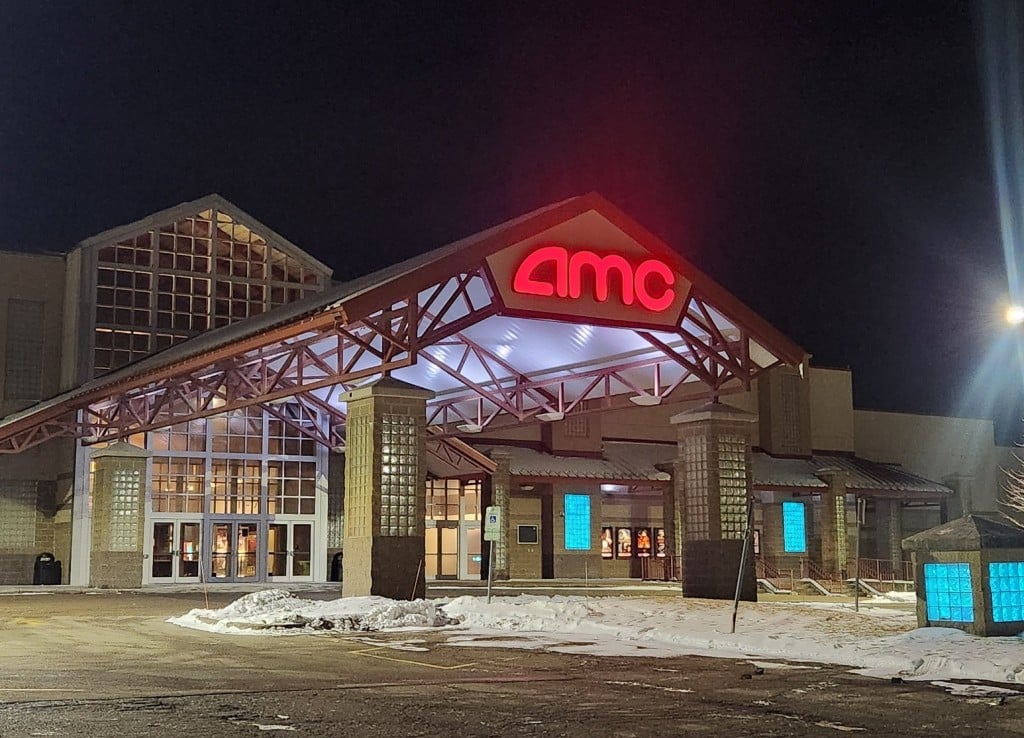
The screens these films occupy across Madison, whether for one show time or 20, should instead be illuminating burgeoning and veteran artists who are unencumbered by heinous allegations—artists who want to tell “an authentic story rather than [make] a ‘blockbuster cash grab,'” Jackson adds. She cites regional to national filmmakers like Rafael Charles Ragland, Donnell Writes, Raoul Peck, Channing Godfrey Peoples, Jordan Peele, Nia DaCosta, Barry Jenkins, Ava DuVernay, and others as examples of voices who should serve a more profound role.
Crowds who are still going out to screening events may seem smaller in number; but anecdotal evidence at movie theaters over the recent holidays, plus the reportedly dozens of sold-out screenings from the 2025 Wisconsin Film Festival, I’d argue that Madison-area people have wholly embraced a return to cinemas post-pandemic. They are seeking something more intentional than an endless content scroll. To preserve these spaces, we need to continue going to the movies, but also vote with our wallet and our voices.
If you aren’t already, consider the director behind a film you plan to attend, especially if it is new or premiering locally for the first time. Seek out films by women, trans, non-binary, and BIPOC artists when and where you can. Speak out against films by writers and directors with problematic pasts or ties and who have not made amends. As you are comfortable, author a blog or Substack post, write a polite email, call a theater to talk to staff or a box-office manager, or talk to programming directors in person if there’s an opportunity.
Jackson echoes those sentiments: “Stop going to the megaplexes and special events that host these offenders AND make the actual switch to see just as many films, and spend as much money, at the art / artist-focused events.” She also advises viewers to write letters, get on community boards, join arts unions in their collective action, and take jobs at the establishments most impactful to your community and who are working those changes from within. “Don’t take ‘no’ for an answer from the sidelines,” Jackson asserts. “Force people to hear you on the field.”
There are a myriad of active filmmakers out there who we can advocate for and who aren’t under a plague of troubling accusations. We should be looking to affect change at every level, but we can at least be listening to and supporting those who better represent progressive values.
Who has power in Madison,
and what are they doing with it?
Help us create fiercely independent politics coverage that tracks power and policy.
Author

Related Articles

Police surveillance technology needs proper accountability
Grassroots resistance against Flock cameras are writing the blueprint for comprehensive reform.

Don’t shrink the Common Council and County Board
Madison needs more representation, not less.

Starter homes? No, we need starter apartments
As homeownership continues to be out of reach for too many Madisonians, we should build more owner-occupied, multi-family housing.