
Spiritual thought in sound geography: An exit interview with Luke Leavitt
The versatile, formerly Madison-based musician talks with us following his recent move to Denver.

The versatile, formerly Madison-based musician talks with us following his recent move to Denver.
During his seven-year tenure in Madison, Luke Leavitt brought a delightfully weird and multifaceted approach to the city’s music landscape. He threaded seemingly disparate music scenes together with virtuosic jazz piano-playing and astutely satirical pop-song lyricism. This past August 11-13, Leavitt played his final run of shows as a Madison resident—two with his “yacht rock” (but more like jazzy prog-pop) sextet, The Levitations, and one with improvisatory trio Laminal Animil—before relocating to his hometown of Denver, where he got his start as a performer.
Beginning with Cop Circles in 2017, Leavitt displayed a tendency towards prolific collaboration in Madison. Even during pandemic lockdowns when all live performances curbed or moved to virtual audiences, and artists often had to trade ideas and tracks remotely, Leavitt creatively persevered with a number of collaborators. During this time frame, Leavitt steadily built a modest library of solo material on his Bandcamp page, first releasing Bildungsroman For Cricket in February of 2021, and most recently, Rose’s Space in April of 2022.
If you happened to catch Leavitt live during the past full year of live shows since 2019, you may have heard some of the tunes on the latter adapted and rearranged for a full band. One of those, the acerbically deadpan “Capitalism,” made Tone Madison‘s best tracks of 2022 list. While Leavitt has been quiet on releases for the past year and a half, he has several projects in the works. Those include a trio album, Cruel Optimism, with Madison bassist Ari Smith and Milwaukee drummer Devin Drobka, and a 33-minute ambient-jazz soundscape, Concert In The Shell, which includes a cover of Ornette Coleman’s “What Is The Name Of That Song?” originally from 1982.
In the live performances I was fortunate to catch (with Feestet, The Levitations, Laminal Animil, or solo at Garver Feed Mill and Café Coda residencies), Leavitt at times came across like a more gently self-deprecating answer to Australian oddball singer-songwriter Kiran J. Callinan. But his musical persona is impossible to pin down, as he criss-crosses and dissolves genre boundaries and even lines between disciplines in his studies and teaching through UW-Madison’s Department of Geography (where he’s still currently pursuing a PhD). Within traditional infrastructures, Leavitt thrived as one of the most drolly progressive minds that our city’s had to offer in the past half-decade.
In late September, Leavitt spoke with Tone Madison over Zoom about his early years, bringing a punk energy to experimental or multi-genre music (but mellowing out these days), who he first connected with in Madison, using irony to address difficult topics, learning from the high caliber of musical peers in the “fertile” Madison scene, how the pandemic shaped his musical direction and artistic purpose, the concept of listening as tethered to music/sound geography pedagogy, upcoming projects, and much more.
Tone Madison: How are things going for you in Denver, and what brought you back there?
Luke Leavitt: I’m here mostly for family reasons. Just to help out with my mom. She’s getting up there. So that really is the primary reason. But at the same time, I’m from here, and I have a lot of old connections here. My sister’s here. In a way, it’s also about reconnecting with my hometown a little bit.
Tone Madison: From the time that you were there previously to now, what is your sense of the music scene? How’s it changed? I saw you had a recent gig at this Hi-Dive club opening for Strange Ranger. How did that go?
Luke Leavitt: That went really well. I joined my friend, Ben Donehower, and the sort of shifting group of musicians that he gathers under the name of Fragrant Blossom. And in this iteration, Ben, myself, and a new friend, Eden, played a kind of mix of, like, bossa nova meets synthwave. I never succeed at naming these things very well. [laughs] With some ambient, [too]. So it turned out really well. And what I liked about it was that it’s a pretty horizontal kind of group. There’s no leader, per se. We’re all writing songs.
Tone Madison: Pretty democratic?
Luke Leavitt: Yeah, it’s pretty democratic, which I like.
Tone Madison: What’s the configuration with instruments? Is it horn and synthesizers?
Luke Leavitt: In total, we have flute, guitar, synthesizers, drum machines, vibraphone, and bass. But there’s only three of us, so we kind of rotate between them. It’s a nice timbre, though. Eden composed a piece for four flutes. So I subbed in with a flute synthesizer. And, you know, we alternate that with pop tunes. Maybe ’50s inspired? Latin jazz, like [Cal] Tjader. Like lounge-adjacent jazz.
Tone Madison: So, the stuff Stereolab ended up incorporating into their sound? That kind of stuff?
Luke Leavitt: Yeah, a little bit Stereolab. If you know the group Antenna, that’s another one.

Tone Madison: Let’s flip back, do a 180, to your time assimilating here in the Madison music scene in 2017 or so. At least, that’s when I remember first seeing the Cop Circles project on bills at Mickey’s and Communication. You still can still find those through a Google search, which is how I confirmed them. I definitely remembered a Mickey’s show, but I was like, “Oh, you played at Communication, too.” But I don’t remember ever seeing you perform live as Cop Circles, by some unfortunate coincidence. What was that your sort of entry point into the scene here? And, if that was, what did those early performances here teach you about the differences between Madison and Denver?
Luke Leavitt: Um, wow. There’s such history. [Both laugh.] I mean, what I’ve really come to learn is that there are multiple scenes within each city. It’s not like they’re monolithic, which is a good thing. I came into my own as a performer in Denver, and my presentation was pretty wild and kind of far-flung, a little out there.
When I had a lot of my own sort of nervous energy, I would perform in a way where I was flailing about or screaming or thrashing on the floor. But I was always doing it with genres where you wouldn’t expect that to happen. I’ve always loved some of the things that I mentioned, jazz, bossa nova, ambient music, and textural electronic music. To bring that sort of punk delivery was kind of fun in those days—to music that doesn’t traditionally have that. But I just got a little too old. And also I’ve mellowed out with age. I don’t really have the capacity or need to scream into a microphone for 30 minutes. [laughs] In fact, I remember I was on tour in Buffalo, around 2017, and I had a show where I really knocked my head against the wall. I had a big welt after. I was like, “What—Why am I doing this again?” I’m just giving myself bodily damage for some, you know, unneeded reason.
So anyway, long story short, Madison was where I kind of transitioned. I stopped doing Cop Circles. I started to delve more seriously into jazz. And that was in part through the University [of Wisconsin-Madison]. Find new modes of expression. Do things that were more collaborative, maybe more nuanced, emotionally. With that, I stopped playing DIY shows and did more jazz shows, but I think having a foot in both worlds has been kind of how I’ve moved through music for a while now.
Tone Madison: Back in, I guess it was probably 2017, Scott Gordon wrote a piece on your “Highway” collaboration with Ethan Jackson. Was Ethan one of the first people you made connections with in Madison as an artist?
Luke Leavitt: Yeah, Ethan was. I think we played a house show at Spencer Bible’s house way back. And now Spencer has really had a lot of success with his latest group, The Mall, [in St. Louis]. But at that point, we were just doing house shows here and there. He took a liking to my music.
And I met Ethan through him. But yeah, Ethan and I still talk. We collaborated recently. I did some piano for an ambient track of his. I think we both have had a similar journey. We’re like, “Well, we don’t really need to say anything.” [laughs] We’re not trying to say anything to anyone in particular. I don’t know if that’s entirely true for me. But even I’ve talked about creating music that is—sounds good on the ears and is soothing. So yeah, we still dart back and forth on musical ideas.
Tone Madison: Did you make any other connections? Well, how many shows did you perform as Cop Circles in Madison? Not very many?
Luke Leavitt: Not very many, yeah. And eventually I thought the name was a bit glib, to be honest.
Tone Madison: It’s not a bad name. I mean, it’s not any worse than the Zach Hill project Nervous Cop or whatever that was. You know what I’m talking about? [laughs]
Luke Leavitt: Yeah. I think there was maybe a little, or a lot, of indie men using “cop” in their name. Which is interesting. There’s Love Cop; I think they’re out of Portland. [Thinking] Yeah, Nervous Cop, I don’t know.
Tone Madison: That was like a one-off thing that doesn’t exist anymore. It was a very early- to mid-2000s thing.
Luke Leavitt: Right, and that’s kind of when I formed Cop Circles, at the tail end of that. And also the punk lineage of poking fun at cops, but I wasn’t really trying to feed any sort of “cop energy” after a while. Whether ironically or not. So I stopped doing that right before the pandemic. Was considering retiring that [name], and I eventually did.
But honestly, I just moved back to Denver, and people come up to me and say, “Oh, I know your Cop Circles songs from, like, 2012.” A few days ago, a stranger came up to me, and was like, “Yeah, my wife loves your song, ‘Nihilistic Freakazoid.’ She always listens to it on road trips and stuff.” So, it’s been nice to know that people got into that and listen to it here. And actually, Eden in the [Fragrant Blossom] band wanted to do some Cop Circles tunes in this new trio configuration. And I just have to say, I think the ship has sailed a bit on that. That energy.
Tone Madison: Is there a person or multiple people who sort of inspired your overall musical persona? There’s certainly like a glam parody satire thing going on with some of your music, but it’s certainly not running through all of it. Like you have a literary sort of angle. Your last solo record, Rose’s Space—Isn’t that a tribute to the philosopher/writer, Gillian Rose?
Luke Leavitt: Yes, it is. But there are two Gillian Roses. One, a philosopher, who studies the Frankfurt School like Adorno and people like that. And then the one that I dedicated this album to is a feminist geographer. So they’re not entirely different worlds, but they are two different people with similar names and kind of weirdly overlapping, niche sort of literary interests. But Gillian Rose, yeah, she’s someone who I’ve had to study as a graduate student, and who I teach to my undergrads. So I was writing songs about geography just for my own pleasure and as a way to make it fun for students to learn about topics that they don’t really have exposure to. Like, what is feminist geography, for example.
I think I’ve also always had a double life being, like, a grad student in that music and art can be much more immediate and gestural and emotive. And oftentimes those things are subtly disciplined when you become a scholar. You just have to provide evidence for everything. And, you know, to put it simply. So I wanted to sort of reclaim a little space around how I was like being trained as a thinker and create a little breathing room with music. I know it’s a little vague, but—
Tone Madison: Yeah, you have different musical worlds, as you talked about, like bringing a sort of punk energy to music that you wouldn’t necessarily associate with—kinetic energy or whatever you want to call it. If you watch the “Cowtowwn” video—sorry to keep harping on Cop Circles [laughs]. There’s a relationship between satire/irony in some of your music and sincerity/earnestness, maybe. When Scott Gordon wrote about your “Capitalism” song for our best tracks of the year last year, he kind of mentioned that in there. I was like, “Yeah, maybe that’s something to get into if you’re inspired to.”
Luke Leavitt: Yeah, that’s definitely a course that’s run through my music forever. I think humor is such a fascinating facet of music, and it’s often a little combustible and in terms that just a little bit of humor can sort of make a song novelty or make it gimmicky. You think of people like “Weird” Al or something.
Tone Madison: Frank Zappa, maybe?
Luke Leavitt: For sure. Humor highlights performativity of the music, maybe sometimes at the expense of the emotional import. And at the same time, it’s one of the few tools I feel like I have at my disposal to talk about really difficult things. When I was writing songs, for my students—talking about capitalism, talking about feminist responses to patriarchy—these are very heavy topics. And often in the classroom, they’re presented really dryly pretty quickly, so that you may be able to process them intellectually, but maybe not emotionally. I think there’s a lot of work to be done in terms of acknowledging that, when you’re talking about ideas. Part of that includes the emotional baggage, or what it means to embody that knowledge with wisdom. It’s hard to talk about, right? Capitalism is very violent. At the same time, to put that into music—this is going back to the Frankfurt School—This is a long-standing problem in terms of how do you represent things that are very, very difficult? How do you sing about capitalist violence or patriarchal oppression? People have different strategies. And a strategy for me a lot of the time has been to use irony. And I think that’s where the sort of earnestness meets the humor and sort of what comes across as a bit more jokey. But it’s really a strategy to square the circle of, like, confronting really wicked problems in the world that don’t have easy solutions. That said, that’s just one strategy. And I think maybe, as I get a little bit older, I’m exploring other strategies that aren’t so performatively bombastic.
Tone Madison: Very well-said. Yeah, I mean, maybe, on the surface, it’s comparable to a stand-up comedian working through personal issues, but you’re doing it not quite so close to the heart. You’re tackling broader concepts, but putting more emotional spin on them through a sense of humor. Don’t know if “spin” is the right word there. [laughs]
Luke Leavitt: No, I think [with] a lot of these things you do have to have spin. You have to tackle them at angles, you know? And I wouldn’t want to think that there’s one answer or direct confrontation with a lot of these problems. That probably isn’t even true.
I can give you another example of this. I’m working on a new song called “The Rich Don’t Know God.” And for me, it tries to get at [how] mostly Christian spirituality has become untouchable in terms of speaking back to it. It’s almost impolite, right? It’s impolite to talk about someone else’s religion. But that’s a sure way to keep it from ever being scrutinized in any productive way. And I think that has a lot of toxic elements that are very closely aligned with how we glorify power and money. And cloak in a sanctimonious sheen of being “morally good” to do those things. To seek power, to seek wealth at the expense of others, as if that was ever Christian in the first place. I ended up having a confrontation with someone about it.
But honestly, Grant, I’m kind of just mellowing out. I’m kind of getting more into the introspective and healing components of music, like making people feel like they have some respite. Allowing myself to relax—to let what needs to come up, come up, you know? So I’m a little less in-your-face these days, I think, and maybe coming to Denver is like part of that transition. And [it] was already set in [motion] in Madison when I got more into jazz. Because jazz is such a sacred music. It tackles a lot of these issues, too, in a very different way. Where I think maybe there’s a little more earnestness, potentially, that I welcome at this stage in my career.
Tone Madison: Well, thanks so much for getting into all that. Very deep answer, but tremendous, really. My next question is basically just me tracing through how I got to know your work. I really came to know who you were in mid-2022, when you first performed publicly in Laminal Animil, kind of the improv/jazz scene here with Tim Russell and Ari Smith. Yeah. But you also had some residencies or recurring gigs around town. You had the Sound Tile series at the Garver Feed Mill for a while. And at a Friday happy hour gig at Café Coda. Was that just kind of like a similar format? Like solo piano?
Luke Leavitt: Yeah, the style and inflection were slightly different. It was more standards. But yeah, it’s pretty similar.
Tone Madison: Toward the end of your stay here, I kind of got into your Levitations ensemble, which started out as a quintet, but then it became a sextet?
Luke Leavitt: Yeah, we added Maggie Cousin maybe a month or two later. But yeah, it was pretty much in place from the beginning.
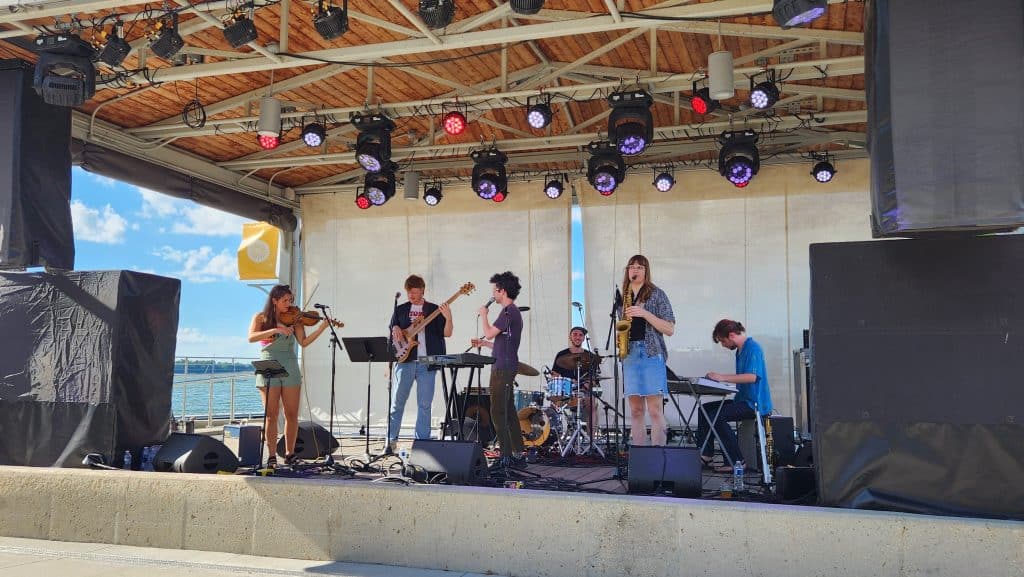
Tone Madison: OK, yeah. And I think that project, that ensemble, harnesses your predilection for merging different musical worlds. I remember reading in that sort of zany, hyperbolic biography about how you met in some European city and then came back together. But you ended that by calling yourselves “yacht rock.” But after that gig on the Memorial Union Terrace in August during that scorching afternoon, I told you I was hearing more of a prog-pop sort of thing going on comparable to one of my favorite musicians, Zach Phillips (of Fievel Is Glauque and Blanche, Blanche, Blanche, and a myriad of other projects).
So, your versatility as a songwriter/musician is pretty staggering and appealing to someone like me, who’s all about chameleonic weirdness, or however you want to categorize it. I’m curious how you split your time between all these different projects and how you feel they may complement one another. Well…I guess it’s in the past tense. You’re not actively doing these things right now. [laughs]
Luke Leavitt: I’m always learning from my peers. I think that is what sustains my interest the most. And in Madison, the jazz community was pretty open. And people like [saxophonist and Café Coda owner] Hanah Jon Taylor, I would even go so far as to say helped mentor me into owning my own sound. Thomas Ferrella [of BlueStem Jazz] also helped get me that Sound Tile gig, and also encouraged me to find my own voice with the piano. And then there were some jam sessions at Café Coda where that happened as well. And all that really intrigued me and drew me to music people were making, I’d add Ari Smith, my roommate, to that. He is a brilliant composer, and always willing to share their music.
All of which is to say that I find that, if I have open ears, and I’m moving through spaces, where music is happening with people who are similarly spirited, the music is going to hybridize. It’s going to change. It’s going to conglomerate in weird ways. That’s how sound works, right? You can play any two sounds, throw them on top of each other. They will coexist. The boundaries between jazz and rock, and experimental music—even experimental music can become its own genre, right? The boundaries between these things happen after the fact of the music. They happen with audiences and the public and critics and with marketing.
I’ve just never felt that to be compelling. I think it’s maybe a bit safer, and can help you find community and stability and belonging, which are all really important things. I’ve never quite operated in that way. And fortunately, I found interlocutors who feel similarly, like Ari Smith and Tim Russell. Tim and I both have played in punk bands in the past when we were a bit crazier. He’s told me some crazy stories about his youth. [laughs] I don’t know if you saw the [July 26] Common Sage show over the summer. But [artists] there were doing things even outside the confines of what experimental music is supposed to be. There’s a great example of that spirit, right? In Madison, you’ll get a lot of people coming through. They’re doing all sorts of high-caliber, but pretty far-flung stuff. And there’s a really sensitive audience at those shows. Really open ears and multigenerational, across different music scenes, cutting across the Midwest. So there’s a lot happening in Madison, and it’s a very fertile place for music.
Tone Madison: Another question I had related to that was—you transitioned into pandemic lockdowns, and then you came out of it. How did the pandemic shape that or complicate things with all of these different projects and gigs?
Luke Leavitt: Well, I’ve always been very comfortable making music on my own. But what I realized during the pandemic was that I was often fantasizing about other people listening to this music at some point. Which I think is normal. You know, you write something. You’re like, “Oh, how will people respond?” But it forced me to temper that kind of investment, because there were no audiences in sight. None of us musicians really knew when we would ever play for an audience again. So, even though I was really comfortable making music on my own, and I still enjoy it a lot, it made me think, “Why am I actually doing this? Is it just to sort of build up some sort of brand or image or something that people could consume later?”
It was after the pandemic that I really revisited my love for jazz and improvised music, and spontaneous music, because that was totally void, and I couldn’t take it for granted anymore. And so, shortly after that, we formed Laminal Animil, and I started booking more jazz shows, and embracing that side. And I think that’s more where I’m going to now, instead of crafting pop songs in the isolation of my darkened chamber. [laughs]
So yeah, the pandemic definitely had an impact. I also think people realized musicians, myself included, were probably pondering in their hearts the sustainability of a lot of different things that seemed [to be] on shaky ground. So, maybe an easier, more clear way to put it is that a lot of stuff was changing. A lot of painful changes were going on, and are still going on. A lot of realizations about how the State could choose to neglect or support people. How that support or that neglect is distributed differently was highlighted. The arbitrariness of it, right? We all got these stimulus checks. Some people were on really nice unemployment. And it sparked for me questions like, 1. Things that seem to be pretty brittle, but also 2. Things could really change. There could be a shift in terms of how we organize ourselves and how we sustain ourselves. That has to influence your art, right? If you’re talking about accessing some feeling internal or social, the pandemic undoubtedly shifted, for me, at least, my priorities and how I think about my art. For sure.
Tone Madison: This is another conversation but I mean, Wisconsin arts funding is like third to (or actually) last in the nation or something. So, yeah, it’s unfortunate. I don’t know where Colorado is on that list.
Luke Leavitt: Colorado is a little bit more robust in Denver. But I mean, that’s sort of the inheritance of a certain line of thought around art, which is that you should have some autonomy. Like, it can’t be totally reduced to economic incentives, but there’s something extra to it. And that, oftentimes in the DIY scene—this is interesting, because I’ve had perspective on both—leads to self-exploitation, because people are just doing it because they love it. And that can strangely overlap with how art is undervalued.
In the jazz scene, there’s a little more of a robust economy and set of norms around what you should get paid. It’s definitely not as much as it should be. But in Madison, in my experience, it’s possible to make a living as a jazz musician. I never quite approached that. But I could see how it could be possible. But overall, during the pandemic, if you have wages, and you’re getting some sort of a basic income or something, then you can make art. Then you can sit and dwell with these problems and process them artistically and spiritually. There’s definitely a through line between how the State supports the arts, and what kind of art is being made, and what kind of [role] art it has in society. What kind of things it can say, what kind of risks it can take, communities that can draw together.
Tone Madison: All profound thoughts, and subjects that don’t have easy answers. But it’s very rewarding to dig into them.
Luke Leavitt: Yeah, for sure.
Tone Madison: So, to go back to—you mentioned, when we were talking about your musical persona, you mentioned your connections to geography. So you did study here in the PhD program? Or did you get a Master’s here first?
Luke Leavitt: I got a Master’s, and I’m still in my PhD program. I’m teaching.
Tone Madison: So, you’re in the Department of Geography. It’s kind of entangled with your journey as a musician in the Jazz Studies program here as well, because that was your minor. Entangled, at least on the surface of your academic interests. How would you define music and sound geography? And what sort of inspiration do you take from it in either approaching your music in the abstract or actively writing or performing it for a particular space?
Luke Leavitt: Well, I would say, one connection between music and sound geography is listening. And how a person can listen. It sounds a little New Age-adjacent, and it is. [laughs] But I’ve been thinking a lot about the spaciousness of listening and the techniques that one can develop to listen more broadly. If we just take this in terms of listening to your body—that’s something that you hear, right? How do you do that? Maybe through meditation, through different movement practices indebted to Eastern philosophy. But one way to also do that is through music. And, the thing about listening and space, is that you suspend the narrative that you are trying to get to the end of. Let’s say I upset someone. How do I make it right? Sometimes that becomes an overwhelming pressure that can obscure what needs to happen in the body and in the spirit. For a deeper answer to come that is gentler, kinder, honest. And so for me, there’s sort of a metaphorical space there where you have to slow down your thought process. I think listening with music is a way to do that. And this is the science of music that jazz musicians, people in the Black radical tradition. I’m thinking of Robin D.G. Kelley, who thinks about music in this way, as a science of individual collective healing.
And so as a geographer, you’re interested in social change. I feel like you can only get so far by writing articles that dissect the problem. Sometimes you actually need to stop analyzing, and start feeling in order for more spirit-focused or communally aware solutions to emerge on their own. For me, I’m interested in looking at how music and listening can engender new forms of thought, but I’m not the first one to do that by any means. So I’m really interested in how jazz musicians and ambient New Age musicians have strangely overlapping concerns about social individual healing. And so that’s what my dissertation is about. People like Yusef Lateef, Horace Tapscott, Milford Graves—these are all artists who approach this sort of question of healing and social justice from different perspectives that I find quite important. Inspiring.
[Yusef Lateef] is an example of someone who was definitely interested in harmonizing the personal and the social. And his term was “autophysiopsychic.” He preferred to call his music that as opposed to jazz. And as you can break that down into “auto” being self, “physio” being the physical body, and “psychic” being the spirit body. And so he really believed that in order to play good music, he had to lead a good life, which is something that Hanah Jon Taylor actually told me as well. He had heard from Yusef Lateef. And it’s a term also that this newer artist, Angel Bat Dawid, espouses in her work. There’s definitely a lineage in terms of trying to find your spirit in a social collective. Of course the New Age critique you might hear is like, “Oh, are you just trying to like, become a perfect being?” Just be totally—
Tone Madison: Transcend?
Luke Leavitt: Yeah, transcend. Yeah, right. And that’s sort of the other side of this kind of discourse. And New Age music, maybe it can fall into that trap a bit. So I’m interested in that continuum as a scholar, but it definitely informs how I think about music, too.
Tone Madison: It’s interesting that you went into this, Sorry if I wasn’t specific enough. I was more interested in your own music. Not the landscape of music. [laughs]
Luke Leavitt: Oh, oh, oh. [laughs]
Tone Madison: But that was super interesting. And we got to talk about Yusef Lateef, which is a plus. But yeah, is there a piece of music or a suite that you’ve written? Or are in the process of finishing that draws specifically from these concepts that you just mentioned, and went into detail about?
Luke Leavitt: Oh, yeah. I think it’s actually the lifelong journey of playing improvised music, honestly.
Tone Madison: So, not specific to just one thing.
Luke Leavitt: I mean, it’s in all of my music. I think lately I’ve become more attuned to being honest with how I feel about my music and not trying to write stuff that I think is cool, or whatever. Really owning what I feel is in the moment. But I wish I could say I had music that takes it up as a theme, but I think it’s more of a subcurrent.
Tone Madison: We can get into some of the recordings that you’re planning to release. The first project is a trio with Devin Drobka and Ari Smith. Is the group called Cruel Optimism, or is that the album title?
Luke Leavitt: That’s the album name, yeah.
Tone Madison: When I was listening to that, I just really fell in love with the kind of smoky, romantic qualities of “A Year From Brookside.” That track in particular.
Luke Leavitt: Oh, thank you.
Tone Madison: Yeah, it’s really good. And then you also have an 80-minute improv session with Laminal Animil. Was that at Audio For The Arts, where you recorded?
Luke Leavitt: Yeah, that was.
Tone Madison: In addition to those two, I was really struck by this 33-minute Concert In The Shell, which you wrote at home during the pandemic, but then recorded more recently. Is that also correct?
Luke Leavitt: I started recording during the pandemic, and I finished it after. Kind of tied up the loose ends.
Tone Madison: OK, but you wrote it prior to 2020, then.
Luke Leavitt: I think some of it was in the works prior to the pandemic. Yeah, not all of it.
Tone Madison: That project features familiar players in your circle, but also some new faces who you mentioned, including Charlie Palm on trumpet, Devin Cobleigh-Morrison on horn, and Cole Bartels on trombone. And you also have Maggie Cousin on a track, “Spiritual Latency.” This project, kind of like your Levitations group, seems to sit at the intersection of different modes and styles. When I was listening to it, I was kind of reminded of Brian Eno-adjacent stuff, like the B-side of David Bowie’s Low album. Or like David Sylvian’s Rain Tree Crow project, if you’re familiar with that.
And then, the initial track, “The Cherry Tree,” kind of reminded me of—I was recently listening to Julia Holter’s Loud City Song again, because it just celebrated its 10th anniversary. That’s a huge album for me. That is a very ambient jazz soundscape-y, vibe-y, mood album, which I would say is the case with Concert In The Shell. It’s soothing, intriguing, and even, at times, mind-bending. It’s kind of hitting all the right points for me in terms of what I’m looking to hear or listening for. Do you want to dig into the conception moreso than just kind of the surface level stuff, and what you’re aiming to do with it creatively?
Luke Leavitt: Sure. I would say, [in terms of] inspiration, on one album that really inspired that first track and parts of the other pieces of the album is this Italian artist Raul Lovisoni and collaborator Francesco Messina. It’s called Prati Bagnati Del Monte Analogo [from 1979]. It’s a great album that’s in English. And it’s just like, very subtly rendered, organ and string patches. It has a jazzy element. Musically, it just so good, and the album cover’s so romantic. I definitely recommend looking it up. It’s like this night-on-the-French-Riviera vibes, like with strong lights and wine.
Tone Madison: You’re trying to make a Night On The Memorial Union Terrace. [laughs]
Luke Leavitt: [facetiously] Exactly. Right, with Bucky Badger, Spotted Cow, cheese curds. Yeah, for sure. Oh, my lord. [laughs] So, that’s the inspiration behind it.
Tone Madison: Well, you collaborated with these people. Did you do some of it remotely? And some of it in your house? Like together?
Luke Leavitt: Yeah.
Tone Madison: How did that go? What was that process like? What did it teach you about making music like this, in that way?
Luke Leavitt: I mean, it taught me how amazing players are. Like Charlie Palm and Ari Smith. They just play so well. I just feel really privileged that they took time to contribute to the music, because it’s a real gift. That was the main thing. Devin Cobleigh-Morrison and Cole Bartels and Charlie recorded that Ornette Coleman cover [“What Is The Name Of That Song?”] remotely, but it sounds live. Like the way they’re interacting with improvisations is really responsive.
Tone Madison: I was not familiar with that Ornette Coleman record, Of Human Feelings. That’s a later record that has more electronic and fusion-type elements. Really interesting. So I should definitely check that out.
Luke Leavitt: Yeah, that’s a good one. Ornette Coleman’s harmolodic concept of music has been an inspiration to me lately. He talks about letting discrete figures in the music, like the trumpet, versus the bass versus the drums—each one having its own space to express. [They] aren’t tied to harmony, or harmonic rules in the way that is inherited in earlier jazz. And I think he has a lot of really beautiful thoughts and ideas about how music can be liberated in that way. And it tends to be equated as what you would think of as Free Jazz [in 1961] or The Shape Of Jazz To Come [in 1959]. Those are some of the albums that we associate with Ornette Coleman, but the harmolodic concept can be applied in different areas. It’s just about finding resonant frequencies between semi-autonomous musical entities. I think in ambient music you get that. You might get a synthesizer and a piano that don’t really have anything traditionally in relationship to each other. It could be in different keys, different time signatures. It could be mixed totally differently, unrealistically. And that could be harmolodic in the way, like, “Well, what does this actually make me feel like? I’m gonna just suspend what I think, that this melody should be on top of this harmony, and just see where see where the music takes me.”
Tone Madison: Appreciate the music theory angle here.
Luke Leavitt: [laughs] I just go on. I can’t help myself.
Tone Madison: No, it’s good.
Luke Leavitt: So, with the [Coleman] cover, I kind of wanted to do that. His original has a disco beat. You know, it’s recorded in the late ’70s. And he’s wailing on top of this discordant disco beat, so very much of the Downtown [New York] scene at the time. I brought a little ambient and soundscape, glitch [and] electronica elements to that track. I tried to mix those harmolodically. But really the brass-playing is what brought that whole thing together. It’s those three musicians plus Ari really lift that music.
Tone Madison: Are you going to try to get this album released through a label or a self-release entity? How are you dividing up like the aforementioned projects, Cruel Optimism and Laminal Animil?
Luke Leavitt: I struggle to find outlets, honestly. I’ve been releasing music on my own for like 15 years. And I would like to graduate to something a little more robust or sustainable. And so I’m not trying to release this music too quickly. I’m willing to find a wider audience, even if it means waiting for Concert In The Shell. I have been in talks with a friend here about potentially releasing it. But yeah, for the whole cluster of music I sent [over], I’m just kind of waiting until something presents itself. We haven’t tried reaching out to people. [laughs] But you know, it’s sometimes hard.
Tone Madison: Yeah, a few years ago, I was a little more connected to what individual labels were doing. But these days I’m not really paying attention to it as much. I’m gaming too much or watching people game too much. [laughs] I think that’s part of it.
Luke Leavitt: I’m good to relax. Labels are kind of silly. And it’s not a very healthy industry. You know, it’s very skewed. It’s not a level industry by any means.
Tone Madison: Well, hopefully, something comes through. Because I think this music deserves a wider audience.
Luke Leavitt: Thank you.
Tone Madison: I can see a label out of New York even releasing Concert In The Shell. I’m not sure if it’s like New Amsterdam or one of those types of labels would be interested. But you were just talking about Ornette Coleman drawing upon sounds of the New York scene from that era. Hopefully there’s some synergy. Is that the right word? No, probably not. [laughs]
Luke Leavitt: Perhaps, perhaps.
Tone Madison: Yeah, something there.
Luke Leavitt: I appreciate that. I am thinking about maybe starting my own label, but I don’t really have any money to do that.
Tone Madison: To wind down, I want to make sure I’ve touched upon enough stuff that kind of encapsulated your time here. So to return to that, your time here in Madison—I guess maybe I hinted at this, or we touched upon this initially—but what specifically inspired you here? Or what do you recall most fondly now that you’re not here anymore?
Luke Leavitt: It’s just the players. On one level, the music. But I made some really good friendships in the end. My band, Levitations. People I got to meet through the jazz community. You know, had some real heart-to-hearts with these people. They’re just good people. Good people to know. And it’s the level of musicianship in Madison for the size. I mean, you even that aside, it’s just phenomenal. But the flip side is, like, it’s not a very cold scene. Not a lot of people strutting around trying to prove something. It’s just people like, really, in my experience, wanting to make good music and connect. That requires being in relation with each other, and I really miss that. I really, really value that.
Tone Madison: Do you plan to continue collaborating with anyone remotely? Sending tracks back and forth?
Luke Leavitt: Maybe. Yeah, what I didn’t send you is I have a Levitations album also in the cooker, but it’s a little under-baked. So I might do some touch ups on that.
Tone Madison: I like the culinary language there. [laughs]
Luke Leavitt: Haven’t had dinner yet. [laughs]
Tone Madison: Are there any lingering frustrations that you have? Things you wish that you encountered, or wished changed over time or maybe remained stagnant? Or things that you put a lot of hope into but didn’t pan out quite in the way—besides the pandemic sort of fucking everything up.
Luke Leavitt: Nothing fundamentally. I mean, I learned myself. Like, at some point, I stumbled through making music in ways that were hard, and where I maybe made mistakes in terms of how I went about it. But I see that as a growing process.
Tone Madison: It’s not specific to anything here in Madison?
Luke Leavitt: It’s not really about Madison, per se. I never felt that—yeah, I couldn’t have asked for better peers.
Tone Madison: It sounds like some of the struggles are just, you know, you’re talking about how DIY isn’t really sustainable. It’s all about internal motivation and the sort of buzz you can generate just by that sort of—whatever the term is, self-fulfilling something.
Luke Leavitt: Yeah. I mean, I think there could be more. Sometimes people give you a kind of funny look if you do something that’s a little weird in the jazz world. And sometimes in the DIY worlds, maybe if you play jazz or something, people are like, “Why are you here doing this other thing?” It’s a very subtle thing that doesn’t get to me. Doesn’t happen too often. But it does happen. I don’t think it’s specific to Madison. It’s just, if you’re doing something a little bit strange, you have to work a little bit harder for people to take you seriously. Which I understand.
Tone Madison: I was just thinking of the live stream when the Levitations played at Arts + Literature Laboratory last year. That was the same time as the Wisconsin Film Festival. So I think that’s the reason I missed out on that. But you know, the audience for that type of show is probably more of like—they want to hear not the sort of left field—well, whatever the Levitations are. I call you “prog pop” broadly with some jazz elements.
Luke Leavitt: Sure, dealer’s choice.
Tone Madison: How was the audience at that show, in particular, if you have any memory of it?
Luke Leavitt: Nick Moran hooked us up with that show [part of the DIG Jazz series]. And part of it is to do all originals. And that was the band that we performed with. My bandmates and I sometimes recollect [how] that show was a bit stiff. And that might just be architectural, because everyone was sitting down. And that space kind of caters to more serious art. Maybe when I was younger, I used to think that’s a problem. But I just think there’s bigger problems out there now, basically, than trying to prove that a venue has a specific audience. [laughs] Of course it does. For that show, everyone was masked. So it was hard to sort of get a read. And I think that made it awkward at points. Plus, we had like, just composed a lot of new music. And we were a little green on some of it. So we didn’t quite have the confidence going into it. But that show was not, by any means, something that sticks out as poor memory or something that went south.
Tone Madison: It was probably pretty fun to sing “Get Stoned” to that audience. [laughs]
Luke Leavitt: Oh, sure. I mean, I think they all have gotten stoned, anyway, at some point. Yeah, yeah. [laughs] I mean, that’s the thing, right? The music actually changes depending on where it’s performed. Its meaning changes depending on where it’s performed. So it’s just an opportunity. It’s just another color to me. It’s not like a misfit. It’s just an angle, you know.
Tone Madison: OK, thanks for getting into that. Last question is: do you have any loose plans to return to Madison for a reunion show or two in the next couple years? What do you think that would look like?
Luke Leavitt: Well, Tim, Ari, and I are talking about doing a Laminal Animil release show at some point. I’ll definitely be back to finish out my studies. So that will be another opportunity. So it’s definitely in the works, in the realm of possibility, I would say.
Tone Madison: That would be early- to mid-next year for the Laminal Animil show?
Luke Leavitt: We’ll see. I’m not exactly sure when it would be. I’m still kind of figuring out my life here. So, I haven’t made any concrete plans yet.
Tone Madison: What do you have to keep you going in Denver? It sounds like you’re performing live; you quickly did that like a month after you moved back. So that’s encouraging.
Luke Leavitt: Yeah, there’s new opportunities. Slightly different. I’m reconnecting with old friends and meeting some new players. I never really tried to play jazz here when I lived here, so I don’t know much about that scene. But it’s something I’d like to know more about.
We can publish more
“only on Tone Madison” stories —
but only with your support.
Author
Related Articles
Madison acts rivetingly ring in 2026
Five local bands offer new songs and projects, and capture a hopeful feeling in the new year.
Achieving a broader focus through music photojournalism in 2025
The fourth installment of our live music photo essay series centers a more personal vantage point.
Tone Madison’s favorite records of 2025
A celebration of 20 local releases that defined the year.