
From the archives: Butter where butter shouldn’t be
As Tone Madison’s 10th anniversary approaches, we look back at some highlights from the past decade.
As Tone Madison‘s 10th anniversary approaches, we look back at some highlights from the past decade.
Tone Madison turns 10 years old this year. To mark a decade of our fiercely independent, reader-supported coverage of culture and politics in Madison, we’re revisiting some highlights from our archives. Got a favorite Tone Madison story you think we should include? Let us know by sending an email to editor@tonemadison.com.
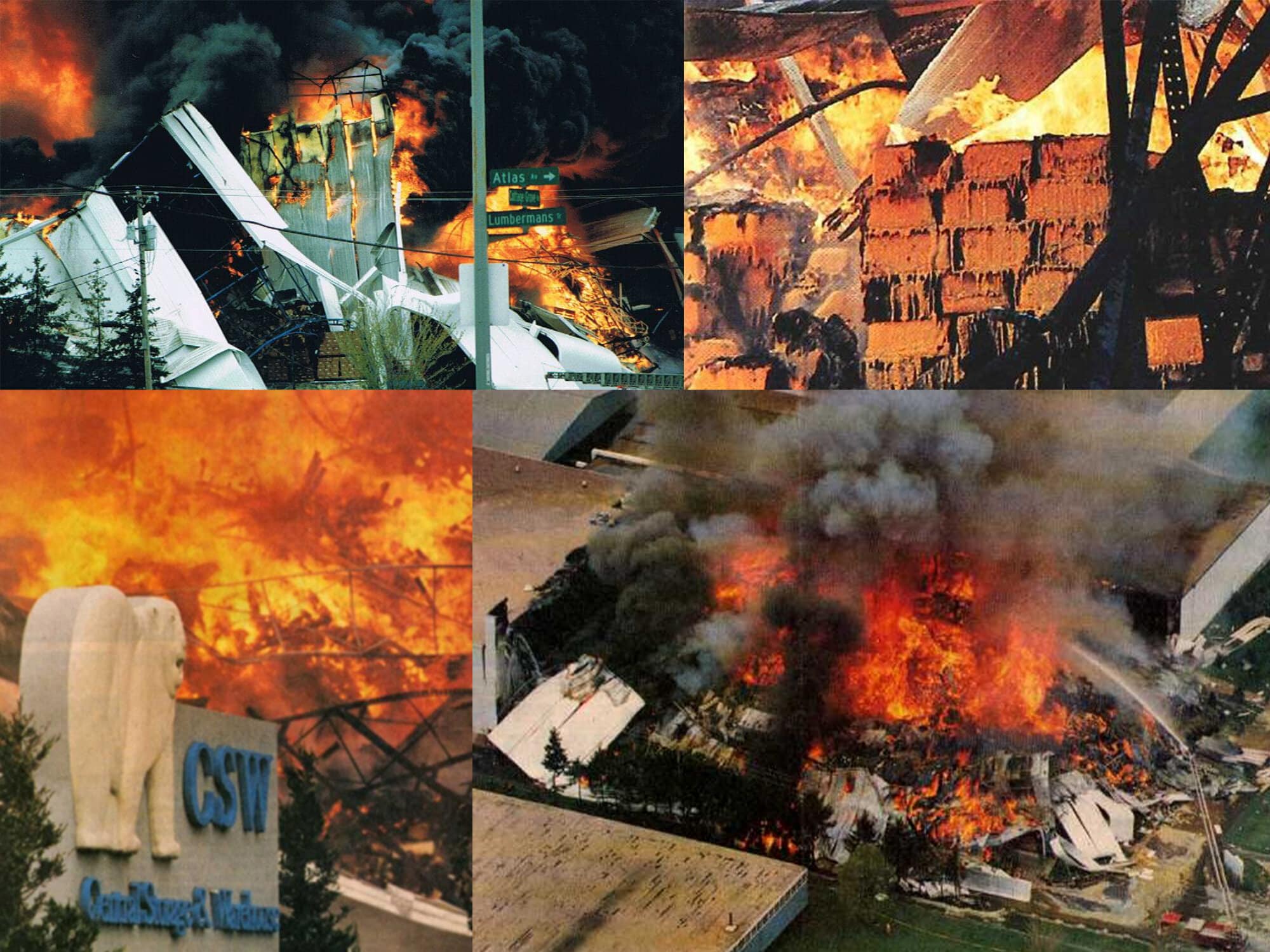
“On May 3, 1991, a fire broke out at Central Storage & Warehouse (CSW) on Cottage Grove Road in Madison after a forklift battery malfunction. The resulting blaze took more than a week to put out completely—thanks in part to plenty of fuel from the insulation around all the cold storage units and all the food, including 20 million pounds of butter.”
—Ben Munson
Editor’s note: One of my favorite aspects of Tone Madison, for as long as I’ve been contributing in some capacity here (closing in on seven years), has been the Microtones column. Few pieces I’ve read over that stretch have embodied the spirit of the column more (to me, at least) than Ben Munson’s exceptional “Butter where butter shouldn’t be,” a look at the 1991 butter-aided inferno that left an indelible mark on CSW. When Tone Madison first introduced Microtones back in 2016, as a special extra for our newsletter subscribers (who still get it a day before it appears on our site), Munson defined its anything-goes approach, with his columns about the ugly water tower near his house, the color taupe, and the aquarium at his doctor’s office. “Butter where butter shouldn’t be” is a perfect evolution from the strengths of the column’s early days.
Munson excavates a piece of Madison’s more fascinating historical and cultural history, implicitly ties it to state culture, and wrangles a complex subject with tact, grace, and a healthy dose of slick humor. It’s everything I want in a Microtones: a strong local connection, a sense of personality, unrepentant playfulness, a bizarre conceit, and an illustration of/commentary on something fascinating that I’d be unlikely to come across otherwise. These are the pieces that stick in my mind, and none have stuck harder than Munson’s ode to a buttery disaster.
“Butter where butter shouldn’t be” digs deep into the impact of the event, using on-the-ground players’ recollections, reported Department of Natural Resources’ totals, and the benefit of elapsed time to tell a measured story. By going outside the conventional time-pegged margins, Munson cooks up—and expertly portions out—a Grade-A story on a particularly greasy fiasco.
—Steven Spoerl, Music Editor
Butter where butter shouldn’t be
The story of a forklift, a fire, and 20 million pounds of butter.
Originally published April 30, 2021.
Weather phenomena happen almost every day despite the odds against the ingredients necessary for their occurrence coming together at just the right time. Tornadoes, blizzards, floods, rainbows, and hurricanes are all awesome and powerful natural events, even if they feel commonplace. A butter river, though, is much rarer and harder to comprehend.
On May 3, 1991, a fire broke out at Central Storage & Warehouse (CSW) on Cottage Grove Road in Madison after a forklift battery malfunction. The resulting blaze took more than a week to put out completely—thanks in part to plenty of fuel from the insulation around all the cold storage units and all the food, including 20 million pounds of butter.
Madison Fire Department Chief Steven Davis has been with MFD since 1989. Just a couple years into his career, he witnessed a food-related catastrophe unlike anything he or anyone else in the department has seen since. Davis didn’t arrive as part of the initial response, but he got there in time to see the outside walls of the building collapse and let loose a wave of melted butter that engulfed everything nearby.
“It literally was a river of butter,” he said.
The trucks, ladders, and other equipment were all in the middle of the sweet-cream slick. Davis said there was at least 5 feet of butter collected in any low spot and that the more water firefighters used, the more “gooey, gelatinous stuff flowed out of the building.”
“In all my training and experience, I’d never come across anything like it. Even the old-timers had never seen anything like it,” he said.
At one point while battling the blaze, Davis was sent to the roof of an adjacent building where he and a few others focused a hose on the fire for about eight hours. When he finally came down from the roof at 5:30 a.m. the next day, he and his team attempted to move the hose line further between the two buildings. He stepped off a loading dock onto what he thought was solid ground and instantly found himself up to his chest in melted butter.
“I had butter in places a guy shouldn’t have butter by the end of that night,” Davis said.
Madison fire crews were on-site for days trying to put out the fire. A fatty dairy moat kept the ladder trucks from getting out and the fuel trucks from getting in, so mechanics had to carry five-gallon buckets of diesel fuel through the butter river to ensure the trucks kept running.
MFD’s job was to put out the fire while trudging upstream through a butter flood. But it was the Wisconsin Department of Natural Resource’s responsibility to make sure the butter river didn’t make it to the nearby lakes and streams.

Containing the butter
According to the state DNR’s records, the fire resulted in the release of 1,000 pounds of Anhydrous Ammonia; 5,000 tons of food products including hams, hot dogs, bakery items, and cranberries; and 12,500 tons of dairy products, mostly butter and cheese. To contain the sludge runoff, the DNR constructed multiple dams to protect Starkweather Creek, a tributary that connects to Lake Monona.
Two state DNR wardens were on site to work with crews from Madison’s city engineering and public works departments to steer the butter river into a storm water discharge (pond 1) beneath the nearby highway overpass. According to the DNR’s site file, water had to be pumped out of pond 1 and across the railroad tracks into another pond (pond 2) because the butter was flowing in faster than it could be sent into the sanitary sewer.
By the end of May 4, 1991, more than 3 million gallons of melted butter and fire runoff had been pumped into the sanitary sewer. But on May 5, the rains came and the rising water levels threatened to send the butter flood over the last dam and into Starkweather Creek. The DNR had to quickly build another two dams before noon.
By May 6, after another 11 million gallons had been pumped into the sanitary sewer. The fire was under control but something had to be done about all the congealed butter that had accumulated in ponds 1 and 2. The DNR said the U.S. Department of Agriculture brought in salvage contractors to remove the food waste.
The following few weeks were dedicated to cleaning up: hauling huge piles of meat and rubble to the Dane County Landfill, staying ahead of rain and heat that re-melted the congealed butter, and gradually pumping butter out of ponds 1 and 2.
Ted Amman of the state DNR, about two weeks after the fire broke out, said efforts to clear the spoiling meat products and keep the melted butter out of nearby waterways were a “success.”
Davis said the DNR monitored the nearby waterways and very few fish died after the fire. He called it remarkable since the butter river appeared so quickly, giving crews barely any time to assemble materials and build embankments.
All told the cleanup cost approximately $550,000, which was covered largely by CSW and a grant from the USDA along with a $20 check from a local daycare that sent a note out of concern for the polar bear—which they named Grover—on CSW’s sign.
The aftermath
In their attempt to clean up all the butter MFD was forced to throw away nearly all the firefighter gear that was used. Davis said since he was still new to the job, he got stuck with steam cleaning the hoses that weren’t completely destroyed by the butter immersion.
In my imagination, a large butter fire would give off the pleasant aroma of movie theater popcorn. But Davis said it was more of a mixture of that, baked ham, and whatever cranberries smell like when they get burned. He described the cumulative effect as a rotten smell, one that has lasted for “years and years” at a nearby fire station.
“On a hot, humid day in the summer, you can still once in a while catch that vague stench almost 30 years later even though the building’s been remodeled,” he said. “We used it as our resting and staging area. The firefighters that would come back there were just covered in the stuff and it just permeated everything.”
CSW has been rebuilt and any trace of the mighty butter river that once flowed through the area has vanished. Although, as fate would have it, a Culver’s—known for its ButterBurger—now sits only a few yards from where the butter flood sprang forth.
Davis’s memories were still so vivid even decades after the fact and he admitted that after all that he saw and experienced, he had to reassess his relationship with butter (and some other foods).
“It was between that and all the hams that we saw floating in the river of butter,” he said. “I didn’t eat ham for a little while after that.”
We can publish more
“only on Tone Madison” stories —
but only with your support.
Author
Related Articles

From the archives: Take me home to the ball game
Celebrating Tone Madison’s 10th anniversary with some highlights from the past decade.
From the archives: Rainbow Bookstore closing its doors
Celebrating Tone Madison’s 10th anniversary with some highlights from the past decade.

From the archives: Layers of art, plywood, and privilege accrue on State Street
As Tone Madison’s 10th anniversary approaches, we look back at some highlights from the past decade.