
Eyeing voting rights, liberals aim to secure Wisconsin Supreme Court through 2030
In the April election, Wisconsin liberals are hoping to expand their majority on a body that could be a critical backstop for voting rights during the next presidential race.

This article was produced by Bolts, a nonprofit publication that covers criminal justice and voting rights in local governments, and is reprinted with permission. Sign up for their newsletter here.
Liberals have an opportunity next month to lock down a majority on the Wisconsin Supreme Court through 2030, which would hand them a critical backstop during the next presidential election, as the right floats new ideas on how to take over election administration.
Ever since he lost Wisconsin’s electoral votes in 2020, Donald Trump and his allies have spread lies about those results and baselessly blamed his defeat on fraudulent mail ballots, winning a key legal victory in 2022 when the state supreme court’s conservative majority banned ballot drop boxes. But that win was short-lived; liberals flipped the court in 2023 and restored drop boxes ahead of the next presidential election.
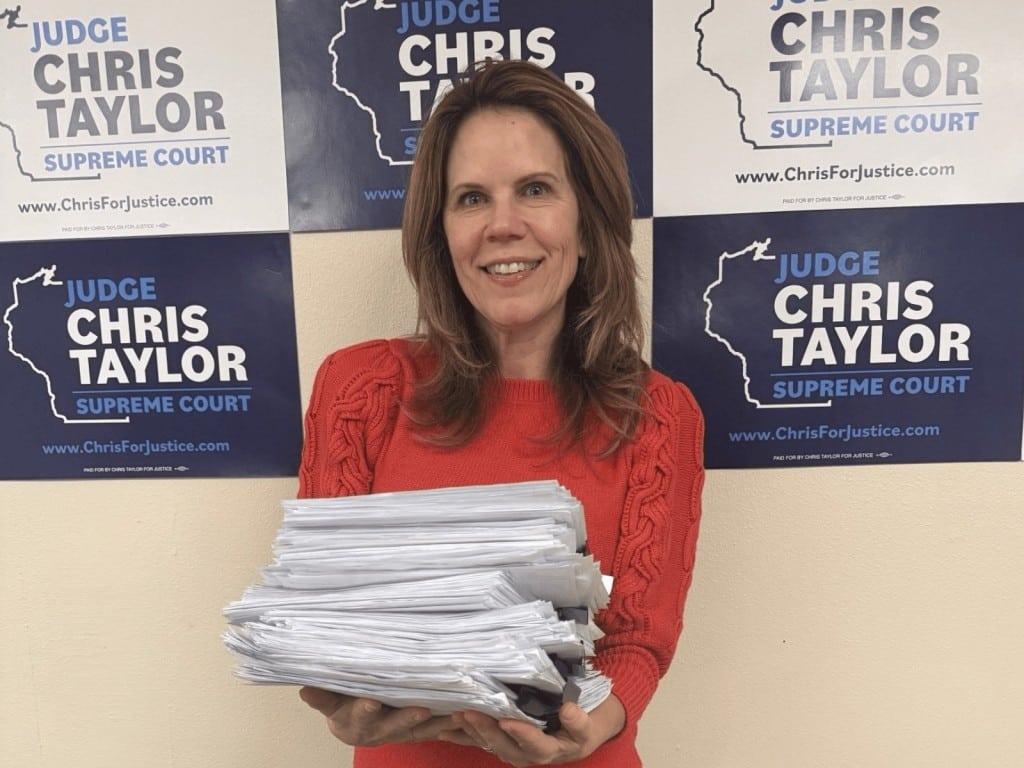
Rebecca Bradley, the conservative justice who authored the 2022 decision banning drop boxes, is retiring this year, and two judges on the Wisconsin Court of Appeals, liberal Chris Taylor and conservative Maria Lazar, are running to replace her on April 7. Should Taylor win, liberals would expand their hold on the court to a 5-2 majority. Liberals have not had such an advantage on this court since at least the 1970s, according to analysis by Wisconsin political scientist Alan Ball.
A Taylor win would also prevent conservatives from flipping the court until at least the end of this decade, barring an unforeseen death or early resignation, as Wisconsin faces continued legal debates on elections, abortion, labor rights, and the role courts should play in overseeing immigration enforcement.
Lazar has called Bradley a “phenomenal jurist,” and she seems poised to build on her legacy if she wins next month. As a former deputy state attorney general, Lazar defended Republican gerrymandering and conservative priorities like voter ID requirements; in her victorious bid for a Court of Appeals seat in 2022, she ran with support from key figures in Trump’s 2020 fight to overturn Wisconsin election results.
Taylor, by contrast, is a former Democratic lawmaker who promises to protect ballot access, and she authored a notable 2023 ruling from the Court of Appeals making it easier to vote by mail. Taylor also says she approves of the state supreme court’s recent decision to toss the GOP’s aggressive legislative gerrymanders; Bradley dissented from that ruling.
High-stakes state supreme court elections in Wisconsin are a familiar sight: In 2023, when voters flipped the court to a 4-3 liberal majority, spending topped the national record for a judicial race. Then, in 2025, liberals defended that majority by winning an even more extravagantly expensive election, defined by Elon Musk’s unprecedented spending on behalf of conservatives.
But the current contest has a lower profile so far. The majority is not at stake, and the race between Taylor and Lazar is not on pace to approach either of the previous two cycles’ spending levels. A Marquette University poll conducted in February found that 93% of voters have heard “little” or “nothing” about this upcoming election, compared to the 61% who said as much at the same point in last year’s election cycle.
Victoria Bassetti, a senior advisor to States United Democracy Center, a national organization that advocates for the protection of democracy, says this election should be taken as seriously as Wisconsin’s previous two, even though the court majority is not immediately on the line.
“Wisconsin has been in the crosshairs of extensive litigation in terms of the way the state runs its elections,” said Bassetti, a former staffer for the state’s late U.S. Senator Herb Kohl, a Democrat. “While this supreme court race may seem like a sleeper contest, from the democracy perspective, it’s anything but low-stakes…. These issues never go to sleep in Wisconsin.”
On democracy issues, Taylor and Lazar diverge significantly.
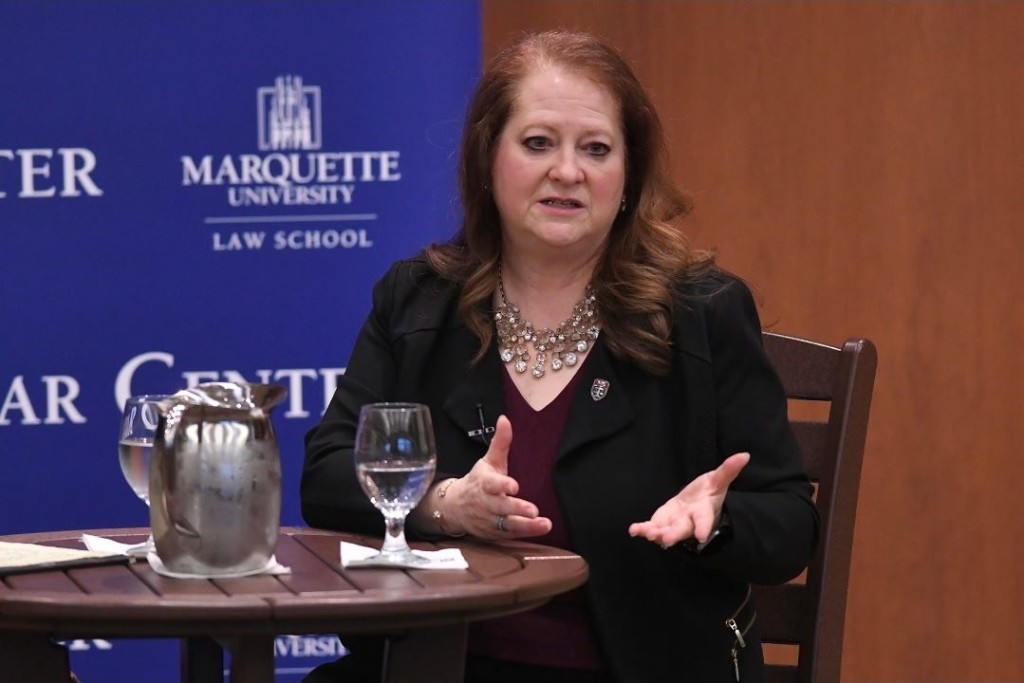
Lazar, as a deputy attorney general, defended previous GOP gerrymanders and Wisconsin’s voter ID laws, which, research has shown, suppress voter participation, particularly in liberal areas and among Black and low-income Wisconsinites.
On the campaign trail, Taylor has touted a 2023 opinion she authored that made elections more accessible to people voting by mail.
Wisconsin requires people filling out mail ballots to do so in the presence of a “witness,” who must provide some personal information, including their address. The 2023 case hinged on the definition of “address,” with Republican state lawmakers arguing that ballots should be tossed when witnesses fail to write their full street address. Rise Inc., a student-led advocacy group, argued for a more expansive approach that would accommodate people who do not have stable, singular addresses and would result in fewer ballots being tossed. Taylor sided with the student group.
Lazar, who did not respond to a request for an interview for this story, told Wisconsin Watch that this opinion shows Taylor is an “activist judge.” Taylor doubled down on her ruling in an interview with Bolts. “What was so evident to me was that there is a real policy, set by the legislature, that people’s votes should count and not be discounted because of a technicality,” she said.
Taylor said she would maintain that approach to ballot access on the state supreme court. “We cannot be fatigued when it comes to democracy,” she told Bolts. “It’s just something we have to keep working on.”
During her time on the Court of Appeals, one of Lazar’s most significant rulings came in her 2024 decision in favor of conservative activists who were seeking access to some voters’ private health information in order to try to prove that they were “incompetent” and ineligible to vote. The case was brought by a group that had tried to overturn Joe Biden’s victory in 2020, with which Lazar sided in arguing that information on people under court-ordered guardianship should indeed be made public in order to maintain accurate voter lists.
The state supreme court’s liberal majority overturned that ruling last year. Bradley, the retiring justice, sided with Lazar, dissenting on procedural grounds.
Lazar was endorsed in her 2022 Court of Appeals campaign by several Republicans directly involved in Trump’s efforts to cast doubt on the 2020 results—including a fake elector who tried to cast an electoral vote for Trump even though he lost the state, and former Justice Michael Gableman, who conducted a widely discredited, conspiracy-riddled investigation alleging irregularities in the election and recommending its decertification.
Whichever candidate wins is very likely to rule soon on key matters of democracy. For starters, two pending cases challenge the constitutionality of Wisconsin’s congressional map, which, in this firmly purple state, has delivered six out of eight U.S. House seats for Republicans.
Democratic Governor Tony Evers is currently pushing for a constitutional amendment to ban partisan gerrymandering in Wisconsin, though the Republicans who run the state legislature are resistant. “We have been looking at redistricting for our congressional maps and figuring out how to do that legislatively,” Democratic state Representative Darrin Madison told Bolts. “We need to address our gerrymandered maps and we will try to do that as soon as possible.”
Democrats have a shot this year at taking over the state House and Senate for the first time since 2010; that is only possible because the state supreme court in 2023 ordered new state legislative maps that unraveled the GOP’s gerrymanders.
The supreme court candidates also diverge significantly on issues other than voting access, including abortion and labor rights.
As a deputy attorney general, Lazar defended abortion restrictions as well as the anti-union law passed during Scott Walker’s governorship, known as Act 10. Taylor previously worked for Planned Parenthood and is endorsed by a slew of labor unions, including Wisconsin’s AFL-CIO, which vigorously oppose Act 10.
Abortion rights dominated Wisconsin’s last two supreme court races, with liberal candidates Susan Crawford and Janet Protasiewicz vowing to protect access in the aftermath of the U.S. Supreme Court’s Dobbs decision. The state supreme court ended up striking down the state’s 19th-century ban on abortion last summer, with Crawford and Protasiewicz in the majority.
This year, Taylor says the top issue she hears about from voters is the Trump administration’s crackdown on immigration and its recent assault on neighboring Minnesota. Marquette’s February poll found that 56% of Wisconsin voters disapprove of ICE generally, including an overwhelming majority of independent voters.
“Everywhere I go, people are asking: ‘What’s going to happen to us in Wisconsin? How do we prevent what happened in Minnesota here in Wisconsin?'” she told Bolts, vowing to seek “accountability” for any federal officials who unlawfully violate people’s rights. The court, she continued, “should be protecting our individual rights and freedoms… our right to speak, our right to peacefully protest, which is as American as apple pie, our right to walk down the street and not be subjected to unreasonable government intrusion, and our ability to make our own private decisions about our lives.”
Lazar told PBS Wisconsin that protecting the rights of protesters “is a federal issue,” rather than a matter for state courts to get involved in.
As Lazar now works to defend Bradley’s seat for conservatives this April, Wisconsin conservatives will be back in this position before long: The term of another member of the court’s right-wing faction, Annette Ziegler, expires next year.
If Lazar wins this spring, conservatives would have a shot at retaking a court majority in the run-up to the 2028 presidential election, but they’d need a winning streak by defending Ziegler’s seat next year and then flipping the seat of Justice Rebecca Dallet, who is part of the liberal majority, in the spring of 2028.
If Taylor wins though, the best conservatives can hope by 2028 is to get the court back to a 4-3 deficit. They could also end up in a much larger hole by then, down 6-1.
Who has power in Madison,
and what are they doing with it?
Help us create fiercely independent politics coverage that tracks power and policy.
Author

Related Articles

Police surveillance technology needs proper accountability
Grassroots resistance against Flock cameras are writing the blueprint for comprehensive reform.

Don’t shrink the Common Council and County Board
Madison needs more representation, not less.

Starter homes? No, we need starter apartments
As homeownership continues to be out of reach for too many Madisonians, we should build more owner-occupied, multi-family housing.