
“Eraserhead” exemplifies David Lynch’s signature blend of the surreal and the mundane
The director’s psychological, seminal debut feature from 1977 screens on 35mm at UW Cinematheque on October 10.
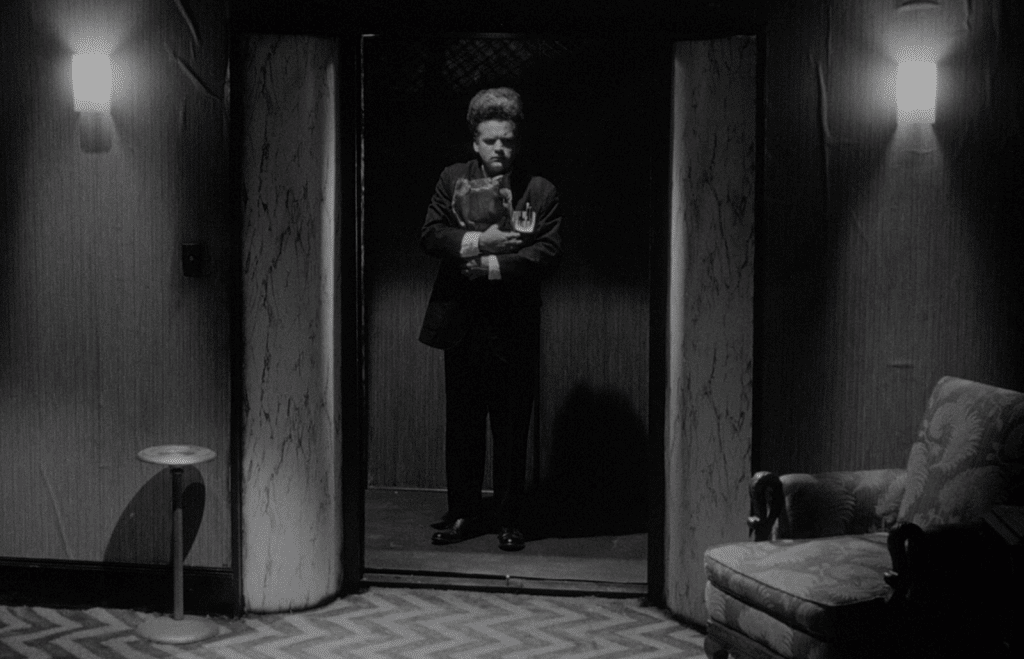
“Eraserhead is my most spiritual movie,” David Lynch discloses in his self-help book Catching The Big Fish: Meditation, Consciousness, And Creativity. “No one understands when I say that, but it is.”
Although the late visionary American surrealist filmmaker and cultural icon famously refused to elaborate on that statement, his wildly imaginative and painstakingly crafted experimental debut feature provides the key to appreciating Lynch’s singular oeuvre. A passion project in the truest sense, Eraserhead (1977) has become an enduring cult sensation and a landmark in American microbudget independent cinema. This lurid, nightmarish descent into the fevered depths of the unconscious mind stands out as the artist’s most distinctive, purely Lynchian film. (And yes, I will elaborate on that.)
Fans of Lynch’s work and outré art in general will have the rare opportunity to see a 35mm print of Eraserhead this Friday, October 10, at 7 p.m. at UW Cinematheque. Previously, the film screened in 4070 Vilas Hall about 12 years ago, which was my first time seeing it on the big screen. The newly installed red seats in the auditorium were, unsurprisingly, packed and it felt like a real cinematic event. An enigmatic spectacle that mesmerized, confounded, and disturbed me in equal measure, this experience opened my eyes to the extraordinary power of Lynch’s art under the right conditions.
Eraserhead depicts the Kafkaesque adventures of Henry Spencer (played by Jack Nance), an alienated young man living in some kind of desolate, dystopian post-industrial wasteland. Henry meets a girl named Mary (Charlotte Stewart) and gets her pregnant, only to learn that the infant will certainly be deformed. Gripped with anxiety at the arrival of their child, Henry tries to escape the horror of his domestic existence.
Lynch tells this bizarre story almost entirely through mood, unforgettable images, and complex layers of sound, immersing the viewer in an insular, hermetic world that feels simultaneously abstract and lived-in. With its sparse dialogue, absurdist humor, meticulously constructed sets, and saturated black-and-white photography, Eraserhead pushes the envelope of what a film can be, or look like, while clearly demonstrating that Lynch had his own MO (“modus operandi”) from the very beginning of his foray into feature filmmaking.
The 2018 book Room To Dream, a unique hybrid of biography and memoir written by Lynch and collaborator Kristine McKenna, offers a detailed account of how his first feature was conceived.
Eraserhead started as a short student film that Lynch proposed to the American Film Institute in Los Angeles while he was enrolled there. During the five years that it took him to complete it, the film changed and evolved along the way. Lynch made the film more or less clandestinely in a complex of abandoned buildings on AFI property, where he built his own modest, improvised studio. The school granted Lynch access to its equipment and left him in peace to make his film.
By all accounts, the young director seems to have cultivated a physical environment for himself that allowed for practically limitless creative freedom to realize his artistic vision. Eraserhead is the only film that Lynch made in this genuinely independent way. It was shot almost entirely at night, funding was never constant, and production stopped many times when the money dried up.
Lynch supported himself by delivering The Wall Street Journal at night and lived on set for some time. The sets were largely built out of scavenged materials while the small but dedicated crew went to great lengths to procure clothing, furniture, and unusual props—including a dog with a litter of nursing puppies and real umbilical cords. Lynch was personally involved in every aspect of the production and even cooked the “man-made” chickens for the dinner scene with Mary X’s parents. He also dissected a cat to get some ideas for textures in the film. Despite the financial constraints and irregular shooting schedule (not to mention methods), Lynch was determined to finish the film at all costs.
Indeed, the lack of funding and the glacial pace of shooting apparently afforded Lynch the time (and space) he needed to incubate his ideas and bring the strange world of Eraserhead to vivid life. In an interview from Chris Rodley’s 1997 book Lynch On Lynch, the director describes the Eraserhead period as one of the happiest times of his life. “The life in that world… there was nothing like it. Things go so fast when you’re making a movie now that you’re not able to give the world enough—what it deserves.” Throughout his career, Lynch faced countless challenges in attempting to bring his idiosyncratic projects to fruition within the studio system. While Lynch always remained faithful to his ideas and went on to become a household name on the fringes of the film industry, the production of Eraserhead was special.
Here, Lynch freely exhibits his penchant for raw, unfiltered avant-garde experimentation while creating his own universe out of relatively little. There really is nothing like it, either in Lynch’s filmography or the entire history of cinema. The director recalls in Room To Dream that some people from the Cannes Film Festival came to AFI and saw a segment of Eraserhead while he and sound designer Alan Splet were mixing it. Later he was told they said, “He out-Buñueled Buñuel,” referring to the Spanish-Mexican surrealist master’s collaboration with Salvador Dalí on the provocative silent short film, Un Chien Andalou (1929)—a nonlinear barrage of striking and irrational images. Although Eraserhead was rejected by Cannes, Lynch’s brainchild ultimately found its niche as part of the late-night movie circuit and became a word-of-mouth sensation. (Stanley Kubrick even purportedly considered it his favorite film.)
Like Kubrick’s epic sci-fi symphony 2001: A Space Odyssey (1968)—”a subjective experience which hits the viewer at an inner level of consciousness, just as music does,” in the director’s own words—Eraserhead leaves room for an infinitude of interpretations and can evoke a strong emotional response from those who are receptive to its otherworldly beauty. “I felt Eraserhead, I didn’t think it,” Lynch once said. Anyone who surrenders to its rich textures, dreamlike ambiguity, and eerie atmosphere knows what he means. The diligent care and effort he put into the project are palpable. No wonder that an exacting, meticulous, and reclusive filmmaker such as Kubrick loved it.
While Lynch would adopt a similarly tactile and off-kilter approach with his subsequent films, his spiritual and aesthetic impulses may have found their purest and most uninhibited expression in this deeply haunting, radiant portrait of paternal angst and alienation that consumed years of his life. “It’s a perfect film,” he once said. “That’s the only time I’ve ever said that about anything I’ve done.”
We can publish more
“only on Tone Madison” stories —
but only with your support.
Author

Related Articles
The Cardinal Bar’s Cuban film series invites local support for Madison sister city
Cine Cubano bridges interest in Cuban cinema with the cultural exchange and aid mission of the Madison-Camagüey Sister City Association.
Three video artists tap into personal histories in the 150 Artists x 150 Years exhibition
Chele Isaac, Toby Kaufmann-Buhler, and Aaron Granat reveal the creative depths of their works, which are on display through February 28 at Central Library.

Video: Sizing up local screening events and prominent performances of 2025
A chat with Josiah Wampfler at OCA Media about our favorite movie-going experiences and acting roles of last year.