
East-siders brought a wealth of tough questions to Madison’s first “budget engagement” of the year
As the City of Madison faces a $27 million deficit for 2025, residents are digging into the details and hashing out priorities.
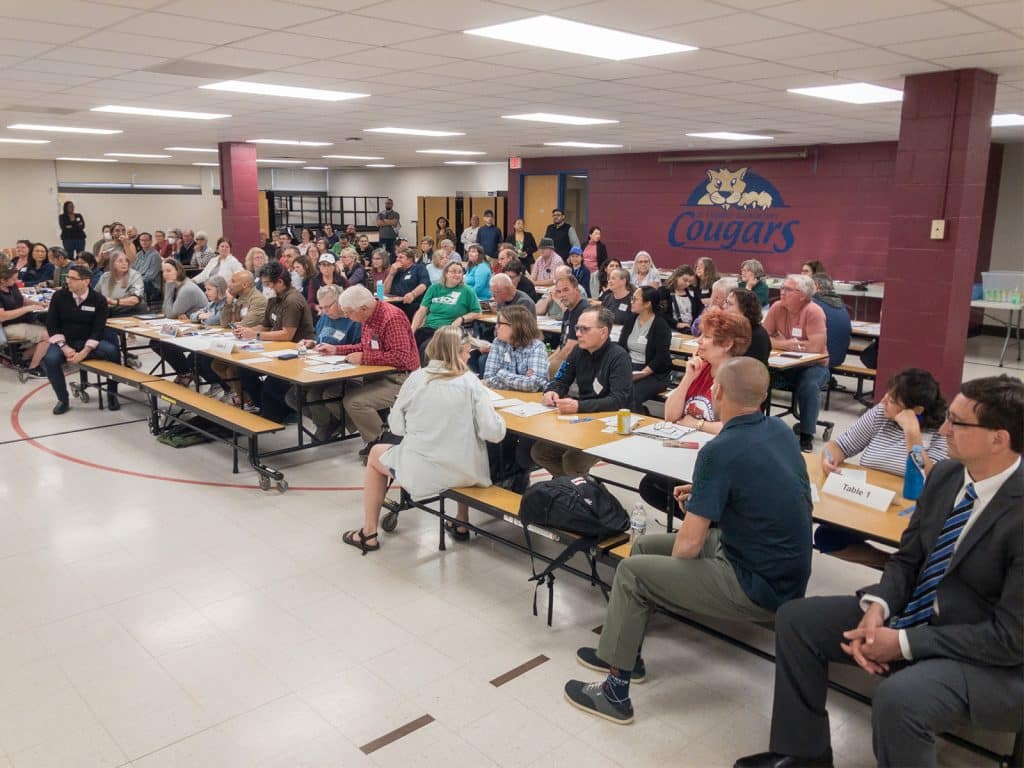
As the City of Madison faces a $27 million deficit for 2025, residents are digging into the details and hashing out priorities.
A shorter audio version of this story was produced for and broadcast by WORT-FM.
On Wednesday, May 1, at 6 p.m. the cafeteria at Kennedy Elementary School on Madison’s east side was packed. Residents, about a half-dozen Alders, and dozens of members of city staff were there for the first in a series of “budget engagement” events the City of Madison is holding as it prepares its 2025 budget. The city is facing a $27 million budget deficit in its general fund, the pot of money that pays for most of its annual operating budget.
(The Wisconsin State Journal reported on Thursday that the city’s finances have done $31.2 million better than expected so far this year, though what that means for 2025 is still unclear. City finance director Dave Schmiedicke is scheduled to give an update on the budget outlook to the Finance Committee on June 10 and a mid-year update to the Common Council July 22.)
State law requires the city to pass a balanced budget. That means it cannot borrow to fill the gap in the operating budget, which is the budget for day-to-day operations and services. That means the city has to consider holding a referendum to raise property taxes, increasing fees, making cuts to various departments, or a mix of all three. (The city can borrow for its capital budget, which funds long-term investments in the physical infrastructure of the city, such as upgrades to buildings or technology.)
City finance director Dave Schmiedicke opened the May 1 budget engagement event with a quick 20-minute presentation on the budget going into 2025. (PowerPoint slides, summaries, and recordings of the presentation and so much more on the budget are available on the city’s website. Also, WORT-FM’s midday show A Public Affair held a one-hour discussion on the budget with city staff and Alder Yannette Figueroa Cole on May 6.) For context, $27 million is approximately the entire operating budget of the city’s Department of Planning, Community and Economic Development. All of the city’s administrative departments (HR, IT, city attorney, finance, etc.) have a combined operating budget of about $30 million.
Another way to think about $27 million: if the city were to close the gap by cutting staff positions, it would have to lay off 270 people, almost 10% of city staff. In 2023, the state legislature tied a desperately-needed increase in shared revenue with provisions that financially penalize cities that cut police and fire staffing (see “maintenance of effort requirements”). So, even though the Madison Police Department’s operating budget cost the city $91 million in 2024, the city risks losing shared revenue if it reduces MPD’s staffing levels. If the city closed the gap with staff cuts that did not include police and fire, all other agencies would have to cut staff by almost a third.
“At this time, the city is working on a truly barebones staff,” Alder Juliana Bennett told Tone Madison in a phone conversation. “To the extent that any more staff reductions means a reduction in the basic city services that we truly need.”
Oh, and that bump in shared revenue last year? Madison received one of the lowest increases per capita in the state—$29, while the average statewide for cities was $195 per resident.
“I’m really struck by the inadequate per capita allocation that we’re getting from the state. I think it’s outrageous,” says Pat Brunner, who attended the May 1 budget engagement meeting. “It occurs to me that the legislature just hates Madison.”
After Schmiedicke’s presentation, everyone got to take a break, grab some food, and write questions for Schmiedicke to answer. And people had lots of questions:
“How are the general operations for each department determined each year? What is done to determine viability and accuracy of expenditures?…”
“Is there a draft budget planned to close the budget gap using only service cuts? Or are the only plans to raise taxes via referendum or use new special charges?”
“Why can’t the city add a city sales tax? Can we add an additional room tax for hotels, Airbnb rentals, etc?”
“What is the amount of the rainy day fund?”
“I thought there were some really great questions this evening. Really trying to understand the city budget and what’s been happening,” Schmiedicke told me after the event, which I covered for WORT-FM. “It’s definitely a greater challenge than we’ve seen in previous budgets so I think this conversation’s really important.”

After the Q&A, people broke out into small groups to provide feedback on city services. One resident stated that “because of climate change, leaves are falling later in the year. So we’re spending money on trucks, and people and fuel and maintenance for them, and they’re driving around not collecting. Because I got leaf pickup and my leaves haven’t fallen yet.” Another asked if Dane County could levy a sales tax and give some of the funds to the city, which his neighbor said is “a good point, because we have a lot of people who commute into Madison for jobs and other things” and use city services.
When asked what people appreciated about Madison, one table talked extensively about the city’s natural beauty.
“I find it just to be a beautiful, like, a naturally beautiful city,” one person said. “And I appreciate that. And so the parks and green space and the lakes and all of that contribute to just, I think, a beautiful city that we live in.”
“That’s what I was just gonna say: with all the parks and, and the water, and they’re so close to everything…” a woman agreed. “You’re in a big city, but yet, you know, to have them just a block or two away, to be able to be on the water is amazing.”
One homeowner got into a discussion with Alder Yanette Figueroa Cole about whether property tax funds should go to support Metro Transit. With the recent redesign of bus routes, she said “the bus service for me is zilch.”
“I’m wondering why Metro can’t figure out how to support itself,” the resident said.
“I would imagine that one way would be to increase fares, so that wouldn’t be equitable,” Figueroa Cole said.
“It’s not equitable for the property tax owner, either,” the resident replied.
Residents also talked about concerns that the city was becoming less affordable, which, if the trend continues, could hollow out the middle class, leaving a city of only the very wealthy and very poor.
Some residents said they would like to know more about where the city’s money comes from and how it’s spent going forward: “I don’t know if I need every financial transaction, but we should just have much more fiscal transparency,” one said. “That I think would help us appreciate what stuff costs.”
“This is exactly what we’re trying to accomplish: to just give people the information they need to have educated decisions,” Figueroa Cole told me after the event. “There’s the level of misinformation that we have out there coming from so many sources, [which] only creates confusion and angers people. There’s nothing better to combat that than knowledge. And the more people understand, the better decisions we all can make collectively.”
However, the state hasn’t given the city much wiggle room. On the one hand, Madison got one of the lowest rates of shared revenue of any municipality. On the other, the Republican-controlled state Legislature limits local governments’ options for raising money. One misconception about the city’s budget that Figueroa Cole said stuck out to her was that a lot of participants were trying to come up with new revenue sources, not realizing how limited those options are by state law.
“Nobody’s here making decisions out of malice or trying to trick anybody or to waste funding,” Figueroa Cole says. “I truly don’t believe that that’s the situation that we’re in. We have a situation that has been happening since 2011.”
At the end of the night, facilitators read off some of the big takeaways from their group discussions. It’s probably no surprise that a lot of people said they don’t want to see cuts in services and appreciate city services such as parks and libraries. Whatever solution, or mix of solutions, the city comes up with, one resident said that it should be focused on the long term.
“As much as I don’t want any [services] to go away, I do want just like the fiscal responsibility question to be before us,” he said. “It goes back to not just punting towards the future, but okay, we can sober-mindedly make hard decisions today, for the future.”
The city has scheduled four more budget engagement events so far:
- For the west side, 6 to 8 p.m. on May 16 at Vel Phillips Memorial High School
- For the southside and near west side, 5:30 to 7:30 p.m. on May 29 at the Goodman South branch of the Madison Public Library
- For the downtown, isthmus and campus region, 6-8 p.m. on May 30 at Madison Municipal Building, and
- For the northside, 6 to 8 p.m. on June 5 at Black Hawk Middle School
More details and registration are available on the city’s website.
On Monday, city officials hosted a budget engagement session on A Public Affair WORT’s midday talk show.
Who has power in Madison,
and what are they doing with it?
Help us create fiercely independent politics coverage that tracks power and policy.
Author

Related Articles

Coliseum renovations should proceed with caution
Dane County should apply strict scrutiny of its partnership proposal with FPC Live, even if it’s the only bidder.

Could an exhibition like “Guiding Ethos” find a home in Madison?
A group show at Appleton’s Trout Museum stands up for “political” art in an era of cowardice and compliance.

Beltline expansion proposals suggest dead-end logic
“Another lane will fix it” still reigns at WisDOT, but the public is pushing back.