
Defending immigrant rights in the fight against fascism
Local activists deploy a renewed emphasis on legal strategy and grassroots organizing.
Since the inauguration, the Trump administration has turned our broken immigration system into a testing ground for the boundaries of executive power. Flurries of executive orders have become part of a strategy to circumvent accountability for unconstitutional measures taken against a so-called “immigration crisis.”
Despite research showing that “crime rates, offending rates and incarceration rates tend to be lower amongst foreign-born individuals,” endless promises to solve the immigration-as-crisis narrative permeated politics in 2024. Whether it was in hopes of winning the White House or a seat in the Senate, this desperate framing prevailed. Concessions to sensationalist right-wing talking points blaming immigrants for crime and unraveling social cohesion eventually set the stage for this hostile shift in our nation’s immigration policy.
The immigration crisis narrative has served its purpose in manufacturing consent for the administration to subject anyone deemed a target, regardless of their legal status, to unimaginable violence and cruelty. Meanwhile, media coverage of escalating immigration law enforcement reifies this narrative, holding a magnifying glass to the chaotic executive onslaught attempting to bring Trump’s mass deportation fantasy into reality.
Back in the Oval Office, Trump finds himself under virtually zero oversight as he guts public institutions to bankroll his agenda. Meanwhile, law enforcement agencies like Immigration and Customs Enforcement (ICE) and the Department of Homeland Security (DHS) are seeing an influx of government spending like never before. Civilians emboldened by anti-immigrant rhetoric are among those benefitting from that investment, taking jobs enforcing these policies as unaccountable, unidentifiable footsoldiers.
This approach to handling immigration—relying on a barrage of dubious legal arguments that paralyze courts—is trickling its way into Wisconsin. Several counties are partnering with ICE for 287(g) and State Criminal Alien Assistance Program (SCAAP) agreements. These policies provide law enforcement agencies with financial incentives for incorporating Trumpian violations of constitutional protections into their activities. Tone Madison reported on the Dane County Sheriff’s Office’s (DCSO) participation in SCAAP in 2023. Two years later, DSCO announced its withdrawal from the program.
“Both programs are these ICE programs that incentivize the detention of people who are here— not just people with an unauthorized immigration status, but now it’s just anybody who they deem might be a criminal,” says political scientist and UW–Madison professor Armando Ibarra. (Full disclosure: Ibarra is my Latino History and Politics professor.)
Individuals trying to navigate the broken immigration system are being detained in courts, and the people in positions to stop it are being silenced. All the while, the threat of federal intervention still looms—because, for this administration, mere complacency doesn’t get the job done quite as fast as total subjugation.
Federal crackdowns are portrayed as a harsh but necessary response to the “invasion” narrative, which opens the door for the executive power to justify revoking constitutional rights and freedoms in the process. This illustration—the menacing authoritarian ripping down the foundations of justice and whipping everything into shape—hinges on the hope that we fall for that fantasy. If we start to believe that our rights are as good as gone anyway, why bother putting up a struggle?
But faltering in the face of authoritarian pressure is not an option. Wisconsin-based organizations—some operating right here in Madison—are showing how this is the case.
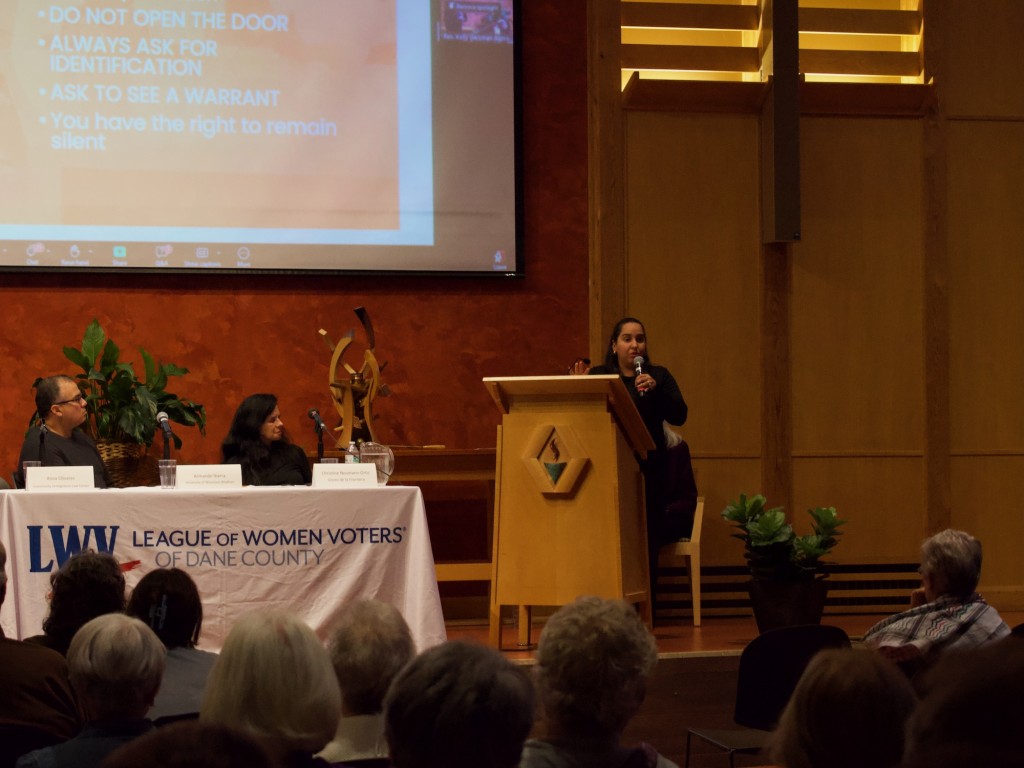
This month, the League of Women Voters of Dane County brought together community voices to share information about immigration issues and measures that people are taking in response to renewed fears. Dane County residents heard from Ibarra, Voces de la Frontera (VDLF) executive director Christine Neumann-Ortiz, and Community Immigration Law Center (CILC) legal director and attorney Aissa Olivarez. The panelists discussed immigration statistics in Dane County, the possibility of federal intervention, and the necessity of community awareness and involvement.
“We need policies that build communities that are safe, collectively prosperous, and protect our rights at a time when the campaign of terror against immigrants is being waged as a tool to attack the judiciary, silence dissent, and violate human rights and due process,” Neumann-Ortiz says, during her panel.
Several organizations have been answering calls to action—stepping in to provide vital resources for the people being targeted by the federal overhaul in immigration policies. VDLF organizes a rapid response network and an emergency hotline for those at risk of being detained. The CILC administers pro bono legal services for individuals in need and hosts a legal clinic that provides counseling directly to individuals and families from all over the state.
“People in immigration court, who are at risk of deportation, have the right to an attorney, but not the right to a government-funded attorney, like we do in criminal proceedings. So we sort of created this public defender-type opportunity for immigrants at risk of deportation through our programming,” says Olivarez.
CILC partners with law students volunteering for the UW–Madison Immigrant Justice Center to connect people at the Dodge County Detention Facility, the only one in Wisconsin, which has now reached capacity. Individuals are now being sent out, often without notice, to facilities across the country, where their cases risk falling between the cracks of the system.
“I think what we’re seeing—along with an uptick in enforcement, detention, and deportation—is sort of this tactic of moving people quickly so that they don’t have access to the information that they would normally have in these facilities,” Olivarez says.
CILC’s operations, like many of the organizations providing these resources, largely rely on individual donations and volunteers. Olivarez describes their mission: “We’re a grassroots small organization, and we’re working to be able to invest to continue to grow. And part of that means, you know, us personally going and speaking at places and doing outreach about this work and educating the community about what universal [legal] representation is, right?”
Open Doors for Refugees (ODFR) emerged in 2016, built from the collective efforts of people attending an event meant to raise awareness for the Syrian refugee crisis.
“After one of the events somebody just said, ‘If you’re interested in doing something about all this, stay after,’ and a lot of people stayed after, and that just kind of started the conversation,” says Jason Mack, executive director of ODFR. Since then, the organization has developed a range of services for refugees settling in Madison, made possible through its partnerships with neighboring organizations. This includes assisting Jewish Social Services (JSS) with refugee resettlement by collecting furniture donations, providing volunteer transportation services, and procuring warm clothes for recent arrivals bracing for their first winter in Wisconsin.
Rather than breaking families apart and pushing people out, these services function to welcome people into the Madison community. “Now, with the Trump administration taking over, they have basically shut down all refugee resettlement,” says Mack. In response, ODFR has pivoted its services toward a broader portion of the community with language tutoring and an upcoming workforce development project for immigrants and refugees.
These are just a few of the many options organized by the Madison community as an organic response to uncertainty and hostility at the federal level. Spaces providing reliable information and resources, like the events that brought together ODFR, create a forum for uniting organizations with aligned goals. This ultimately casts a wider, stronger network that can focus on connecting those in need to resources.
“You have the service organizations that work alongside the city, the state that provide services of connecting people to more socially integrate into the greater community. Then you have the advocacy organizations, or the social movement organizations, that are building collective power from the bottom up and see that as mutual defense needed in this current context,” adds Ibarra.
The energy to show up and do something is there, and it takes sustained collective effort in order to prevent it from fizzling away. The Madison community’s capacity to preemptively act in response to crisis—that of federal violence enacted on our neighbors—shines when the community steps up and develops its own measures to support the most vulnerable. In times of uncertainty, we need a movement that doesn’t wait for a crisis to reach our streets, but instead takes on the job of bridging the deep gaps in our immigration system.
“This is a time for everybody to say, ‘I do have power. I do have things I can do. I can show up. I can volunteer. I can give. I can protest. I can write my legislator.’ You know, like, if we just all just fade under this kind of onslaught, then we let go of the power that we absolutely do have,” says Mack.
Who has power in Madison,
and what are they doing with it?
Help us create fiercely independent politics coverage that tracks power and policy.
Author

Related Articles

Don’t shrink the Common Council and County Board
Madison needs more representation, not less.
Starter homes? No, we need starter apartments
As homeownership continues to be out of reach for too many Madisonians, we should build more owner-occupied, multi-family housing.

The federal war on trans healthcare mirrors that of abortion
Hospitals are folding to anti-trans hate, but the community continues to advocate for trans youth.