
A home base for a tactile, human art form
Textile Arts Center weaves together Madison’s buzzing fiber-arts scene.
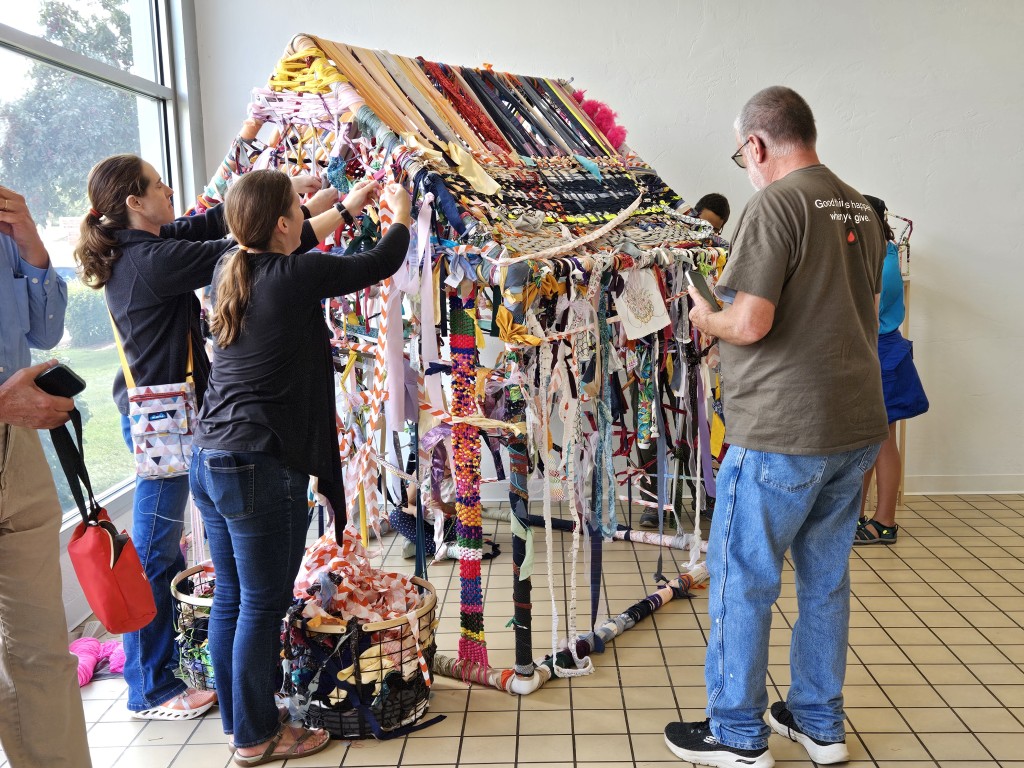
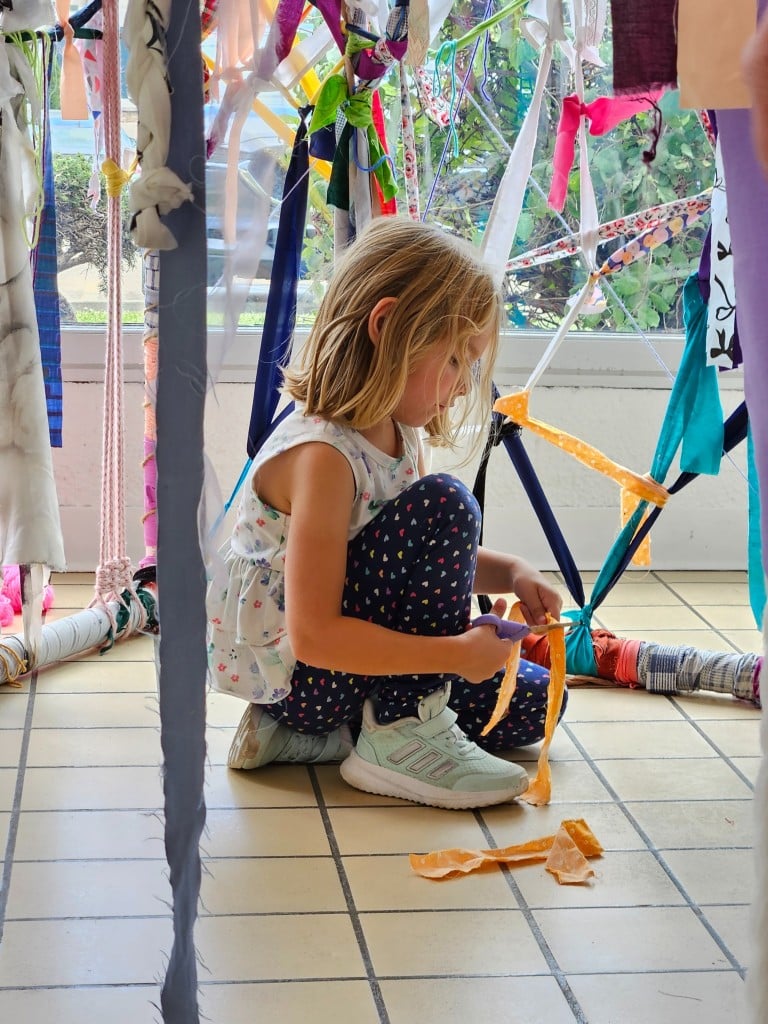
At Textile Arts Center (TAC)’s Community Day on September 7—one of two signature events to celebrate its re-opening at its new location at 1702 South Park Street in early September—attendees were encouraged to take long strips of fabric and add their own touch to a frame shaped like a simple house. Soon, strings thick and thin, textured and bright, pebbled and silky, hung from the frame, in some places loose and flowing, in others carefully woven into each other.
“There were little ones who were not even two years old grabbing strips of fabric or bits of yarn and wrapping them around this house,” Elizabeth Tucker, TAC’s executive director and co-founder, explains.
This kind of living community art project is emblematic of TAC’s mission: to be a space that makes the fiber arts accessible to as many people as possible, no matter your age, expertise, or income level. What once started as a 3,500 square-foot operation in a North Madison incubator space is now a community center that can hold triple the number of events, workshops, and exhibition space.
“We don’t have to choose whether we’re doing an indigo workshop or a free maker meetup,” Tucker says. “We can do both on the same night, which is really exciting.”
With its new home base on South Park Street (shared with The Sewing Machine Project) right along a bus line, bike path, and major thoroughfare, TAC has an increased visibility that Tucker hopes will draw even more people inside. Joining nearby community institutions like Centro Hispano of Dane County and the soon-to-open Center for Black Excellence and Culture, Tucker looks forward to forming strong bonds with these organizations and strengthening TAC’s ties to the local neighborhood.
It was evident that TAC would need a bigger space even before it formally opened at its first location in 2023. The idea for the center was born of co-founders Tucker and Heather Kohlmeier’s desire to bring together Madison’s rich fiber arts scene—comprised of students at UW–Madison’s Textile and Fashion Design program, members of various fabric guilds (of which there are many), and everyone in between—into one building.
“[These circles] are all really active, but there wasn’t a single space that brought people from different backgrounds and techniques together,” Tucker says.
Seeing this need for a common physical ground, Tucker and Kohlmeier got to work dreaming up a textile center in Madison, drawing inspiration from the renowned neighboring Minneapolis Textile Center and other fabric arts centers around the country. The two also conducted focus groups and ran surveys in the community that received an “overwhelmingly positive response.” “We knew that we were on the right track and that this is something Madison could get behind,” Tucker recalls.
In tandem with its desire to help “cross-pollinate” art forms, TAC also aims to make the fiber arts more accessible to a wide audience. Throughout the year, TAC takes in donations of supplies like fabric, yarn, knitting needles, sewing machines, and sells them back into the makers’ community at affordable prices twice a year. Each time, these sales draw in over 500 people.
A fabric arts renaissance
According to Tucker, it is fabric’s ubiquity—the clothes on our backs, the blankets and linens in our homes—that is its strength. In making up so much of our daily lives, fabrics are a global language that everyone can understand.
“There are people that sew, there are people that knit or crochet, there are people that quilt or weave, even in tiny towns in rural America,” she explains. “[Even in places] where you don’t necessarily think of them as having an art scene, they probably have a group of local folks, probably women, who gather together to knit or quilt or sew together.”
And it seems that the universal but often domesticized art form is rightfully getting its time in the limelight, in Madison and beyond. “Something that is really exciting right now in the contemporary art world is that there’s a lot of talk about fiber. Major museums around the country and around the world, and major contemporary art shows like Venice Biennale or Art Basel, are showing fiber in ways that are much more frequent,” Tucker explains. “It’s really top of mind.”
Tucker speculates that this resurgence in fiber arts is due to people’s desire for a change of pace, a new way to engage the self: “I think people want to do something that takes them off of their screens and off of their phones,” she muses. “And no doubt, touching any kind of fiber is the opposite sensory experience to touching the screen.”
A wealth of partnerships
Though TAC has only been serving the Madison fabric arts community for two years, it has built many partnerships across the city, including a book club with Madison Public Library’s Pinney branch and an upcoming mending lab series with The Sewing Machine Project that will begin in October.
The strength and depth of these community partnerships actually made for the perfect exhibition opportunity for TAC’s reopening. Statement Pieces: Quilts With Something To Say is a quilt show hosted in partnership with the Nancy M. Bruce Center for Design and Material Culture as part of their “Year of Quilts,” showcasing creations that provide commentary on environmental, political, and social issues, and the human condition more broadly.
The exhibit, which will be on display until October 18, features 13 majority Madison-based artists who bring their own techniques and interpretation to the art of quilting. Several of the featured artists are part of the Memory Collectors Storytelling Project (MCSP)’s Fighting Alzheimer’s With Art, a program started by Catrina Sparkman, who is also the founder of the nonprofit Creator’s Cottage.
A human art form
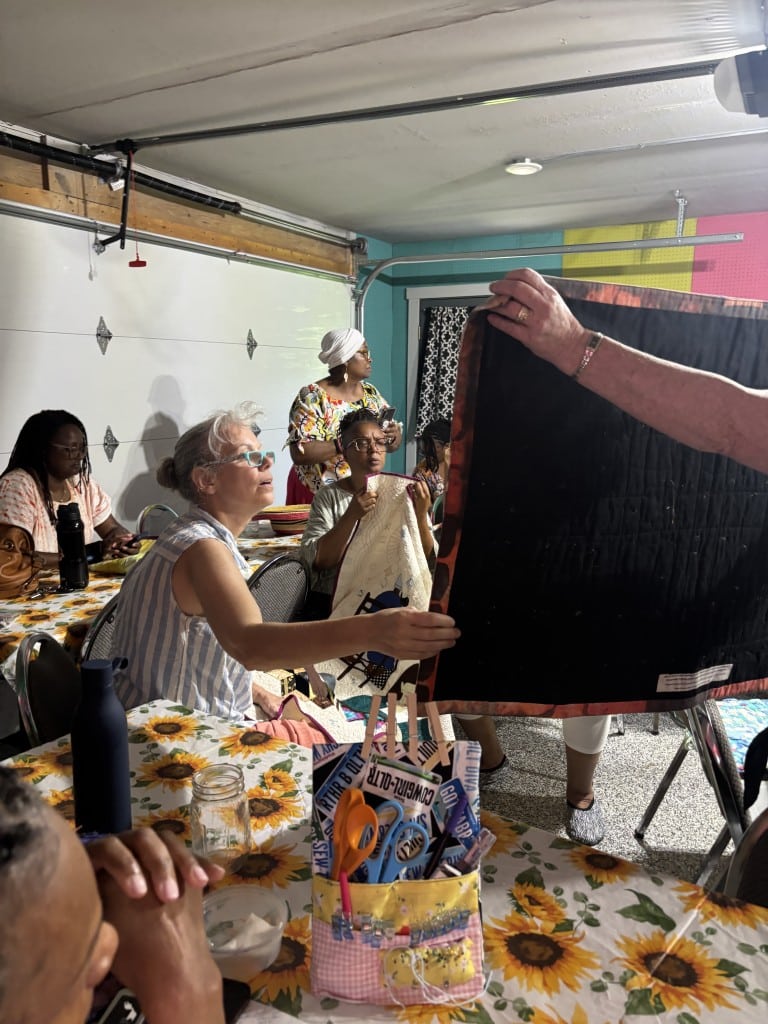
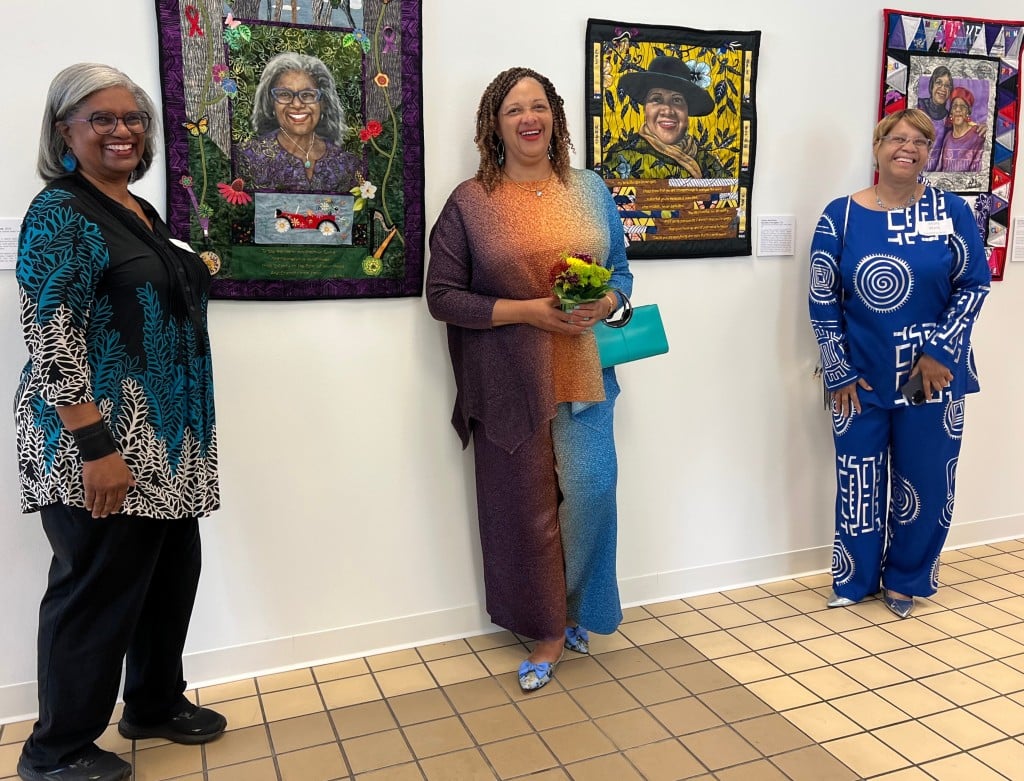
MCSP is a group of primarily BIPOC senior women in Wisconsin who use the arts, health, and community connection to combat the onset of Alzheimer’s disease. The pieces in the show were made in collaboration with artist Alicia Rheal for the Legacy Quilt Project. Each quilter worked with Rheal to create a portrait of themselves, which serves as the center piece of the quilt. Fabrics from each maker’s life make up the rest.
In Francine FinleyStrong’s quilt “Legacy Of Joy And Peace,” a smiling five-year-old FinleyStrong wears a yellow dress and sits atop a throne. What at first appears regal gives way to darker detail: the chair, which draws inspiration from a museum calendar, is actually made up of bullet casings and bomb cartridges from a war in Africa.
Though seemingly a happy accident, FinleyStrong found it fitting: “I had to endure different sufferings but through it all, I still came out of it on top and happy,” she says. “I met all these wonderful people, and that’s why it’s titled ‘Joy And Peace.'”
The levity that FinleyStrong speaks of is depicted in the designs bordering her portrait: Along the edges are light blue and bright green strips of fabric, onto which shells that she collected during her travels are sewn, along with meaningful Bible verses. Marking the corners of the quilt are collections of stamps that FinleyStrong amassed over the years, in addition to ones that friends and family contributed.
“Just putting those thoughts and memories together to bring that piece of art together, that was a labor of love,” she reflects. FinleyStrong recently returned to quilting through MCSP after decades away from it, and is grateful to have such a supportive community at the Creator’s Cottage to share this craft with.
“Now I just love it,” she shares. “I keep telling people I’m a kindergartner. I’m just learning this, so I have to be patient with myself and keep going and learning all these techniques as I go along.”
Having MCSP as a safe space to learn and relearn quilting rings true for many of the group’s members. Vaunce Anne Ashby’s first love was always art—even in her decades-long career as an educator, she always found ways to incorporate art into her students’ assignments and in the clothes she wore.
After retiring, she remembers going to a quilt show in Milwaukee about 10 years ago, and was stunned by the flexibility and creativity of the art form. “I remember how intrigued I was because they weren’t straight square boxes,” she recalls.
This might’ve been one of Ashby’s first encounters with art quilting, which incorporates “non-traditional techniques” that add more shapes, textures, and elements into a piece than you might find on an average quilt.
So, when Ashby met members of MCSP at a Madison quilt show two years ago, she knew that she wanted to try her own hand at art quilting. Joining the group at the Creator’s Cottage has given her a “happy place,” an environment that is different from other “questionable experiences” she’s had in the quilting world, largely related to race.
“August of last year was my first meeting with my memory quilters, and I haven’t looked back,” Ashby says. “I’m pushing the envelope as to what traditional quilters define as quilting.”
Ashby’s quilt, which boasts of vibrant yellows and deep blues, is a bold portrait that showcases her beaming defiance, sporting a floral black hat, bright red lipstick, and surrounded by blue leaves. Beneath her portrait is a quote addressed to young brown girls, reminding them of their worth and strength. Ribbons commemorating each of the schools and districts that Ashby has devoted her career to border the entire quilt.
Pieces that make a statement
Though MCSP’s mission is distinct, the universality of quilting has broadened its reach to those who might fall outside of the group’s targeted demographic.
“For me, [quilting] was an unexpected container for all sorts of things that I felt connected to in my work and in my own art practice,” artist and Legacy Quilt collaborator Carlee Latimer shares. “I came into it through the lens of drawing more than sewing and so it was just really interesting that it clicked for me, because I wasn’t really expecting it to be this anchor.”
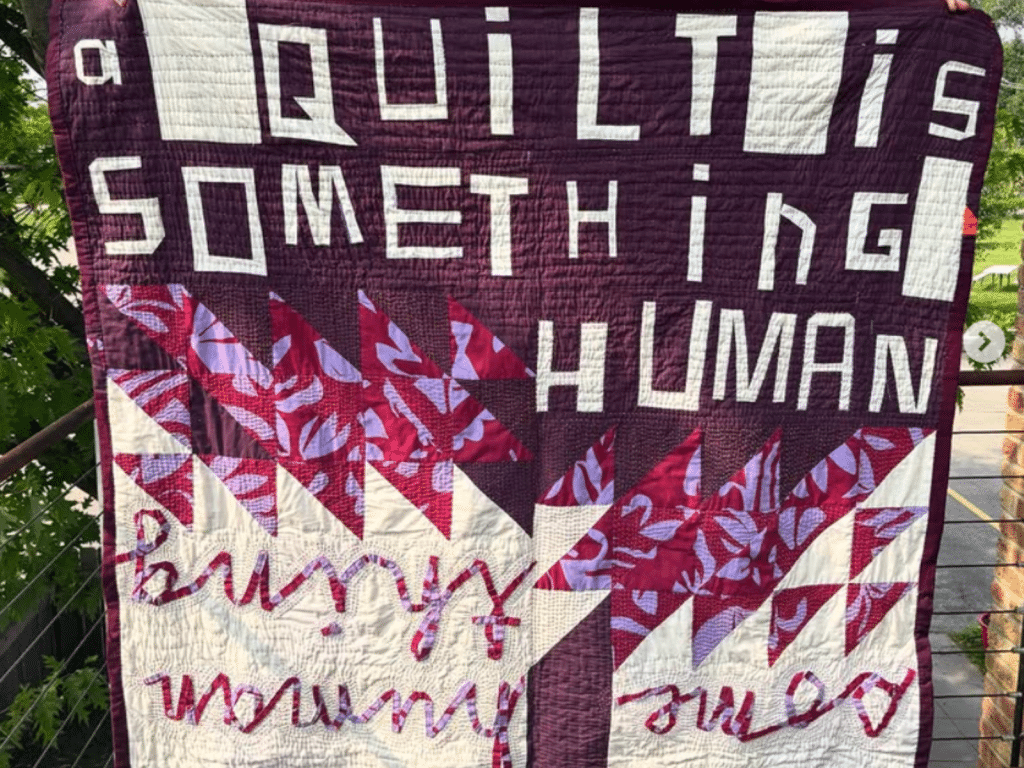
In lieu of a portrait, Latimer’s “Statement Pieces” contribution is a purple quilt which reads: “A quilt is something human” from the 1972 book The Foxfire Book, which explores quilting’s significance in the Appalachian community. The letters are written in both white block print and a patterned cursive, accented with patches of magenta and lilac.
Perhaps this assertion of humanness is at the heart of both the exhibit and Textile Arts Center more broadly: through the varying patches of our lives—the good and the bad, the joyful and the painful, the mundane and the utterly exhilarating—something more beautiful than we could’ve ever imagined can emerge. Using fabric as a medium commemorates, celebrates, and advocates.
The very act of sewing, mending, embroidering, or quilting is individual, but if these artists and organizers have any say in it, these slow, process-oriented practices are made infinitely better by the presence of others, from whom we can grow, learn, and create.
And these pieces—vibrant, defiant, and alive as they are—might be able to speak for themselves, but so do the hands that made them: “You can’t ignore the fact that someone’s hands were all over this, whether you use a machine or hand stitch or a combination,” Latimer says. “You can’t really ignore the humanness of it, and then everything that it holds.”
Other “Statement Pieces” featured artists include: Misty Cole, Leah Evans, Sarah FitzSimons, Sheryl Henderson, Ireri Andrea Muñiz Ortega, Christine Paris, Heidi Parkes, Kathryn M. Simmons, Mary Wells, Ruth Yasko.
TAC’s annual fall show, “Interwoven,” features creations from TAC supporters, and will open on October 30.
We can publish more
“only on Tone Madison” stories —
but only with your support.
Author
Related Articles
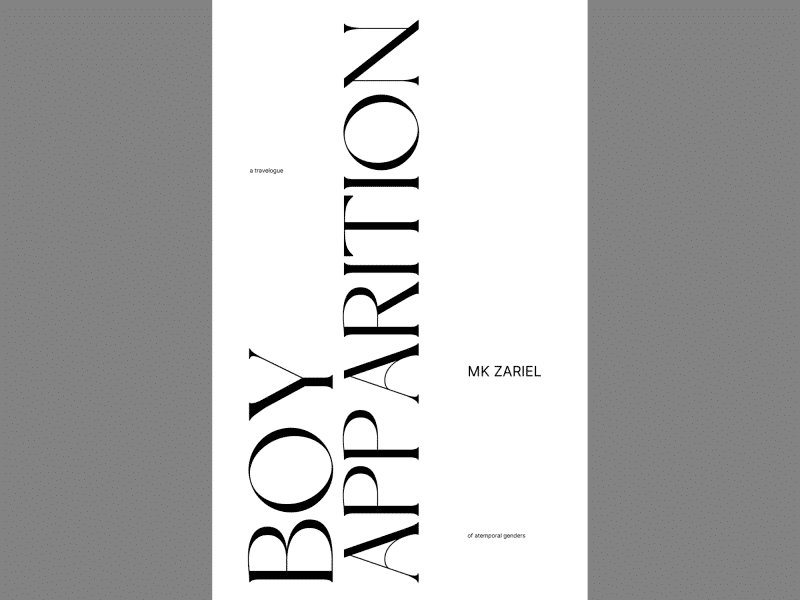
“Boy Apparition” finds queer liberation by challenging normative constructions of masculinity
mk zariel’s chapbook coaxes us to the edges of our imaginations, and is infused with the undercurrent of love that is necessary to keep going.
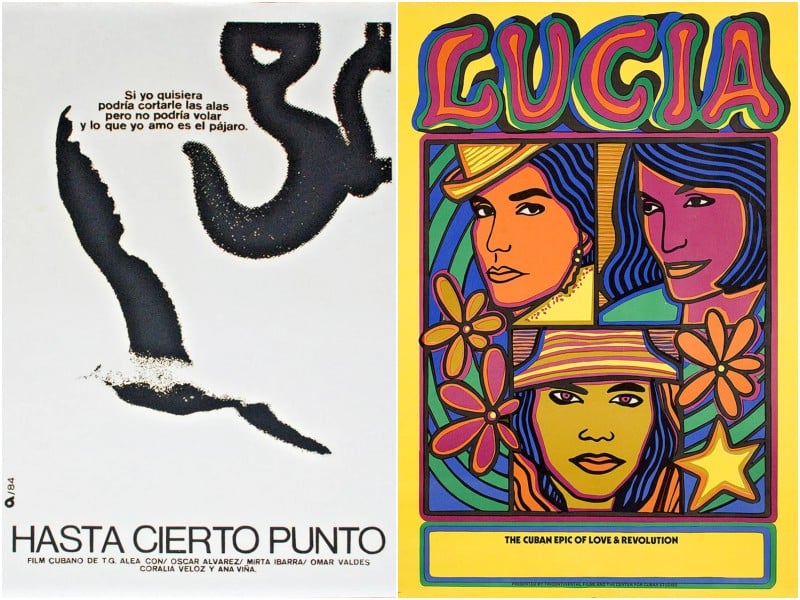
The Cardinal Bar’s Cuban film series invites local support for Madison sister city
Cine Cubano bridges interest in Cuban cinema with the cultural exchange and aid mission of the Madison-Camagüey Sister City Association.
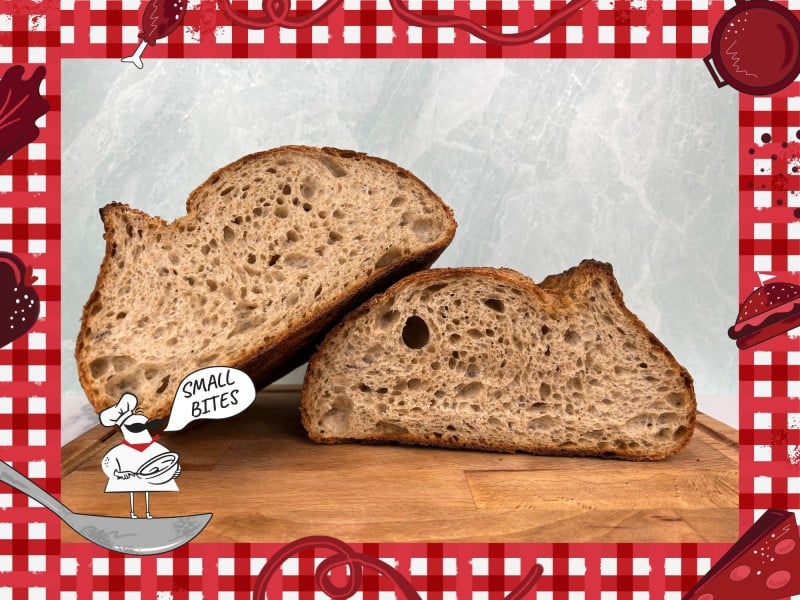
Small Bites: How I make bread
Meditating on the process, flour, flavor, time, and place.