
Lisa Low’s “Replica” grapples with racial alienation and whiteness
Moving from childhood to adulthood, the author’s new poetry collection confronts and reconciles expectations in order to live authentically.
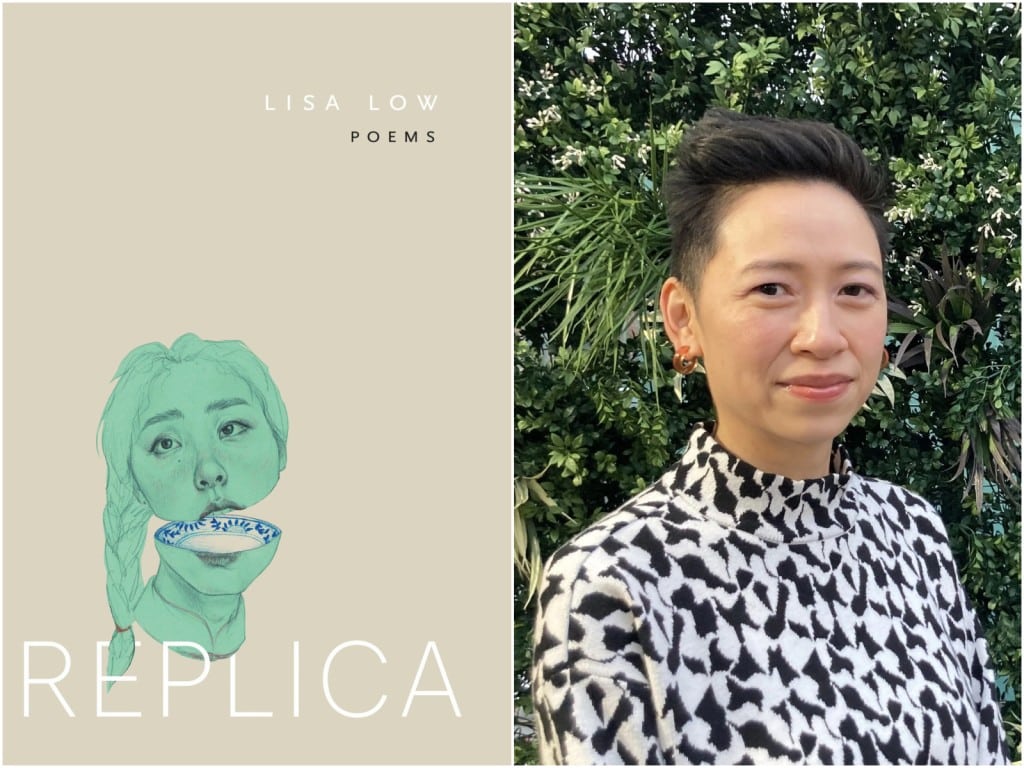
The cover of Lisa Low’s Replica features the portrait of a young Asian woman with indifferent, if not sad, eyes. With her hair pulled back in a side braid and her skin a light green hue of jade, her head is bisected cleanly at the mouth, the bottom half of her skull revealing the white and blue porcelain of fine china. The bifurcation reveals a quiet violence, one that could potentially render her silent. On the other hand, it might just be the rupture needed to break her wide open.
Like the woman in this portrait (a self-portrait entitled “Celadon, Porcelain” by Yuqing Zhu), the mouth of the speaker in Replica is wide open and speaks about, around, and directly to whiteness. Part girlhood diary, part craft lecture, and part reality-TV show confession, Low’s debut full-length collection takes us from the spaces of childhood (playgrounds, hair salons, elders’ bedsides) to those of adulthood (graduate school parties, Reddit rabbit holes, the home shared with a partner) and charts the nuanced ways the narrator has grappled with her proximity to and relationships with whiteness. At first, she feels timid in her approach to the subject, guardrailed by anxiety and societal expectations. But as the speaker moves through the collection, they become brash and unapologetic, talking about whiteness “indiscriminately,” not caring to “test the comfort of my audience in advance” (“Feedback Loop”).
Many writers of color can relate to the paranoia that comes with having to speak for an entire race—not because we want or intend to, but because that is often how white audiences understand our experiences. In “People Who Look Like You,” a long-form prose poem that sits sturdily in the middle of the collection, Low articulates this dilemma perfectly: “The problem of being with a white man belongs only to you, not to the / white man with whom you share this problem.” Forced to assume this defensive stance, Low’s writing prompts us to wonder what else we might put our creative energies toward were we not made to explain our every move in order to render ourselves legible.
Of the many intimacies interrogated throughout the collection, I felt most drawn to the poems that teased out the complexities of mother-daughter relationships. At once perpetually reaching for the mother figure and resistant to the ways in which she is changing, these poems speak to how we must work to reconcile our ideas of our loved ones with the people standing before us, along with how they might evolve over time (“Each time I look into my mother’s / house, she is not where I left her,” from “Dollhouse”). Replica, after all, is a book of reconciliations: between who society expects us to be and who we are; between what our love looks like to others and what it really is; between the need to justify our existence and letting our defiance speak for itself.
In early March, I sat down with Low over Zoom to talk about racial alienation, mothers as muses, and new directions for her work ahead of Replica‘s March 24 release with University of Wisconsin Press.
Tone Madison: You have a robust creative writing education and are heavily involved in the creative writing community. How did you come to poetry?
Lisa Low: I think like a lot of people, I loved to write when I was a kid, and I had a high school teacher who was really great. I was super shy as a kid, so I just wrote my things, and I didn’t speak in class, but [my teacher] was really amazing. And then I took poetry workshops in college, and kind of went on from there. I feel like at the time I thought that I needed to do other genres to be a good writer. My professor was like, ‘No, it’s okay. If you like poetry, you should just do poetry.'”
I write a little bit of nonfiction right now, and that’s been exciting to explore. But with poetry, I just feel like there’s something really cool about how you could just be in the space for such a short time. Even [in] just a page, you can be totally transported space-wise but also emotionally.
Tone Madison: Your racial alienation is very much rooted in place and specifically, the Midwest. Can you talk a little bit about that experience and how writing has helped you process and/or navigate that space?
Lisa Low: I think [the collection] is a little bit chronological, just because the first section has a lot of my older poems, and then it kind of changes strategy of thinking about whiteness as the book goes along. [With] the beginning poems, I was just like, “Hey, I want to write about these experiences that happened to me.” And then as I kept writing about it for several years, I was like, “Oh no, I want to write about these things, but there’s so many expectations attached to what I should think about and how I look like and how other people expect me to say certain things about race or not.”
So that brought me into the other sections of the book where I was like, “Hey, I want to address writing about race through the ars poetica.” It was really helpful for being like, “I can talk about this directly.” I was thinking of reality TV, like the confessional camera, and just looking directly at the camera. I feel like the ars poetica is the poetic form of that. So I felt like the writing, and then writing about the writing, was something that really intrigued me.
Tone Madison: Some of your poems directly grapple with the struggle of writing about your experiences with race. What do you feel like the form of poetry allows you to tap into that perhaps, an essay, cannot?
Lisa Low: In grad school, I really admired writers who wrote about lots of different topics and a lot of different forms, but I was never that person. But I love that poetry can get on the same topic and just kind of circle around it in different ways. I feel like with several poems in this book, I was really thinking about what the sentence alone can do and how it engages with white spaces—both literal and metaphorical white spaces. That’s kind of inherent in the poem [“White Spaces”] itself, thinking about your audience being predominantly white, and what they’ll bring to it.
Tone Madison: We follow you from childhood to adulthood, and I feel like a lot of the poems at the end of the book collapse time and reach back to that younger self. How do you see this book, if at all, healing or avenging younger versions of you?
Lisa Low: That’s really nicely put. The last ars poetica, I was like, “Hey, this poem originally had a different ending where I had the younger self or the speaker looking up at the ceiling or releasing the speaker.” Like the idea of, “Oh, I’m not gonna write about this person again.” But then as I was revising, I was like, “I want to be able to facilitate that and give her that kind of space.” Writing about experiences that are meaningful to her, even if they are fitting a certain stereotype.
Tone Madison: You write a lot about your mother and the complexities of your relationship over time. What, to you, makes mother-daughter relationships so generative to write about?
Lisa Low: It’s one of the oldest relationships you have in your life. It’s equally good and bad at the same time. Someone was asking me before, “Oh, how is it writing about your partner or family members?” I said, “Oh, it’s way easier to write about my partner than my mom.” She loves and supports me and what I’m doing, but it’s more complicated. I think it’s also complicated in the sense that [mothers are] written about quite a lot, and [I was] trying to find new ways to think about it and write about it. I feel like I kept writing into the sad mom trope or the sad Asian mom trope. So just trying to find a way to honor the experience in all of its ways.
Tone Madison: It’s our oldest relationship, so it’s the one that evolves the most.
Lisa Low: It evolves the most, but then it reminds me of how your mom sees you in a certain way but you want to be seen in a different way. But I think the opposite can be said for, “I thought of my mom this way when I was growing up and there might be new ways of seeing her as I get older.” Allowing each other to be people who grow and change.
Tone Madison: One of the first poems in your book titled “Forty Years” is about your mom saying she can talk to “anyone” when she actually means white people, which to me, is a declaration of assimilation. You seem to have a bit of disdain for her proclamation. If not assimilation, what do you feel like Asian Americans should strive for?
Lisa Low: That’s a good question. In that poem and other scenarios like that, I find it really interesting. I feel like this probably happens with a lot of Asian parents, you don’t say “white people” but you actually say it all of the time [implicitly].
I think there’s some combination of how different generations have dealt with being in America and seeing your parents interact with white people in a different way than you do. So I think instead of assimilating, you’re pulling from different people in your life across generations and incorporating your new way of talking about whiteness if you want to, or not talking about it if you don’t want to. Me and my mom both find it funny of each other, how we interact with white people. We’re just learning from each other.
Tone Madison: You have a pretty clear indictment of whiteness and perhaps [even] white readers. What do you hope your readers of color get out of this book?
Lisa Low: Yeah, there’s the poem “White Spaces” that I was talking about earlier, which is talking specifically to white readers. I hope that in that poem and other poems of mine, the poem can look in different directions, or have something for other people. Even though I’m directly talking to white readers [in that poem], it’s also coded for those who get it and understand it.
Tone Madison: After this book’s lengthy and thoughtful exploration of whiteness and how you’ve navigated your proximity to it, and how that’s changed over your life, do you feel like your work is going in new directions? Do you feel like you’ll still be exploring this, but in a different way?
Lisa Low: Yeah, I feel like this book is single-minded. I’m not sure if that’s the right word, but it has a really clear stance on whiteness and everything around it. But I think now I’ve been trying to think about how to write poems and essays about a lot of things at once. I feel like a lot of poems in the book—they’re more like, “Hey, this is about one or two things” and really dig into that. I really admire poems that can cover a lot of things at once. I’ve been working on a series that’s “on” something. I wrote an essay “On Envy,” and I wrote a poem “On Effort,” and “On Vanity.” I think thinking about race is a part of a lot of those big, difficult emotions and experiences too.
Tone Madison: You did an interview with Electric Literature in September of 2025 when the cover of your book was revealed, which was designed by adam bohannon, and featured original artwork by Yuqing Zhu. In that interview, Zhu says of the portrait: “Here I depict myself as a vessel with the capacity to hold anything the world has to give and also perhaps offer something in return.” What are you hoping to hold right now, as you offer your book to the world?
Lisa Low: It kind of goes back to what you said earlier about building space for myself and my younger self, and different versions of that. Especially getting into this busy season of, “What does it mean to promote my book and be a little bit more public than I’ve been used to?” I haven’t been very good at self-care generally. So, holding that space for myself to be a writer in a way that I have been versus this new journey that I’m gonna go on with the book.
We can publish more
“only on Tone Madison” stories —
but only with your support.
Author

Related Articles
Good birding in all seasons with the storied Charles “Chuck” Henrikson
The retired lecturer and winsome ornithologist has been coordinating Tuesday birder hikes at the Arboretum for well over a decade.
Lea Jacobs sheds new light on an old master in “John Ford At Work”
The UW Professor Emeritus’ new book on the storied American director coincides with a five-film UW Cinematheque series this spring.

Small Bites: How I would fix Madison dining
Going out on Sundays and other thoughts on building a more sustainable food city.