
Queer Campout is reclaiming the outdoors
Queer adults get to enjoy swimming, hiking, and crafting—without the hyper-gendered baggage of Boy/Girl Scouts.
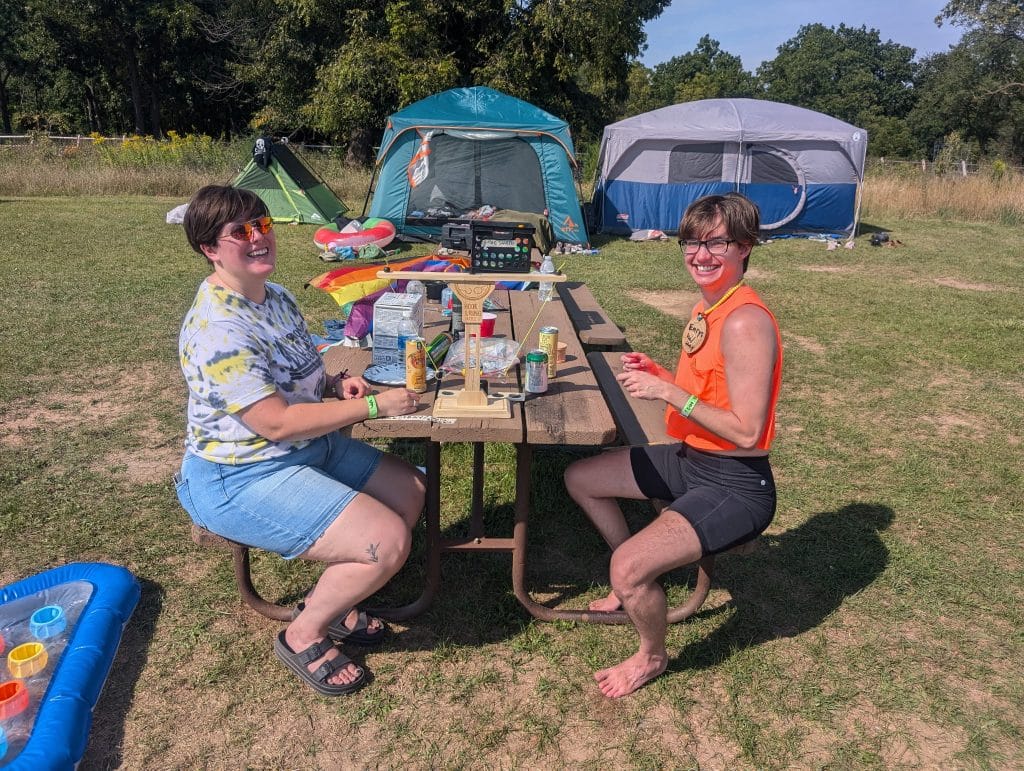
Queer adults get to enjoy swimming, hiking, and crafting—without the hyper-gendered baggage of Boy/Girl Scouts.
Logan Bitz grew up outside. One of his earliest memories of connecting with nature happened when he was five years old and a fox came into his grandmother’s backyard in Waukesha. Bravely, he crawled up to it, close enough that he could almost touch it. The adults in the house watched from afar, letting the exchange run its course.
“They eventually saw it and didn’t fuck with me,” he recalls. “They just let me do it.”
Moments like these spurred Bitz’s love affair with the outdoors, camping plenty throughout his youth. During high school, when he wanted to avoid being home, the natural thing to do was to head outside. He picked up a job at a summer camp for people with disabilities outside of Milwaukee, and began to see how the outdoors could be a place to build community with others.
Bitz would eventually move on from this camp to a similar place in Michigan, but things weren’t the same. His original camp, which was primarily staffed by Marquette students, had people who “really cared.”
“The camp in Michigan had all the amenities that this other camp didn’t, but [it] didn’t really have the staff that was as passionate about it.”
In 2019, he began the process of getting gender-affirming surgeries, and in particular, his bottom surgery. Bitz started trying to acquire the professional paperwork that allowed him to get these surgeries and cull together the funds to pay for the surgeries.
“I needed to have all this super-expensive laser hair removal on my arm [for bottom surgery], and I couldn’t afford it,” he says. “I was like, ‘I want to make money, but I don’t want to do GoFundMe because it’s too public.'”
So he turned to what he knew: In 2022, Bitz began promoting what he called the “Queer Campout” (QC) everywhere he went—hanging flyers in gay bars and asking to steal the mic for a quick promotional spiel during shows.
The premise was simple: If queer folks wanted “in” on a three-day camping trip in the woods outside of Milwaukee, they’d pay Bitz $50 and sign safety waivers and participation guidelines to secure a spot. The rest was on Bitz to carry through on his word.
“It was like a real trust game back then too, because it was just a Google form,” he explains. “I didn’t have a website. I was just like, ‘I promise that it’ll happen.'”
Because he grew up exploring the outdoors, Bitz was in a unique position to share this kind of experience with others.
“I felt like no one else was doing it, you know?” he says. “I own a lot of camping equipment, so the level to entry [is] a lot easier. I don’t have a venue, but I can get a group campsite. I can go outside.”
Bitz’s grassroots campaigning worked. That year, 35 people across their 20s and 40s signed up to go camping with him, many of them from Milwaukee, where there are fewer opportunities to be outdoors compared to other parts of the state. Participants enjoyed setting up their own camp sites, cooking meals over the fire, playing group games, cliff diving, swimming, hiking, and more. And, thanks to one enthusiastic camper, each participant even left the weekend with a DIY, screen-printed t-shirt.
When Bitz invited Mya Guiliani to be part of the first Queer Campout in 2023, it was an easy “yes” for them. Growing up in the Northwoods, Guiliani spent their childhood hiding, fishing, and riding horses on their grandparents’ small farm. A Milwaukee-based printmaker, artist, and curator, Guiliani describes themself as a “busybody” who gets involved in things “by being loud and just asking.”
“I asked Logan if he thought printing shirts would be cool,” they explain. “On a practical level, I’ve been working for arts and culture oriented nonprofits for eight years, and I have a lot of relevant experience to lend to QC.”
“The printing is simply for the love of it,” they add. “I’m a printmaker and giving folks access to the art form keeps it alive, fresh, and engaging.”
Ahead of each trip, Guiliani, now QC’s Art Director, designs the annual camp t-shirts and preps the screens so they’re ready to use come Saturday. The day before, Guiliani also leads campers through the tie-dying process so they have a colorful base to work with when it comes time to print.
“There’s a huge emotional difference between being handed a branded thing and getting to make something yourself,” they say. “I feel like I’m giving my new friends something to take home and remember an experience that is hopefully special and loved.”
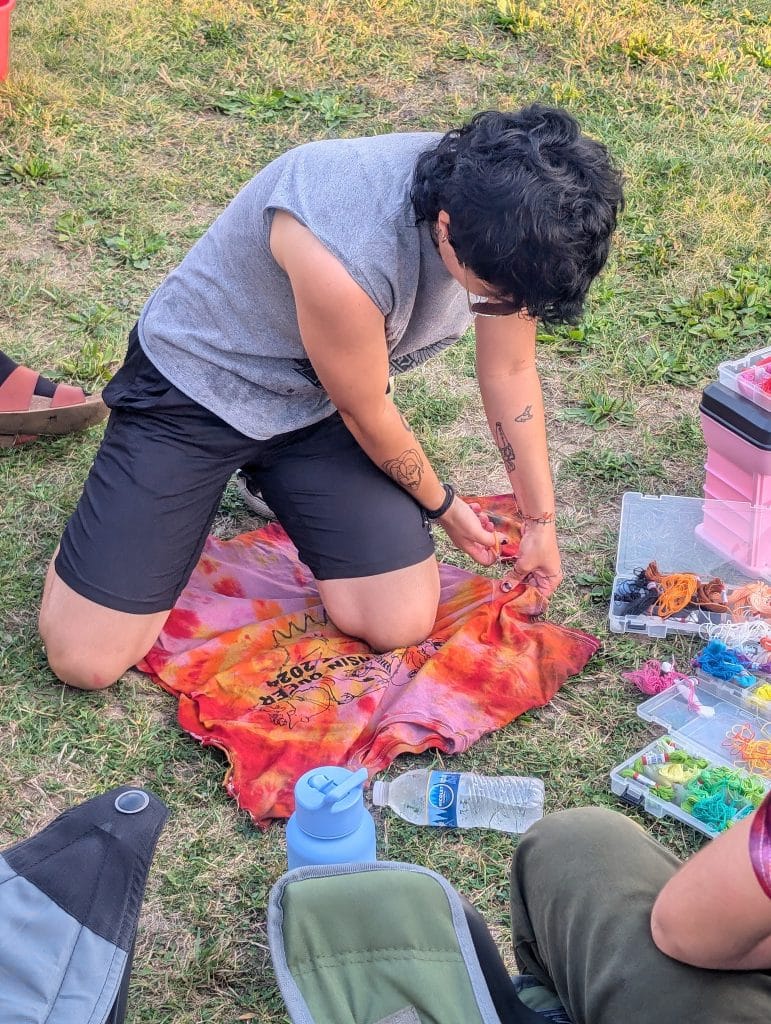
It’s precisely these kinds of activities that make the Queer Campout so one-of-a-kind. In part, Bitz sees the weekend as a reclamation of the hyper-gendered iterations of camp that children often find themselves in.
“I loved summer camp, but I hated being in Girl Scouts because all the stuff I wanted to do was in Boy Scouts,” Bitz explains. He further noted that Girl Scouts weren’t allowed to go on real treks, carry pocket knives, and oddly enough, weren’t made to cook as much.
“For me personally, it’s like reliving my youth and getting to do the summer camp thing without all the gender that I didn’t like,” he says.
This notion of being able to enjoy camp activities with people who instill feelings of safety and security becomes especially obvious during the Saturday beach morning, where campers are invited to go down to the water for a group swim.
“People will say, ‘Oh, yeah, I’m not gonna do that one. I’m gonna hang back.'” Bitz explains, pointing to anxieties around body image and the fear of being harassed in public. “But so far, not a single person has ever hung back. Everybody’s gone.”
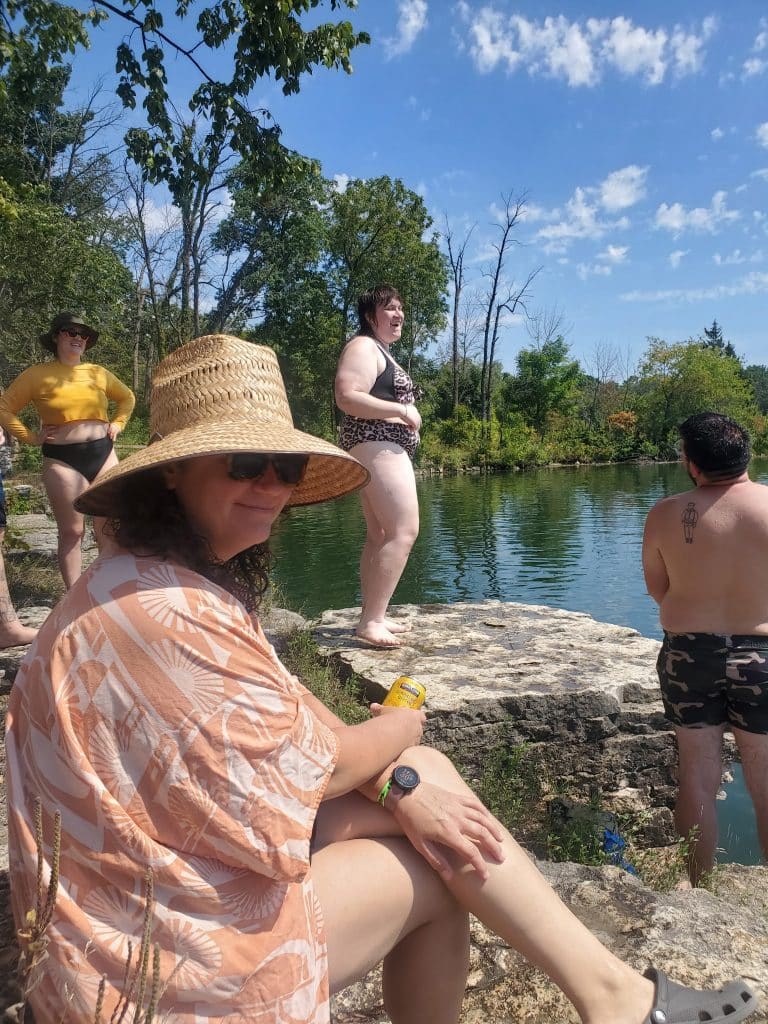
There is, in fact, power in numbers. “When there’s 40 of you…nobody fucks with us,” Bitz says.
“Feeling comfortable going into an unknown space outside the city, with strangers from everywhere, can be much more difficult when your existence is political,” Guiliani adds. “I think the queer experience is expected to be so small.”
And yet, even with this increased sense of safety, Bitz is keenly aware of the fact that there are still many people who are hostile towards LGBTQ+ individuals. For this reason, the location of the camp is only disclosed to campers after they’ve signed up.
As Queer Campout has gained more popularity, its organizers have strived to make it as accessible as possible to members of the queer community who are the most marginalized. For each session this year, the campout has scholarships for BIPOC and trans folks.
This accessibility comes not only in the form of financial assistance, but in comfort. For example, a friend of Bitz’s in Milwaukee sews silk hoods into sleeping bags to make sure they are protective for Black hair.
Supporting Trans Wellness
During its first iteration in 2023, Queer Campout raised around $2,000, which helped Bitz with the costs associated with the bottom surgery he underwent in November of 2024. And while Bitz started the campout so he could pay for his personal needs, it’s grown to help others with their gender-affirming surgeries via one large payout to a specific person in need. It’s also now nestled into an ecosystem providing gender-affirming care of different kinds.
Today, Queer Campout is a formal program of Trans Wellness, a 509(a)(2) that provides support for local and out-of-state transgender folks seeking gender-affirming surgery in Wisconsin. Trans Wellness’ other arm, Trans Medical Mutual Aid (TMMA), provides necessities like landing kits (thermometers and backscratchers to people who have traveled for surgery), medication dispensers, supportive pillows with custom covers (for sanitation purposes), and other practical supplies needed after surgery. For those earlier in their gender-affirming care journeys, TMMA volunteers also provide education about these surgeries and how to secure appointments.
Because of the thorough resources that TMMA is able to offer, when someone seeks funding through QC, TMMA is actually their first stop.
“You have to be willing to speak to Trans Medical Mutual Aid and sign up for financial aid—if you qualify—before we give you money,” Bitz explains. “Because if we can save you money that way, we’re going to do it.”
And because TMMA has proven to be such a successful resource, Bitz admitted that they’ve had trouble finding someone to support the past two years.
Despite the huge material impact that Queer Campout has had since it began—raising about $5,000 in total—its organizers know that initiatives like his exist because of the lack of structural funding and support for gender-affirming care.
“[Charities are] a shitty substitute for being cared for by the government and society, which is what we should be doing for each other,” Bitz says.
For Bitz, like many others, the process of acquiring letters of readiness—the paperwork that would allow him to undergo bottom surgery—was a long and complicated journey. It pushed up against a medical system that often doesn’t have minority individuals’ best interest in mind. He sought out consultations with multiple doctors to establish mental healthcare with the goal of obtaining a letter. “I knew my insurance. I knew what requirements I had to meet. I [was] willing to jump all the hoops,” he says.
And yet, Bitz found himself “scammed” by multiple practitioners who would deny him a letter at the last minute. “They’d see me and they’d be like, ‘I don’t do letters at all,’ after I paid my copay and waited [to see them].”
Frustrated by these dead-end consults, Bitz stumbled across a booth at PrideFest where a licensed professional counselor and a psychologist were providing readiness assessments for letters for free.If appropriate, these assessments also resulted in free documentation.
After chatting with the individual, Bitz was granted the letter he had been working so hard to get. “He was like, ‘Clearly, you meet all the requirements,'” Bitz recalls about their consultation. “It was so hard, and then it just wasn’t.”
“Gender-affirming care is healthcare, and is as necessary and personal and ideally, unpolitical, as any other form of healthcare,” Guiliani adds. “Queer Campout exists because healthcare is cost prohibitive for most people, and the funds we raise can help mitigate those problems.”
Especially amid the fraught climate that the Trump administration has created, which seeks to disenfranchise just about every minoritized group, Bitz knows that increasing access to gender-affirming care now more than ever.
“It’s just so bad right now. It’s hard to even imagine what [a perfect world] would look like, but in my mind… [I keep going back] to regret rates,” he says. “All surgeries have a regret rate. Hip surgery, I think it’s like 16%. I think the average regret rate of a surgery is about 12 to 14%. But then the top surgery regret rate is less than 0.2%.”
“These surgeries have a regret rate that’s so low that it’s clear that we’re preventing people who need it from getting it,” he emphasized.
This year, Queer Campout will have two weekend sessions: July 18 through 20 and August 8 through 10. While general registration is now full for both sessions, spots specifically saved for BIPOC and trans folks are still open.
To learn more and/or claim a spot, reach out to the QC by using the contact page on Trans Wellness’ website.
Who has power in Madison,
and what are they doing with it?
Help us create fiercely independent politics coverage that tracks power and policy.
Author
Related Articles
Creating a music community on the isthmus with “Evan’s style”
Musician and arts organizer Evan Fernandez discusses the importance of managing the HQ practice space for local bands and his own ensemble, The Porch Flowers.
“Limerent Pittsburgh” intricately constructs a folkloric affection of place
Artist Anne Ciecko’s 2025 videopoem is a highlight among the 30 selections of this year’s Midwest Video Poetry Fest at ALL on April 4.
Good birding in all seasons with the storied Charles “Chuck” Henrikson
The retired lecturer and winsome ornithologist has been coordinating Tuesday birder hikes at the Arboretum for well over a decade.