
There’s always more to see and sensorially absorb in Tuohy and Barrie’s experimental films
Mills Folly Microcinema presents eight shorts by the Australian creative partners on March 26 at Arts + Literature Laboratory.

Mills Folly Microcinema presents eight shorts by the Australian creative partners on March 26 at Arts + Literature Laboratory.
When one thinks of filmmaking “spectacle,” it is usually high-budget films loaded with special effects and complicated setpieces. In the avant-garde world, the more spectacular works are usually labor-intensive technical exercises, the best of which are akin to an Eddie Van Halen solo: technique-forward but no less grin-inducing for their invention.
Longtime creative partners Richard Tuohy and Dianna Barrie’s short films are just this kind of spectacle—reminders of the infinite possibilities within a single image, provided it’s in the hands of capable editors. The 80-minute Mills Folly Microcinema program of their work at Arts + Literature Laboratory on Wednesday, March 26, at 7 p.m., charts the development of their editing-room virtuosity from city symphonies (2012’s Seoul Electric) to nature films (2024’s The Land At Night).
On their own, the eight shorts are little structuralist sculptures, often presenting a certain editing intervention up front and then applying it to various pieces of footage. Different film strips weave together, as in the Jakarta-set Pancoran (2017), or pile on top of one another, seeming to blend into one another in a never-ending stack, as in Seoul Electric (2012). In Valpi (2019), the image is like a Rubik’s Cube, cut in horizontal lines with each line time-delayed so that one never sees the whole. The Chilean city of Valparaíso acts as an optical puzzle for the viewer to reconstruct.
In both Valpi and China Not China (2018), Tuohy and Barrie play an additional trick on the viewer by shooting the same slow pans of their chosen sites several times and layering the results, presenting more-or-less single images that exist at multiple points in time simultaneously, similar to the hallmark works of peers like Tomonari Nishikawa or Alexandre Larose. The effect is to defamiliarize cityscapes in the edit; the body of work becomes a globe-hopping collection where each place can only be assembled as a whole in the viewer’s mind by linking all the pointillistic detail.
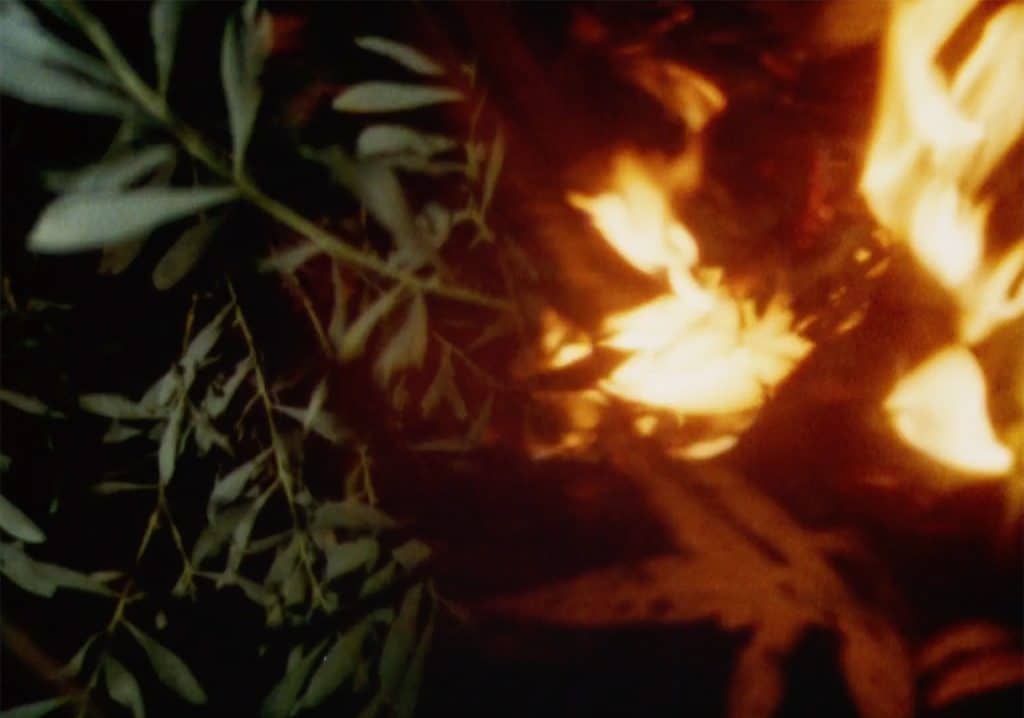
The duo’s recent output, in the latter half of this program, shows an interest in a more assured direction. Images stand more on their own, which reduces the amount of post-processing. They rely more on in-camera editing. Starting with their Angus Meckiff collaboration, Like A Lighthouse (2023), Tuohy and Barrie begin to move their camera faster and in shorter bursts, letting disorientation come not from the density of information in a single space but from simply how much gets jammed into a short period of time. Even when the frame fills up with information, the careening camera still feels distinctly natural, its eye only interrupted by counterpoint images contained in a circle at center screen.
The Land At Night (2024) is a nocturnal complement, with the duo using a flash gun and Bolex to capture rapid-fire images of gnarled trees and empty homes. Each second of the film is a crime-scene-suggestion unto itself. These two recent films are also the only ones in the program shot in the duo’s native Australia. The focus on the innate qualities of their surroundings comes through clearly, whereas Tuohy and Barrie’s other films seem to understand their spaces through a sort of assimilation via abstraction.
The films are no less virtuosic, though, in the way they compress the experience of large amounts of space and time into the space of a short that never exceeds 15 minutes. This seems to be the key takeaway from any of Tuohy-Barrie’s individual films, and certainly a selection of them: There’s always more to see, and infinite ways to cram the sensations into our days.
We can publish more
“only on Tone Madison” stories —
but only with your support.
Author
Related Articles
“Limerent Pittsburgh” intricately constructs a folkloric affection of place
Artist Anne Ciecko’s 2025 videopoem is a highlight among the 30 selections of this year’s Midwest Video Poetry Fest at ALL on April 4.
Lea Jacobs sheds new light on an old master in “John Ford At Work”
The UW Professor Emeritus’ new book on the storied American director coincides with a five-film UW Cinematheque series this spring.
Inspiriting radical communal aspirations: an interview with Ben Balcom on “The Phalanx”
The Milwaukee filmmaker’s latest experimental short premieres locally at the Chazen Museum during the 2026 Wisconsin Film Festival on April 12.