
Gabriella Cisneros’ “Impermanence” creates a lasting cinematic impression
The Milwaukee-based filmmaker’s latest short screens October 5 at the Midwest Video Poetry Fest, amid international selections and local, live collaborations.
The Milwaukee-based filmmaker’s latest short screens October 5 at the Midwest Video Poetry Fest, amid international selections and local, live collaborations.
“Voice is like a fingerprint on a film,” says Milwaukee-based video artist, poet, and filmmaker Gabriella Cisneros in a recent phone conversation with Tone Madison. Cisneros is elucidating her decision to use her own voice to narrate and shape her latest, most personal and accomplished work to date, Impermanence (2024). The eloquent remark recalls the process of translating the written word to visual media, notions of authorship, and the heightened sensory dimensions that we apply to art.
The five-and-half-minute Impermanence is just one of the short films that will screen at the fifth annual Midwest Video Poetry Fest (MVPF) this month at Arts + Literature Laboratory at 111 South Livingston Street, Suite 100. The 2024 MVPF consists of two hour-long Saturday programs on October 5 (which will include Impermanence, as well as an in-person post-screening Q&A with Cisneros) and the following week, October 12. Both programs start at 7 p.m., with a suggested donation of $5.
This year’s MVPF will feature 28 short films and video poems. Both nights will lead with live collaborative performances from locally tethered artists (and also conclude with Q&As with them): poet Erika Meitner and filmmaker/animator Michelle Marie Kelley on Oct. 5 and First Wave Scholar Diya Abbas and filmmaker/producer Natalie Hinckley on Oct. 12. But Cisneros’ contribution this year is the lone inclusion in the main video programs from a Wisconsin-based artist. Yet, even if it constitutes a sliver of the total event time, its significance shouldn’t be understated.

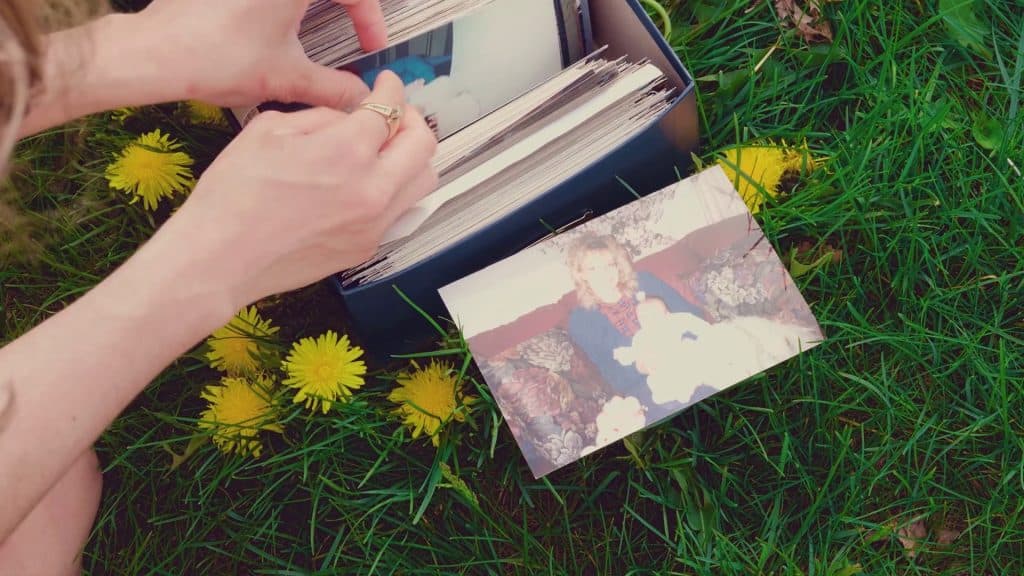
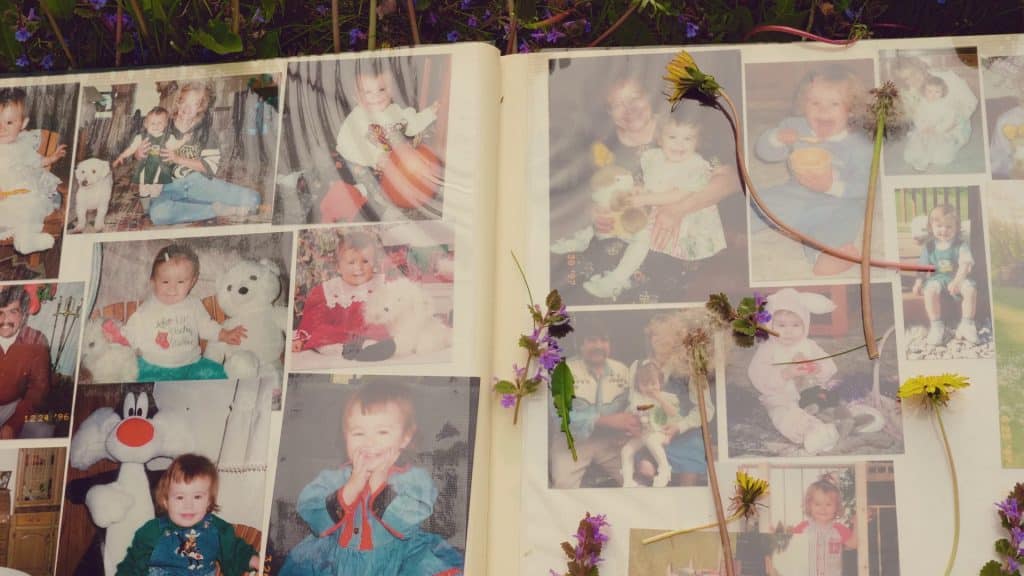
Cisneros conjures the inner world of Impermanence with her own soothingly trebley voice: “I’m looking for how much I looked at her.” This line, with its immutable sense of inspection and introspection, brings to life a meditation on 22 years of memories of Cisneros’ mother, Karen Fabian. Her life and Cisneros’ own are captured in an index of glossy, largely 4×6 photo prints from decades past on a verdant field of flora of the present.
The reality of Fabian’s loss in August 2018 came into focus during Cisneros’ altered experience with time during pandemic lockdowns. “I’ve always wanted to talk about my mom’s death, but I can’t just talk about that directly,” Cisneros says. During those spring months in 2020, Cisneros found herself gazing out the window, both intentionally and inadvertently studying patterns and the nature of change or the “seasonality of everything,” as she frames it. “[The impetus of the project wasn’t a] specific memory with my mom, but I thought a film about my mom fit very well with a film about the seasons.”
In Gaps, which screened during the 2023 Midwest Video Poetry Fest, Cisneros spliced her own writing with excerpts from English self-help author Oliver Burkeman’s musings on the perception of time (a theme Cisneros continues to explore in Impermanence). While Gaps presented the words entirely in the form of on-screen text, she chose to include steady voiceover narration in this latest work. Her inquiries read aloud, from the beginning to the last frames, reflect the interiority of the writing and the therapeutic process of art-making that unearths the enduring from the transitory. Who would Cisneros be if not for the presence of her mother (and her younger self) in these photos, stacked and arranged?
“I want to pull at the sides of the frame, just enough to get a glimpse of my family in that moment,” she says in one of the film’s more evocative moments. In conversation, Cisernos adds, “You don’t get a full look at aging or changing in any way until you look back,” alluding to the perspective she gained as she assembled the footage, photographs, and voiceover reading of her titular poem.
The dynamic between the personal and universal was also key to crafting this film’s final version. “I left the voiceovers in when I wanted to be hearing a story from me about me. And then the text on screen, I tried to make it [come across] so that the person reading it might hear their own voice in their head and be able to apply it to their own life,” Cisneros explains.
Shifting away from the text-only personal essay of Gaps, Cisneros says the use of voiceover has a simpler aesthetic origin constructed with an audience in mind, bringing them into her contemplations. “I don’t like how my voice sounds, period, I guess, when I listen back to it,” Cisneros confesses, chuckling. “But I really like the sound of a voiceover, because it allows you to watch what’s on screen and hear something at the same time. And it’s a lot easier to concentrate on both.”
In that way, Impermanence is a terrific primer for Cisneros’ various experiments in video poetry and documentary, which date back to 2016’s It Feels Like ______ and 2020’s Painting/In Mirrors. Cisneros says that when she was studying film at UW–Milwaukee from 2014 to 2018, “the most full way I could express my thoughts about basically anything, was being able to show with the video and tell with the writing that I added.” As she developed a more fully realized artistic voice, it was about bringing together these creative paths, the harmony and transcendent quality between these mediums.
As in prior years, the Midwest Video Poetry Fest is harnessing this vivacity in the marriage of spoken word and video art with two collaborative live performances. Prior to the Madison premiere of Impermanence on October 5, UW–Madison English professor Erika Meitner will read her solace-seeking poem “Touch Cave.” Meitner’s words will be coupled with admittedly “awkward” handheld public restroom footage by Michelle Marie Kelley, whose letterpress-animated Davenport (2023) has become one of the MVPF’s all-time highlights. Kelley notes in an email that her nine-year-old daughter, a piano student, is assisting in the composition of the score.

By comparison, the following Saturday’s collaboration on October 12 between poet Diya Abbas, and returning local videographer Natalie Hinckley (who worked on a live collaboration with Cynthia Marie Hoffman for last year’s MVPF), is more spiritually and politically focused. Abbas writes that their selected poem, “ars vitalia,” is “an ode to living…to re-discover that essential sound, that original call to purpose that we lost somewhere along the way trying to survive in a late-stage capitalist empire. That sound is personified as a woman, as the divine feminine…This divine feminine is every woman in our daily lives.” Hinckley’s visuals will complement those ecstatic sentiments, writing that she will create “a play of tactile experiences and elements captured with macro lenses. I will manipulate light, water, powders, [and] details of flesh to draw out internalized knots.” Hinckley describes her impressionistic approach as that of “shining a flashlight to your body, seeing it glow red, revealing blood and life.”
By curating these writer-filmmaker pairings, MVPF co-founders Rita Mae Reese and Genia Daniels have maintained a distinctly Midwestern fingerprint on the festival while still expanding its ambitious international reach. Selections this year hail from as far away as Angola (Jaliya Bird’s Heartbreak), Sweden (Andja Arnebäck and Sara Garib’s the apple and the tree), Yemen (Ahmed Abdul Raqeeb Alkhulaidi and Mariam Al-Dhubhani’s No Words), and New Zealand (Naomii Seah and Flora Xie’s Supernova), and from other parts of the US Midwest (seangarrison and Khalid Ali’s Memphis Blues).
The 2024 incarnation also finds the MVPF establishing dialogue with like-minded curators outside the region. Rana San, co-director of Seattle’s Cadence Video Poetry Festival (CVPF), made the succinct video haiku, synch : swim, which will screen shortly after Cisneros’ Impermanence on the first night, Oct. 5.
It was in Seattle at the 2023 edition of CVPF that Cisneros grasped the true resonance and impact of her specific kind of work. “That was the first time I had ever seen a whole festival about films similar to mine. It blew my mind,” she says. Reese and Daniels are cultivating a similar experience here, and a foundational home in Wisconsin for these intensely and concisely conveyed artistic statements.
The fourth paragraph has been corrected to reflect Cisneros’ 22 years of memories of her mother.
We can publish more
“only on Tone Madison” stories —
but only with your support.
Author
Related Articles
“Limerent Pittsburgh” intricately constructs a folkloric affection of place
Artist Anne Ciecko’s 2025 videopoem is a highlight among the 30 selections of this year’s Midwest Video Poetry Fest at ALL on April 4.
Lea Jacobs sheds new light on an old master in “John Ford At Work”
The UW Professor Emeritus’ new book on the storied American director coincides with a five-film UW Cinematheque series this spring.
Inspiriting radical communal aspirations: an interview with Ben Balcom on “The Phalanx”
The Milwaukee filmmaker’s latest experimental short premieres locally at the Chazen Museum during the 2026 Wisconsin Film Festival on April 12.