
Worlds hidden in (captions)
Recognizing the expressive translation endeavors of film subtitlers.
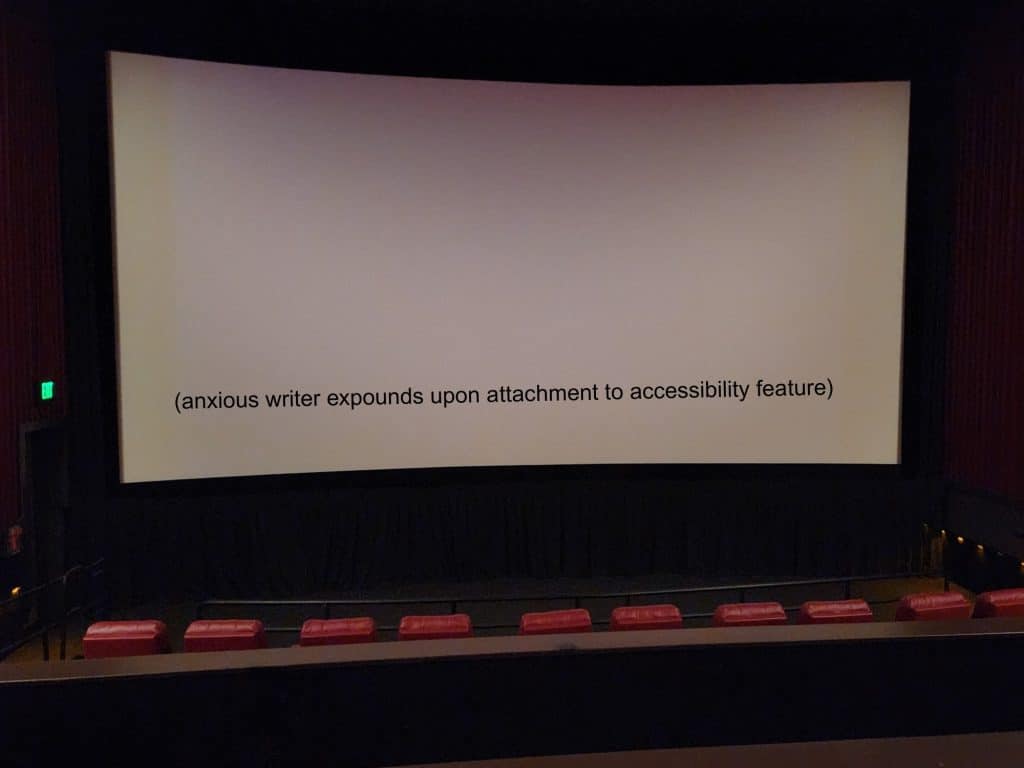
Recognizing the expressive translation endeavors of film subtitlers.

This is our newsletter-first column, Microtones. It runs on the site on Fridays, but you can get it in your inbox on Thursdays by signing up for our email newsletter.
Despite being the film editor of this publication, I have the deepest fascination with sound and music, driven by a compulsion to ascertain all that I can through recorded audio. A 10-second skip-back button for the immutable march of reality (or mad dash forward) would come in handy, because I always feel like I’ve missed a key syllabic emphasis or witty offhand comment in conversation. My richest interviews with local and national filmmakers, recorded and transcribed, tend to reveal a shared affinity for the process of sound design or scoring, as the artists themselves are multidisciplinary with backgrounds in radio, live music performance, sound editing, or even audio description.
Recently, though, I’ve become stuck in an inner monologue at the intersection of the cinema and sound worlds. My curiosity piqued at the thought of peeling back the curtain to acknowledge my relationship to the creative and meticulous but hidden work that goes into SDH (or subtitles for the d/Deaf and hard of hearing). The social media mind dictates that I lead with the eminent Lynchian example of SDH: “(ominous whooshing).”

For the past 15-plus years, I’ve been watching most English-language films at home with subtitles, and SDH is often the default option for English subs. This has become a trend among Millennials (53% of whom watch with subtitles most of the time) and Gen Z (at 70%) with the rise of streaming services in the 2010s, according to this 2022 Preply article, updated in 2024. The focus-group survey tracks that phenomenon as it relates to a variety of factors that cut bidirectionally. These include actors’ accents, rate of speaking, and dialogue getting muddled in the sound mix; subtitles also aid viewers learning a second language or with retaining focus.
I’ve ticked all those boxes in the past, and regard subtitles as a terrific accessibility feature for anyone and everyone that can help better define the margins of the world in which films or series exist. Lately I’ve burrowed into the rarified niche I would define as “parenthetically creative translation.” Those could be 1) articulating guttural utterances that are more emotional than plainly expressible in words, 2) offering adverbs and adjectives to strengthen the tone of a character toggling between addressing different people or subjects, or 3) delineating sounds that aren’t precisely discernible in on-screen spaces or those that have originated off-screen. These instances all require an intuitive input, from an often-uncredited someone or multiple people—who I’d lightly define as collaborators—to convey contextual information.
Which brings me to the catalyst to this concentration of thought (and this commentary)—watching the world premiere of American Theater (2025) in early March as part of this year’s virtual Slamdance Film Festival. The documentary, co-directed by Nicholas Clark and Dylan Frederick, showcases a tenacious, politically right-leaning theater troupe in Elders Mill, Georgia, who attempt to put on an October production of The Salem Experience, a musical about the 1692 witch trials. The film itself isn’t as concerned with moral debates as the broader, slightly ironic commentary on “it takes a village (of outcasts)” and the sorts of connections forged in arduous, time-pressed circumstances. (Sure, I empathize with some of these folks, but we don’t share a lot of common ground.)
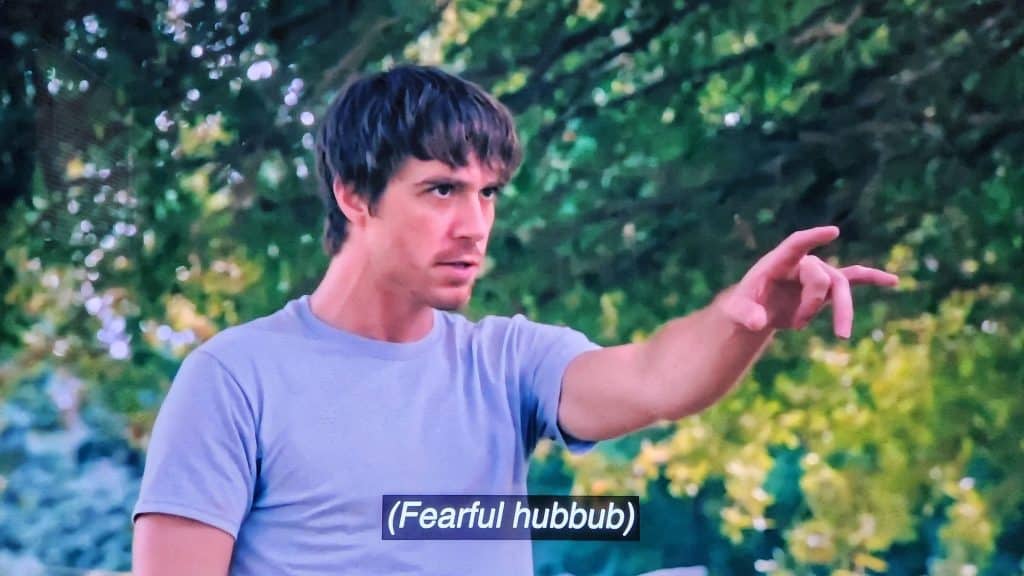
During an outdoor rehearsal scene 28 minutes in, the SDH translation of “(fearful hubbub)” appeared on the screen over a crowd of actors’ unisonous murmurs—the musical mob’s uneasiness and penchant for gossip. It’s a vivid pairing of words that I don’t think I’ve ever seen used to convey tone or action, but it seemed so perfect in the moment. Yet I can’t compliment or offer appreciation to the person or team tasked with this. And if they were acknowledged, it was, as per usual, a self-accreditation in the last frames of the end-credits crawl, which I don’t recall glimpsing.
Of course this isn’t isolated to a brand-new film like American Theater; it’s the case for the vast majority of others in past decades, who do not have subtitlers or captioners listed among the principal credits (or even in an online database). The work is decentralized and falls on people, like those at the National Captioning Institute, outside the orbit of a film’s in-house post-production crew.
Just over a week ago, when I was watching the late Jeff Baena’s directorial debut and underrated zom-com, Life After Beth (2014), another tonally complex and chaotic moment caught my attention. The Blu-ray SDH description of “(imitating whimsically)” preceded the titular zombie character (Aubrey Plaza)’s snide, monotonic mocking of her boyfriend Zach (Dane DeHaan). She babbles, “Together forever together forever together forever.” This subtitling choice is a more flawed translation of the scene and tonal intention, but chalk it up to my own peculiarities? Thinking about this moment, either exactly contained on the pages of Baena’s screenplay or beyond his scope, reinforces the film’s uncanny entanglement of personal and community tragedy that is elevated to resonant emotional horror.
The SDH minutiae in these instances pries open an interesting gateway between artistic mediums. Primarily, though, these parenthetical subtitles exist as a means of accessibility, to help as wide a swath of people as possible to appreciate all the contextual clues that are communicated audibly (in spite of the notoriety of subtitles erroneously or unflatteringly defining ♪ music genres ♪, as my friend JoAnne Powers has pointed out in personal conversation).
These recent fixations and my long-standing at-home practice of watching with subtitles have left me wondering about the discrepancy between viewing experiences in different environments. Why is watching an English-language film in theaters—whether in Madison or anywhere nationwide—without subtitles so frequently the default option? The first time I recall noticing open captions in a film listing came through WUD Film several years ago, when the committee would host up to three showings of a new film over the weekend at the Marquee Cinema in Union South. Their final screening on Sunday afternoon would be reserved for open captions. These days, WUD’s programming is somewhat abridged, but I have noticed the committee is still hosting new Friday night films with open captions on occasion. Take this past semester’s timely Conclave (2024) on the last day of February (a film that actually begins with a long string of sound captions before any dialogue is spoken) and vigilante actioner Monkey Man (2024) in April.

AMC Fitchburg 18 has also been committed to open-caption screenings, though the number seems to fluctuate depending on the day. Last Friday, May 9, four new releases (many of the action variety) were advertised to screen with open captions—Thunderbolts* at 1:30 p.m., Fight Or Flight at 2:10 p.m., Shadow Force at 2:30 p.m., and Clown In A Cornfield at 5:30 p.m. The following day, only the Shakespearean musical Juliet & Romeo had an open-captions screening at 3:45 p.m. AMC had replaced the open captions listing for the English-language slasher, Clown In A Cornfield, at 5:30 p.m. with one that featured Spanish subtitles. On Mother’s Day, AMC was not offering any open-caption screenings. Still, even if it’s seldom offered, and largely during the afternoon hours, the magical bastion of AMC is providing the accessibility feature.
So, if this column may serve a more inclusive, relevant purpose beyond personal reflection of an idiosyncratic fascination, it can be to nudge other campus and downtown spaces like the UW Cinematheque (4070 Vilas Hall) and Madison Museum of Contemporary Art (MMoCA) to at least consider or even formally poll people on having additional screenings with captions—or continue with one-time screenings that offer open captions in English or Spanish. Given the popularity among younger generations—who we all want to uphold the moviegoing tradition, and comfortably develop etiquette in the shared cinema space—I might argue that it’s imperative.
Seeing as we are in the lull of May with several campus-affiliated venues on hiatus, for now it’s simplest to encourage readers to try watching a film they otherwise wouldn’t at home with a closed caption or SDH option—on a streaming service, 4K Blu-ray, old DVD, or even a VCR’s CC function for an analog tape. Even if you’re not someone who’s stuck inner-monologuing about sound accessibility features, may the effortless action of switching on the subtitles stir some curiosity and appreciation within you, beyond the boundaries of any particular film.
We can publish more
“only on Tone Madison” stories —
but only with your support.
Author
Related Articles
Starter homes? No, we need starter apartments
As homeownership continues to be out of reach for too many Madisonians, we should build more owner-occupied, multi-family housing.
Madison needs a wake-up call
The longer we pretend this City is a progressive haven, the more people will be harmed.
Stop spotlighting new films by known abusers
Madison boasts a dynamic movie culture, yet still needs programmers and community voices to facilitate change.