
Woody Allen is not an “international discovery”
Asking UW Cinematheque staff to reconsider their June 20 screening of Allen’s latest movie, “Coup De Chance.”
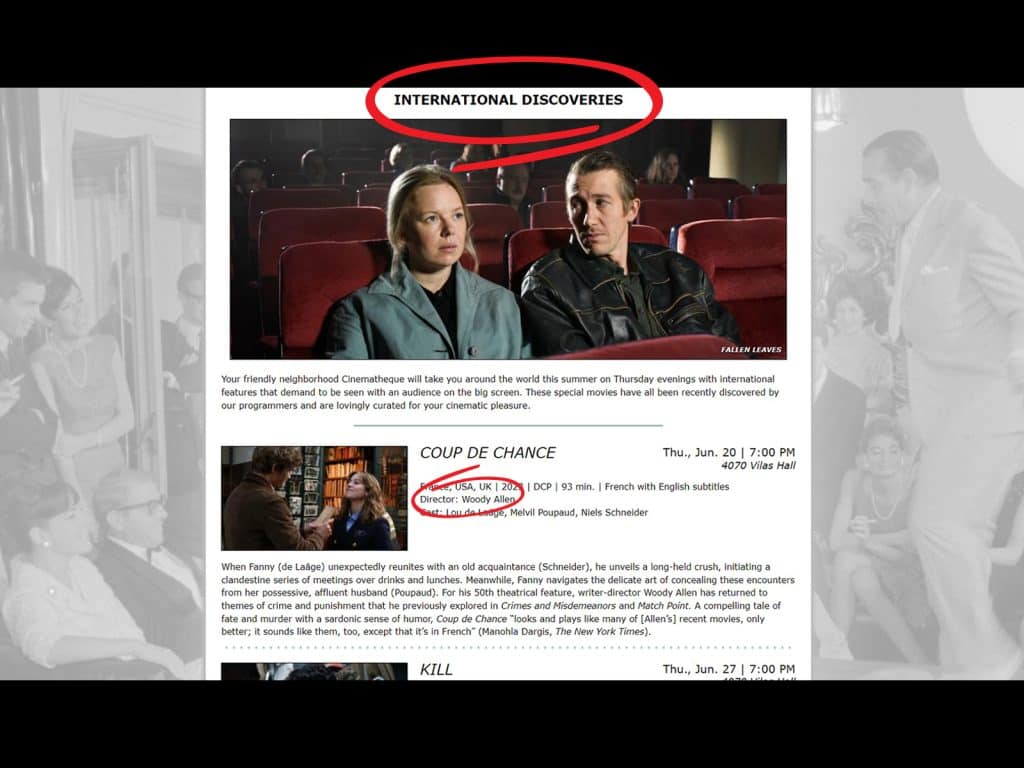
Asking UW Cinematheque staff to reconsider their June 20 screening of Allen’s latest movie, “Coup De Chance.”
If you generally keep up with Tone Madison‘s film section, around this time of the spring (the interim, if you will), you might expect us to drop a solid encapsulation of UW Cinematheque’s summer calendar. I’ve written a few of those broad previews in the past, most enthusiastically when theaters reopened in summer 2021.
The Cinematheque primarily screens movies for free during a majority of weekends out of the year (something like 36 or 37 out of 52), opening its doors to the public at 4070 Vilas Hall on the UW–Madison campus, usually at 7 p.m., and hosting screenings at other venues, including the Chazen Museum of Art.
In the nearly 14 years I’ve lived in Madison, I’ve found Cinematheque to be an unfailing resource for cinema-lovers on a budget (more than ever these days), or anyone who wants to watch a feature outside the stream of new tentpole releases flooding into commercial venues. You can see the face-value of this summer season’s six-film Wednesday series dedicated to the late scholar David Bordwell. In a speech during the opening night of the 2024 Wisconsin Film Festival, Artistic Director Mike King revered him as someone who sustained a significant facet of Madison’s film-culture identity for decades.
But before our film team rushes into previewing any individual screenings Cinematheque has planned for the whole of summer 2024, I personally have a few questions.
Peek at Cinematheque’s “International Discoveries” series on Thursdays, and the first feature on the list, screening June 20, is Coup De Chance (Stroke Of Luck) by Woody Allen. Huh? Forgive my misgivings, but the inclusion here of one of the most recognizable names in American cinema, dating back to 1977, seems misplaced. Coup De Chance was slipped into this series on a technicality, because it was shot in Paris during the autumn months of 2022 with a French cast. But the fact that Allen hails from America is actually a lesser problem. His work and public image since the early 1990s—when the writer-director began an affair with the adoptive daughter, Soon-Yi Previn, of his then-partner Mia Farrow—are contentious to say the least. And that is to ignore critical and cinephilic reevaluation in the wake of #MeToo more recently.
I’m not here to sort through that turmoil or lob my own suspicions at Allen or anyone else in his personal orbit, because reporters and even filmmakers have chronicled the extensive sexual abuse allegations against Allen in unpleasant detail. I am approaching my inquiry more from the point of view of a regular or occasional moviegoer: what is the intended or unintended message of this programming choice for a predominantly liberal, socially conscious audience?
The series title “International Discoveries” implies the discovery of visions of new talent in the director’s chair. Or maybe films that originate from a part of the world not known to the West for its cinema. And yes, it could also just be that a film’s subject matter is fresh and lively—a particular work from an old master achieving a newfound redemptive quality (see: an Independence Day screening of Aki Kaurismäki’s Fallen Leaves, for which I have many kind words). Given the thematic links that UW Cinematheque’s promotional copy draws between Coup De Chance and Allen’s Crimes And Misdemeanors (1989) and Match Point (2005), in addition to New York Times critic Manohla Dargis’ excerpted quote about the film “looking and playing like many of [Allen’s] recent movies, only better; it sounds like them, too,” discovery doesn’t seem remotely applicable.
It’s impossible to argue the importance of Allen’s style and work to the American movie landscape over the past five-plus decades, and I can’t disentangle that from even my own strange, self-deprecating comedic sensibility. I, myself, have logged 20 of Allen’s 50 features since the mid-2000s, but abruptly stopped watching at the midpoint of last decade for a myriad of reasons. Mainly, since the year 2000, Allen has exhausted the well, and neutered his own type of neurotic comedy, drama, and mystery genre-mingling that defined the evolution of his heyday, from subverting 1970s slapstick to ’80s melodrama. But the problem here isn’t even a question of quality or faulty, formulaic revitalization; it’s one of endorsement.
If the Cinematheque or another campus partner wants to screen Annie Hall, the influential (and frankly terrific) mockumentary Zelig (1983), the absurdist Russian literary satire of Love And Death (1975), or the beautiful ode to sisterly bonds in Hannah And Her Sisters (1986), I don’t think programmers should have any qualms about doing that. Those films are captivating and moving on multiple levels. They’re still significant to bridging eras of film history when Allen wasn’t mired in scandals. But in 2024, now in his late 80s, what is Allen’s present influence on any emergent wave of cinema?
In light of Allen’s problematic personal profile, and Madison audiences’ varied awareness of that, the programming choice of Coup De Chance comes across to me less like support of the work itself, and more like an obstinate prod, even if it sincerely is not. It’s also, not even by my own admission, a Woody Allen template; the aforementioned write-up and Dargis quote let us know exactly what to expect. And we’ve seen that many times over. And for those who haven’t, there are simply other, better introductory options in his canon.
For me, this would also be a little less irksome if this bastion of campus cinema was showing more films directed by women or nonbinary people. But this year has been a boys’ club. Only two out of 42 films on Cinematheque’s spring calendar were directed by women, and only one out of 18 is this summer. That’s three out of 60, an average of 5% for 2024 thus far (not including Cinematheque programmers’ overlapping work with the Wisconsin Film Festival, which was, by my own calculation, considerably higher at 28% during its eight-day run this past April). Those simple figures don’t tell the full story of screenwriting and production credits, but that key creative representation is a part of the equation behind a famous Roger Ebert quote: “For me, the movies are like a machine that generates empathy.”
Here’s a short list of new (and even newer) films that I think would comfortably fit into the Coup De Chance slot, should UW Cinematheque staff choose to pivot away from a new film by Woody Allen before its screening date of June 20. These 10 features more clearly represent “international discoveries” both in literal terms but also in slightly more figurative ones: Alexandre Koberidze’s What Do We See When We Look At The Sky? (2021), Rita Azevedo Gomes’ Kegelstatt Trio (2022), Huang Ji and Ryuji Otsuka’s Stonewalling (2022), Carla Simón’s Alcarràs (2022), Rosine Mbakam’s Mambar Pierrette (2023), Helena Wittmann’s Human Flowers Of Flesh (2023), Yui Kiyohara’s Remembering Every Night (2023), Elene Naveriani’s Blackbird Blackbird Blackberry (2023), Jiajun “Oscar” Zhang’s All, Or Nothing At All (2023), and Angela Schanelec’s Music (2023).
If we want to robustly define Madison film culture moving forward, maintain the high quality of access to hard-to-see films for people in the downtown vicinity, and encourage new generations to embrace the rewarding ritual of moviegoing, we should sincerely commit to elevating the profiles of diverse filmmakers who most clearly speak to spirited and equally diverse points of view. Programming shouldn’t incidentally placate the nostalgic few who are thrilled by the prospects of the 50th, and maybe last, Woody Allen movie in a theater.
We can publish more
“only on Tone Madison” stories —
but only with your support.
Author
Related Articles
Three video artists tap into personal histories in the 150 Artists x 150 Years exhibition
Chele Isaac, Toby Kaufmann-Buhler, and Aaron Granat reveal the creative depths of their works, which are on display through February 28 at Central Library.
Video: Sizing up local screening events and prominent performances of 2025
A chat with Josiah Wampfler at OCA Media about our favorite movie-going experiences and acting roles of last year.
Stop spotlighting new films by known abusers
Madison boasts a dynamic movie culture, yet still needs programmers and community voices to facilitate change.