
Wisconsin energy utilities sacrifice affordability and sustainability to fuel the AI gold rush
Gas plants used to power data centers increase costs for consumers, risk of exposure to pollutants, and accelerate the harms of climate change.
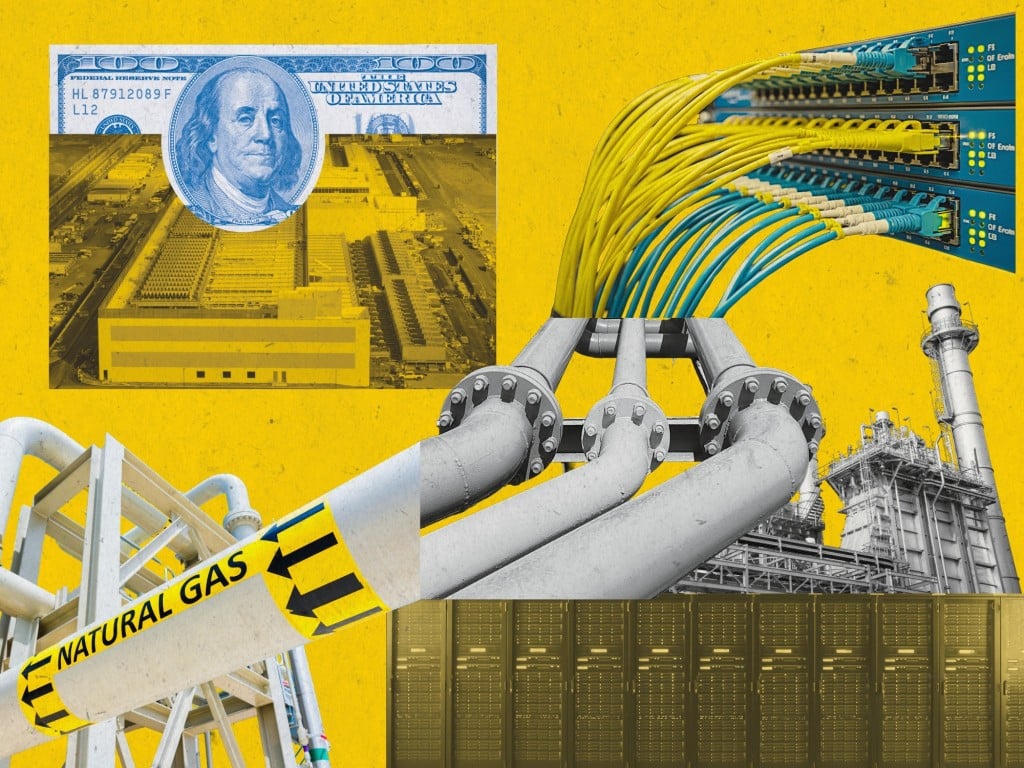
Throughout Wisconsin, data centers have struck an unusually bipartisan nerve. Residents in all corners of the state have protested and, in several notable cases, successfully thwarted the construction of data centers in their communities, motivated by worries ranging from rising electricity costs to the loss of treasured rural landscapes.
And while Big Tech and AI boosters enjoy the enthusiastic support of the Trump administration, both Republicans and Democrats in the Wisconsin legislature have now rushed to propose their own versions of bills to put guardrails on the so-called AI gold rush. In January, the Madison City Council went a step further, proposing a temporary moratorium on all new data center construction.
Important distinctions in these approaches aside, they demonstrate the pressure that elected officials feel from on-the-ground resistance to Big Tech’s takeover of Wisconsin’s energy grid.
Utility companies have tried to manage opposition by telling ratepayers that their fears of soaring electricity bills are unfounded: they can guarantee Microsoft, Meta, and other “large load” customers pay their fair share for the huge amounts of energy and infrastructure data centers require. Two such proposals submitted by We Energies and Alliant Energy will be heard by the Public Service Commission (PSC), the government body responsible for regulating utilities, on February 10 and 24.
But utility companies’ promises of self-regulation belie a vested interest in hasty data center buildout and fossil fuel power generation—and the communities most affected by energy costs, air pollution, and climate change will pay the highest price.
How energy utilities cash in on data centers—and make the public pay
A recent report published by the Wisconsin Policy Forum, a nonpartisan research organization, found that statewide energy sales have decreased by 9% since 2005—a trend that is good for reducing greenhouse gases, but not so good for the profit margins of utility companies.
Energy-hungry data centers bolstering the AI boom have arrived at a seemingly perfect time for energy utilities worried about contracting growth and competition from distributed renewables.
In 2023, Microsoft announced their plans to build a massive data center in Mount Pleasant, the company’s largest AI “campus” to-date. Overall, at least seven hyperscale data centers, including controversial projects planned by Meta and OpenAI/Oracle, have been proposed or approved across the state. Proposed facilities in Port Washington and Mount Pleasant are estimated to consume 3.9 gigawatts of power alone, or more than all of the homes in Wisconsin combined according to analysis released by Clean Wisconsin.
A huge jump in demand requires an attendant increase in power generation: good news for energy utilities.
Unlike traditional corporations, investor-owned utilities (IOUs) are granted a government approved rate of return for their investments in infrastructure—in Wisconsin, that rate is 9.8%, which consumer advocates argue is unnecessarily high. While utilities don’t collect profits on operating costs, like employee salaries, they can and do make profits from investments in physical assets. This means that the most lucrative—and investor-friendly—move for a utility is to expand, if not overbuild, infrastructure and pass those costs onto consumers through rate hikes.
Renewable energy is the cheapest and quickest way to deliver new energy to the grid to meet soaring demand. But IOUs prefer to build natural gas plants because they are more infrastructure intensive and costlier to build—meaning higher bills for ratepayers and more money for shareholders.
The volatility of gas prices is a big part of the reason energy bills are so high right now. Rather than develop renewable energy sources that are cheaper and healthier, utilities lock customers into paying higher bills to fund costly fossil fuel power generation. And whether or not the AI bubble bursts, the methane gas plants they build to meet data center demand will make them a guaranteed profit for decades to come.
Case in point: customers are still paying We Energies a guaranteed return on a coal power station that shuttered in 2018—and will be until at least 2039. By the end of the year, customers will inherit a tab upwards of $1 billion dollars for retired coal plants.
While ratepayers worry about growing energy bills, utility companies are making massive profits across the nation. According to a recent study published by the American Economic Liberties project, those excess profits amount to $50 billion annually.
Wisconsin is no exception. WEC Energy Group, We Energies’ parent company and the largest electricity provider in the state, made $1.5 billion in profits in 2024. Things are going so well, they announced a 6.7% increase in payouts to shareholders at the end of 2025. And Alliant Energy, the service provider to Meta’s hyperscale data center, made $690 million in profits in 2024.
Worse yet, Wisconsin energy companies wield record profits to stall the clean energy transition—and to hire lawyers who defend increasing energy costs, all on the customers’ dime.
Tax breaks for big tech, rate hikes for the rest
The growth of data centers is often framed as an inevitable force sweeping over the state—and the rest of the country. But utility companies and politicians have gone out of their way to attract developers to Wisconsin.
In the 2023-2025 budget, the legislature included a sales and use tax exemption for data centers, estimating that the state would lose approximately $8.5 million during the initial construction phase of qualifying projects. The eligible hyperscale data centers currently under construction allegedly received $40 million in tax breaks in 2024 alone. That means tax breaks in the millions are diverted from government revenue and delivered directly to some of the richest, most influential tech companies in the world: Microsoft, Meta, and Oracle.
State and local officials have touted the economic benefits of proposed and planned data centers—these benefits depend on the AI bubble staying intact and overstate the impact of the relatively few permanent jobs that these massive industrial facilities bring. A study published in January 2026 estimated that for every $13 million invested in data centers in Virginia, only one permanent, full-time job was created.
The supposed benefits also externalize, or ignore, the environmental and health costs imposed by data centers.
Meanwhile, Wisconsin ratepayers are already paying some of the highest costs for electricity in the Midwest, and rates across the country are rising. Just last year, the Public Service Commission approved $300 million rate increases for Alliant, We Energies, and MGE across the next two years.
These rate increases, in part, fund the expansion of fossil fuel infrastructure to meet the projected—and unprecedented—energy demands of hyperscale data centers. They also help to fund profits for IOU shareholders, even as one in four Americans can’t afford their electricity bills.
As energy bills climb, spurred by data center construction and high fossil fuel prices, residents are forced to choose between heating their homes and paying for other essentials, like groceries and healthcare. Conditions are made worse by the elimination of programs designed to help reduce energy costs. Last year, Trump fired the entire staff of the Low Income Housing Energy Assistance Program (LIHEAP) and tried to eliminate funding for 2026. In 2024, LIHEAP provided $127 million in funding to Wisconsin residents.
According to data shared by Atlas Public Policy, Trump also canceled over $40 million in grant funding from the Inflation Reduction Act that was dedicated to solar development, energy audits, and other efficiency measures to help reduce energy burdens for low-income residents in Dane and Milwaukee counties. In Milwaukee, the funding was dedicated specifically to helping predominantly Black and Latino communities, who face the brunt of pollution in the city, weatherize their homes and reduce their energy costs.
With assistance on the chopping block, unaffordable energy bills are likely to affect a wider net of residents, and make high energy burdens, which disproportionately affect communities of color and low-income residents, more punishing.
Fast-tracking data centers, fast-tracking fossil fuels
Last year, We Energies was approved to build two new methane gas plants, announced following Microsoft’s $3 billion investment in Mount Pleasant. The new plants in Oak Creek and Paris are estimated to release nearly two million tons of CO2 equivalent annually, and a 2025 study estimated that the health costs of these two methane plants alone would range between $119-$192 million annually. Those estimates represent cancer, chronic health issues, and premature death for the thousands of residents living near these plants.
We Energies has also submitted requests to acquire two new “wholesale merchant” gas plants being built by Invenergy, a private energy company based in Chicago. In Darien, Invenergy is planning a 324 megawatt (MW) methane gas plant—the Foundry Ridge Energy Center—designed to help meet energy demands during peak times, like hot summer days.
Darien residents have opposed construction of the new plant, expressing concerns about pollution affecting their families and farms. Brittany Keyes, Clean Air Policy Manager with Healthy Climate Wisconsin, explained that the regulatory approval process for merchant plants is less stringent, allowing We Energies to expand natural gas energy generation without the same level of public input or scrutiny.
In Janesville, a proposed hyperscale data center to be built on publicly-owned property, formerly a GM plant, is at the center of another local battle. Further south in Rock County, Beloit residents live next door to West Riverside Generating Station, one of the most carbon-intensive methane gas plants in the state. Just last year, Alliant was approved for an expansion of their Rock County gas plant—the kinds of infrastructural investments, and additional sources of pollution, that are more likely with data center growth.
While touted by utilities as a cleaner power source, natural gas, or methane, has a carbon footprint that rivals coal—and, as one recent study found, in its liquefied form is actually 33% worse. Methane gas plants are also major sources of particulate matter, sulfur dioxide, and ozone, which contribute to respiratory and other health complications.
Coal, one the most expensive and dirtiest energy sources, is also getting a new lease on life thanks to data centers. We Energies also announced they would delay the closure of their Oak Creek coal power plant, located just south of Milwaukee, until the end of 2026. Similarly, Alliant, which helped to attract Meta to build a hyperscale data center in Beaver Dam, will extend operations at the coal-powered Columbia Station plant until 2029 and at the coal-powered Edgewater Station in Sheboygan until 2028.
Meanwhile, dozens of renewable energy projects across Wisconsin are still waiting to be connected to the grid. Utility companies, though, are jumping the queue to fast-track the interconnection of new gas plants while clean sources of energy are sidelined.
Proposals to preserve big tech’s not so fair share
With utility companies facing formidable pushback from Wisconsin residents, We Energies, the state’s largest energy provider, filed a proposal to require special rates for “large load” customers. In theory, the proposal is meant to require big tech companies to pay their “fair share” for their additional energy demands they bring to the grid.
But both PSC commissioners and clean energy advocates expressed serious concern about loopholes in the proposal.
Under We Energies’ large load tariff agreement, companies that use upwards of 500 MW of power would be responsible for covering 75% of new power sources. The other 25%, as well as all fuel costs, will be passed onto ratepayers—a betrayal of the commitment to compel big tech companies to fully cover their share.
By contrast, Ohio Power Company, the largest energy utility in the state, instituted a “large load” tariff for customers whose energy demands exceed 25 MW—or 20 times less power than the qualification proposed by We Energies. In Texas, one of the leading states for data center development, the legislature passed a bill that defined “large load” customers as those that consume 75 MW and higher. We Energies’ “large load” tariff leaves Wisconsin residents vulnerable to shouldering the burden for data centers that still consume large amounts of energy, but less than the exceptionally high 500 MW threshold.
As the proposal currently stands, the timeline for the cost-sharing requirement expires after 10 years, whereas the typical lifetime of a methane gas plant is at least 30 to 40 years. Advocates worry that the 10-year limit doesn’t sufficiently protect ratepayers from stranded assets if data center proposals collapse or companies leave the state.
The public can participate in the PSC’s public hearings for We Energies’ proposal on Tuesday, February 10, 2026 at 1 p.m. and 6 p.m.—and can submit public comments until February 17, 2026 (details and links below).
The details of Alliant’s “individual contract rate service agreement” for Meta’s planned facility in Beaver Dam are shrouded in secrecy, and it remains unclear just how much energy Meta’s data center will use, despite Midwest Environmental Advocates’ lawsuit to compel the release of projections to the public.
However, what is clear is that neither proposal is designed to fully shield ratepayers from big tech’s drain on the grid.
In testimony submitted to the PSC, Clean Wisconsin argued that Alliant’s proposal failed to “adequately protect other ratepayers.” The environmental organization’s concerns included the short length of the contract, an insufficient contract termination fee, and the risk of customers paying higher rates. Hearings for Alliant’s proposal will be held on Tuesday, February 17, 2026 at 1 p.m. and 6 .p.m., and public comments will be accepted until February 24, 2026.
The future of data centers in Wisconsin
Despite utility companies’ apparent attempts to preempt legislative regulations, many politicians have now pushed for new rules to stipulate terms for data center construction and grid connection.
Republicans fast-tracked AB 840 through the Assembly where it now awaits a vote in the Senate. Democrats introduced AB 722 in early December, a bill that similarly attempts to regulate data centers, but includes protections for workers, a provision to require 70% of data center energy come from renewable sources, and a large customer fee to fund sustainable development and energy assistance.
As Keyes explained, these pieces of legislation don’t go far enough to protect residents from pollution or rising energy costs—and data centers are making the already difficult task of decarbonization “worse, if not impossible.”
Locally, the Madison City Council proposed a temporary moratorium on new data center construction, one that advocates hope will be replicated by other municipalities. Brett Korte, staff attorney for Clean Wisconsin, said the organization is calling for state leaders to take a pause and fully assess the impacts before “bending over backwards to roll out the red carpet” for these projects.
The future of data centers in Wisconsin remains uncertain, just like the AI industry itself. Economists and investors warning of an AI bubble have expressed growing concerns over AI companies’ circular financing and low potential for profitability.
But even if the AI bubble doesn’t burst—and even if legislators find a way to guarantee big tech pays for their share of electricity and infrastructure—Wisconsin residents will be saddled with new sources of pollution that accelerate the unfolding chaos of climate change. This is to say nothing of the other harms that AI’s “success” poses, such as automating denial of Medicare claims or degrading the information ecosystem.
And if the AI bubble does burst and data centers are sold for parts, the fossil fuel energy infrastructure built to prop them up will live on. And the costs of these methane gas plants will not only hit the already-strained pocketbooks of customers, but will poison the air residents breathe.
Sidestepping the input of their ratepayers, utility companies have decided to trade the known benefits of climate change mitigation and clean air for the speculative benefits of AI. The profit motive—and the growth imperative—demand it.
Upcoming Public Opportunities to Weigh-In on Data Centers:
Tuesday, February 10 at 1 p.m.: PSC We Energies (WEPCO) “Large Load Customer” Tariff Public Hearing
Tuesday, February 17: We Energies (WEPCO) public comment period closes
Tuesday, February 24 at 1 p.m.: Alliant PSC public hearing
Tuesday, February 24 at 6 p.m.: Alliant PSC public hearing
Tuesday, March 3: Alliant public comment period closes
Who has power in Madison,
and what are they doing with it?
Help us create fiercely independent politics coverage that tracks power and policy.
Author

Related Articles
Wisconsin communities face scrutiny over data center secrecy
The town of Beloit is the fifth Wisconsin community with an NDA for a possible data center.
Eyeing voting rights, liberals aim to secure Wisconsin Supreme Court through 2030
In the April election, Wisconsin liberals are hoping to expand their majority on a body that could be a critical backstop for voting rights during the next presidential race.
Police surveillance technology needs proper accountability
Grassroots resistance against Flock cameras are writing the blueprint for comprehensive reform.