
We’ve witnessed a true test of the quality of Madison Alders
The Charles Myadze controversy has revealed how low some Common Council members will go.
The Charles Myadze controversy has revealed how low some Common Council members will go.
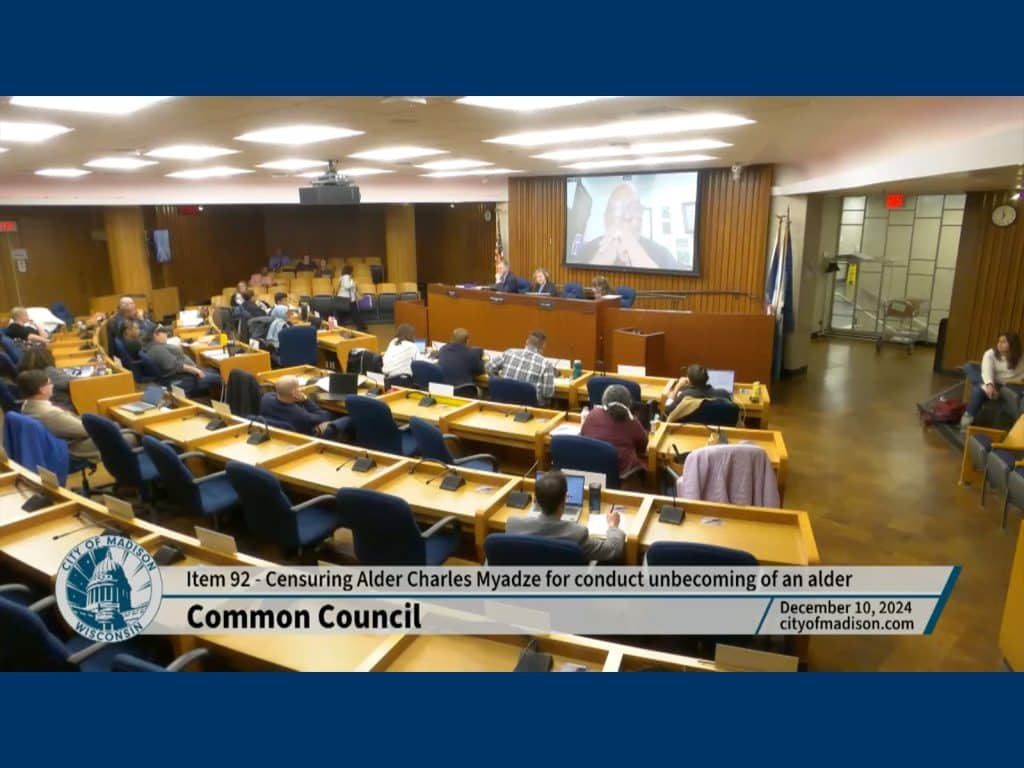
We now have a nice rock-bottom minimum standard for serving on the Madison Common Council, thanks to the December 10 adoption of a resolution censuring District 18 Alder Charles Myadze. The censure served as a formal rebuke of Myadze, amid numerous allegations that he harassed and abused women in both personal and professional situations.
Simply put: There are differences between the censure and the criminal process Myadze now embarks upon in the wake of his December 12 arrest on domestic violence charges. Alders who understood those differences and articulated them clearly are fit for public office. Alders who played rhetorical games and tried to blur those differences are not.
The 14 Alders who sponsored the resolution (along with Mayor Satya-Rhodes Conway) did the right thing in standing up for District 2 Alder Juliana Bennett, who came forward with accounts of Myadze sexually harassing and threatening her. They did the right thing by supporting the leadership of District 8 Alder MGR Govindarajan, who introduced the resolution. It’s nice to see a majority of the council backing up the two youngest Alders. Now, this is not unqualified praise of every Alder who cleared the rather minimal bar of declaring that it’s not OK for an Alder to behave as Myadze is accused of behaving. (Hell, Myadze’s misleading statements about the results of a City investigation should’ve been another reason for censure, but let’s not get our hopes up.) Nor is it an unqualified condemnation of all the Alders who voted against the resolution or abstained from voting in apparent protest. Several of them expressed their misgivings about the tangled racial politics of the council and mixed feelings that derive from their own experiences as survivors. That is not for me to challenge.
What I can’t abide from the censure’s opponents is the bizarre and pitiful dissembling about what the censure actually meant and what the Council’s role actually is. They conflated the censure with a criminal conviction, complaining that it “punishes” Myadze without due process. In fact, the censure is a symbolic declaration with no binding consequences. (Also, is it asking so much that alders know the difference between “censure” and “censorship”?) They conflated the scope of the Council’s role in censuring a member with the much narrower scope of the controversial investigation into Myadze’s behavior, which determined that his conduct didn’t violate specific harassment policies in specific ways. Worse, they claimed that the censure was a departure from the bounds of the Council’s role. This is an egregious and inexcusable lie.
There was so much quibbling, during the Council meeting, about legal technicalities that really aren’t that relevant to the censure itself. It should be a given that we hold elected officials to a higher standard than “didn’t technically violate the law.” Granted, in this day and age, that horse has left the barn, then returned to burn it down. Still, come on. All of these people understand the difference between conduct that violates a specific law and conduct that warrants an expression of disapproval. Specifically, the resolution declares that Myadze’s behavior “failed to meet the professional and ethical standards required of a council member.” It is purely symbolic. It has no legal impact and inflicts no direct consequences or penalties. Rhodes-Conway stripped Myadze of his committee appointments, in a separate action. Appointees serve at the pleasure of the mayor, who also appointed Myadze to those committees in the first place.
During the December 10 meeting, District 20 Alder Barbara Harrington-McKinney—who ended up walking out just before the actual vote—said that the censure’s supporters “convicted” Myadze and that the censure was “outside of what should be considered.” District 14 Alder Isadore Knox implied that the censure was somehow an affront to the rule of law (to the extent that one can make sense of his arguments at all) and called it a “political assassination” and an “inquisition.” District 12 Alder Latimer Burris recused herself and District 7 Alder Nasra Wehelie abstained, both after sharing some misgivings but not quite reaching the same heights of disingenuousness and hyperbole.
At worst, Myadze has been judged in the court of public opinion, or at least judged publicly by his colleagues. That’s something you sign up for when you get into politics. And if Myadze and Harrington-McKinney want to accuse someone of undermining due process, they could look in the mirror. They’re among the council’s staunchest defenders of the Madison Police Department, and of a criminal justice system that corrodes due process for thousands of ordinary residents. It is no small irony that Myadze now stands before that system, accused of battering Gloria Reyes, a former police officer.
Keep in mind that Harrington-McKinney and Knox kept making their outlandish arguments in Myadze’s defense even after Bennett suffered a family emergency during the meeting. Bennett’s father, who attended to speak on her behalf, had a heart attack in the meeting chamber. She accompanied him to the emergency room. He survived, and Bennett rejoined the meeting remotely, enduring all this while still fighting to hold Myadze accountable. In that moment, how can anyone on that body extend so much compassion to Myadze but so little to Bennett?
Knox went on to say: “It is not our job to judge each other. It’s those residents, those citizens we represent. They judge us, and they judge at the ballot box.”
This is a deeply misleading, simplistic, and infantilizing way to delineate between Alders’ roles and voters’ agency. We have accountability measures for government officials outside of elections, precisely because the public deserves additional recourse. Governing bodies of all kinds—city councils, state legislatures, nonprofit boards, corporate boards, and so on—routinely set all kinds of rules about how their members are expected to behave. They make decisions about how to respond when a member is accused of violating those rules. Sometimes it is their job to judge, especially when one Alder is accused of harassing another in work settings.
The Madison Common Council itself affirmed this in January 2023, when it unanimously adopted its Elected and Appointed Official Code of Ethical Conduct. In fact, the whole point of the measure was to ensure that Alders, Mayors, and appointed committee members have to follow the same rules as rank-and-file City employees. That included Administrative Procedure Memoranda 3-5 (APM 3-5), the specific rule at issue in the investigation of Myadze. It provides for sanctions, including “formal censure,” “removal of a committee member,” and—in rarer cases defined by Wisconsin law—removal from the Common Council.
The plain language of this policy makes it clear that Alders were indeed doing their job here (most of them, at least). The censure is entirely within the scope of a policy the Council unanimously approved when 12 current Alders were already in office, including Harrington-McKinney. This also includes Myadze himself, who, unbelievably, cited that very policy during his comments at the December 10 meeting.
Keep in mind that the investigation concerned itself only with whether or not Myadze violated APM 3-5 and state and federal employment laws. It did not set out to determine whether or not Myadze violated the Elected and Appointed Official Code of Ethical Conduct more broadly. This is an important distinction. APM 3-5 defines harassment and discrimination in lengthy, detailed terms. It’s so complicated and so full of potentially exculpatory technicalities that the City has a 35-page guide to accompany it.
The Code of Ethical Conduct makes Alders subject to APM 3-5 itself, but also goes on to prohibit bullying, harassment, and discrimination in broader terms.
For instance, APM 3-5 defines “harassment” as “unwelcome severe, pervasive, or persistent conduct that unreasonably interferes with an employee’s work performance or conduct that is severe or pervasive enough to create a hostile work environment, or conduct that directly affects an employee’s condition of employment.”
The Code of Ethical Conduct defines “harassment” as “repeated or egregious unwelcome, intimidating, hostile or offensive actions, words, jokes or comments based on any protected class status or statuses.”
This sets a more generalized standard. One could violate the Code without violating APM 3-5. “Severe,” “pervasive,” and “hostile work environment” proved to be crucial sticking points in the investigation. The investigators were tasked with deciding not just if Myadze’s behavior was “unwelcome” or “offensive,” but whether that behavior was so “severe” and so “pervasive” that it made it harder for the complainants to do their jobs and/or made their overall work environment hostile. The Common Council as a body can consider the situation outside those strict parameters. Alders know this.
The misframing of Myadze’s censure reached an unhinged climax well before the meeting, when Harrington-McKinney took to Nextdoor and used Martin Niemöller’s “First they came” to illustrate her view of the situation. Niemöller wrote the poem in 1946 to capture his own complicity during the rise of the Nazi regime and the Holocaust. Harrington-McKinney even offered her own updated version. No, I am not kidding:
When they came for
Alder Skidmore, and I did not speak out.
Then they came for Alder Halverson, and I did not speak out.
Now they come for Alder Myadze; and I must speak out.
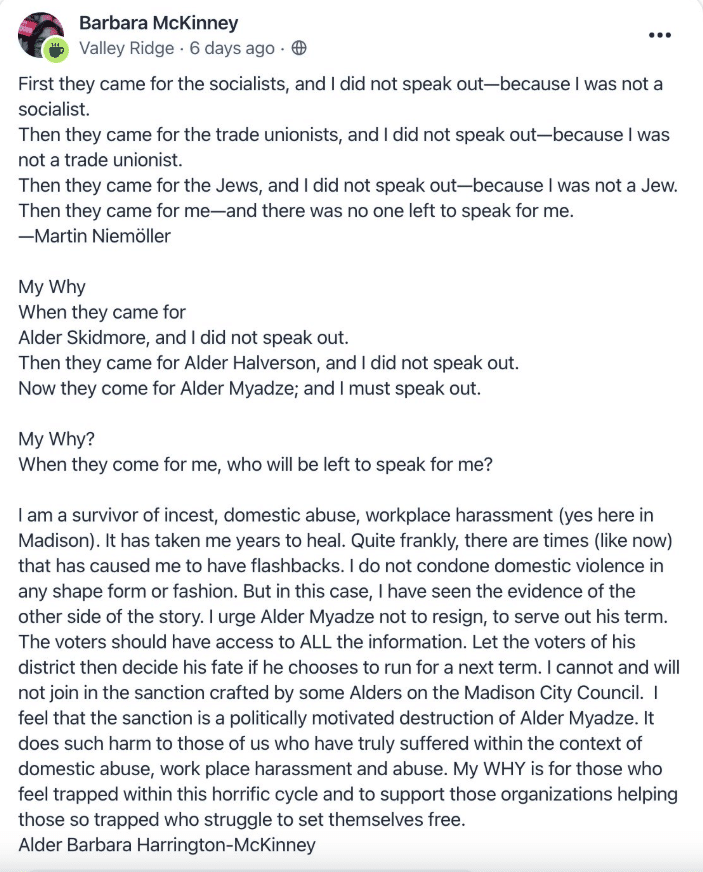
Paul Skidmore lost re-election after a hot mic caught someone calling a local activist a “cunt” during a Council meeting (Skidmore denied it was him, and an investigation yielded inconclusive results). Gary Halverson resigned after it turned out that he’d been a dues-paying member of a hate group. Myadze decided not to run for reelection after six women accused him of abuse and/or sexual harassment. Somehow all this parallels repression and genocide.
Harrington-McKinney’s post is one of the wildest things that has happened in City politics in a long time, an outlier even among the Common Council’s outliers. The more mundane distortions of Alders who misunderstand or misrepresent their jobs, though, should trouble us just as much.
Who has power in Madison,
and what are they doing with it?
Help us create fiercely independent politics coverage that tracks power and policy.
Author

Related Articles

Don’t shrink the Common Council and County Board
Madison needs more representation, not less.

Starter homes? No, we need starter apartments
As homeownership continues to be out of reach for too many Madisonians, we should build more owner-occupied, multi-family housing.

The federal war on trans healthcare mirrors that of abortion
Hospitals are folding to anti-trans hate, but the community continues to advocate for trans youth.