
We set out in search of rapid on Metro Transit
Ground-level views from the long-awaited arrival of BRT.
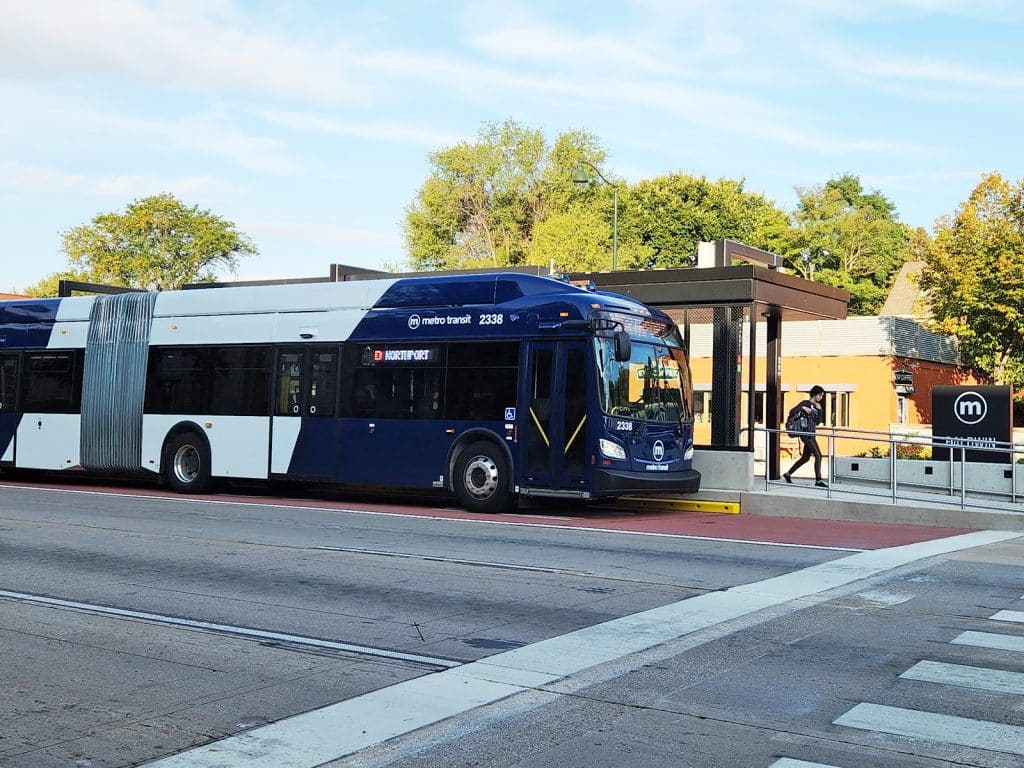
Ground-level views from the long-awaited arrival of BRT.
Madison has witnessed its civic equivalent of a great comet that flies by only once a generation: A thing actually getting done and becoming real. Metro Transit launched its first official Bus Rapid Transit (BRT) line on Sunday, September 22. We finally get to ride this thing after decades of planning and aspiring.
We kind of deserve it after enduring the past five years, when BRT became the symbolic dividing line between people who want Madison’s growing population to live in a more dense, functional city and those who think Mayor Satya Rhodes-Conway is taking away their right to drive in the durned automobile, or something.
We experienced so much just to get to this point: Bizarre political tantrums from the business community. Re-drawing bus routes (mostly erasing them, if we’re being honest). Tedious op-eds about pedestrian malls (Promenade! Promenade! Promenade! Take the buses off State Street, so that we may have the grandest promenade!). Compromises. Bizarre political tantrums from affluent homeowners. Locking down federal funds. Picking out designs for new bus stations. Bizarre political tantrums from former mayors. Budgetary uncertainties. Bizarre political tantrums from those who were not destined to be mayor. And then things like construction, more arguing, complaining about construction, fiddling around with bus tracking, building up excitement with endearing photos of guys in sunglasses, and acquiring new vehicles. Enough! One bus ride, please!

Rapid Route A girds the far east and far west sides via the isthmus. For most of the way, it runs in dedicated-ish bus lanes and boards at newly built stations down the middle of major roads including East Washington Avenue. Metro also plans to turn the existing Route B into a north-south BRT line by 2028. For now, the B and F buses will also use BRT stations for the portions of those routes that coincide with the A.
A bunch of Tone Madison contributors took notes as they navigated this new system over the course of its first week in operation. The exciting new features, the pain points, the sometimes elusive “rapid” part—we tried to explore it all, documenting our first rides and considering some key questions about how BRT works in Madison. We’ve compiled our observations in a sprawling diary that deliberately offers an entirely ground-level, anecdotal view. Join us on an exciting and occasionally frustrating journey. And reach out to us with your tips and questions about BRT at editor@tonemadison.com, because they’ll definitely help us as we continue our reporting on Madison’s transportation challenges.
Some initial rides—some rough, some average
C Nelson-Lifson: The Transit app said my A bus on Sunday morning (September 22) was coming in “10 minutes” for approximately 20 minutes. Meanwhile, two different buses passed the bus stop that were “not in service.” While I waited at the Wright/Fair Oaks stop, the electronic sign said “There are no upcoming departures.” It wasn’t until a bus passed in the opposite direction that I felt confident that there would be a bus coming at all. I finally got on a bus and it was pretty full but with plenty of open seats. By the time we got to the Paterson stop, the flap that makes it accessible for wheelchair users/strollers to get on and off the bus got stuck and the doors wouldn’t close. This lasted for about 10 minutes, and then we got on a bus that arrived behind ours. This bus was designated “not in service,” so we had to wait for the previous bus to leave and also for the new bus driver to get situated, which took probably another 10 minutes.
At the next stop the new bus was having different issues with the doors, and at the subsequent stop the bus driver said we had to change buses again. Since this stop was on the Square, I decided to get off and walk the rest of the way to work. I got to my first bus stop at 11:00 a.m. and got to work at 12:25 p.m., and the Transit app told me that if I got to the bus stop by 11:10 I would get downtown by 11:36, which meant I was late to work! This is normally a bus ride that took 25 minutes on the old route. During the brouhaha of switching buses, one of the other passengers said that they had gotten on by Home Depot and the second bus we were on was the third bus they had been on. Nevertheless, energy seemed to be mostly good throughout all the snags and many people cheered when the doors eventually closed on the second bus.
Sara Gabler: My first ride on the new BRT line was uneventful. I paid for my ticket at the kiosk, loaded my bike, watched other riders stare into space, and got off at my stop. It was everything a bus ride should be: mundane.
I know the city has some kinks to work out and there will be some hiccoughs along the way. But on Monday, there was no chaos or fanfare, just people trying to get from point A to B as they did before.
I have a unique commute that I don’t expect the BRT to address: I work in the service industry and therefore ride the bus outside peak times. And though I commute through campus and downtown, the isthmus isn’t my destination.
To get to one of my jobs, I have to take two different bus lines. As I found out from my test commute on Monday, taking the BRT instead of another route will cost some riders more, because if you pay with cash and get a paper transfer ticket, you can’t use that transfer ticket on a BRT route.
Having lived in cities without public transportation, I am genuinely impressed and pleased with Madison’s bus service. But, at the end of the day, I won’t be using the BRT because it actually doesn’t reach me and because paying double-fare isn’t financially sustainable.
Grant Phipps: I took the C to the Chazen Museum of Art, as I would normally, in the early afternoon on Sunday (September 22). On the way back, I decided that I’d try to see what was happening with the reimagined A line. A low-pressure day, not going to or from work. First flag I encountered was that the tracking system with Google Maps wasn’t even listing a current time for the C route, if I had wanted to take that. When I brought up the Google Maps app around 4:15 p.m., it was predicting the next C bus would arrive three hours later, after 7 p.m.
I walked down to the split bus shelters for the new routes along West Johnson Street. If you want to take the A, B, or F buses, you stand in the larger shelter closer to East Campus Mall; but if you want other buses, you need to stand in the smaller shelter just down the way directly across the street from the parking garages. Google Maps was telling me that the A line going East was set to arrive six minutes late, originally scheduled for 4:23 p.m., and it got there at 4:29 p.m. (accurately, according to the tracker). So at least that is something.
As soon as I stepped into the new BRT shelter, I encountered a woman who I normally see on the prior A route going West during weekday mornings at Baldwin at 7:21 a.m. (or slightly earlier, because that bus was almost always slightly early). She recognized me and started talking about issues she had Sunday morning. We were only standing there for about five minutes, but she said that she had tried to take the new A line near the East Towne Mall around 7:15 a.m., but it never showed up. She had to wait until 7:34 a.m. to catch the presumably next one. Chock it up to first-day logistical issues, but I’ve been seeing these problems for months now with buses that are scheduled and just never arrive.
The new bus itself seemed slightly narrower, but was considerably elongated compared to the other buses we’re all used to. From campus back to the Baldwin stop, someone entered via the side door towards the back (not main door near the driver) with a bike at State Street, and just propped it against the bike racks only to have the bike fall over. People aren’t used to this, exactly, and we’ll have to use these long straps on the side of the bus or their bike locks or secure the tires in place somehow.
The ride itself and traffic for a late Sunday afternoon seemed unusually heavy, and so, by the time the bus got down to Baldwin area, it was probably running about eight minutes late on the tracker, but I didn’t check.
Sam Harrington: I took the bus Sunday morning just for fun because I’m a climate and public transit nerd. I was initially going to ride the whole way to the end of the line in the West because that gets me close to where my parents and best friend live. But I didn’t want to give away my whole Sunday so I just went to Hilldale instead .
Despite an initial delay, it was an easy and smooth ride and on the way home I did declare that I’d never drive to Hilldale again. I live two blocks from East Wash so the A and B are super convenient for me. I also work from home so I pretty much just ride the bus for small errands or recreation. I’d like to one day take the bus all the way out to visit my crew in the burbs but they’d have to pick me up at the station so who knows if I actually will.
It was fun that they had metro people out at the stops. My friends and I peppered the guy at the Midvale station with questions. He showed us the cool line-jump signals for the bus there, gave me a card, and helped me load it with money. I’m excited to never have to buy another 10-ride pass again.
Scott Gordon: I took my first partially-BRT ride on Monday, figuring I’d run out to grab some lunch. I took the B from the north side to Jacknife on East Wash. Thanks mostly to delays on the way back, this took me about an hour and a half round-trip, to and from a place that’s only about 3 miles from where I live—so, not an improvement speed-wise. I spent only about 15 minutes of the trip waiting for food and maybe 5 minutes or so walking between the restaurant and the bus stops.
I realize that policymakers, Metro officials, and media observers are going to largely chalk up delays during the first weeks of the BRT rollout to “just ironing out the kinks.” And sure, we can give Metro some grace as everyone adjusts to new buses and stations and procedures. I would argue that we still need to treat delays as a chronic, systemic problem. If these nice new buses aren’t reaching these nice new stops on-schedule (or close—no one’s asking for perfect), we will not have accomplished much. The more reliable Metro can make its service, the easier it will be for riders to take spontaneous trips without cutting a big hole in their schedules. A system that gives people more flexibility to navigate their surroundings will attract more riders and more political support. It may almost always be slower than driving a personal car or paying for a cab, but we should close the time gap as much as possible.
The southbound B I caught was on time, nearly empty, looking clean, with what I guess is that new-bus smell. Another good omen: Usually, when I’m riding the southbound B on Packers Avenue, it rolls over an uneven set of railroad tracks right before the intersection with International Lane. This sends an absolutely bone-shaking SLAM through the whole bus. (I think I have pretty decent public-transit sea legs but trust me it’s kind of awful.) On this trip, it didn’t happen!
My B northbound bus from the Baldwin stop ran 14 minutes late. At one point, I noticed that the arrivals tracker screen in the station said it was coming in seven minutes. I set a countdown timer for seven minutes on my phone. The countdown ended, and the bus arrived four minutes after that. On this return trip, the bus sat at North and East Wash for several minutes as the doors repeatedly opened and closed on both sides. So that was a little confusing. But the delays gave me some extra time to check out the features of the new buses and stations.
Maddie Batzli: As someone who has an irregular, hybrid remote/in-person work schedule, I tend to ride the A on average twice a week. This week I didn’t have any reason to go into the office, so my only experience on the BRT was riding the B route from East Wash at Paterson to get downtown. Google Maps estimated the bus would be six minutes late, and to my surprise, that ended up being accurate. The arrival time indicator in the station was also accurate. I find that often there’s a lot of variability in accuracy about the Google Maps arrival time predictor—often buses that are noted as “late” end up arriving on time or even early—so this was a pleasant surprise.
The ride itself was pleasant and uneventful. I was riding in the early afternoon, and was the only person at the Paterson stop at that time, and one of three other people on the bus for the duration of my short ride. I didn’t experience any of the “rapid” benefits of the BRT, but I didn’t expect to since I was only riding a few stops.
I appreciate the immense amount of effort that the City has put into seeking to improve the bus system, and I think only time will tell whether these benefits will be distributed equitably, or create even bigger equity and accessibility gaps between riders. Metro has been receptive to some rider feedback throughout the bus redesign process (including rerouting new routes and reinstating former routes), and I hope they continue to gather and respond to feedback through the BRT rollout and beyond.
I am curious to see how the Sheboygan Avenue / Eau Claire Avenue stop on the west side functions, as that’s usually where I get off and on the A for work. Detours in the Sheboygan/Eau Claire/Whitney Way area have been ongoing since March 2024, but stop closures and reopenings have been inconsistent and poorly marked. The week of September 16, just several days before the start of the BRT, the signage indicating where one should wait for the A was nonexistent. Even after checking the Metro website for detour updates, it was not clear. A kind person who was more familiar with the area let me know that I should wait for the A next to a sign that said “bus dropoff only” and had no indication that it could pick up passengers, and no sign indicating which buses came to that stop. Because the A1 was 15 minutes late, it arrived at the same time as an A2 bus, and instead of stopping at the same station, the two As proceeded to go different directions upon reaching the Eau Claire / Sheboygan intersection, with one following the “main” route down Sheboygan and the other following the detour route down Eau Claire. Luckily, the A that followed the detour route did indeed pick me and others up at the “bus dropoff only” sign. On the Metro website, it says that the A detour routes will continue through the start of the BRT. I am hoping they have worked these kinks out this week, or will do so shortly.
New buses and stations: are they good?
Sam Harrington: One unanticipated aspect is that because the bus is so quiet, conversations are easier to hear. I made some ephemeral new friends on Sunday who just joined in when I was chatting.
Studies have shown that electric buses (though most studies have been about electric school buses specifically) can save lives and reduce childhood asthma, particularly in communities that have been historically disinvested in. It’s good that they’ve got the big electric buses on the B route already, even if it’s not fully BRT, to reduce some of the traffic pollution burden on the south side. WMTV News reported recently that “Metro’s current buses use over 5,600 gallons of diesel each year. But in [after the launch of BRT], one third of the fleet will include 60-foot all electric buses.” When we talk about the costs of public transportation projects we also really need to be talking about the savings that will come from reduced pollution. A Harvard study found that replacing a 2017 diesel bus with an electric bus would lead to an average of $84,200 in benefits per bus ($43,800 in health benefits and $40,400 in climate benefits). Plus electric vehicles are much cheaper to maintain than combustion-engine ones.

I roll my eyes often when the City talks a big game about climate action, but I do think that the way they’ve done BRT is a huge step. It’s good to see this level of commitment. Obviously, more improvements will be needed as the city grows but it really does feel like an investment in the future. A few months ago I was standing at the old Paterson and East Wash stop and looking at the construction of the BRT station and, behind it, the new mass-timber apartment building. It feels good. It feels like people are stepping up in big ways and signaling that a healthier city is possible.
Scott Gordon: Being able to board and deboard through both front and back doors, which are wider on the new electric buses, is a massive improvement. Now I can stop being irrationally angry at people who exit through the front (not counting those who need to for one legitimate reason or another) when others are trying to board.
Even when BRT isn’t delivering on speed, the new stations make the wait so much more bearable. If there’s a delay, at least you can sit down comfortably and get to the good part of a transit trip, which is having a little time to yourself to read or whatever. The station design provides a nice balance of shade and natural light. I’ve spent untold hours of my life baking or freezing at Madison bus stops, so this makes a huge difference.
C Nelson-Lifson: The design of the new stations seems fine but also seem like they could get really crowded at certain times of the day.
Sam Harrington: I’m into the heaters. There should be more benches but I’m glad there’s two, at least. They feel fancy to me.
Scott Gordon: I like the heating components at the new stations. Just the name, “Re-verber-ray Designer Series by Detroit Radiant Products Co.,” has a goofy retro charm I can’t resist. (We love a radiant product, don’t we folks!) I’m going to start trying to convince my audio-nerd friends that they are high-end, boutique reverb units as a bit.

Sam Harrington: You can’t tell what letter the bus is when it’s stopped at the station from inside the station.
Dan Fitch: Very weird design failure. I mentioned it to the Metro helper at one stop I was at and he said “Hmm, you’re right. Well we’re still ironing out the kinks!”
Sara Gabler: I noticed this too.
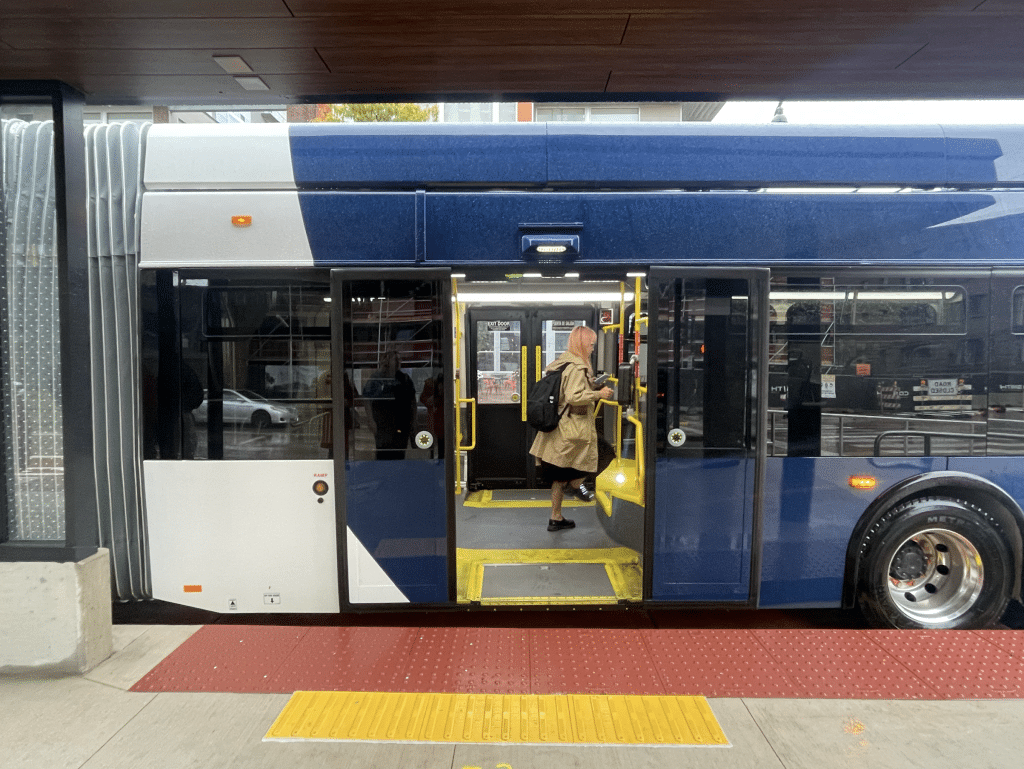
Testing out the new bike features
Sara Gabler: Because I don’t live near the BRT line, I biked about three miles to University and Midvale, where I caught the A line. From there, I rode to Atwood and back. I boarded the bus at one of the new center stations, rolled my bike into the rack inside the rear entrance of the bus, and attached a large velcro strap to its frame to keep it in place. The bike racks are sufficient, but not foolproof. I stood next to my bike during the ride (and the city suggests doing this), because my bike lurched about as the bus took turns etc. All told, my bike-and-bus commute took about 45 minutes one-way, which is the same amount of time it would have taken me to bike the whole way.

Dan Fitch: I found the new bike features passable, but even a bus trip with two bikes was a bit chaotic.
Sam Harrington: It seems like it would be stressful to use if the bus was full. I asked my girlfriend about this since she’s been commuting to west campus via the A since the 28 has been super unreliable. She said the bus has been really crowded in the morning but one guy brought on a bike and everyone made it work. He had to ride squished up next to the bike, though.
Scott Gordon: The bike racks could get crowded fast, especially if a lot of riders have panniers and crates and so forth. Still, this is such an improvement over the bike racks on the fronts of regular Metro buses, which can create delays and frustrations for drivers and passengers alike. I appreciate being able to bring my bike along on a bus trip either way. Doing that with less lifting, or exasperated bus drivers trying to gesture how to use the rack? Great. Similarly, the new buses’ additional racks for bags/parcels are going to make the system so much more useful for those of us who run errands without a car.
The new fare system
Rachel Litchman: What happens to people who have paid for tickets already when the new fare system is implemented? It isn’t clear if they are still going to have the regular ticket readers in the buses, so what will happen to those tickets that riders have already paid for? Metro’s website says that these passes will still be available and usable, but for a “limited time only.” It’s unclear how many weeks or months that would be.
Kay Reynolds: Another page on Metro’s website tells riders: “Bring in your unused 31-day passes and multiple ride cards and have that dollar value added to your account.” It’s unclear if partially used cards can be redeemed.
Dan Fitch: The new passes work fine on buses that have the new readers. Not all non-BRT routes have them yet and sometimes they’re busted, so drivers have to wave people on. Back-door loading works great to speed entry.
Sara Gabler: I hear that UW-Madison students now get Fast Fare passes that are good for the entire time they’re enrolled at UW, which means that they don’t have to pick up a new bus pass every semester.
Maddie Batzli: UW staff have Fast Fare passes for our discounted bus passes, which is convenient. We used to pick up a new bus pass every year, or receive a new pass by mail. Now we have a Fast Fare card that can be re-loaded annually. The card-tapping system has worked seamlessly for me so far, and I think it’ll be an even better upgrade once riders are able to use Google Wallet and Apple Pay sometime in 2025. This will hopefully make for a lower barrier to entry for new riders or infrequent bus riders who don’t carry cash. However, I have concerns about how the new fare system will impact current riders through this transition, especially those without bank accounts or easy access to internet, since so much information about the BRT and new fare system is being shared on the Metro website and much of the benefit of the new fare systems requires frequent internet access; this may end up being an equity issue.
Kay Reynolds: The new Fast Fare pass requirement doubles the amount of change and learning to use the new BRT, which will disproportionately affect neurodivergent and/or disabled riders. An email link on Metro’s “Fast Fare Checklist” page goes to cityofmadison.com instead of starting a new message in the user’s default email client (Gmail, Outlook, etc.)—a careless mistake that’s inconvenient for anyone, but especially for website visitors with low vision.
The directions on the page also are not specific enough. Email them what? Why not have a form? Metro could make the information needed clearer and the process more efficient. Neurodivergent folks are likely to get stuck if we don’t know what or how we are expected to communicate.
The six- to eight-day wait time for a mailed pass is not timely enough if a rider is only just now finding out they need a pass, especially if they need reduced fares. And guess which route riders can take to pick up a pass at the Metro office! The A, on the BRT line, which ideally one would already have a Fast Fare pass to use. Cool.

Metro has also created new hurdles for riders applying for the system’s half-price fare program, which is only compatible with Fast Fare passes. BRT ticket stations can top off a Fast Fare pass but can’t issue an individual half-price ticket. It’s not clear whether riders looking to pick up reduced-fare cards from Metro’s office have to bring a completed form. If the form isn’t ready when you pick up the card, do you have to come back to the office again?
I’ve relied on 10-ride passes for years to get a modest fare discount. Day, week, and month passes do not provide any savings to me as a more sporadic bus rider. The only way for me to get a discount now is with a disability permit. So… are y’all really going to make me go across town BY BUS to get my doctor to fill out this bus fare form? While it might only sound like a minor inconvenience, this kind of errand would exhaust me so much that I’d be basically incapacitated for 24 to 48 hours afterwards. Bus delays have also made me late to doctor appointments before, which has affected my ability to receive care and makes me more nervous about my permit journey. If disabled people are going to be forced to jump through hoops that are objectively more difficult because we’re disabled, can the directions at least be clearer?
I created a Fast Fare account online. The app store links in my online Fast Fare account don’t go anywhere. Maybe they shouldn’t display that as an option yet if the apps haven’t been rolled out? The app could probably solve some of the problems I’ve mentioned. From here, it seems to be pretty easy to add funds to my Fast Fare account. I think it’s acquiring a card and a disability permit that will be challenging for a lot of riders.
I fully planned to use the BRT to get to Communication for my Friday print shifts, but at this point I am feeling far too overwhelmed by unclear directions and unexpected fare-related hoop jumping to even try. I appreciate accessibility updates like the decreased step height to board the bus, but I can’t help but feel like fare logistics weren’t fully considered, especially for disabled riders. I still hope to take a better look at one of the new stations up close (I’ve been wondering if some of the benches I saw during construction were unfinished or hostile architecture), but it will probably be a while until I actually use the BRT.
Tracking with mobile apps
Rachel Litchman: Google Maps’ accuracy is variable. It is often not great about letting you know if a bus is running late or ahead of time. Estimated arrival times will randomly switch with short notice. Google Maps also does not differentiate between some of the new routes that have similar names (for example, there are two “D” buses, D1 and D2, and Google Maps will just say both buses are the “D” bus, meaning you can get on the wrong bus).
Scott Gordon: On Monday evening, I caught a B bus southbound to meet up with a friend. I used Metro’s online bus tracker in a mobile browser. At 5:19 p.m., the scheduled time for the bus to reach my stop, the tracker began showing the bus as “DUE.” It continued to show as “DUE” until the bus actually picked me up, at 5:33 p.m. So, what does “DUE” mean? To me, it implies an imminent arrival, say within the next minute. If a bus can be “DUE” for a full 14 minutes, while the bus line is running an every-15-minutes schedule, then we don’t have a system that’s really legible for riders in anything like real time.

Grant Phipps: Google Maps is actually accurately tracking the buses (for the most part). This has been, unfortunately, uncommon, as I am a regular transit rider. There are (or were) so many tracking issues, they can’t even be neatly summarized: buses that are incorrectly timed—running too early or progressively late (not keeping up with tracking apps), buses that never show up (truly baffling), buses that refuse to pick people up on the rare occasion (not even because they’re full, but due to tardiness, the next bus at 15-minute interval arriving just behind it). Thus far, in my limited experience, BRT has been alright. I wouldn’t say it’s a drastic improvement, but if the tracking continues to prove reliable, then I’m in support. The other variable might be differences between traditional weekdays and weekends with the number of riders and types of riders. Too soon to make an assessment there, but if I end up taking a bus to the Dane County Farmers’ Market or to campus through October, I’ll obviously have a better idea. The interiors of the buses themselves will take some getting used to, as the main entry/exit door spaces are more spacious than the other bus models, but those areas are connected to narrow, one-person-wide aisles that make moving about more of a challenge. On my route to work on Wednesday, September 25, people seemed confused by this design, and weren’t at first sure where to sit or stand. Maybe this is just a short-term thing, and people will quickly adapt, but I imagine people routinely having to uncomfortably squeeze by others in certain situations to board or disembark on crowded buses at peak hours.
Accessibility
Scott Gordon: As Rachel Litchman has documented in two works of comics journalism for Tone Madison, Metro Transit bus stops often lack shelter or seating of any kind, and often present other accessibility barriers. The new BRT stations at least give people a chance to get out of the cold, rain, or glaring sun, which should be a standard thing throughout the bus system. Rising heat presents a real health and safety threat, despite what you might have heard about Madison being a “climate haven.” Disabled and elderly people who rely on the bus should be able to get some relief from the elements when they’re waiting. The benches and leaning rails at the new stations also represent a massive improvement. As we invest in this new infrastructure, I hope Metro will make similar boosts in quality to stops along non-BRT routes.
Dan Fitch: Less stepping up to board the bus is pretty nice. An elderly man on one of my bus trips this week remarked on it, quite pleased, when getting on.
Sam Harrington: I don’t know if I just got super lucky but I didn’t have to wait for the walk signal at all at any crosswalks (I crossed six times on Sunday—four times at Paterson and twice at Midvale). It was super easy to get halfway across University and East Wash, two roads that I find typically scary to cross the full way.
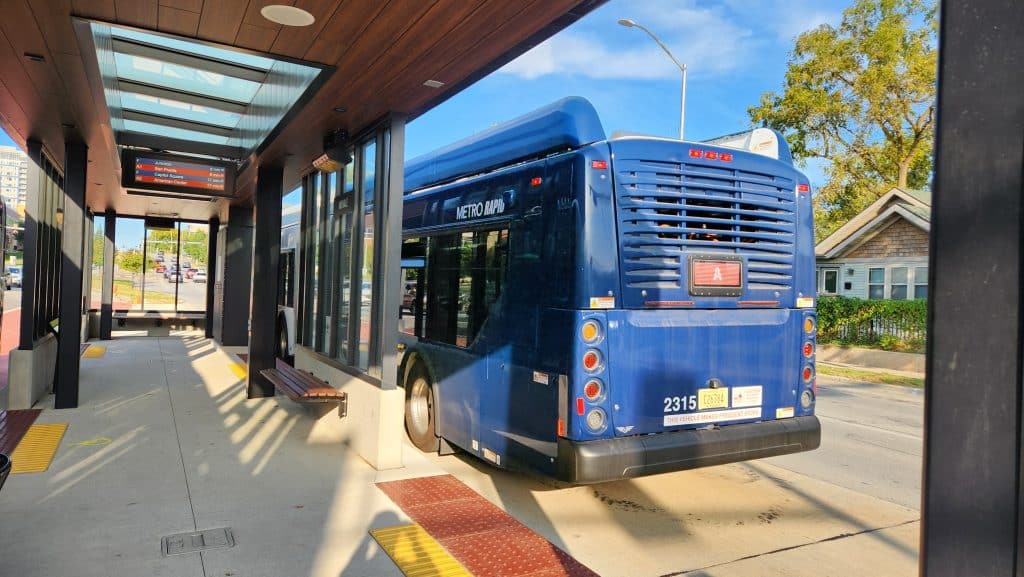
Sara Gabler: I had different experiences rolling my bike onto and off the bus depending on how close the driver pulled up to the station. I had to lift my bike off the bus at one stop because the bus was over a foot away from the platform. This wasn’t a problem for me, but potentially an issue.
Dan Fitch: Because it takes longer to get off the new buses, I saw a group of caregivers with some special-needs kids have trouble getting off in time and the entire bus had to yell to get the driver to wait.
Overall communication from Metro
Dan Fitch: Minor signage fail:
The signage at other stops, e.g. on East Wash, has full color maps with directions to get to the new stop. One of my trips this week, Paterson’s old westbound B stop had someone waiting at it who didn’t notice the laminated “stop closed” sign posted, but a Metro employee was at the BRT stop and ran across to help.
Scott Gordon: We also saw a lot of this kind of thing when Metro rolled out its redesigned network in summer 2023—printout signs zip-tied or taped around poles with notices of service changes, stop closures, and so on. Between spring and fall of 2023, Madison Transportation Twitter mainstay Jonathan Mertzig documented some of this craptastic signage and noted some improvements along the way, but still, come on.
This does not inspire confidence. That’s not how you want a government agency to communicate with people. Public transit in a lot of cities too often feels like an ad-hoc, improvised experience, a rumor that might or might not prove out. Metro just adds to this feeling when it communicates poorly about system changes, and about more routine things like detours. With all this new BRT infrastructure in place, I hope Metro can follow through and start making our transit network feel more solid and reliable.
How does the new BRT line connect up with other Metro bus lines?
Sara Gabler: I don’t live near a BRT line, so I have to take a feeder route, the D, from the southwest side to the BRT. This is no different than my regular bus commute in which I have to take two different buses to get across town (from the southwest side to the northeast side). However, you can’t use a transfer ticket on the BRT line, which means that instead of costing $2 to get across town, it now costs me $4 to get across town using the BRT.
Scott Gordon: It’s not clear how the B’s actual fixed route is supposed to get to and from East Wash. On a southbound trip I took Monday, it turned from North Street onto East Johnson Street, and took that to East Wash. On a northbound trip later that day, it turned from East Wash to North, using the old stop there next to a Papa John’s franchise. Its relationship to the two East Wash/Milwaukee Street stops is a little puzzling. So, at that one intersection, we’ve got two different BRT platforms in the middle of East Wash (one for eastbound trips and one for westbound trips), and the old conventional stop at the northeast corner (solely for northbound B trips).
This wasn’t too disruptive for me, because I’ve been taking some version of this trip on Metro for years, adjusting to various changes as the old Routes 21 and 22 dissolved into the B. But I can see this really creating confusion and frustration for someone who’s new to using Metro.
Which gets me back to one of my biggest gripes about Metro: The system is just not very legible unless you’re taking the same specific trips over and over again. Madison doesn’t have one cohesive grid system (build a city on an isthmus, they said! It’ll be cool, they said!). Bus routes have to get a little twisty sometimes to navigate the awkward hodgepodge of our cityscape. BRT simplifies this a bit—at the cost of gutting routes that ran deeper into neighborhoods—but doesn’t ultimately make things all that intuitive. If you’re new to town, or an existing rider using Metro to go somewhere you haven’t taken the bus before, you face a pretty ridiculous learning curve.
Correction: This story has been corrected to clarify issues with transfers between non-BRT buses and BRT buses.
Who has power in Madison,
and what are they doing with it?
Help us create fiercely independent politics coverage that tracks power and policy.
Authors









Related Articles
Wisconsin communities face scrutiny over data center secrecy
The town of Beloit is the fifth Wisconsin community with an NDA for a possible data center.

Eyeing voting rights, liberals aim to secure Wisconsin Supreme Court through 2030
In the April election, Wisconsin liberals are hoping to expand their majority on a body that could be a critical backstop for voting rights during the next presidential race.
Police surveillance technology needs proper accountability
Grassroots resistance against Flock cameras are writing the blueprint for comprehensive reform.