
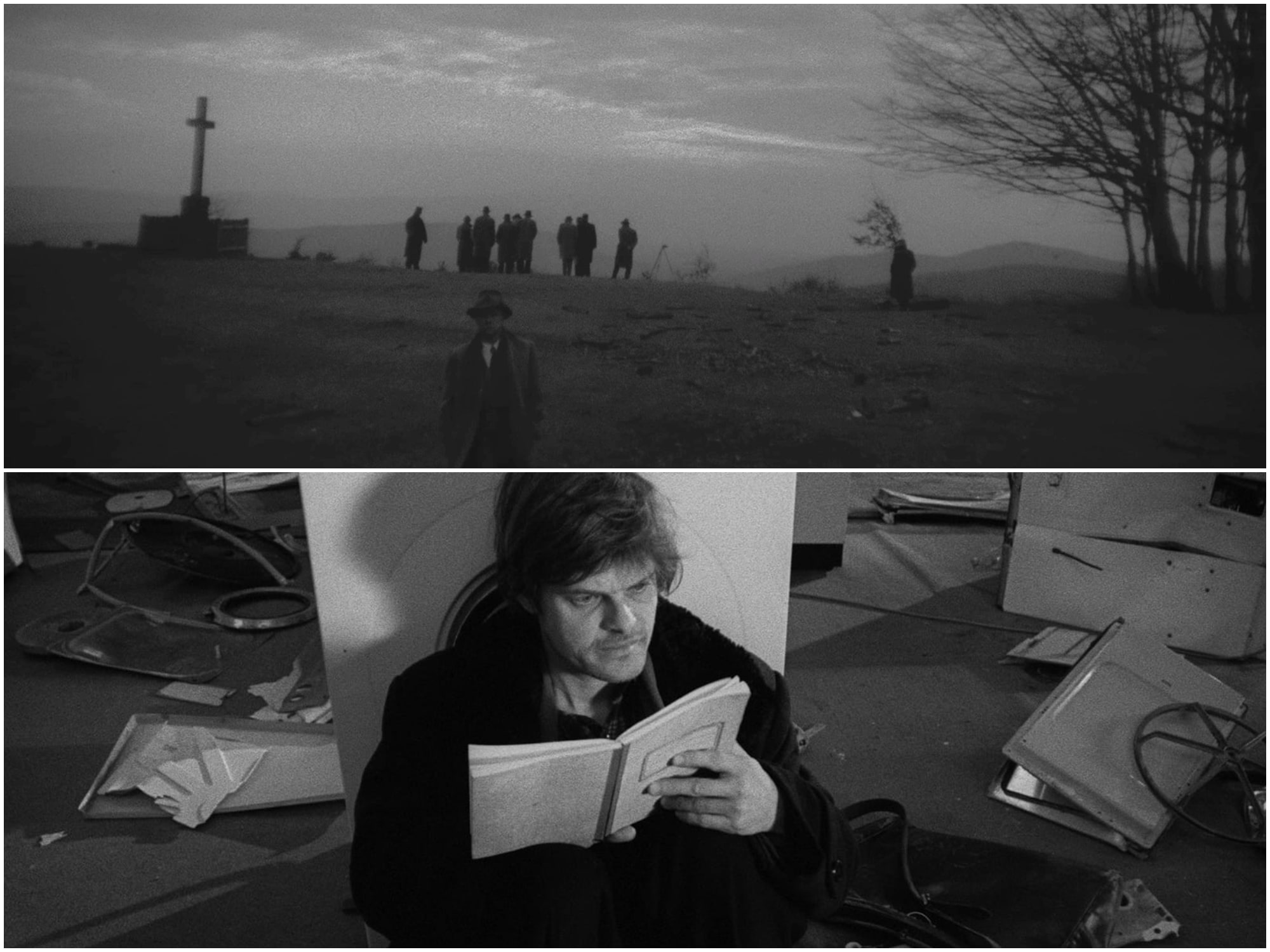
The two Hungarian art films by György Fehér and Béla Tarr screen in new restorations at UW Cinematheque on July 7 and 14.
We’re living in apocalyptic times. Despite social and technological progress, it seems like the end of humanity is closer than ever. Yet, isn’t that what at least some people in every era of history have thought? Isn’t it the very act of trying to impose our own ideals on the world that leads us into thinking its destruction is imminent?
Over the next two Fridays at UW Cinematheque, two Hungarian literary adaptations will explore these ideas in some capacity: György Fehér’s rarely seen Twilight (1990) on Friday, July 7, at 7 p.m. (no vampires in this one, though there will be crosses and children preyed upon), followed by Béla Tarr’s Werckmeister Harmonies (2000) on Friday, July 14, at 7 p.m.
Twilight is the story of a police investigation into a serial murderer of adolescent girls, which becomes a point of obsession for a retiring detective (Péter Haumann). He continues to try to solve the case after retiring from the police force, even after everyone else is satisfied the case is wrapped up when the main suspect commits suicide in custody. The tale is based on Swiss writer Freidrich Dürrenmatt’s 1958 novella The Pledge: Requiem For The Detective Novel, which was originally written after producers forced Dürrenmatt to write a neat ending for his It Happened In Broad Daylight (1958) script.
The Pledge has been adapted a number of times over the years, most recently by Sean Penn for his 2001 film of the same name with Jack Nicholson in the main role. Where Penn does a fairly literal rendering of the story, Fehér presents the same basic story in a more abstracted and menacing way. The key scene that the plot hinges on, where the detective pledges to the dead girl’s mother on a cross that he will catch the killer, his soul be damned, is the most effective scene in Penn’s version; in Fehér’s film, however, it is reduced to a background sound similar to Christopher Plummer’s epic speech in The New World (2005). This pledge is not even delivered by Haumann’s detective, but instead his partner (János Derszi), while Haumann’s character hides from the girl’s parents outside.
Haumann and Derszi’s characters wander about a landscape steeped in a thick fog that seems to manifest the evil and ambiguity they have no hope of escaping. What they are doing and why is often abstracted to a point where it seems like the characters are merely acting out of instinct. In other words, it’s a film very heavy on the vibes, and those vibes are very heavy. The idea of justice seems like an idea as artificial as Werckmeister’s harmonic scale that Béla Tarr will come to take aim at in his 2000 film. But it’s all rendered in a particular shade of deep grey reminiscent of, well, twilight. It’s a familiar type of story, just observed in a view from squinted eyes, half-woken from the nightmare of modern existence.
Tarr’s Werckmeister Harmonies, his follow-up to the seven-and-a-half-hour Sátántangó (1994), which UW Cinematheque screened both in-person and virtually in 2020, takes its name from Andreas Werckmeister, the Baroque composer who was responsible for the creation of the tempered scale. This artificially manipulated scale provided the basis for modern Western music, but in the process, changed the way Westerners understood the world around them. Tarr and his frequent writing partner László Krasznahorkai (the movie is based on his novel The Melancholy Of Resistance) clearly view this as unforgivable hubris. Werckmeister subtly cut Westerners off from the harmony of the natural world in favor of a self-contained harmony of human invention. But no matter—we’re going to live through the consequences of that idea, and there’s nothing to be done about it.
Harmonies follows János (Lars Rudolph), a wide-eyed and creative young man who acts as a courier in a small town conspiracy, not realizing that he’s going to face severe consequences for mere association with certain people. He’s been tasked by his Aunt Tünde (Fassbinder veteran Hanna Schygulla) with delivering an ultimatum to her estranged husband and professor György (Peter Fitz) to get him to join a growing movement in the town to “impose order” (which is always followed up by the assurance that “nothing will fundamentally change”). The story mostly sticks to János, so the specifics of this movement’s demands remain murky, because he doesn’t seem to have much of an idea of what they want until it’s too late. While this vague threat of violence brews, the town is also visited by a traveling carnival act. Despite being distant from any ocean, they promise a whale in the back of a truck as well as a warm-up act by “The Prince.”
This all unfolds in Tarr’s characteristic long takes that have made him one of the pillars of the so-called “slow cinema” movement. Both Tarr and Fehér take this technique from Hungary’s master of the previous generation, Miklós Jancsó. (Tarr has gone on record to say that Jancsó is “the greatest Hungarian film director of all time.”) Where Jancsó used his elaborately staged takes to extol the glory of collective action and struggle that will bring about Communism, Tarr and Fehér are of the generation where that idealism has been destroyed, and collective action is more indicative of a slow creep towards Fascism.
In the last 30 years, Tarr is indisputably the international star of Hungarian cinema, but Fehér was a close collaborator who is now posthumously getting his due (Fehér died in 2002, shortly after the release of Harmonies). Fehér is listed as a writer of additional dialogue on Harmonies, as well as a consultant on many of Tarr’s projects starting with 1984’s Almanac Of Fall, and Tarr, in turn, is listed as a consultant on Twilight.
Both these films may require some patience in their languid pacing and black-and-white cinematography. But if you can get on their wavelength and sink into their moods, you may be able to understand something about the uneasy undercurrent of human behavior that’s rearing its head more and more often these days.