
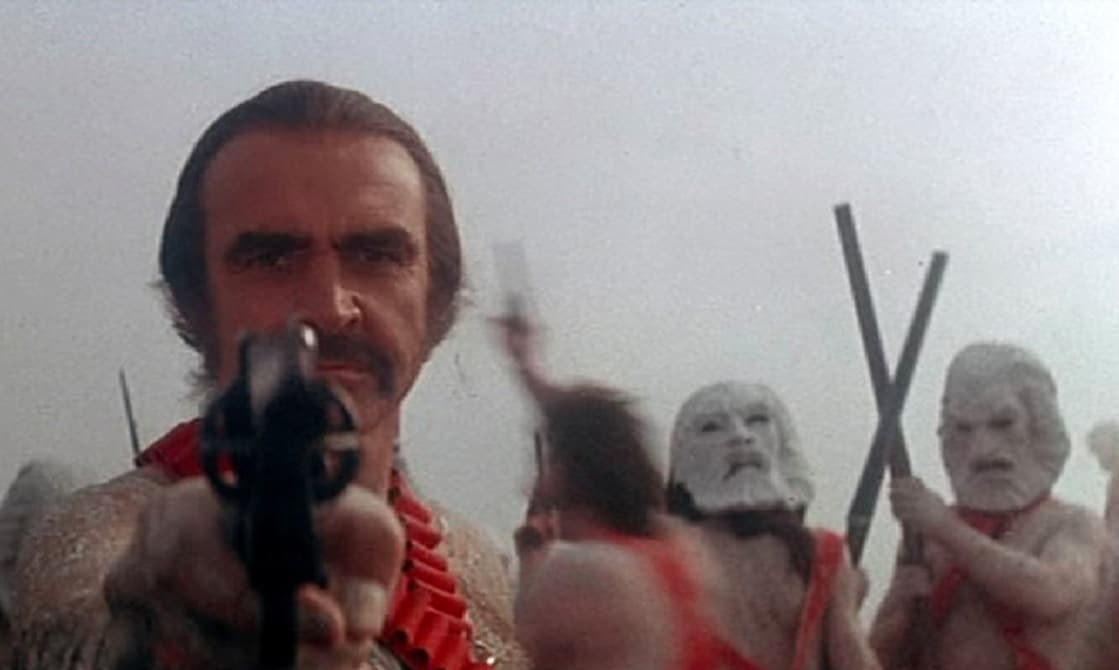
John Boorman’s eccentric sci-fi satire from 1974 screens in a DCP restoration at UW Cinematheque on July 6 at 7 p.m.
The psychedelic sci-fi satire Zardoz (1974), still stands as one of the strangest films of the 1970s. Wearing little more than thigh-high boots, red underwear, and sporting a ponytail, Sean Connery stars as Zed, the leader of a band of barbarians who worship the floating stone head Zardoz in the year 2293. Proclaiming “The gun is good! The penis is evil,” Zardoz commands its followers to rid the post-apocalyptic wasteland of the remnants of humanity.
Realizing he’s been worshiping a false god, Zed stows away inside Zardoz’s head to be transported to The Vortex, home of an advanced race of immortal humans. Guided by an omnipresent computer, these Eternals have acquired psychic powers and live an austere, highly structured life sealed away from the rest of humanity. Zed’s arrival threatens to disrupt The Vortex’s fragile social order, as the Eternals begin to experience long-suppressed human feelings of rage, hatred, and desire in the film’s kaleidoscopic climax. In using mirrors, rear projection, and a fractured, acid-fried editing style, Zardoz‘s final act seems expressly designed to blow stoned moviegoers’ minds.
Director John Boorman has lovingly described Zardoz as a work of hubris, reaching for a high-concept vision far beyond its budget. Riding high after the success of Deliverance (1972), Boorman wrote, directed, and produced the film himself. Like many of Boorman’s films, Zardoz was filmed near his home in Ireland, which provides the film with lush pastoral landscapes later used in Excalibur (1981). Cinematographer Geoffrey Unsworth, best known for his work on 2001: A Space Odyssey (1968), gives the film a hazy atmosphere that heightens its mythic storytelling.
While most science-fiction visions of the future involve gleaming, high-tech metropolises, Zardoz’s aesthetic is half-futuristic and half-medieval—plastic bubbles and supercomputers fused with an agrarian society that uses horse-carts and grain mills. The film’s costumes—designed by Boorman’s then-wife Christel Kruse Boorman—reflect the characters’ class differences, contrasting Zed’s minimalist uniform with the Eternals’ unisex crop-top knits and new-age peasant garb.
Met with utter confusion upon release, Zardoz has maintained a cult reputation as an oddity in Connery’s post-Bond career. It’s overly ambitious and often quite silly, but Zardoz doesn’t fully deserve its “so bad it’s good” reputation. While the film’s costumes and trippy special effects are charmingly dated, its vision of an immortal technocratic ruling class sealed away from the masses isn’t much different from the dystopian fantasies of today’s Silicon Valley billionaires. If anything, Boorman’s parable of extreme economic inequality, screening in a new digital restoration at UW Cinematheque on July 6, seems less fanciful today than it did in 1974.