
“The Year” presents a prosaic alleyway as a poetic gateway
A conversation with Milwaukee-based filmmaker Grace Mitchell, whose experimental short makes its local premiere at the Wisconsin Film Festival on April 4.

A conversation with Milwaukee-based filmmaker Grace Mitchell, whose experimental short makes its local premiere at the Wisconsin Film Festival on April 4.
Often, the most striking aspect of an experimental short film exists beyond the creative depth of the work itself. For viewers, it can be a reflexive thrill to regard the disparity between a written synopsis and the radical techniques an artist uses to visually and aurally convey their emotional state(s) or subvert our collective, conditioned concept of narrative.
Milwaukee-based writer and filmmaker Grace Mitchell’s 10-minute diary film, The Year (2024), is a curious example in that Mitchell’s own synopsis and the summary provided by Mattie Jacobs in the 2025 Wisconsin Film Festival guide are both unusually, linearly literal. The Year is a film that contains a fragmented timeline of recurring shots of an urban alleyway, which are rapidly intercut with jarring bodily functions, lushly tranquil joys, and tangential meditations. And yet those descriptions cannot wholly evoke the plain and poetic beauty of what Mitchell has captured on Super-8 film. It is the ineffable beyond the dynamic lives around her and the fixed view outside her Milwaukee residence over the course of—as the title suggests—12 months’ time.
Apart from the more gently obvious essay films and autofiction comparisons to contemporaries like Ariel Teal and Kym McDaniel (to name just two), The Year is personally, microcosmically reminiscent of David Easteal’s three-hour slow-cinema opus The Plains (2022). Easteal, confining his film to long commutes in a car, and Mitchell here, observe routine and change through the outwardly unchanging, as they shape and become shaped by their own self-imposed methods and the film medium. This makes The Year feel at once inextricably idiosyncratic and relatably, universally observant—resonant intrigue burgeoning from within the realm of our unforgiving post-Covid world.
The 2025 Wisconsin Film Festival’s “Wisconsin’s Own Experimental Shorts” program at the Chazen Museum of Art on Friday, April 4, at 6 p.m. will include both the Wisconsin premiere of The Year and the Midwest premiere of Heart Shaped (2025), a 13-minute confessional-letter-focused short that Mitchell co-directed with Sofia Theodore-Pierce. At the time of this article’s publication, tickets for this 13-film showcase are still available.
Ahead of that event and Mitchell’s in-person appearance, Tone Madison talked with Mitchell via phone about complex ideas of time, working with Super 8, themes of love (or lack thereof) in her inspired collaborations with Theodore-Pierce, and assessing personal stakes or risk in their art. Mitchell further unveiled the extensions of personal filmmaking that materialize on her biweekly FM radio show, Entry.
Editor’s note: This interview has been edited for clarity.
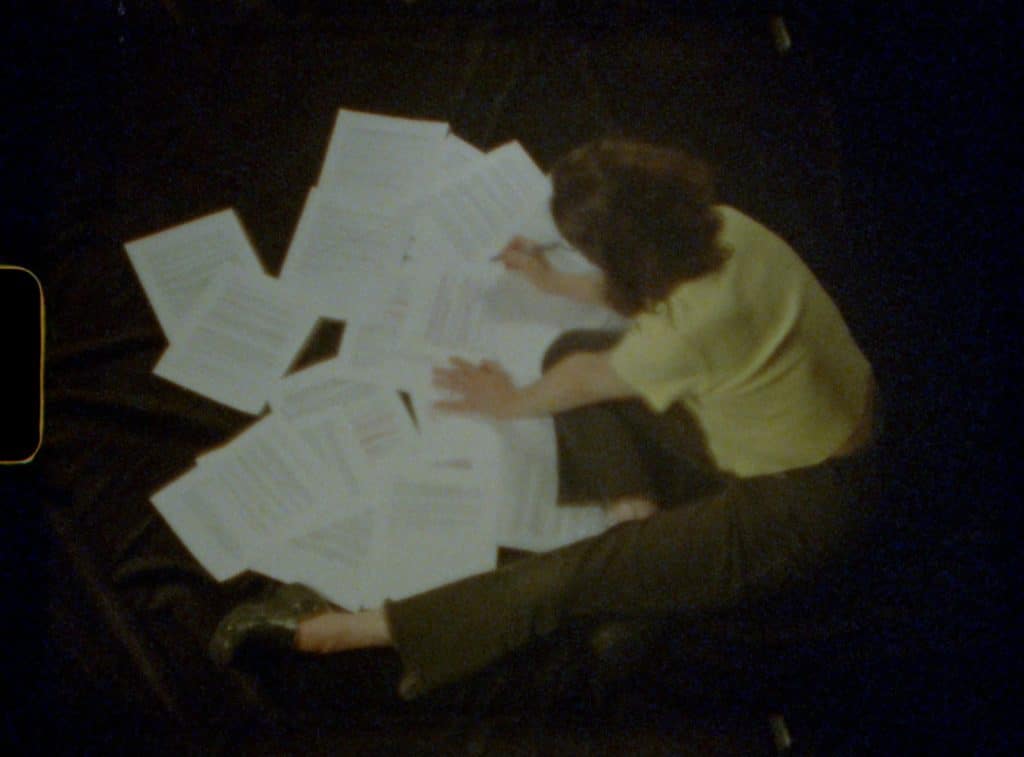
Tone Madison: I think what I most responded to in The Year is the method of documentation. It feels like you’re doing some kind of variation on 1 Second Everyday, the 1SE video app [which aids users in chronologically stitching together video snippets into a complete “film”], but not exactly as that app perhaps intends you to. It’s more of a collagic video diary on the act of observation itself, somewhat akin to a film you made in 2021 called Easy Go.
Can you talk about the origins of The Year, and maybe working in that sort of style?
Grace Mitchell: I’m interested in personal cinema and the idea of the diary film. And specifically with the diary film versus a travelog or an essay film, is that it’s stuck in linear time. It’s stuck in a calendar and days passing, following this more rigid structure. That’s something I haven’t really done before. I’m usually finding the sequencing in the editing room. So it can be like one shot is from 2018 and the next is from 2024, and the two create this new sense of time. Or more of like a bodily rhythm.
But I was interested in rules and rule-making, and also seeing linear time as a restriction that could open up in some way. I was also interested in surprising myself within the everyday in a new way. And so I wanted to chart time in this fashion, but I didn’t want to do it in such a literal way like [with] a calendar day or a date or some more literal transcriptions of time passing. I wanted to do it in my own style. That birthed the idea of the alleyway by my house being this calendar. And so every day or almost every day for a year, I would shoot a few frames with this Super-8 [camera] that I thrifted. That kind of gave me the idea to do a Super-8 film.
I’ve worked with film, but I’m usually a digital person out of accessibility and affordability. But I saw it as a sign to try a new trick or a new thing. Again, it’s all about exciting myself and finding discovery within the kind of mundane repetition. So the film also helps in the way that I couldn’t see it. I couldn’t erase it. It’s burned into this emulsion, and that’s the day. That grew into something else. And then, within that, I was like, “I need something that still feels true to the bodily rhythms, which are nonlinear and spiraling. They go back and forth, and are wishy-washy and chaotic.” I wanted that wedged in the everyday, and that’s kind of like the combination.
So I would also have these film shoots where I would stage things or I would ask a friend if I could film them. Or it would just be around the house. And it created this kind of composite of time as it’s passing and time as it feels. That’s where the idea came from—my execution or game plan with The Year.
Tone Madison: That’s very eloquent. Thank you.
Grace Mitchell: Yeah, I had coffee, so this is great.
Tone Madison: [Laughs] After I watched this for the first time, I was thinking this seemed a lot like a “Covid film,” like something that emerged from Covid lockdowns where you’re stuck inside looking outside at what’s going on. But maybe there’s not as much of a relationship there as I’m inferring.
Grace Mitchell: Yeah, no, I think Covid made me more hermetic in general. Before Covid, I was really externally driven, and I was more extroverted. And then when lockdown happened—and I think a lot of people relate to this—you move into this relationship with yourself. And there’s more comfortability with solitude as well as this kind of bordering-on-isolation habit that I formed through Covid. So, yeah, I would say that I’ve carried on this hermetic feeling inside of me in my day-to-day life. That didn’t exist before.
Tone Madison: Yeah, I feel similarly. Although, I wouldn’t say I was externally driven or extroverted before that. [Chuckles] But I was more prone to socializing or just going out and doing things.
Grace Mitchell: Right. That is now a really conscious decision for me: to go out. Where it used to be like, “I’m going out. What am I doing?” You know? So it’s just like different decision-making.
Tone Madison: You mentioned that alleyway or street is outside your house in Milwaukee. Is there any sight or scene you discovered from that vantage point that you did not include in this film? It sounds like you had a lot of footage, but maybe not… in terms of total minutes, I guess.
Grace Mitchell: I used maybe half of the footage I shot. But I included a lot of the alleyway. I think I was trying to be true to that form of including every shot. Almost all of the alleyway is actually in the film. I just wish I would’ve gotten more alleyway in the winter, because I don’t think I was shooting every day in the winter. There’s just one shot of snow. But yeah, there’s way more carving or excluding with the bits in between the alleyway.
Tone Madison: There’s so little that actually changes. It’s kind of an accidental commentary on stagnation or something. It’s not the exact same shot every time, but very close. The position of the garbage bins along the fences and houses is almost exactly the same. I mean, I guess it would be, but—[chuckles]
Grace Mitchell: It was actually a good practice at noticing, because it would get me excited when—”Oh, there’s a cloud.” I got really obsessed with the minutiae of the alleyway, where I was like, “Oh, someone is pulling out of their driveway.” These things that are really minuscule, that we don’t really bat an eye at, it became like drama to me. A flashing light, a bird just landing, or a cat’s crossing. Those are such big actions. Otherwise, there isn’t really change. So it was good at heightening the small.
Tone Madison: That’s a great way to put it.
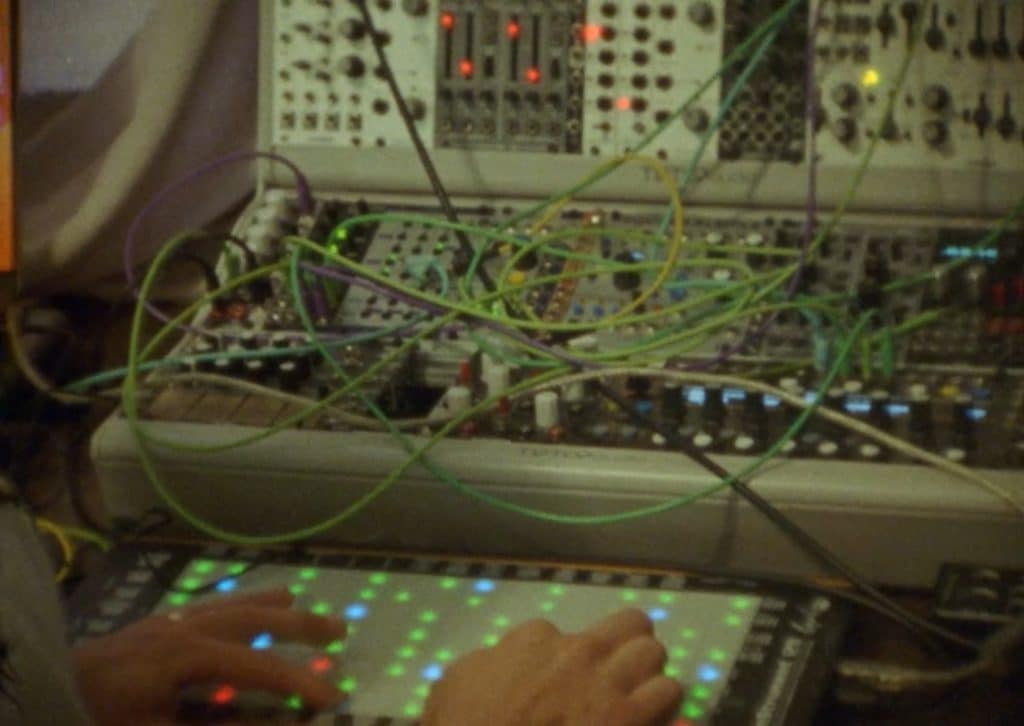
The very beginning, the first 75 seconds, feature this crawling analog synth scale by Eric Risser. You’re moving this handheld camera down the alleyway, and then you cut to footage of him actually performing the music. Is this, in a way, tethered to your choice of shooting this on Super 8? Do you see the analog act of “recording” in this way as more tangible, and able to capture the energy and spontaneity over digital construction or documentation?
Grace Mitchell: In capturing his performance?
Tone Madison: Yeah, I guess.
Grace Mitchell: Maybe? But it fucks up the synchronization. I was actually really annoyed that I couldn’t properly sync his actions to the sound, because [Super-8 sound and video] record at different speeds. I didn’t know until I was working with the sound, and I was like, “Why is it not matching?” But I do think Eric works in these analog technologies, also. He loves old video mixers, and he loves old synths, and instrumentation that is really fitting with Super 8 in this way. It feels like it’s speaking the same language to some degree, visually and sonically.
So, yeah, I think there was a matching that I had in mind. I pictured this with this film stock, because it’s a tungsten, so it’s gonna pull out the reds really severely. It’s gonna be really warm and glowy. And so I knew, when he was playing, it would look really nice. And the reds and greens would match traffic and car lights. Make a graphic match or visual rhythming between his instrument and his alleyway.
A lot of it is associational, and makes sense only through those subtle rhyming techniques. But that’s also how I come up with ideas. “This reminds me of this reminds me of this.” If I was to say there’s an inspiration there, it’s probably the Gertrude Stein idea of like “A rose is a rose is a rose.” “His red light is a car light is a blood stain” is this kind of game, almost.
Tone Madison: Ah, OK. Thank you. Did Eric assist with the sound design of the film itself? Or was he just doing those synth sounds?
Grace Mitchell: He’s my bandmate [in Large Print, since 2017]. He’s such a wizard and so smart, that I was like, “Can you just riff, and I’ll record it for a soundtrack?” So he knew what it was for, but he had no real direction. I just wanted to document him being the wizard he is. That was [the extent of] his involvement with it. I actually don’t think he’s even seen the movie.
Tone Madison: [Laughs] Well, you should send him the file you submitted to the festival’s FilmFreeway.
Grace Mitchell: I know, I should do that.
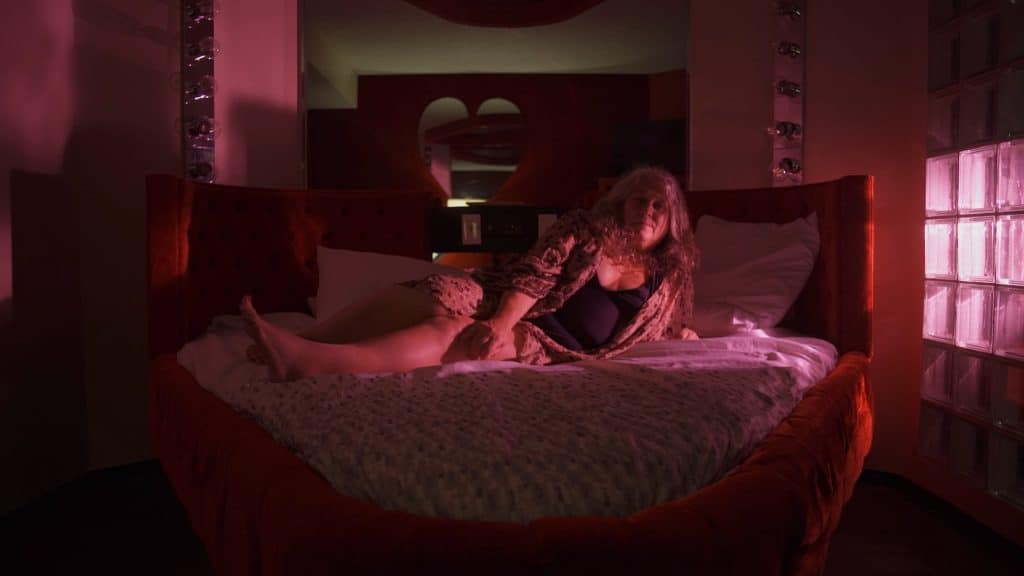
Tone Madison: To move past The Year a bit… Also in this program next month at the Wisconsin Film Festival, you’ll be presenting Heart Shaped, which you co-directed with Sofia Theodore-Pierce. It’s an interesting piece to compare with The Year, in that it features nearly continuous dialogue, an exchange of personal letters and sexual confessions back and forth that “set the scene” in the Don Q Inn in Dodgeville.
The Year is largely without language—though, it has incidental dialogue and conversation. But at one point, someone who’s unseen does read part of a poem aloud (that begins with the “My beating heart…”). It seems to share a kinship with Heart Shaped about love and loving someone. I’m wondering if that relationship is very intentional or coincidental. In my head, I can hear those words from The Year popping up in one of G or S’s letters in Heart Shaped.
Grace Mitchell: Oh, for sure. I wouldn’t say it’s coincidental, because it’s all connected. But it wasn’t on the top of my mind. But those sentiments are kind of at the root of a lot of my films. This is what it all actually boils down to: love and lack thereof, or how to express that inwardly or outwardly. So there’s these kind of really base ideas that are being expressed. With The Year, I purposely wanted to not have language be this guide. Because I feel like I use language as a guide a lot with my films. So I [thought], “How can I evoke that feeling and then finally kind of package it up in this messy journal entry poem of my friend?”
Heart Shaped is definitely connected to that idea of that sentiment and the idea of writing and reading those words out loud in that confessional nature or something like that. It kind of feels like it’s not meant to be read out loud, but we’re doing it anyway.
Tone Madison: Yeah, very private. Not secretive. “Private” is probably a better word. Do you want to talk a little bit about the collaborative relationship that you’ve developed with Sofia? What methodology do you share, and where do you diverge in your method of working?
Grace Mitchell: Sofia and I came to each other as collaborators through each other’s work. We admired each other as individual filmmakers and decided to see what it’d be like to put our heads and minds and creative choices together to make this third thing that is part-Sofia, part-me, and part-combination. And so we made Pet World (2022) first, which felt like these exercises in scene-building and character-building but also learning how to work with each other. Through that process, we quickly developed this creative language with each other. We get each other creatively in this way that maybe isn’t super legible to other people, but we can lock in with each other easily.
It’s really great to have someone who is down for it in the same way. Since we both make personal films, we were interested in making fiction, and what fiction would look like coming from personal-cinema filmmakers. So that’s why we have a lot of characters, but we also come back to having stakes in it for ourselves, too. Part of why we included our letters is because 1) Sofia became long-distance. She moved to New York [a couple years ago to teach at Binghamton University]. So, we were like, “How do we somehow remedy this?” Because we were in the middle of a project. And also, “How do we put ourselves on the line like we ask of our actors to do?” That’s where a lot of our problem-solving comes in, and part of where our style comes in. It turns into more of an autofiction. But that’s strictly just by our desires to have risk and to include ourselves in some way.
We are working on a third project right now, but it’s kind of in a grey area.
Tone Madison: OK. I’m curious about that, for sure.
Grace Mitchell: It’s just gonna be two rolls of Super 8 that we shot in Ohio together. I think it’s gonna be super-simple. Our past films, Pet World and Heart Shaped, are rather elaborate, and [required] several shoots and several people. [Those were] big productions for us, coming from super-low budget and low-production, mostly doing everything ourselves. So I think we’re going back to our roots—just the two of us. We each have a Super-8 camera, and we’re more or less filming each other filming each other. I feel like it’s a more bare-bones piece.
Tone Madison: Psychologically, there’s a lot to unpack there. [Laughs] But yeah, I understand what you’re saying.
Grace Mitchell: [Laughs] Mm-hmm.
Tone Madison: Well, there is the exchange of ideas and viewpoints and confessions. That exists in Heart Shaped. This is manifesting differently in this forthcoming project, maybe.
Grace Mitchell: Yeah, for sure. We also started this letter correspondence as a way to try to create more material for the film. “Who are these characters?” We wanted to fill in the space a little bit. Thinking about the hotel as this inherently erotic place, but inherently lonely, and all these kinds of swirling emotions. So, when we wrote to each other, we had that in mind. “Let’s tap into this side of ourselves that is existent, but maybe not the first and foremost version of ourselves.” So, in turn, we became characters, too. Where we were like writing about sexual escapades and deviances and love. But maybe that wasn’t what our day-to-day was all about. So, an exercise for us in our own way of creating character.
Tone Madison: Where can people keep up with your projects? It sounds like you’re a multi-hyphenate person. You have a band, and you’re a filmmaker. Anything else upcoming in April in Milwaukee or Madison that you’d like to share?
Grace Mitchell: One thing is that I also host a radio show [on 104.1 WXRW Riverwest Radio] every other [Monday at 4:30 p.m.] called Entry. [Next one is on March 31.] People send entries, which can be like a diary or grocery list or whatever, and I’ll play weird music and read stuff. And it’s just like a place to do what I do in my films, but as a sound project. There’s a lot of experimentation.
I’m not on social media, so my website is pretty up to date, ’cause that’s kinda my only platform.
Tone Madison: You’re doing it right. No social media. [Laughs]
Grace Mitchell: Well, it ruined my brain. I had been on social media since I was 12 years old, and it kind of wrecked me. It made me so self-conscious, and it consumed my time. It was taking my time, and time is precious. I wish there was a better way to know what is going on, but I believe we’re moving away from it little by little.
Tone Madison: I had a radio show for about three and a half years. I was a community member as part of the student station, 91.7 WSUM. I played—I’m a big fan of European avant-prog stuff.
Grace Mitchell: That’s great. How often was it, and how long was the show?
Tone Madison: It was an hour long every week, and I skipped around to different days of the week. Started on Monday originally and then I moved to Wednesday, and I think I was on Thursday at one point, too. Yeah, it was fun doing that, but it was a lot of work, and on a volunteer basis.
Grace Mitchell: Was that a college radio station?
Tone Madison: Yeah.
Grace Mitchell: College radio’s the best. Got all the good stuff. I’m obsessed with radio right now, and I think there’s so much excitement in thinking about sound and airwaves and communicating through airwaves. And I think that’s also my repulsion around social media and me trying to use a more archaic art form for communication. Who knows who’s listening, but that’s also the charm. There’s no “liking” and validation, and I think there’s something really freeing about that, too.
There’s something… a character-driven-feeling about it. Putting on a voice, having a radio voice, being disembodied as a voice. I think there’s something sort of interesting about feeling that different experience as a human. Getting to put on this different air.
Tone Madison: I think that comes through in your filmmaking as well. You have a lot of voiceover that’s not synced with the images. Emphasis on dialogue narration.
Grace Mitchell: I’m interested in the body separating itself and then coming back together and these composite versions of itself. I think that speaks more to an accurate depiction of a person as this multifaceted, fragmented being. I think there’s a lot to that, that I’m always teasing out and finding different ways of expressing. This day and age, too, it’s nice to not lead with having a body, and the voice on the radio frees you up of having to think about that.
We can publish more
“only on Tone Madison” stories —
but only with your support.
Author
Related Articles

Video: Talking 2025 Wisconsin Film Festival with Josiah Wampfler
A collaborative episode with OCA Media after recovering from festival fatigue in the wake of the 27th annual event, which was held from April 3 through 10.
Mortal and moral inquiries at the 2025 Wisconsin Film Festival
Our writers ponder four incisive, formidable documentaries (and essay films) screening as part of the fest from April 4 through 10.
“Thank You For Banking With Us!” offers a rich, uplifting portrait of resistance to patriarchal oppression
The Palestinian dramedy by filmmaker and academic Laila Abbas premieres locally at the Wisconsin Film Festival on April 5 and 7.