
The outsides of other people’s homes
Complaints about ugly new housing abound in Madison, but they aren’t getting us anywhere.

This is our newsletter-first column, Microtones. It runs on the site on Fridays, but you can get it in your inbox on Thursdays by signing up for our email newsletter.
The only thing outpacing the construction of new multi-unit housing in Madison is the speed with which people voice their complaints about how boring and same-y it all looks. Now, we could be having a very interesting discussion about the aesthetics of housing. There is a compelling bread-and-roses angle to all this: Can we please make the rent without having to sell our kidneys on the black market, and have something neat to look at? But we are not having this conversation. Gripes about bland cookie-cutter apartment buildings merely serve as an ever-present garnish when a comment thread wears on or when Paul Fanlund bangs out another one of his bizarre persecution fantasies. (I’m not going to devote another whole piece to rebutting Fanlund’s latest diatribe, because Justice Castañeda already did a brilliant job of that in a June 26 guest column for Isthmus.)
I am convinced this is a bullshit excuse for the speaker to wave away the substance of the issue, compensate for their own lack of insight, and avoid saying outright that they don’t care about renters who are being priced out of Madison. It’s a talking point going nowhere, detached from any particular value or goal, and forgotten as soon as it’s served its purpose as a complaint. It’s another interchangeable component you can take or leave while throwing together a Rube Goldberg device of motivated reasoning.
In an alternate universe where all the new apartment buildings are visually striking, the exact same people’s bizarro counterparts are complaining about all these wacky new eyesores going up everywhere. Creative architecture draws more attention to itself, and thus prompts more opinions and more complaints. The renowned Madison-based architect Kenton Peters, who died in June at age 93, serves as a prime example. As Wisconsin State Journal reporter Nicole Pollack noted in an obituary, “Peters’ bold use of materials and colors often put him at odds with officials and neighbors who felt his work was not ‘Madison’ enough.”
Peters had the last word on that. He reveled a bit in the controversy, as actual grown-up architect Mary Dahlman Smith noted in a lovely 2020 piece for Tone Madison about the Peters-designed Kastenmeier Courthouse downtown, complete with an illustration by Shaysa Sidebottom. (Smith also wrote in 2019 about the architectural merits of Harry Weese’s much-maligned and now-doomed Humanities Building, with help from the attentive gaze of photographer Molly Wallace.) When apartment developers do get into a creative mood, they express it by coming up with ridiculous building names that also serve to torment Tone Madison contributor Jesse Raub, so… careful what you wish for, I guess. Point is, “Madison” is what we make it. All the better if it gives us something to argue about.
There has never been a normative demand that all the housing we build in Madison, whether single-family houses or apartment complexes, should be visually distinctive and not look alike. Most of our neighborhoods are not showcases of varied architectural styles. Often the demand is quite the opposite—that all the homes in a given neighborhood follow similar parameters of style, size, and so forth. Builders are generally not looking to reinvent the wheel when it comes to exteriors and floor plans. Unless you’ve got the budget for elaborate customization, chances are your house or apartment is itself a cookie that was once cut. (And unless you’re loaded, you’re not going to end up in one of Kenton Peters’ condo buildings in downtown Madison, or one of the mid-century modern houses Frank Lloyd Wright or his students designed around the area.) Hence the basis for a lot of the exact same people who complain about look-alike housing to oppose projects or zoning changes that do not comport with “neighborhood character.”
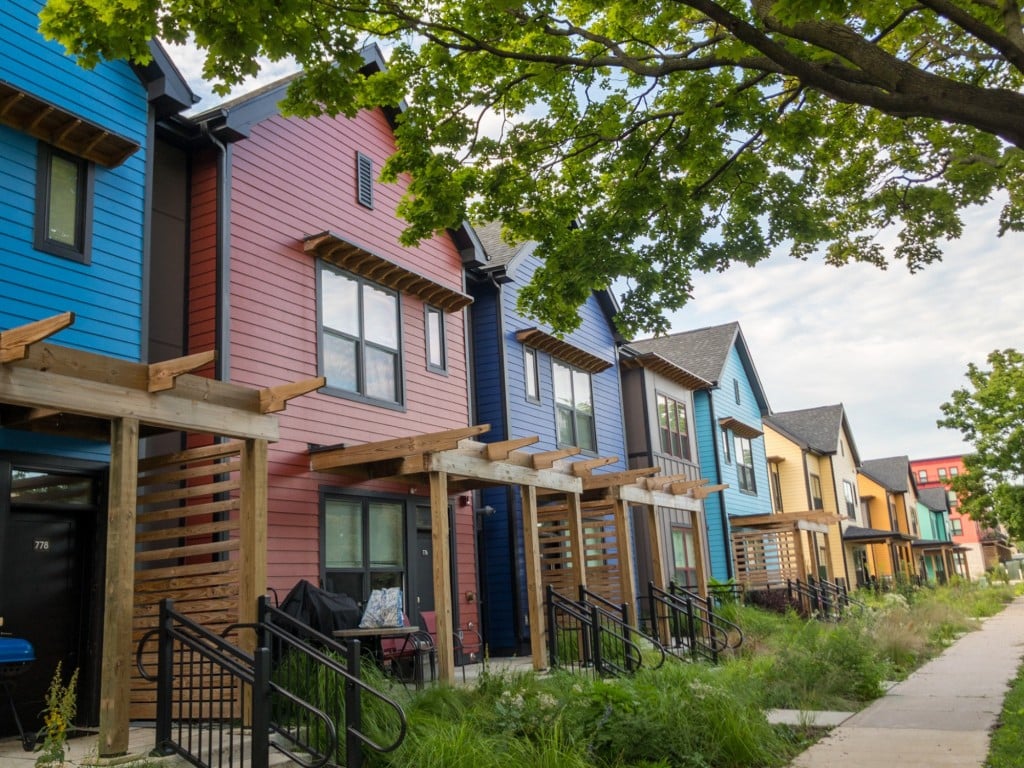
At best, one can seek an honest balance between these two imperatives—try to get neighborhoods both attractive and cohesive. It’s still extremely subjective but maybe there’s some consensus to be found. One example of a happy medium I’d offer is the redeveloped Bayview townhouse and apartment complex, in the historic Triangle formed by West Wash, Park Street, and Regent Street. Its solid-color facades of blue, green, red, and orange are straightforward but not bland. Three artists and a bunch of community members collaborated to create a mural adorning one of the apartment buildings at West Wash and Regent—which pulls the surrounding color palette into a lively burst of imagery. Whenever I pass this development, it literally cheers me up. Its mix of apartments, townhouses, and common space also illustrates that people who rhetorically pit density against things like parkland and a range of housing options are dealing in false choices. It looks like a nice place to come home to, and yes, that counts for a lot.
So let me answer the broader complaint here with a friendly challenge. If you sincerely care about the exterior look of housing, then follow through. Ask what we can do to give more people a nice place to come home to. If you approach the problem that way, I guarantee that you will come up with more substantive policy ideas, gain more allies, and even have more productive conversations with people who disagree with you. That matters, even if better policy outcomes aren’t guaranteed.
What do the people in these apartments think? Is the living space meeting their needs? Do they have the quality of life they deserve? What are their thoughts about aesthetics? Do they want character or do they want central air? These questions come first.
Take a look around. Most of the housing that people have built, on earth, period, is not particularly eye-popping. Plenty of housing is bland or ugly on the outside but quite pleasant on the inside. Landlords have carved up many a pretty old house into heinously unlivable units. A lot of the housing that we think has character and charm today might have seemed dull in its own time.
I have lived in 13 different places in Madison over the past 20 years. Of those, 12 were rentals and one was (long story short) a brief but memorable journey into home ownership. A handful were pretty nice to look at inside and out. A few were unremarkable from the outside and pleasant enough inside. One was a little blah and stuffy inside, but in a complex with nice courtyards and common space that made up for it. Sometimes you get both aesthetics and good living space, sometimes you get one of those things, sometimes you get neither. Renters know that it’s always been a grab-bag.
I of course don’t have the data on people who lean hardest on the aesthetic complaint—how many rent, how many own, how they break down along economic, age, racial lines, etc. I’m tempted to guess but then I would be going purely on vibes. (Or finding people who’ve made public statements about it and looking them up in Dane County or City of Madison Assessor property records to see if they own million-dollar homes. You can do this, but at a certain point it begins to feel kind of creepy.) What I can describe is who can bring any real weight or credibility to the issue.
If you own your home, especially a free-standing house or a whole building, I don’t care what you think about this! You have more control than renters over the appearance of your home, inside and out. Paint it whatever color you like. Plant whatever makes you happy in your yard. Throw in your choice of patio furniture, maybe one of those decorative garden bowling ball things. Take out that wall you’re sick of. Buy some gigantic OLED displays, and turn your den into a Nextdoor panopticon command center. It’s yours, baby!
Depending on the situation, you might need to call the Diggers Hotline or get a permit from the city or buy a nice bottle of scotch for the condo association president. Maybe the neighborhood busybody will complain. Maybe the neighborhood busybody is you. Point is, you’ve got a lot of discretion over the aesthetics of your housing. Statistically speaking, you are also more likely than renters to have the financial resources (a good income, access to credit, etc.) to pay for your new decorations or home improvements. Buying a home is a pain in the ass under the best of circumstances, so once you’ve got one, you should make sure to enjoy it to the fullest. Spend more time looking at the inside of your home and less time looking at the outside of other people’s homes. You will be happier this way.
Basically, the only people I want to hear it from are people who live in one of these buildings or people on the apartment hunt who might have to consider living in one. (And maybe people who have one going up really close to their home. If you can reach out your window and touch one of these new buildings, such that both your feet are in contact with an interior floor surface in your home and the palm of at least one of your hands is in contact with the exterior wall of a new multi-family housing building, OK, some neighborly grace is in order.)
If you rent, you have inherently less discretion over the aesthetics of your housing than a homeowner. If your landlord is working from a boilerplate Wisconsin Residential Lease, chances are you’ve agreed to a provision stating “Tenant shall not, unless permitted in the rules or with specific written approval of Landlord, physically alter or redecorate the Premises.” Some landlords are more lenient than others about interior painting or what have you. But if your landlord has put down some truly heinous carpet or committed other crimes in the arena of interior fixtures, you’re stuck with that until you move out.
If all of these people were sincerely concerned about aesthetics, they would have clawed their own eyes out long ago at Madison’s existing stock of multi-family housing. Some of it has character; some of it had character but went to rot at the hands of negligent property owners; some of it is just fine; and some of it was ugly in the first place. Chances are that most of the people you see every day around Madison are living somewhere kind of dreadful and overpaying for the privilege.
I’m not going to try to steel-man the arguments of people who use aesthetic gripes to justify their aversion to increased density and new housing. No need to invent good faith where it doesn’t exist. Some people clearly just want to stay in an idealized Madison of the past. Leave them there.
If these people wanted more aesthetically pleasing housing—as opposed to what they really want, which is no or very little new housing—they’d be doing all sorts of things that they’re not doing, and talking about all sorts of possible solutions that they’re not talking about. They’d look for points where the affordability crisis intersects with these loftier concerns. Commission more public housing projects with the involvement of local artists and creative architects. On that note, stop doing such an abysmal job of funding the arts—this really does end up tying into all sorts of practical policy issues, and even the most cookie-cutter neighborhood can be attractive if you add public art. Hold design contests for community members to pitch in their own visions of what housing should look like.
Expand the City of Madison’s existing grant programs for building improvement. Incentivize and/or require property owners to make practical updates like central air (which is not a luxury but a necessity in the era of climate change and increasingly dangerous heat waves) and accessibility upgrades. Crack down on slumlords. Maybe don’t let crappy commercial landlords own architecturally significant buildings, because that’s insane? Challenge the false and inadequate official definitions of “affordable.” Maintain and expand Madison’s already great public parks, yet another factor that can make up for drab housing.
Sure, it all sounds like a tall order. As it is, we’re not doing enough to simply make sure that people have affordable housing. Policymakers increasingly seem incapable of even thinking of solutions that add up to more than simply hurling ourselves upon the mercy of market forces. The housing emergency can make aesthetics feel like a frivolous concern. At the same time, it challenges us to think differently about our problems and our needs. We should strive not just to survive this crisis, but to emerge from it with a more holistic and human approach.
The State Journal‘s recent story about Kenton Peters’ death called back to this earlier quote from the architect: “I think every generation has the right, the prerogative, to build buildings that express their age.” I find this inspiring. The people struggling to hang on in Madison right now deserve to claim that right and prerogative. Any discussion about the look of new housing should start there, and not with the gripes of the generations who’ve already had the chance to make their marks.
Who has power in Madison,
and what are they doing with it?
Help us create fiercely independent politics coverage that tracks power and policy.
Author

Related Articles
Stop spotlighting new films by known abusers
Madison boasts a dynamic movie culture, yet still needs programmers and community voices to facilitate change.

Achieving a broader focus through music photojournalism in 2025
The fourth installment of our live music photo essay series centers a more personal vantage point.

Madison’s musical odds and ends of 2025
A meditation on the past year’s musical margins.