
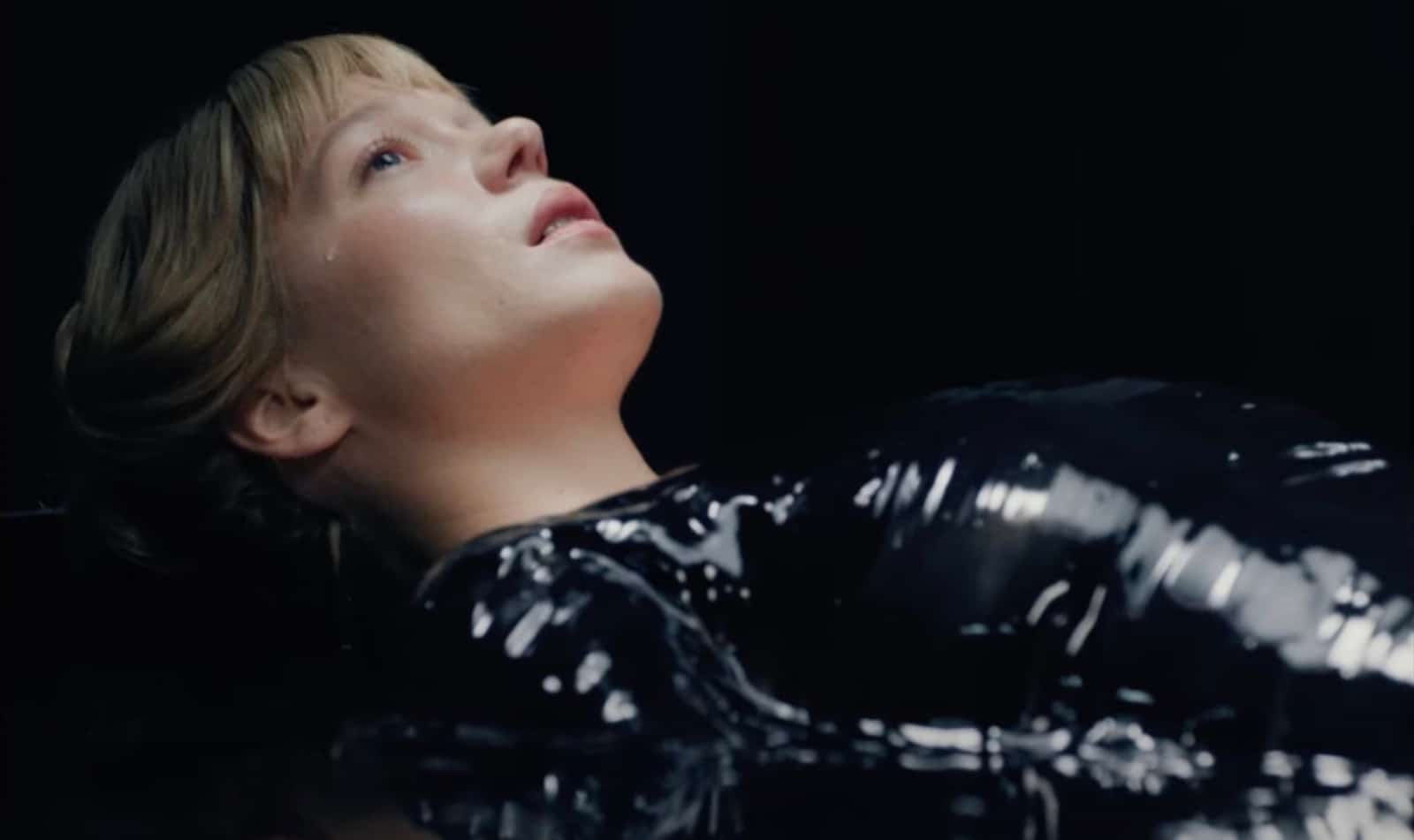
Bertrand Bonello’s latest psychological, postmodernist period drama premieres locally at AMC Fitchburg 18 on April 26.
French writer-director Bertrand Bonello has always been a tough nut to crack. He’s been steadily cranking out well-regarded and visually accomplished films since the late ’90s; but the thematic threads between his films have been hard to parse outside of his interest in a general discursiveness about characters’ labor conditions, which puts him in a messy lineage with Jean-Luc Godard. Further complicating matters is his newest film The Beast (2023), a time-jumping international production with an international cast that, just by virtue of its mixed modality, is potentially Bonello’s most dense and accomplished work yet. It opens commercially with a local premiere at the Fitchburg AMC 18 on Friday, April 26 (with two sneak screenings on Thursday, April 25), and additional show times through at least Wednesday, May 1.
In a room cloaked in greenscreen, we’re first introduced to Gabrielle (Léa Seydoux), who’s given directions by an unseen director to imagine a scary beast next to her. But this is only one version of Gabrielle, revealed later to be a past self, remembered by the present-day version of her in 2044. In this near-future setting, the main tenet of Scientology has turned out to be basically real, and an increasingly popular form of therapeutic mood-stabilization involves scrubbing the pain of past lives from one’s DNA. The three versions of Gabrielle we meet (in 1910, 2014, and 2044) are all lonely and searching in their own ways, and find some form of connection with Louis (George MacKay); in 1910 he’s a lover, in 2014 an incel making front-facing camera videos in his Jeep, and, in 2044, another potential patient in past-life regression.
This sort of modular storytelling is rich territory for Bonello, who has always gotten incredible mileage out of his mise-en-scène, which he can now tweak across space and time for maximum literary effect (the 2044 Gabrielle also goes to a bar with a different year’s theme each time, so there’s an additional sort of nested time travel to 1963, 1972, and 1980). Bonello’s regular cinematographer, Josée Deshaies, adds more dimensions by mixing cameras and aspect ratios, recreating, in macro, the overwhelming effect of the visual detritus the characters encounter. In one 2014 scene, news footage of riots is blocked out by pop-ups for plastic surgery in Gabrielle’s browser (and, later, inexplicably, scenes from Harmony Korine’s 2009 absurdist romp, Trash Humpers).
But the film’s most striking images are its most minimal, particularly in the imagined future: lone animals in cityscapes, people walking around in full-face transparent masks. Like the liminal mall in Bonello’s satirical thriller Nocturama (2016), the future setting of The Beast seems barren except for intentional placements of individual objects, everything a reference to a past time and feeling. The oldest Gabrielle precipitates this by manufacturing dolls, objects that recur in each future setting in increasingly disturbing ways. The dolls are collectively a path towards isolation over time, and there’s an irony to Gabrielle encouraging their increasingly detailed and realistic production only to be trapped by further developed simulacrum down the line.
It’s here that Bonello’s trans-historical argument comes into focus: the idea that we have always desired emotional connections with people more for our own fulfillment, and that industrial production has only given us more opportunities to fulfill our desires with objects. And even if that thesis seems played out in a post-Black Mirror world, Bonello and Seydoux’s dynamism fills in the gaps to make the density of The Beast never anything less than compelling.