
The body camera issue
Our second-ever print edition accompanies our ongoing coverage of surveillance and transparency.
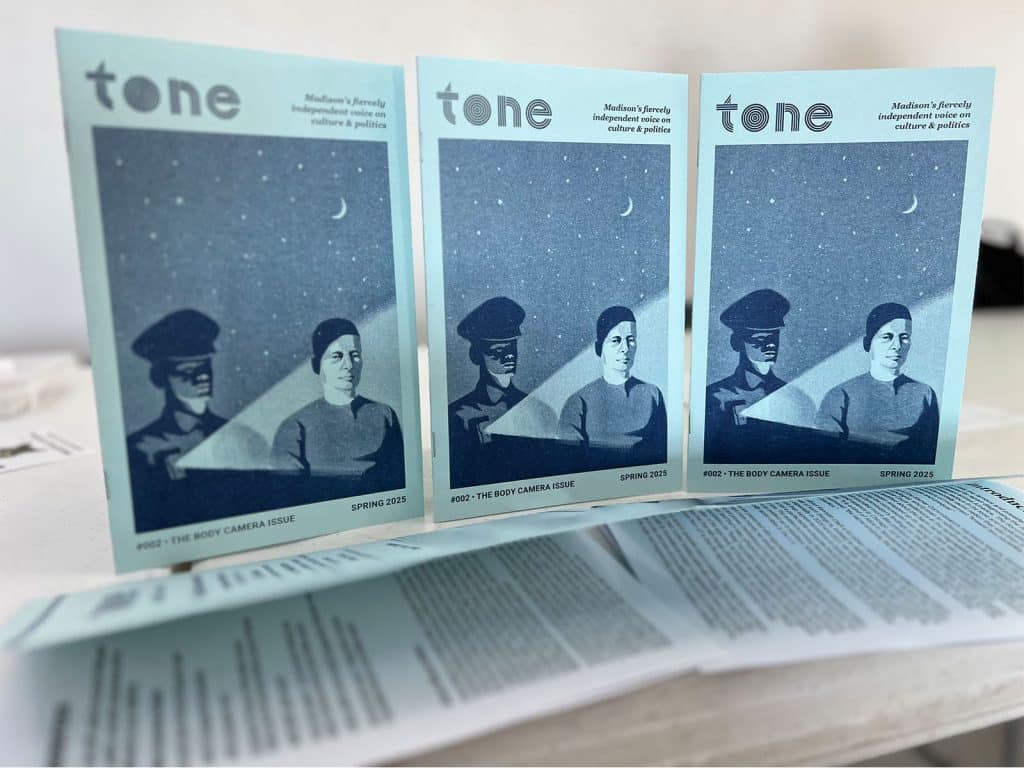
Our second-ever print edition accompanies our ongoing coverage of surveillance and transparency.
We’ve spent a lot of time over the past couple years reporting and writing about police body cameras. Tone Madison‘s latest print edition focuses entirely on the subject, with all-new illustrations by Andrew Mulhearn, design by Kay Reynolds, and an introduction by UW-Madison history professor Simon Balto.
The issue recaps what we’ve learned while reporting on local police agencies’ pursuit of body cameras and the obstacles a new Wisconsin law poses to people seeking access to bodycam footage. We’ve even added a bit of new reporting and material just for print readers!
We’ll be selling copies for $5 each at Madison Print And Resist on Saturday, April 26 from 11 a.m. to 4 p.m. at the Central Library. We will also have copies available at our next Tone Madison Office Hours, on May 30 at Giant Jones, and we hope to have them available for sale at a couple other locations soon—details TBA!
If you got here via the QR code in print, look below for links to all the stories and resources mentioned.
Credits
Design and coordination: Kay Reynolds
Illustrations: Andrew Mulhearn
Written and edited by Scott Gordon (Publisher, Tone Madison), Christina Lieffring (News and Politics Editor, Tone Madison), and Kay Reynolds
Special thanks to Simon Balto for his introductory essay. About Simon:
Simon Balto is an associate professor of history and College of Letters and Science Mary Herman Rubinstein Professor at the University of Wisconsin-Madison, and the author of the multi-award-winning Occupied Territory: Policing Black Chicago From Red Summer to Black Power (University of North Carolina Press, 2019). He is a regular contributor for The Guardian, and has written for multiple scholarly and popular publications, including TIME, The Washington Post, The Baffler, American Quarterly, The Journal of African American History, and The Journal of Urban History. He is the recipient of numerous fellowships, including from the National Endowment for the Humanities, the American Council of Learned Societies, the Andrew W. Mellon Foundation, and most recently, the Carr Center for Human Rights Policy at the Harvard Kennedy School.
He is currently at work on two new projects. White Innocents: Terror, Racism, And Innocence In The Making of Modern America (contracted with Norton) is a history of white mob terrorism in the United States from Reconstruction to the civil rights era, and of the refusals and incapacities of the nations’ assorted “criminal justice systems” to reckon with it. “I Am A Revolutionary”: The Political Life And Legacy Of Fred Hampton (contracted with Haymarket) is a biography of the life and political afterlife of Fred Hampton, leader of the Illinois Black Panther Party, who was murdered by the FBI and the Chicago Police Department in 1969 at the age of twenty-one.
Get Tone Madison in your inbox
📥 EVERY TUESDAY: Catch up quickly on upcoming local events and our latest arts, culture, and politics stories.
📥 EVERY THURSDAY: Enjoy our newsletter-first column, Microtones, and a curated selection of stories from Tone Madison and other local outlets.
Stories we mentioned in this edition





Additional resources on body cameras and more
Sample Open Records Request Letter, Wisconsin Freedom of Information Council
Street Level Surveillance Hub, Electronic Frontier Foundation
Electronic Privacy Information Center: State Law Enforcement Body Camera Policies-Prism: The history of police body cameras is more complex and troubling than we’ve been told
Final Report and Model Policy of the Police Body-Worn Camera Feasibility Review Committee
Critical Resistance: Reformist reforms vs. abolitionist steps in policing
Prism: The history of police body cameras is more complex and troubling than we’ve been told
Alec Karakatsanis, “The Body Camera: The Language of our Dreams,” 2024
Community Policing and Body Camera Ad Hoc Committee report
YWCA BWV Community Engagement Sessions report
Body Worn Camera Feasibility Review Committee report
Gregory Gelembiuk (served on the Body Worn Camera Feasibility Review Committee; the only scientist on the committee): two letters on errors and deficiencies in the Body Worn Camera Feasibility Review Committee report.
Who has power in Madison,
and what are they doing with it?
Help us create fiercely independent politics coverage that tracks power and policy.
Author

Related Articles
Behold, Tone Madison’s December 2024 print edition
We made a zine to commemorate our 10th anniversary.