
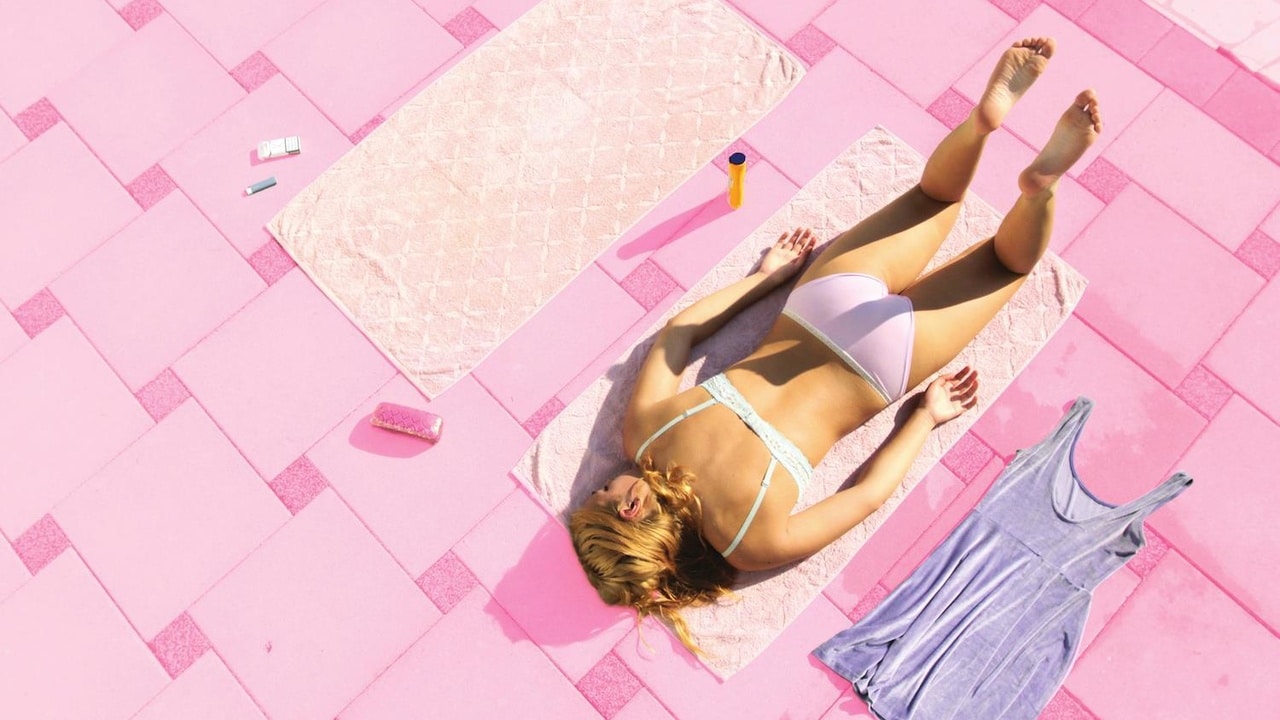
Writer-Director Ena Sendijarević visits the Wisconsin Film Festival on April 8 to present her candy-coated existential comedy.
Ena Sendijarević’s enchanting existential comedy Take Me Somewhere Nice (2019) begins with the image of Dutch-Bosnian teenager Alma (Sara Luna Zorić) gazing listlessly at her dual reflection in a dressing room mirror while shopping with her mother. After a lengthy pause, she says, “I can’t decide.” Although she is referring to the simple choice between a lilac dress or a red one, this statement perfectly encapsulates the dilemmas Alma faces, setting the scene for the strange journey that follows.
An impassive, world-weary young woman on the cusp of adulthood who was born in Bosnia but raised in the Netherlands by her divorced mother, Alma finds herself caught between two nations, two cultural identities, and her two parents. She decides to go back to Bosnia and visit her estranged, ailing father, who returned to his homeland after abandoning his family. Upon her arrival at the airport, her shady, taciturn cousin Emir (Ernad Prnjavorac) greets Alma with mostly indifference. Despite not being gainfully employed, he is apparently too busy to drive her to the hospital. Alma can’t get her suitcase open; therefore she’s forced to wear the same clothes every day. She dyes her hair blonde, impulsively has sex with Emir’s charming friend and “intern” Denis (Lazar Dragojević), and remains in limbo in Emir’s drab, cheerless apartment.
Alma eventually takes matters into her own hands and boards a coach bus to reach Podveležje, the remote plateau where her father resides. However, the bus departs without her during a pit stop and she loses her luggage. Stranded in the middle of nowhere and destitute of money, Alma sets off on foot toward her destination. Thus begins a series of surreal, meandering misadventures that gradually open her eyes to the stark realities and breathtaking natural beauty of a foreign land in which she remains an outsider.
Along the way, she encounters an array of lost souls, including a jaded and aging refugee singer who was formerly a prostitute, a slick and sleazy politician, a pretentious hotel illusionist, and a pair of brutal seaside thugs. Take Me Somewhere Nice emphasizes Alma’s nagging fears, idle pleasures, reckless sexual energy, and aimless defiance. A scene in which Alma, Emir, and Denis blast a cassette tape of Sonic Youth’s “Kool Thing” during a cocaine-fueled nocturnal joyride in a borrowed car exemplifies the spirit of the film—presumably a reference to Hal Hartley’s 1992 dramedy Simple Men, in which the main characters dance to the same song.
Take Me Somewhere Nice makes its local theatrical premiere during the 2024 Wisconsin Film Festival on Monday, April 8, at 5:30 p.m., at Flix Brewhouse (tickets are still available as of the publication date). With this elegant, elliptical debut feature, Sendijarević offers a gently absurdist look at the vicissitudes of daily life in contemporary Balkan society. As the Dutch-Bosnian writer and director explores the complex relationship between an immigrant and her native country, her film suggestively portrays Alma’s interior world with off-kilter camera angles, candy-coated visuals, meticulously stylized compositions, and an air of clinical detachment. Throughout the film, Alma seems to be perpetually pulled in opposite directions, while becoming increasingly aware of her blossoming sexuality and nonchalantly seeking to escape the ennui of her bourgeois existence.
Sendijarević mainly tells Alma’s story through vivid impressions of reality and mood, rather than a classical narrative structure. Her process of self-discovery, rebirth, and personal growth takes viewers from hyperreal urban spaces adorned with brutalist architecture to desolate rural terrain and the verdant, mountainous landscape of Bosnia and Herzegovina. Sendijarević’s film evokes the alluring emptiness of modernity and reflects on the region’s turbulent political history, while also revealing the resilience and volatile beauty of the damaged people that Alma crosses paths with.
Sendijarević cites Jim Jarmusch among her inspirations; Take Me Somewhere Nice inevitably invites comparisons to Jarmusch’s 1984 minimalist deadpan comedy Stranger Than Paradise, which follows the aimless travels of a Hungarian émigré visiting her cousin and his friend in the United States. Sendijarević has also gravitated towards filmmakers like Rainer Werner Fassbinder and Aki Kaurismäki. In a Mubi Notebook introduction to her debut for its global online premiere, Sendijarević discusses the influence of Ali: Fear Eats The Soul (1974) and The Match Factory Girl (1990), two of her favorite films. Despite the obvious cinematic references, Take Me Somewhere Nice never feels derivative or predictable. Sendijarević manages to breathe new life into the timeworn road movie and coming-of-age story, creating a fresh, idiosyncratic, and sensitive character study.
Like her protagonist, Sendijarević was born in Bosnia and raised in the Netherlands. Because of the Bosnian War, her family fled the country when she was five years old and ended up in the Netherlands after some years in Berlin. Prior to Take Me Somewhere Nice, she drew on her personal history to make a short film, Import (2016), about a Bosnian refugee family trying to integrate into Dutch society. With Take Me Somewhere Nice, Sendijarević dives deeper into autobiographical questions of fractured identity, migration, and belonging, while providing a contrast to what she calls the “victimizing aesthetic” of so many straightforward social-realist films. “How can I make a film where I can laugh about my own situation?” Sendijarević asks in a 2019 interview with Variety. “Because I think humor gives empowerment. So this is what I tried: to take my own problems and make fun of them, in a way, and liberate myself from this victimizing view.”
Sendijarević has been granted the opportunity to share and discuss her film with audiences throughout the world. In fact, she is scheduled to appear in person at this film-fest screening of Take Me Somewhere Nice for a Q&A on April 8, as well as on Saturday, April 6, to present her latest feature, Sweet Dreams (2023). “One of the questions that is asked the most is why I used humor to tell this story,” Sendijarević says. “I respond with a quote by Billy Wilder: ‘If you’re going to tell people the truth, be funny or they’ll kill you’.”