
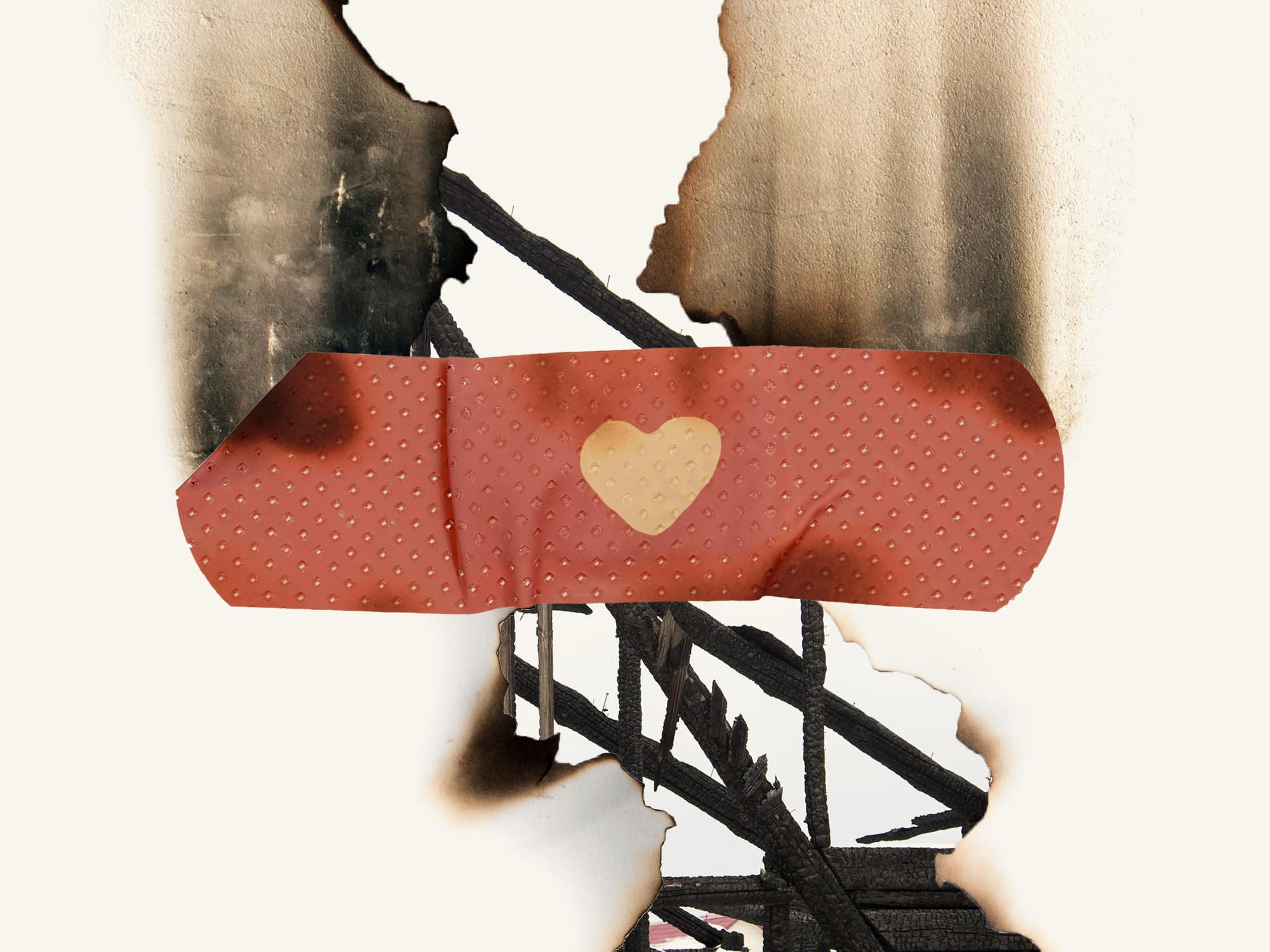
People who lost their homes in the March 2023 fire share accounts of discrimination from the Red Cross, and praise community mutual-aid efforts.
Pamela and Sylvester Mahones awoke to fire alarms blaring. It was early morning and their apartment, in the Monona Hills complex on Owen Road, was pitch-black. Startled and lost in the dark, Sylvester suggested an escape plan to throw Pam, who uses a wheelchair, off the third floor balcony. She told him that she would rather jump instead.
On second thought, they decided to feel along the darkened hallway walls to the elevator. Choking in the smoke, Pamela realized she’d left behind numerous oxygen tanks she needed to breathe, along with almost everything else that they owned. To their relief, the elevator was operational, and they were able to evacuate the building.
They had escaped from the infamous Monona Hills fire on March 18, 2023, which killed one person and left dozens of other residents of the 70-unit apartment complex displaced.
The Monona Fire Department later handed off its investigation of the fire to the Division of Criminal Investigation at the Wisconsin Department of Justice. DCI investigators closed the investigation in October, concluding that the fire started “on or near the stovetop of apartment #204,” but have classified the cause of the fire as “undetermined,” WDOJ spokesperson Gillian Drummond tells Tone Madison. “An undetermined classification does not necessarily mean that investigators don’t have an idea of what likely happened, it simply means that there is more than one competing hypothesis related to the origin of the fire and if all but one can’t be eliminated utilizing the scientific method, a determination other than undetermined can’t be applied,” Drummond says. “Based on the report, investigators at that scene were unable to eliminate unattended cooking on the electric range as a possible cause of the fire.”
A statement by the Dane County Medical Examiner’s Office identified the deceased as Annette F. Dorenzo, 64, of Monona. Dorenzo was pronounced dead at the scene.
“It was already flames coming out of [Dorenzo’s] apartment,” Pam recalls of the moments after she evacuated the building. “The windows exploded and everything.”
Pam and Sylvester left the building to take refuge in their truck. They did not have the keys to warm up or drive the truck away, but it was better than nothing as they waited that sub-zero night for almost an hour.
The police were the first on the scene, because the Monona Fire Department’s response was delayed.
Kristie Goforth, a former Monona mayoral candidate and former member of the Monona City Council, dropped by the scene to check on her friends. The fire had just been put out, and she had just visited Monona Hills a couple of weeks prior. Goforth is currently the executive director of the nonprofit Free Bikes 4 Kids Madison, and is a member of the Sault Tribe of Chippewa (Ojibwe) Indians. Goforth notes that there were many people of color housed at Monona Hills, especially seniors. Goforth believes that understaffing at the Monona Fire Department might have slowed the response that night. (During her 2023 mayoral campaign, Goforth was endorsed by the Fire Fighters Local 311, the union representing firefighters in Madison and several of its suburbs, including Monona.)
One police officer went into the burning building to retrieve a handful of Pam and Sylvester’s belongings: keys to the truck and Pam’s purse. They haven’t retrieved anything else from their apartment—none of their other possessions or furniture—since. Their apartment was located on the south side of the building, which Monona Hills Apartments management later admitted in a letter “experienced significant fire damage on the third floor.”
Pam, who suffers from Chronic Obstructive Pulmonary Disease (COPD), had difficulty breathing, which was only exacerbated by the smoke she had inhaled during the escape. The fire department brought her oxygen tanks to relieve her breathing, only to take them away after a brief period because they were reserved for emergency response, and not disaster relief care.
Once the fire was finally under control, disaster relief efforts began. Pam and Sylvester met two representatives from the American Red Cross, who arranged transportation to the nearby St. Stephen’s Lutheran Church in Monona for shelter. Meridian Group, the Middleton-based company that developed and managed Monona Hills Apartments, was working with the Red Cross to coordinate disaster relief services. Meridian Group owns multiple apartment complexes, in Wisconsin and Illinois, that focus on low-income, disability, and senior housing.
Goforth arrived at the church, witnessing the pain and anguish of survivors. She also discovered the survivors’ immediate needs, including toothbrushes, deodorant, socks, and underwear. She helped purchase some of these items and delivered them to the survivors in shelter at St. Stephen’s.
The Red Cross shelter at St. Stephen’s Church
At St. Stephen’s, Pam and Sylvester thought they had found sanctuary. They say the people at the church were very nice and welcoming. The American Red Cross promised to provide care and disaster relief services. Pam, Sylvester, and the others faced an immediate lack of housing and basic essentials, without access to their apartments, if their belongings even survived the fire. They were in a vulnerable situation and were relying on safety nets for their survival.
But Pam and Sylvester say the Red Cross did not fulfill its promises. In fact, the treatment they received at the hands of the organization deeply insulted and offended them and others in the community.
Hannah Olson got involved with a community mutual-aid group helping the Monona Hills fire survivors because somebody close to her lived in the facility. She alleges the volunteers and staff of the Red Cross had frequent turnover and would routinely yell at the survivors when the public was not looking. Olson brought supplies and noticed the supplies the Red Cross intercepted would disappear when the survivors were still in their pajamas, smelling of smoke from the fire.
Olson was especially interested in the Red Cross’ activities because she had heard of previous controversies about the organization’s relief efforts. A 2015 ProPublica story about the Red Cross’ Haiti relief efforts was headlined “How the Red Cross Raised Half a Billion Dollars for Haiti and Built Six Homes.” ProPublica has published investigations into the Red Cross’ relief efforts, including during Hurricane Sandy in 2014 and Hurricane Harvey in 2017. ProPublica‘s investigations into Hurricane Sandy relief also revealed that the Red Cross had children sheltered near sex offenders and threw away 35,000 danishes meant for hungry survivors because the Red Cross did not know how to deliver them.
Discrimination allegations
Pam says the Red Cross actively excluded her and Sylvester from crucial aid needs like food, Gatorade, mobility aids, and accessible ways to ask for help. Olson recalls hearing how a volunteer threw out Pam and Sylvester’s food in front of them. At the church, Pam did not have access to any supplemental oxygen tanks for a couple of days. She didn’t have access to a phone charger or a charger for her mobility scooter. She struggled to breathe and to move her right hand due to a previous wrist injury. Due to her mobility issues, she was unable to raise her hand to get the attention and help of volunteers.
Pam notes that the church janitor, however, supported her and had been bothered by the behavior of the Red Cross volunteers. The staff at St. Stephen’s were helpful and welcoming, Pam emphasized, in stark contrast to the volunteers.
Pam, who is Black, says the volunteers were older, and they picked and chose who got help, and seemingly favored the white survivors. The survivors allege both racial and disability discrimination from Red Cross volunteers. She says they yelled at her, and insulted her in a difficult time. “Red Cross was real hateful to us,” she says. One of the survivors compared the relief shelter to a jail, Olson says, with heavy restrictions on leaving the shelter.
Pam urinated on herself a few times because she couldn’t raise her hand to get Red Cross volunteers’ attention. When she finally got help, only one of the two church bathrooms was open to survivors, and it was in use at the time. Olson recalled how Pam requested help using the bathroom, explaining that the Red Cross was not providing medical assistance.
The Red Cross was concerned about Covid spread at the time and had the survivors take Covid tests. The survivors did not see the test results firsthand, but they were told they tested positive and were forced to move to a hotel. A member of the mutual aid group, Alex, who asked to be identified by an alias for reasons of job security, says the Red Cross pushed the pair out to a hotel in an “an isolated part of town” away from the resources the Red Cross kept available for others at the shelter, including a resource fair.
Once it was clear that the disaster relief efforts were limited, the community began organizing local mutual aid efforts, to provide help where more powerful actors had failed. In the case of Pam and Sylvester, the Red Cross paid for nights at the hotel sporadically and without enough advance notice, leaving vulnerable community funders to pay for their stay. The mutual aid group, organized through an ad hoc group chat, gathered donated supplies and funds from the community, so the survivors could rebuild their lives. (Full disclosure: I have been personally assisting this group since May, providing rides, food deliveries, and moving assistance to survivors.)
Tone Madison obtained texts from a Red Cross RN, Suzanne Kremer, who had reached out to Olson asking about the survivors’ medications, despite Olson’s lack of medical credentials. This interaction did allow Olson to request more paid hotel nights from the Red Cross after the community funded almost a full week to keep the survivors from being thrown on the street. On March 25, 2023, about a week after the fire, Sara Dorow, the Disaster Recovery Manager for the Wisconsin region of the Red Cross, offered client assistance cards to fund the survivors’ hotel stays “through the weekend and into the next week.” Dorow also promised to have dinner dropped off for them, after the community had been crowdsourcing survivors’ meals and groceries the previous week. Groceries that I, personally, among many others, helped bring to survivors.

Pam and Sylvester kept a good portion of those donated supplies in their truck at the hotel. One night, the supplies were stolen from the vehicle. Once again, they had to start over.
Another mutual-aid group member, Cat, who asked to be identified by this pseudonym due to concerns about personal safety, gave both Pam and Sylvester Covid tests the next day. The results were negative. Pam believes the previous, supposedly positive tests were an excuse to remove some people from St. Stephen’s.
“The Red Cross was trying to figure out a way to get rid of us, the Black people,” Pam says. The Black people were grouped together in a hostile way by the volunteers and given less assistance, Olson says.
Different survivors had very divergent experiences with the Red Cross shelter and assistance. A Channel 3000 story published shortly after the fire quoted other survivors praising the Red Cross’ relief efforts. “They’re our helpers,” Kisiah Johnson, who had lived at Monona Hills since 2011, told Channel 3000. “They’re giving us shelter, and they fed us,” said Oscar Balderas, who had lived there since 2008, in the same report. They go on to describe receiving essentials from the Red Cross, and the community environment among the survivors in the shelter.
The American Red Cross of Wisconsin declined to comment publicly on Pam and Sylvester’s specific experiences, instead requesting to speak with the survivors privately. After an internal investigation, the Red Cross found that their volunteers followed procedures properly. Jennifer Warren, the Regional Communications Director for the American Red Cross, Wisconsin region, relayed that the Covid tests were “encouraged,” though Pam describes their Covid tests as forced. The Red Cross relayed that they were providing free hotel rooms and transportation to those testing positive “in partnership with Dane County Public Health.”
Morgan Finke, Communications Coordinator for Public Health Madison and Dane County, confirms that the agency’s staff worked with the Red Cross in the Monona Hills fire relief effort, through Dane County Human Services. Public Health had an Infection Preventionist speak with a Red Cross representative about infection prevention and control measures and placement strategies. The Red Cross then executed the rehousing of those displaced on their own.
Pam accuses the developer of Monona Hills, Meridian Group, of negligence in fire prevention. She says that Dorenzo had set fires two other times before, and she says that Meridian was aware. Rodney Tapp, the President of Meridian Group, denies allegations of negligence and says that the Monona Fire Department performed proper investigations. Tapp also confirmed that the deceased had received a previous warning once before related to smoke from unattended cooking, but denies that it was a fire or an established pattern before the March fire. Pam and Sylvester received a letter on April 12, 2023, from Monona Hills Apartments regarding the damage, and offering a “donation.” They have not yet been allowed into their old apartment to recover their oxygen tanks, family obituaries, and jewelry. Pam and Sylvester also did not have renter’s insurance to cover their losses, like many of other low-income seniors who called Monona Hills home. Over the summer some residents, largely on the north side of the building, were allowed to return for their things with strict move-out day limits by Meridian. Visitors and movers were required to wear hardhats and sign safety waivers to enter the building.
The management’s letter acknowledged “significant fire damage” as well as “water damage” in the south side of the building—close to the fire’s origin and these particular survivors’ apartment. Meridian also acknowledged “smoke damage” in the north area of the building. The company offered survivors a “one-time donation of $1,500 to each impacted household.” Notably, this was not compensation for damages or neglect.
“They ain’t take responsibility, ya know that, right? Red Cross or Meridian,” Pam says.
The payment appeared, to her, as an admission of guilt to keep survivors quiet about Meridian’s negligence.
Who did help
The response of the Red Cross in helping these Black, disabled seniors bothered those helping out from the community.
“It’s almost like a white knight of them coming into a person of color’s life during a bad situation,” says Cat.
Shortly after the fire, Cat started volunteer work with the mutual aid group. Her involvement started with a Walmart run. She gained experience providing direct community aid as a medic during the 2011 Capitol protests. This sort of on-the-ground assistance is surprisingly rare in a place like Madison, full of well-funded non-profits. These seemingly small, direct efforts to help folks with services, funds, or goods prove critical in dealing with everyday issues that large organizations often overlook. Cat says she appreciates being able to provide some genuine, accessible help to the survivors. These sorts of groups are also more connected to the community, and literate in their specific needs, as well as preventing discrimination.
Pam emphasized how the mutual-aid group helped with chores and errands like laundry, food, and other day-to-day necessities.
Pam and Sylvester praised actors like the mutual aid group. “If it wasn’t for that group, we wouldn’t have nobody…It’s a miracle. I’ve never seen anything like it before,” Pam says.
Months later, Pam and Sylvester finally had a new stable home, and spent all of their money on a bed. The Housing Help Desk at the Tenant Resource Center assisted with a much-needed $1,000 security deposit to get them back on their feet. Survivors say that local media outlets have stopped paying attention to the situation, and so have the non-profits who initially promised help in the aftermath of the fire. The alleged failures of the Red Cross, an international disaster relief non-profit, and Meridian, a low-income developer based in Middleton, who were responsible for providing initial disaster relief, are harrowing. On the other hand, the help of the St. Stephen’s Church provided much-needed support in those difficult times.
These serious allegations against a powerful landlord like Meridian and an international non-profit in the American Red Cross highlight the need for accountability for well-funded, powerful people. Their many responsibilities and generous funding contrasts with their seeming inability to connect with diverse local communities of Black and disabled folks. We must understand that racism is systemic. To tackle it, it’s essential to look at the processes of organizations like the Red Cross, and how they might exclude minorities. The American Red Cross is the US affiliate of the Switzerland-based International Federation of Red Cross, and some locals worry about their ability to connect with communities located halfway around the world.
The local focuses of the mutual aid group, St. Stephen’s Lutheran Church, and the Tenant Resource Center proved critical to providing real on-the-ground support to these members of vulnerable communities. This is the power of folks coming together in times of crisis. There are many remaining questions about Meridian and the American Red Cross, and it’s doubtful they will provide answers to those publicly. This lack of accountability underlines the need to scrutinize large nonprofits, and take a look at smaller local options that know the community, and can engage with people in need respectfully, regardless of who they are. Pam says the community group should be running the Red Cross, instead. According to Pam, “they should have somebody who’s gonna look out for everyone.” The survivors have deserved that from the very beginning.