
Solidarity and obstinance sprouted anew after a police raid on UW-Madison’s pro-Palestine encampment
The protest marked a week of growth and peace, as some local officials showed support and others refused to take the movement seriously.

The protest marked a week of growth and peace, as some local officials showed support and others refused to take the movement seriously.
It’s been one week since UW-Madison Chancellor Jennifer Mnookin called in police to forcibly clear a student protest encampment on campus. The May 1 early-morning raid on the peaceful assembly on Library Mall resulted in 34 arrests, including students and several faculty members. All but four of those arrested were processed and immediately released, while the remaining four are currently awaiting trial on charges ranging from resisting arrest to assaulting an officer.
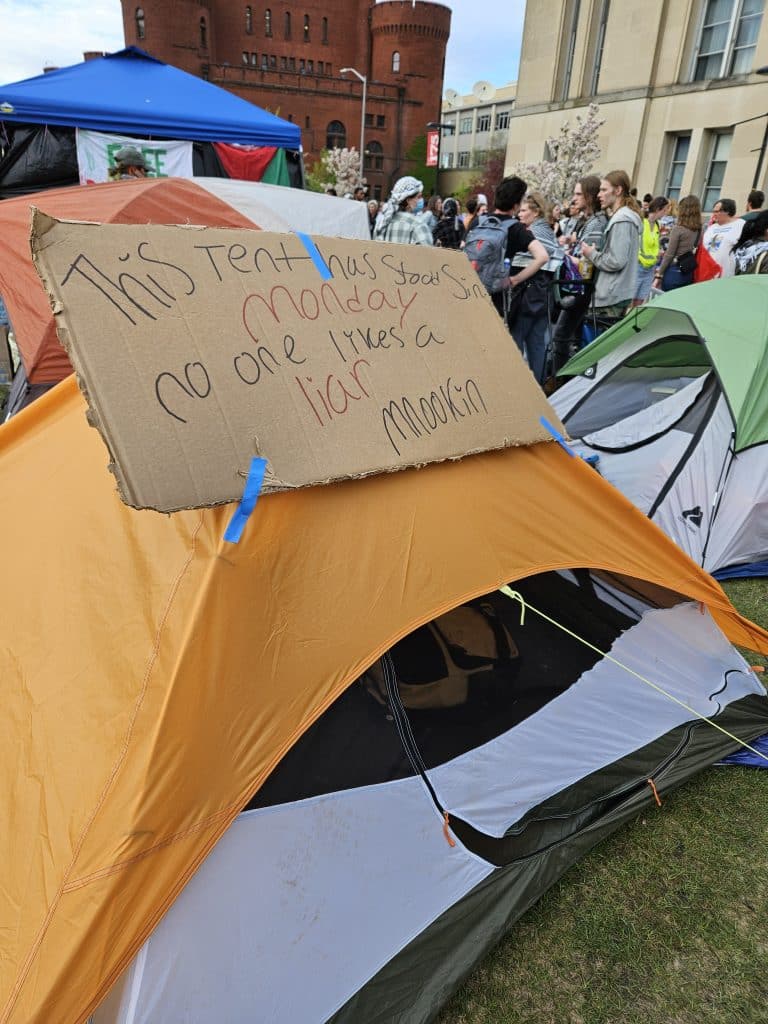
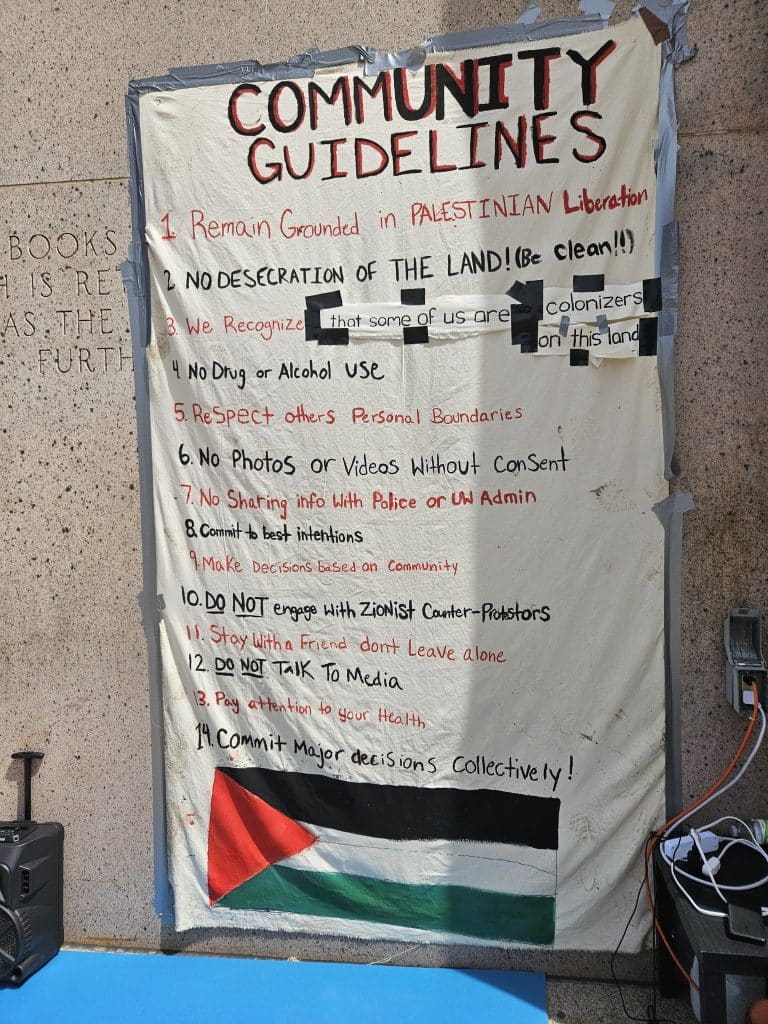
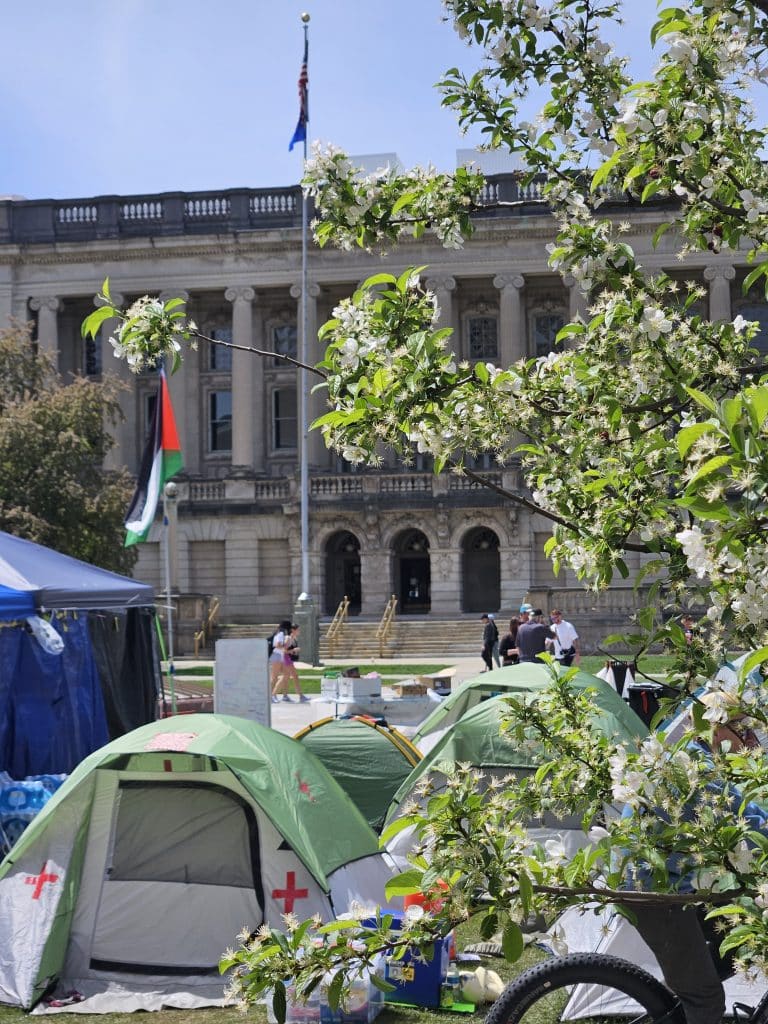
The encampment was rebuilt almost immediately after police left that same day. In fact, protestors set up more tents than before, and more people turned out to support after witnessing the scenes of police violence on social media and local news. Since then, the grassroots group of encampment organizers have put on teach-ins, movie screenings, free meals, and a Shabbat dinner, and have continued to hold safe space for Muslim attendees to do daily prayers.
Students established the camp as part of a protest to demand that the UW disclose any and all investments it holds in Israeli companies and/or defense contractors, and to commit to divest those funds. They’ve also urged the UW to officially call for an immediate and permanent ceasefire in Gaza, where the Israeli military has been waging a now 8-month-long war that’s killed at least 35,000 people—including 14,500 children—injured more than 78,000, and displaced some 1.7 million. The action was and is part of a much larger wave of student-led protests across the country focused on calling for an end to genocide in Gaza and for U.S. institutions and government to divest from the war machine that makes it possible.

Despite the protestors’ clearly stated demands and overwhelmingly peaceful tactics, they’ve routinely faced heavy-handed and often violent responses from university administrators, police, and government officials. Just a few colleges and universities have opted instead to engage in good-faith conversation with organizers and reached peaceful outcomes. Misinformation and deliberate lies about the protests and those involved have also run rampant on social and mainstream media, with elected officials like Sen. Tom Cotton (R-AR) calling protesters “fanatics” and referring to encampments as “little Gazas.” President Joe Biden also decried the protests in a recent speech, falsely conflating criticism of the Israeli government with anti-Semitism, a tactic also being wielded by those on the far-right who themselves have promoted truly anti-Semitic tropes like the “great replacement” theory.
Biden is one of many public figures pushing the message that Jewish students feel unsafe in the face of the pro-Palestine protests. Abbie Klein, a UW graduate student and one of the protest organizers, notes that very little concern has been shown for the many Jewish students and faculty involved in and/or supporting the protests themselves.
“I am a Jewish student out here for Palestine, and we’ve seen a lot of talk about making sure Jewish students on campus feel safe, and resources provided for them, but there’s been none offered for those of us who are being brutalized by police,” Klein says.
Common Council deadlocks on vote of support for protest
The Madison Common Council on Tuesday deadlocked 8-8 on a vote to approve a resolution supporting the protesters’ free speech rights and calling for a ceasefire in Gaza. After a long public comment period, during which most speakers expressed support for the student encampment and anger at the ongoing violence in Gaza, the final tally fell short of the 12 yes votes needed to pass.
The resolution was sponsored by Alders Juliana Bennett, Marsha Rummel, Nasra Wehelie, Sabrina Madison, and Mike Verveer. Alders MGR Govindarajan, Amani Latimer Burris, and Isadore Knox, Jr. also voted to pass the resolution. On the no side were Alders Tag Evers, Yannette Figueroa-Cole, Barbara Harrington-McKinney, Charles Myadze, Nikki Conklin, Regina Vidaver, John Duncan, and John Guequierre. The remaining alders were absent.
“I voted in favor of the resolution because it supported students’ first amendment right to protest,” Govindarajan tells Tone Madison. “I’m disappointed it failed to pass, but I will continue my communication between UW Administration and organizers to focus on de-escalation and safety for everyone as I have been since last Monday.”

Evers on Tuesday night offered an alternate resolution that softened the language of the original, and also failed to pass. It removed references to the death toll in Gaza, the destruction of hospitals and schools, and the recent discoveries of mass graves. While the original stated that police agencies “initiated an escalation tactic through executing a raid on the peaceful protest” (and went on to specify some of the violent tactics police used on protestors on May 1), Evers’ version reflected his stated desire to avoid assigning blame: “the peace was broken when the University Police Department initiated an operation to remove student tents on Wednesday morning, an action that was met with resistance on the part of some protesters, resulting in arrests and injuries.” Evers’ changes struck a reference to an April 29 incident in which police officers physically shoved Bennett, Govindarajan, and Dane County District 2 Supervisor Heidi Wegleitner as they left a police staging area at the Fluno Center. Bennett and her co-sponsors called specifically for Mnookin to authorize the encampment. Evers suggested a more general call for the administration and protestors to keep negotiating in good faith.
“To me, the alternate said nothing of real substance,” Bennett says. In an interview with Tone Madison, Bennett didn’t mention Evers by name, but expressed disappointment in “the sponsor” of the alternate resolution: “It really did seem like he was not interested in actually listening to people and was more so interested in mansplaining and listening to whatever thoughts are in his head,” she says.
Despite the outcome of Tuesday night’s vote, Bennett thinks the effort was worthwhile.
“An additional benefit of having this conversation on the Council floor, which I know a lot of my colleagues probably didn’t want to have, is that we brought people to local government that otherwise wouldn’t have engaged on this level,” Bennett says. “Even [though it failed], having eight members of Common Council that showed their support for [protestors] is important and impactful.”
UW faculty and staff show solidarity
On Monday, May 6, UW faculty and staff held a walkout and rally on the mall to show support for the student protest and to issue forceful statements condemning UW-Madison administrators’ decision to call in police. They condemned the arrests of several faculty members, making a point to note that they were almost all people of color. Members of United Faculty and Academic Staff Local 223, as well as a group of Jewish faculty, staff, and students from the UW, both read statements calling out the use of force against the protesters and urging constructive dialog going forward.
“We are Jewish faculty, staff, and students at the University of Wisconsin-Madison who stand with the peaceful and righteous coalition of student activists calling for the university to divest from Israel,” Amanda Shubert, an English professor, read from a statement signed by hundreds of Jewish faculty, staff, and students. “We join our Muslim and Muslim-allied colleagues, Jewish Voice for Peace-Madison, and the over 2,000 faculty, staff, students, alumni, and donors who signed the ‘Statement in Solidarity with Student Protest from the University of Wisconsin-Madison Community,’ in demanding that the university allow student activists to express their freedom of speech for Palestinian rights. In a climate in which ‘Jewish safety’ is being used to justify repression of student activists fighting against genocide, we refuse to have our identity as Jews weaponized against our own values. We also refuse the conflation of anti-Zionism with antisemitism. We will not be silenced or intimidated by specious claims that to stand against war, genocide, occupation, and ethnonationalism is to discriminate against ourselves.”
Shubert read the statement despite several attempts by a handful of counter-protesters to shout over the speech. Yellow vest-wearing student marshals worked to de-escalate the situation, and Shubert was able to continue. Another Jewish faculty member and faculty senate representative for Community and Environmental Sociology, Joshua Garoon, gave remarks before heading into Bascom Hall to join a faculty senate meeting.
“I want to cast back to Saturday night, when there was a Havdalah on Library Mall,” Garoon said, referring to a Jewish ritual that marks the end of Shabbat. “Tons of Jewish students out there. What I want to focus on are two particular Jewish students, who I could not be prouder to have gotten to know this week, who were wearing yellow vests, who were de-escalating, and who also managed to join the Havdalah ritual. They sang, they hugged, they were courageous in the face of people who tried to tell them they didn’t belong there. They were courageous in the face of people who told them that they aren’t ‘real Jews.’ I could not be prouder of them or the Jewish students who came over from that Havdalah who had civil discussion with people in the encampment for half-an-hour afterwards. They modeled for us, who are much older than they are, what this should actually look like, and they should be heard as a message to the chancellor and everyone else in the administration that their reaction to this protest has been abominable, and that those students, who couldn’t agree on a single thing, left bumping fists and calling each other brother. That made me about the proudest I’ve been in the last 11 years I’ve been at UW. That made me proud to be a Badger.”
A group of some 200 faculty, staff, students, and community supporters later joined Garoon inside, quietly filing into the meeting room, with many registering to speak and ask questions. Some of the most direct questioning came from sociology professor Samer Alatout, who was arrested and suffered a minor head injury during the police raid and is the faculty advisor for the UW chapter of Students for Justice in Palestine, one of the main organizing groups behind the encampment.
“One of my biggest critiques for what happened this week is that the administration has taken itself to represent the university, and that it is the university,” Alatout said. “Every time there was an offer [from students to talk], the administration insisted the encampment come down before they talk.”
There have been several meetings between student organizers and university administrators, though Mnookin herself has not been present at most. The most tangible result of those negotiations thus far was a commitment by the administration to hold off sending in police again so long as the negotiations were ongoing.
“If [the police] come again and the students have not reached an agreement, I will stay again,” Alatout added. “I will stand between them and any police officer.”
Mnookin pushed back on the criticisms, saying, “I can’t authorize a single exception to one organization unless I’m prepared to make the same decision for all other groups.” Mnookin was referring to the state statute that bans tents on campus but allows a carve-out for the chancellor to opt not to enforce that ban at their discretion.
“How would we respond if a neo-Nazi group—such as the one we had here in Madison in November—made similar use of campus lands?” Mnookin said.
Protesters committed to the long fight
The encampment entered its tenth day on Wednesday, after organizers met with UW Administration on May 7 and said they were offered the same commitments as the week before.
Administration officials emphasized that they are not authorized to make investment decisions, but that they would facilitate “access…to relevant decision-makers so that you may present your concerns and requests.” They asked that protesters agree to those commitments and dismantle the encampment by Wednesday at 4 p.m.
According to reporting by The Daily Cardinal, protest organizers said that they had presented the officials with a new proposal for ethical divestment and investment, a framework for accountability and overall commitment to ethical standards at the May 7 meeting. They also called for the charges to be dropped for those arrested on May 1. Organizers say that administration officials did not read or engage with the new proposal. They also rejected the commitments in UW’s offer, and instead called for a rally for the time of the UW’s proposed deadline.
“What we would like to see happen is for the Administration members involved in negotiations to actually take us seriously,” Klein says. “We are going to stay out here until our demands are met. Will do what we need to do to get this university to listen to us, hopefully get them in good faith to meet with us, though as of yet that doesn’t seem to be the situation.”
Who has power in Madison,
and what are they doing with it?
Help us create fiercely independent politics coverage that tracks power and policy.
Author
Related Articles

Coliseum renovations should proceed with caution
Dane County should apply strict scrutiny of its partnership proposal with FPC Live, even if it’s the only bidder.
Could an exhibition like “Guiding Ethos” find a home in Madison?
A group show at Appleton’s Trout Museum stands up for “political” art in an era of cowardice and compliance.

Beltline expansion proposals suggest dead-end logic
“Another lane will fix it” still reigns at WisDOT, but the public is pushing back.