
Resilience and strength in ethnic studies
Federal attacks on representation can’t overshadow visibility, as UW–Madison establishes the first Midwestern Puerto Rican Studies Hub.

This is our newsletter-first column, Microtones. It runs on the site on Fridays, but you can get it in your inbox on Thursdays by signing up for our email newsletter.
Earlier this month, UW–Madison students, staff, and faculty mobilized in defense of the university’s ethnic studies course requirement after a UW System miscommunication indicated that the university’s requirement could be eliminated.
A FAQ tab on the UW System site—accompanying a policy document detailing the incoming course recategorizations that will be employed in order to comply with Wisconsin Act 15—stated there “will not be an ethnic studies or diversity course requirement.” Fearing a significant loss of access and representation for the diversity of experiences and opportunities that ethnic studies provides, community members collected testimonies and encouraged expressions of collective outrage at the decision in response.
University leadership quietly clarified the language on its site overnight on October 8, about a week after Associated Students of Madison (ASM) first raised a call to action. The FAQ answer was amended to “The Universities of Wisconsin through the Board of Regents do not require ethnic studies or cultural diversity courses. Individual universities currently have discretion in this area and that autonomy is not subject to change.” This affirms that UW–Madison would still maintain its ethnic studies requirement. ASM subsequently followed up with a statement that thanked the community for swiftly mobilizing and denouncing misinformation from UW.
ASM Chair Landis Varughese expressed frustration with the lingering uncertainty surrounding the situation. Varughese called it “a public departure from the values of ethnic studies by the University of Wisconsin–Madison when they did not have to,” in an interview with The Daily Cardinal for Alaina Walsh’s October 8 article.
“Students should not be learning of the future of ethnic studies through the grapevine,” Varughese said in a release statement from ASM.
There’s no way to know for certain whether this negligence was a genuine slip-up or blatant disregard for the communities that the UW purports to serve. No matter, the situation lines up with UW’s posturing away from DEI initiatives, which has proliferated under the threat of slashed federal funding.
Folding under the pressure of an increasingly powerful Republican legislature, UW–Madison has quickly jumped from claims of “reimagining” DEI initiatives to shutting down its Division of Diversity, Equity, and Education Achievement (DDEEA) in July. In this context, floating the possibility of further diminishing what little inclusivity-promoting measures the institution has left only adds to the mounting pressure that students who benefit from DEI initiatives and ethnic studies have been feeling.
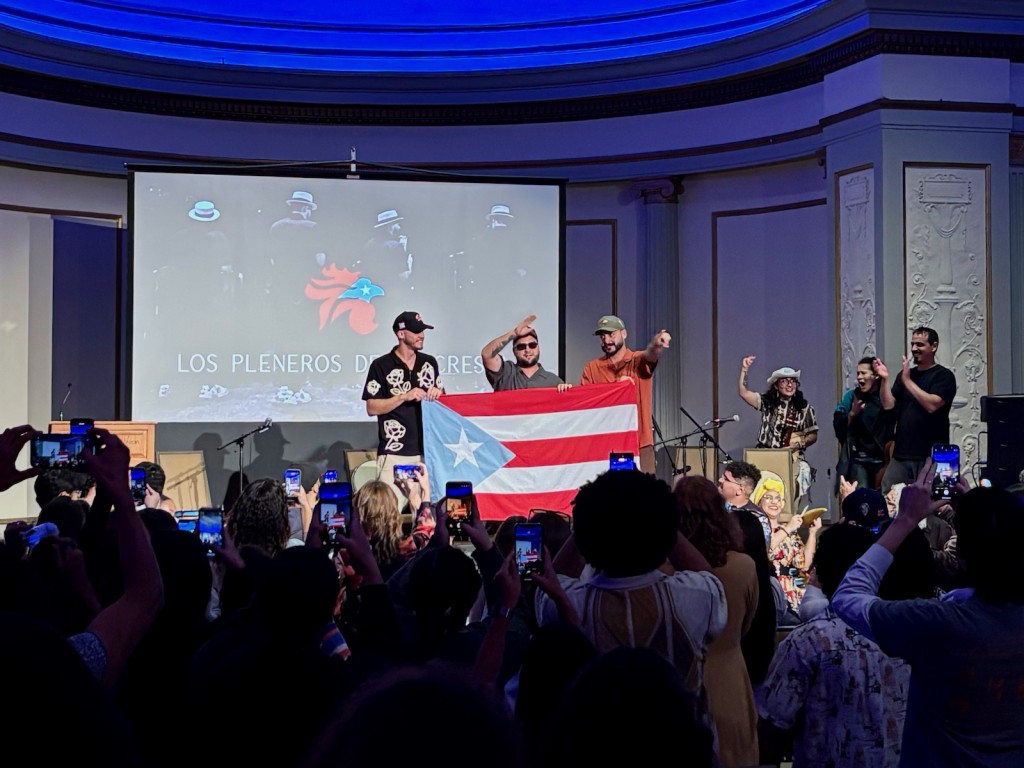
Despite this, the rapid show of solidarity among the UW–Madison community in the face of this threat demonstrates the overwhelming strength and resilience that these programs encourage. No amount of scrutiny and harassment is going to force any community to hide its pride. These characteristics were loudly espoused by the Puerto Rican Studies Hub (PRSH), whose inaugural celebrations on October 13 could be heard echoing throughout the Memorial Union.
Led by UW professors Aurora Santiago Ortiz (Gender and Women’s Studies and Chicane and Latine Studies) and Jorell Meléndez-Badillo (History) and backed by a $3-million grant from the Andrew W. Mellon Foundation, the PRSH is the first Puerto Rican studies center in the Midwest. “It speaks to the urgency at this moment to continue having ethnic studies in our curriculum. I’ve seen the benefits. It means something to students,” Santiago Ortiz tells the Milwaukee Journal Sentinel.
The PRSH aims to bridge together academics, artists, and the public with “lectures, musical performances, fellowships, film screenings, and more” through 2028. It kicked off with an interactive performance by Puerto Rican plena ensemble Los Pleneros de La Cresta.
The group was featured on the critically acclaimed album Debí Tirar Más Fotos by global pop phenomenon Bad Bunny. Meléndez-Badillo also played a notable role in constructing the album’s message through the help of his writing, providing the anecdotes of Puerto Rican history that accompany the album’s visuals. In a January 2025 interview with Tone Madison, he explained that the visuals serve as “corresponding Spanish-language educational materials, offer[ing] a history lesson,” for those who have been denied the opportunity to study their national history.
Meléndez-Badillo has exemplified that commitment to education in spearheading an innovative ethnic studies center alongside Santiago Ortiz through the PRSH. This commitment is highlighted by the fact that the duo’s joint effort accomplishes a decades-long initiative to bring Puerto Rican studies to UW–Madison, according to a 1987 report by a university steering community on minority affairs. Furthermore, the inauguration of this center amidst a climate of rampant federal funding cuts attests to the resilience underpinning this endeavor, which stands firmly committed to representing students.
While right-wing forces continue to make educational spaces and universities unwelcome spaces for minority communities, those communities are showing that they are unapologetically present and making history on campus. Despite the wider environment of uncertainty for academic safe spaces, it is evident that the desire for ethnic studies in the UW community burns fiercely.
Who has power in Madison,
and what are they doing with it?
Help us create fiercely independent politics coverage that tracks power and policy.
Author
Related Articles
Madison needs a wake-up call
The longer we pretend this City is a progressive haven, the more people will be harmed.
Stop spotlighting new films by known abusers
Madison boasts a dynamic movie culture, yet still needs programmers and community voices to facilitate change.
Achieving a broader focus through music photojournalism in 2025
The fourth installment of our live music photo essay series centers a more personal vantage point.