

The new nature documentary about moths of Northeastern India premieres at UW Cinematheque on November 7.
Moths and pupa have served as indelibly beautiful literal and figurative visual motifs in cinema. Prismatic winged patterns were used to seminal, flickering effect in Stan Brakhage’s three-minute experimental short, Mothlight (1963). That fervid fascination has imprinted onto recent narratives like The Moth Diaries (2011), The Duke Of Burgundy (2014), and Crimson Peak (2015) in the past 15 years. These works of fiction, among others, atmospherically harness the moths’ swarming magnetism (like moths to flame, they fittingly say), and high-frequency, majestic flutters.
Nocturnes (2024), a new nature documentary and quasi-ethnographic work by Indian filmmakers Anirban Dutta and Anupama Srinivasan, takes a more grounded and matter-of-fact approach to moth and lepidoptera representation on film. It harkens back to Mothlight in both direct and indirect ways, but also expands into penetrable scientific territory.
UW Cinematheque has hand-picked Nocturnes for a proper widescreen view, as it will premiere locally on Thursday, November 7, at 7 p.m., at 4070 Vilas Hall. Dutta and Srinivasan let viewers become flies on the wall—or moths on a screen, as it were—while also honing in on the elevational field study of lepidopterist Mansi Mungee and her slim crew in the Eastern Himalayas near Bhutan.
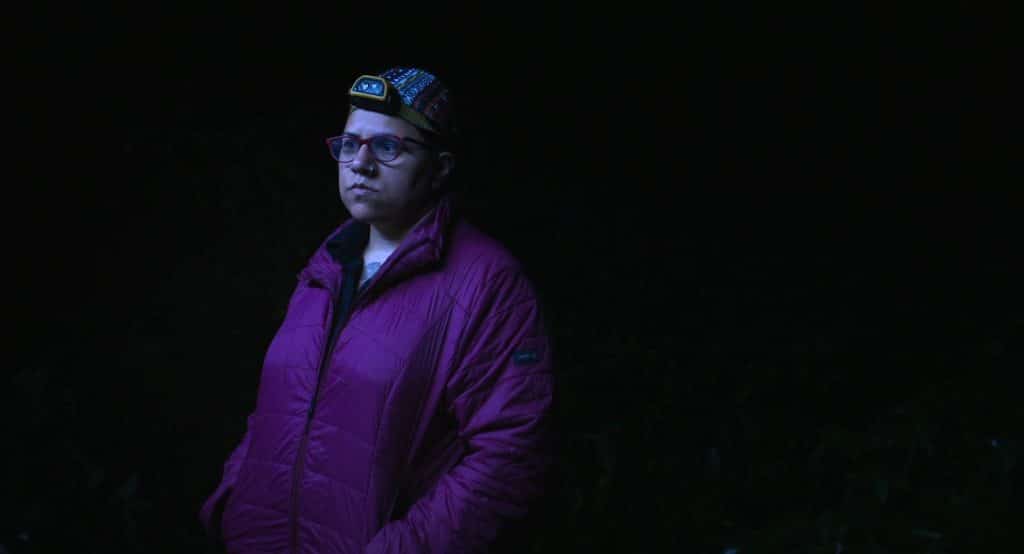
Mungee’s alternatingly inquisitive and instructive voice serves as a sort of second guiding light, augmenting the intense, integral fluorescent lamp sources she’s powered to attract the moths for observation. Sinking into nocturnal ruminations about her own work for a biodiversity lab, Mungee relays, via voiceover, childlike wonderment that led her to Northeastern India, as well as realities about moths’ adaptability that have ensured their survival over millions of years and mass-extinction events.
In particular, her interest in the large hawk moth (sphingidae) stirs a nagging concern a third of the way through Nocturnes. At a lower elevation, Mungee notes that she observed over 50 hawk moths a few nights prior, yet now sees none. “This is not normal fluctuation,” she anxiously processes aloud while gazing at the large gridlike fabric screen she and Indigenous research assistant Bicki have pitched upright like a tent.
:focal(200x133:201x134)/https://tf-cmsv2-smithsonianmag-media.s3.amazonaws.com/blogging/featured/Brown_and_pink_moth..jpg)
Of course Mungee is alluding to environmental effects on moth life here (and thus, all animal life) induced by global warming. Mungee freely admits to possessing more elephantine questions than resolute answers, hence her sustained research. Though, she instinctively knows there is some correlation between thorax-abdomen size and temperature. “How many moths have already disappeared, and how many are left?” she rhetorically asks at one point in her peripatetic prodding. As a researcher, Mungee will require years to pore over coded spreadsheets and hundreds of photos at elevations 200 meters apart, up to 2800m.
At times, her human-devised fieldwork seems to exist on the fringes of the tranquil focus on the moths’ themselves. Mungee is observing the moths, but the filmmakers and director of photography Satya Rai Nagpaul all are, too, and observing them differently than her. The viewer, amalgamating these different perspectives, also notices the lepidoptera in their own distinctive ways. Yet, undeniably, the universal act of seeing here is tethered to a kind of revelation. Most humans only observe moths in specific situations—as stiffly pinned taxidermied objects under glass or, conversely, in mid-flight, darting in a blurry flurry to the nearest artificial light source for warmth.
During one routine at daybreak when Bicki shakes out their moth screen onto the grass, the scene as captured by the co-directors suddenly becomes a striking reminder of the delicate, even cruel beauty of the world. It’s one that will inevitably be affected by an incremental, catastrophic climate shift. This conceptual exploration neatly segues into a portion of Mungee’s presentation to a group of her peers about the hawk moths, featuring her pointedly refined questions about the moths ascending the mountainous region as temperatures climb.
As filmmakers, Dutta and Srinivasan’s perceptions ultimately channel these subtly disquieting moments into adjacent shots that dive low to the ground for the first time, adopting an almost diorama-like framing. They shift the literal scale of Nocturnes again, reorienting viewers to examine moths on terms outside of the purely literal or figurative aesthetics with which they’ve grown most familiar through constructs in popular media.
The patient 83-minute film is quite obviously about the significance of persistent observation in the moment, but Nocturnes also seems to prophesize an inextricable mix of hope and dread that wells within Mungee and through the struggles of our planet’s uncertain future. And for all the film’s simply seen microcosmic and macrocosmic beauty, that’s most deserving of attention.