
Mortal and moral inquiries at the 2025 Wisconsin Film Festival
Our writers ponder four incisive, formidable documentaries (and essay films) screening as part of the fest from April 4 through 10.
Our writers ponder four incisive, formidable documentaries and essay films screening as part of the fest from April 4 through 10.
Documentaries aren’t necessarily Tone Madison‘s eminent go-to for film coverage. Scan our most recent archives, and you’re bound to come across numerous pieces on classic genre films of several shades as well as historically important art-house fare, and even some modern experimental shorts or influentially transgressive pieces. Over the past year, we’ve tried to emphasize brand-new narratives that have popped up in commercial theaters.
But there’s something about the Wisconsin Film Festival that acts as an intrigue magnet for our writers, pulling the documentary from either perceived or actual scarcity. In the lead-up to the 2023 Wisconsin Film Festival—a monumental year for film-centric contributions here—we covered seven documentary features in just five days. Last year around the time of the festival, we wrote at length about four docs in three days. This March, like clockwork, many of our writers’ top priorities landed in the loosely defined documentary or nonfiction category, and so we’ve wrangled them together in this noteworthy, substantive anthology.
A surprising theme seemed to emerge within the works’ superficially disparate subject matter. Through an interrogation of the true crime genre (Zodiac Killer Project), the art of cheesemaking (Shelf Life), ecological journeys through human resilience (Apple Cider Vinegar), to the barbaric traditions of bullfighting (Afternoons Of Solitude), all these films actively and/or subconsciously meditate on mortality and morality. Whether through a wide lens and inclusive approach of the essay film of the first three, or the gripping character portrait enveloped in the sustained severity of the latter, all these stimulating works embody innovation in the documentary form at the halfway point of the 2020s. Their vitality is integral to appreciating film dialogues and cinematic language as a whole.
If you’re looking to add just one more thing to your short (or extensive) itinerary as the 27th installment of the festival gets underway this evening, April 3, we think any of these will do the proverbial trick. At the time of publication, only the Monday, April 7, afternoon screening of Apple Cider Vinegar is at “rush-only” status (meaning, tickets only may be available in person at the door); but advance tickets are available for all other screening times. —Grant Phipps, Film Editor

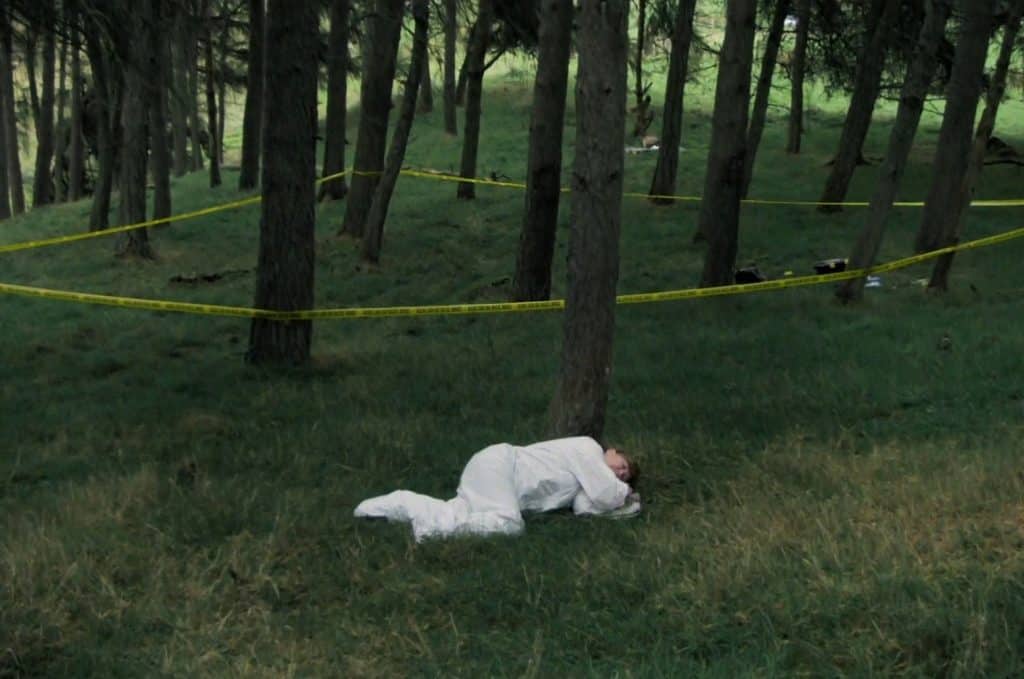
Zodiac Killer Project (dir. Charlie Shackleton). Friday, April 4, 1:30 p.m. at Bartell Theatre and Saturday, April 5, at 1:30 p.m. at Bartell Theatre.
Charlie Shackleton is a conceptualist in a filmmaker’s clothes, using the potential of filmmaking to explore broader concepts around film production and act of viewing. His last film The Afterlight (2021)—comprised solely of shots of actors who are now dead—only exists as a single print that’s meant to screen indefinitely until it disintegrates. This sense of structuring absences guides his newest film, too, the descriptively titled Zodiac Killer Project (2025).
On its face, Shackleton’s film seems to be making lemonade from its proverbial lemons. He originally set out to make a documentary adaptation of The Zodiac Killer Cover-Up, highway patrolman Lynden Lafferty’s personal account of his off-the-record investigation into the Zodiac case, but rights negotiations for the book fell through after some work had already been done on the film.
Over establishing shots taken when Shackleton was location-scouting, he details in voiceover what he would have done had he made that film. Along the way, Shackleton breaks down his project’s inevitable similarities to other films and TV miniseries like The Jinx (2015) and Making A Murderer (also 2015) to interrogate our recent obsession with the true crime format. Occasionally, staged material pops up—usually in quick, focused shots that highlight a gesture or a look as Shackleton had envisioned it in the final project. The inserted moments have the quality of the speculative fictional material in other docs he mentions, only this time for an imaginary film instead of a murder.
More than any of the projects mentioned, Zodiac Killer Project recalls James Benning’s Landscape Suicide (1987), another slow study made up mostly of static landscape footage that sidelines the sensational qualities of murder in favor of looking at its reverberations in the place around it. Except the “place” in question here is a genre. True crime has created a prefab, procedural aesthetic to be a useful container for the uncertainty, complexity, and pathology of needing to know and not knowing. These are now, ironically, routine parts of the form. The Zodiac case, one of the famously unknowable (and thus inexhaustible-for-content) events, set the blueprint for these kinds of projects. It encouraged infinite narratives to take hold in an emergent information economy with too much to know.
Zodiac Killer Project arrives when our information overload has resulted in repeated treatments of the same material, leading to a general narcissism in these types of projects. And that is despite the insistence that investigating murder is always a matter of justice and respect for the victims. Shackleton doesn’t maintain illusions about the necessity of his own project (he mentions early on that true-crime projects are a useful funding shortcut for documentary filmmakers these days). By the end, one gets the sense that we’re seeing a eulogy for a form more than a creative workaround. What this really sets up is a fruitful new avenue; while we’ve exhausted killer psychology, we’ve barely scratched the surface of investigator psychology. —Maxwell Courtright

Shelf Life (dir. Ian Cheney). Saturday, April 5, 11:00 a.m. at Barrymore Theatre.
Few films have made me long for a contemporary version of “Smell-O-Vision”—the short-lived attempt in 1960 to show a movie with odors—as much as executive producer Robyn Metcalfe and director Ian Cheney’s delightfully thoughtful Shelf Life (2024). This documentary is as much about the passage of time as it is about cheese.
In one scene, an unnamed Vermont cheesemaker pulls a small handful of cheese from an aging wheel like a core sample that’s been drilled out of a glacier and presents it to his assembled workers. A colleague brings the cheese right up to his nose to evaluate its smell; as I watched this, I involuntarily inhaled along with him. Such is the beauty and care with which the many cheeses in this film are shot. I often found myself, as one cheese enthusiast recommended, trying to appreciate them through not just vision but taste, touch, smell, and even hearing.
Early in the film, a “cheesemother” (her credited title) in Tbilisi, Georgia, mentions the idea that “cheese is milk’s leap into immortality.” It is that thesis of time and aging that elevates this documentary beyond a straightforward appreciation of all things cheese. In lesser hands, that kind of thematic parallel—cheese ages, and so do we—might be a bit on the nose, but Metcalfe and Cheney are savvy enough to keep the focus primarily on the cheese.
“We try not to talk about the number of months a cheese is, the number of years a cheese is, and we talk about where that batch is on its own journey,” Vermont cheesemaker Zoe Brickley expresses. On its own, that is a nuanced and insightful take on the cheese-aging process from an expert; within the context of the film, it’s also a statement that gives the viewer pause, especially as we watch cheesemakers from around the globe at various stages of their own journeys. It’s up to the viewer to decide just how much they want to reflect on this parallel.
Shelf Life makes occasional forays into more explicit reckonings with time and human mortality. They provide a thread that, without feeling heavy-handed, weaves together stories from seemingly far-flung people, places, and cheese-making practices. When Salima Ikram, an archaeologist working in Egypt, discusses the intersection of cheesemaking and mummification—both involving chemical changes and transformations in the interest of preservation—I was reminded of the earlier line about cheese being milk’s “leap into immortality.”
If that’s too navel-gazing, the filmmakers are ready with another, more grounded take. When Georgian cheesemaker Galina Inasaridze—who lived through Soviet occupation—is asked what she’s learned from cheese and the land, she replies, “I didn’t learn anything from cheese or the land.” Fortunately for us, there is much to learn and reflect on in this tight, carefully crafted 76-minute documentary. —David Boffa

Apple Cider Vinegar (dir. Sofie Benoot). Sunday, April 6, 2:00 p.m. at Marquee at Union South and Monday, April 7, 12:15 p.m. at Flix Brewhouse Cinema 7.
Life is at the precipice in Apple Cider Vinegar (2024), Sofie Benoot’s digressively inquisitive, yet enlightening essay film on relationships between personal ecology and broad geology. All pathways stem from the filmmaker’s discovery and removal of a kidney stone.
The Bruges-born Benoot—carrying around the smooth mineral deposit like a timepiece or show-and-tell conversation-starter—treks from her home in the UK to Cape Verde to Palestine to California with questions that further probe human biology as well as political ideologies in worker protections and environmentalism.
Apple Cider Vinegar is open-ended and ever-searching, as it expands from assumed autobiography—skewed by the silvery voiceover narration of Siân Phillips, and not Benoot’s own—to the study of landscapes that have been irrevocably altered by human activity. Near the halfway point, astronomer Carl Sagan’s quote “We are made of star stuff” peripherally resonates in the viewer’s mind, on the outside of the film’s framing. Sagan’s words are simply an instinctive reaction to a UK geologist’s mention of fallen meteorite material resembling Benoot’s tiny, pale-colored kidney stone in his hand.
And this is just one instance of the director extending either pensive thought or patient observation beyond surface-level comprehension. Early on, “mineral detective” Lorna Dawson slides Benoot’s stone under a forensic microscope and concludes that it contains weddellite, a material only found in seafloor mud at the bottom of the Antarctic. Perhaps we’re as planetary as much we are pelagic: the heliocentric descending to the abyssal.
As Benoot’s ideas amass and journeys progress, she is distracted less by the personal pain-point of a kidney stone operation and more by the perilous and precarious conditions in which humans are currently living on the earth. Benoot offers distinctive empathy for Palestinian people, many of whom are suffering health and psychological effects from granite quarry operations that are shipping stone to build Israeli houses.
Regarding the latter, a young Palestinian woman shares a distressingly “real” dream of falling into the quarry, as her house is so close to its edge. Considering every sight that Benoot toggles between for nearly 80 minutes, which had begun with a series of webcam-pixelated shots of wildlife—animals that are now scarcer as the climate has changed—it’s hard not to grasp this dream as a grander metaphor for an impending extinction event.
Despite this forthright foreboding, Apple Cider Vinegar is definitely not all doom and gloom. Its idiosyncratic title references a testimonial remedy for the alleviation of discomfort. The way Benoot translates an unmistakably warm, yet dry wit to her surrogate voice aids viewers in pondering and potentially embracing these radical recalibrations of observation. —Grant Phipps
Afternoons Of Solitude (dir. Albert Serra). Saturday, April 5, 8:30 p.m. at Chazen Museum of Art and Thursday, April 10, 4:45 p.m. at Flix Brewhouse Cinema 2.
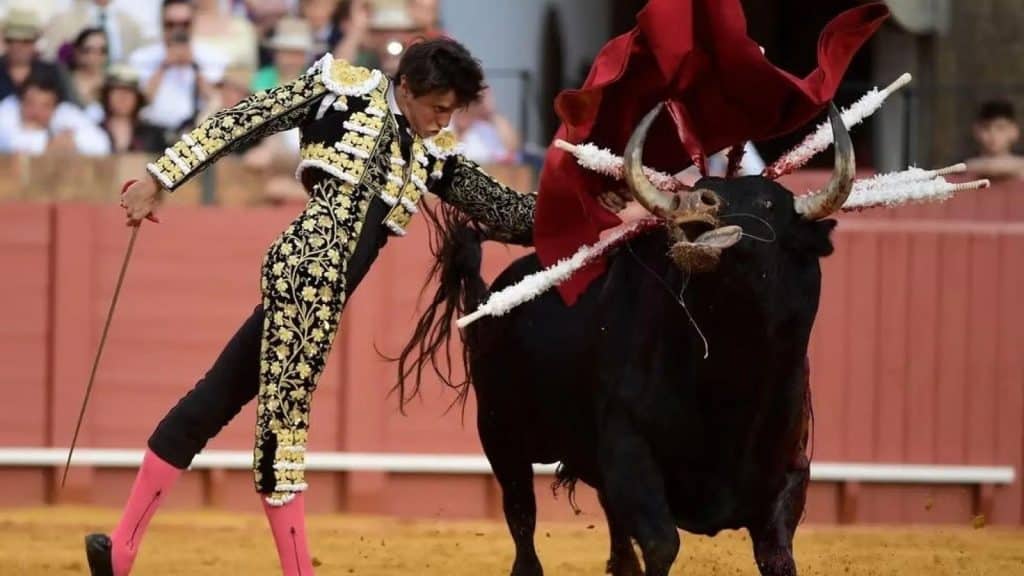
Catalan director Albert Serra has mostly been shooting fiction films internationally in the French language for the past decade. But with his latest, Afternoons Of Solitude (2024), he returns to his homeland to focus a documentary lens on one of Spain’s enduring icons: the matador. Stepping into the role is Peruvian Andrés Roca Rey, who undeniably has movie-star good looks (think a cross between Alex Wolff and Emilio Estevez).
Even in his narrative works, Serra famously works in an improvisational style, often utilizing non-professional actors as well as the freedoms of digital photography. For instance, he shot with three cameras simultaneously for his 2022 feature Pacifiction and then combed through hundreds of hours of footage in post-production. Rey may not have starred in a movie—fiction or nonfiction—before, but there’s no doubt he’s a seasoned performer.
The title of the film may be a little ironic, given that Rey doesn’t ever appear to be alone, constantly surrounded by an entourage of other bullfighters, handlers, stadium crowds, animal opponents and, of course, the camera capturing his day-to-day life. Serra’s primary cinematic theme is how power is expressed and utilized, and here he’s at his most blunt: a human’s ability to kill with impunity for the sake of spectacle.
Serra takes a different approach to the bullfighting subject than the nearest analogue, Francesco Rosi’s The Moment Of Truth (1965), by keeping his camera fixed on Rey, but refusing to commit to portraying him as a hero. Serra doesn’t even give much insight into his personality, beyond the feeling that he’s in a gilded cage. Rey is surrounded by a sycophantic crowd, whose pep talks always have a tinge of desperation in that they’re trying to convince themselves ancient tradition is worth continuing in the modern world.
Once the fights have begun, there’s no bullshitting (pardon the pun). Each fight is rigged against an increasingly exhausted animal that doesn’t fully comprehend what’s happening, but the essentially violent and sexual nature of any athletic endeavor is completely stripped of pretense. Serra largely keeps the stadium crowds off-screen, with their cheers representing human victory over nature or a sadistic taunt, depending on your point of view.
The ornate outfits and meticulously ritualized violence give the proceedings a sadomasochistic flair. Watching blood flow out of an animal being reduced to IRL hitboxes has the potential to make audiences queasy, but isn’t it more honest to engage with humanity’s bloodlust publicly rather than pretend we’ve evolved past it, despite all the evidence to the contrary? —Lewis Peterson
We can publish more
“only on Tone Madison” stories —
but only with your support.
Authors

Related Articles
Inspiriting radical communal aspirations: an interview with Ben Balcom on “The Phalanx”
The Milwaukee filmmaker’s latest experimental short premieres locally at the Chazen Museum during the 2026 Wisconsin Film Festival on April 12.
Continuity and expressive experimentation in the 2026 Wisconsin Film Festival
Eight writers share their initial insights on the eight-day extravaganza, April 9 through 16, across UW campus and Madison.

Video: Talking 2025 Wisconsin Film Festival with Josiah Wampfler
A collaborative episode with OCA Media after recovering from festival fatigue in the wake of the 27th annual event, which was held from April 3 through 10.