
Neighborhood noisemaker
Assessing the local political and social climate through a community dispute.

This is our newsletter-first column, Microtones. It runs on the site on Fridays, but you can get it in your inbox on Thursdays by signing up for our email newsletter.
For some, the time-consuming and mentally draining task of keeping up with current events is reason enough to avoid talking about—much less get directly involved with—politics. This disillusionment and aversion can be attributed to frustration with people in the spotlight of political action who use morally grandstanding rhetoric that doesn’t align with their actions. It’s become a staple criticism and characterization of progressive politics—being built around ornamental optics while lacking substance. A seemingly impenetrable wall of noise surrounds the modern political landscape, and its wearing down our social fabric.
Even in spheres where it seems as though progressive politics dominate, like here in Madison, individuals have a tendency to co-opt language for self-interested means. As a result, questions about sincere rhetoric employed by politically-involved actors ensnaring too much attention in debates. While this attitude can often be seen as cynical purity-testing, it speaks to a real issue of attaining power by invoking popular social sentiments yet not acting on them. Any real opportunity for dialogue is drowned out in the smoke and mirrors of rhetoric and optics.
Conversations that should lead to tangible resolutions are instead enthralled by the semantics and spectacle of elusive culture-war topics. As reactionary measures unfold all around us, it’s critical to cut through this static that exhausts the energy necessary for finding consensus and building a collective movement. Frankly, you’d expect a place like Madison to not waste energy getting caught up in the noise of petty divides.
But as Minocqua Brewing Company (MBC) owner, Kirk Bangstad, puts it in an August 27 interview with WKOW, “you can’t live in the heart of an urban city and get peace and quiet all the time.” At least, that’s what he has to say to neighbors raising concerns about the noise coming from his establishment.
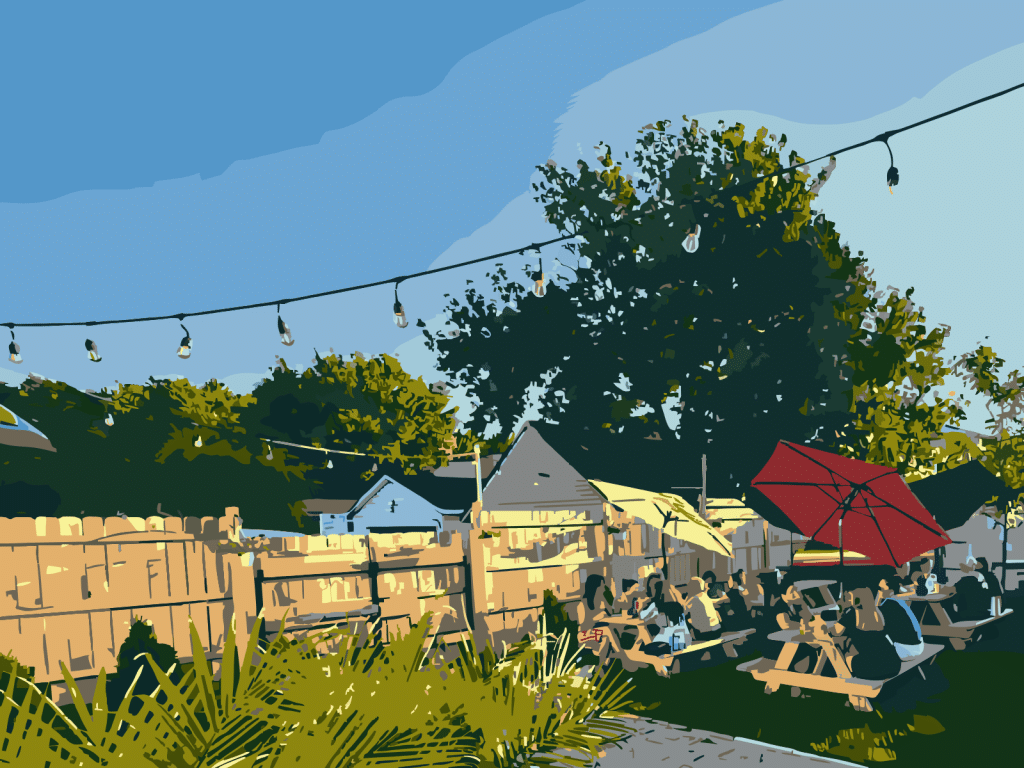
The back-and-forth follows a growing list of tensions between MBC, a brewery bathed in progressive branding, and residents on Oak Street near the taproom (at 2927 East Washington). Despite the city denying an amplified sound permit, MBC hosts live music within earshot of neighboring homes. After lack of cooperation on MBC’s part for a resolution, neighbors responded with their own message. A sign directly facing the business directed onlookers to “Woke on Oak,” a flashy collection of grievances against Bangstad and his political involvement collected online. According to the FAQ page, the site’s aesthetics are meant to evoke an internet “before social media became a weaponized propaganda machine.” This refers to Bangstad’s weaponization of MBC social media to shape a narrative that places him at the center—a victim of oppression and a staunch progressive fighter.
It’s hardly the first time the company or its hostile online activity has instigated conflict. MBC has long championed itself as a hybrid of punditry, activism, and business, blurring the lines between these roles for the worse. His brewing company is a joint venture with a Super PAC of the same name that uses “Dark Money Meant for Good.” He recently used the PAC to file a federal class action lawsuit demanding ICE agents in Wisconsin to identify themselves. However, where this PAC money flows has been questioned by former employees and in a lawsuit.
In the laundry list of MBC disputes, the neighborhood debacle is otherwise unremarkable if not for the absurdist attempts of both Bangstad and his neighbors to (unsuccessfully) communicate using their surroundings. Consider MBC’s booking of an attention-grabbing brass band and the hilariously passive-aggressive website rebuttal that features Bangstad’s own vocals. The site also raises concerns about his online activism (likening it to astroturfing) on account of MBC’s Facebook ads, which have targeted thousands of users to manufacture “the illusion of being wildly important.”
It’s worth considering the role of inflammatory rhetoric within those ads in this conflict. Bangstad’s playbook of stoking online outrage capitalizes on contention, as he takes on topical issues to find any way to implicate his business as a front for the next trending culture war. This diverts attention away from any topical issue Bangstad sets his sights on and funnels it toward MBC’s fabricated role in the solution. The problem here is what is essentially an elaborate marketing campaign consuming all the oxygen.
It’s an alarming display of how progressive discourse can dissolve into vapid signifiers, furthering the divide between the rhetoric we hear being espoused and the harmful policies actually playing out under the veil of culture-war disputes. As calls for community involvement grow in the current climate, we need to be wary of actors who find opportunities to capitalize on that energy.
Who has power in Madison,
and what are they doing with it?
Help us create fiercely independent politics coverage that tracks power and policy.
Author

Related Articles
Madison needs a wake-up call
The longer we pretend this City is a progressive haven, the more people will be harmed.
Stop spotlighting new films by known abusers
Madison boasts a dynamic movie culture, yet still needs programmers and community voices to facilitate change.
Achieving a broader focus through music photojournalism in 2025
The fourth installment of our live music photo essay series centers a more personal vantage point.