
Against collecting
Embracing sentimental value and resisting the urge to splurge in an era of inflation.

This is our newsletter-first column, Microtones. It runs on the site on Fridays, but you can get it in your inbox on Thursdays by signing up for our email newsletter.
I’ve been an amateur gamer since childhood, in the early-mid 1990s, when my mom and grandmother would scrounge up used Atari 2600 units and cartridges at yard sales in my grandparents’ suburban neighborhood for a single $10 or $20 bill. That’s how I ended up with multiple copies of so many games, including personal favorites Adventure (1980), Pitfall (1982), and Q-Bert (1982). If one of them didn’t work after the “proven” blow-in-the-cartridge method, I had backups.
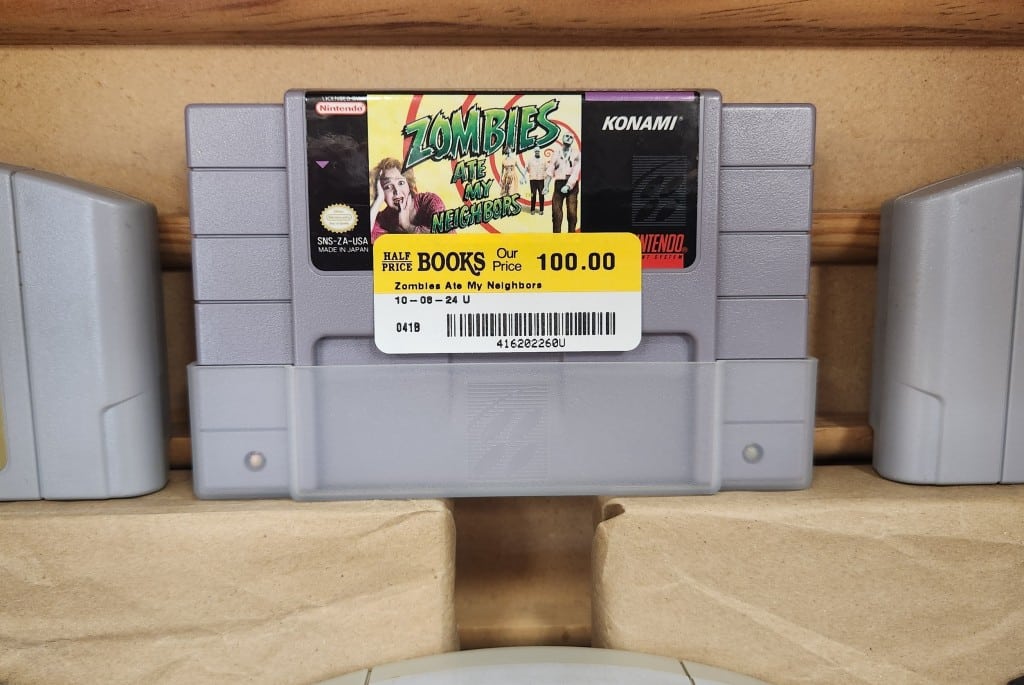
You can still find those slightly label-faded carts or replacements at reasonable prices today, 30-plus years later. Yet, the collectible market has seen a shift as a whole since the beginning of this decade. On a recent trip to Half Price Books across from the East Towne Mall, of all places, it was mind-boggling to stumble upon a loose SNES copy of Zombies Ate My Neighbors (1993) sitting in a locked case at eye level with a $100 sticker slapped on it. A lone example, but overpriced by any metric.
Partly, this shift is a response to inflation, but also how the gaming hobby and collector mindset attracted wider interest when we were all locked inside during the pandemic. In March of last year, Chicago-based YouTuber Super Nicktendo offered a charmingly dry “Retronomics” price-charting look at the million points of data and minutiae, and saw an average of a 70% increase across all game copies over a four-year span ending in 2023. Additionally, both the industry, licensed resellers, and vendors seem to have embraced the concept of “the collector” as an exploitable designation, too—driving a culture of artificial or perceived scarcity, deluges of social-media campaigning to bolster demand, and the beguiling aura of grading and authentication.
And then there are bargain hunters who attempt to make supplemental income recording their own quests to haggle with secondhand sellers at flea markets, boasting to a more niche online seller subset before flipping or hocking certain items. Despite Corey of FlippityFlip‘s assertion that it’s “all about the thrill of uncovering something amazing,” that’s not really what’s happening, at least on the scale of maintaining a monetized channel with weekly uploads. Corey’s conceit is in his handle. Unless it was a one-off happenstance, he’s essentially showcasing, in first-person perspective, his ability to politely deceive people. One capitalist incentive feeding another.
The positively peppy Retro Rick has taken another approach in that same ecosystem. The owner of the GamePoint storefront in Conway, Arkansas, Rick Hutchinson is one of the more gregarious personalities in the collectible gaming world. He’s amassed several hundred thousand subscribers across his main YouTube channel since October 2018 and the store’s channel since May 2022 (which aims to break down his business operations). This past spring, I basically let my inner collector ensnare me, and became drawn into Rick’s orbit through one of his most popular videos where he tracked down an ultra-rare, used car-priced copy of the holy grail of the NES, Stadium Events (1986).
I probably binge-watched a couple dozen of Rick’s videos immediately thereafter (in much the same way I did with Krazy Jason’s movie adventures three years ago). And what I gathered, without officially gathering data, is that this sort of new-form content has also been feeding the market for sellers, in particular, to create the current national landscape in Super Nicktendo’s aforementioned analyses. Rick may act surprised in an April 2025 YouTube short about the $123 price jump of Contra Force (1992) on the NES over the past 15 years; but make no mistake, he’s part of the reason for that.
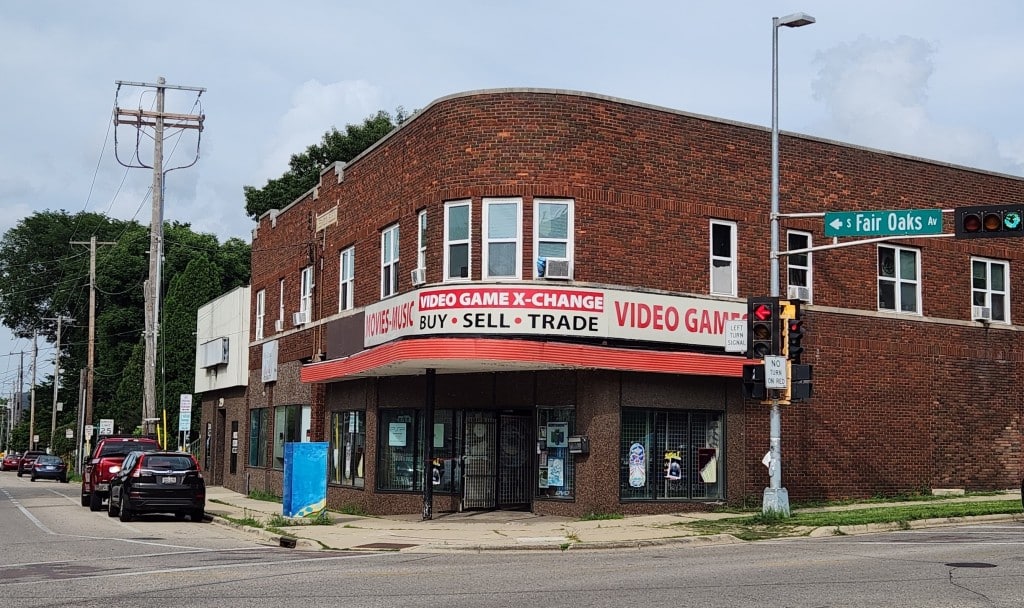
Predictably, this showmanship and these shenanigans have affected the local market, albeit in complicated ways that are hard to quantify in a personal essay. Lance Turner, who has owned and operated Video Game X-Change at 3002 Atwood Ave. even before the SNES launched in 1991, is still reliably doing his own thing in person with a genuinely chill and inviting friendliness. (One of his store’s trademarks is the vintage ambiance created by the radio perpetually tuned to a local rock or metal station.) But he obviously hasn’t been immune to dramatic changes over the years and the broader assessments of what’s considered valuable.
When I visited the store twice in July, Turner and I exchanged some playful comments about some of his impressive inventory (with particular emphasis on his locked PlayStation case and the current desirability or “big thing” of registration cards in instruction manuals for Complete-In-Box titles). We also talked about our mutual awareness of Retro Rick, who’s visited Madison and Turner’s store multiple times over the past few years. (Sidebar: Retro Rick refers to East Towne as an “abandoned mall” in the former video, which is hyperbole at best.)
Despite my criticisms, Turner generally has a good impression of Rick, and feels it’s a net positive to have him gallivanting around to spread the word about Video Game X-Change and other niche stores in Wisconsin and well beyond. Perhaps inadvertently, this has shown Turner how to adapt to the market, wherever it veers, while he maintains his personal passion for all things gaming that’s kept him at the corner of Atwood and South Fair Oaks for decades.
On the subject of the market itself, Turner has embraced the unpredictable. But he’s a little wary of the influence of people exploiting trends these days, post-pandemic. “Most of the stores go off of what the online sales are,” Turner says. “And then there’s only two big formats out there that give you the sales platform that create the data, so people can manipulate it as well.”
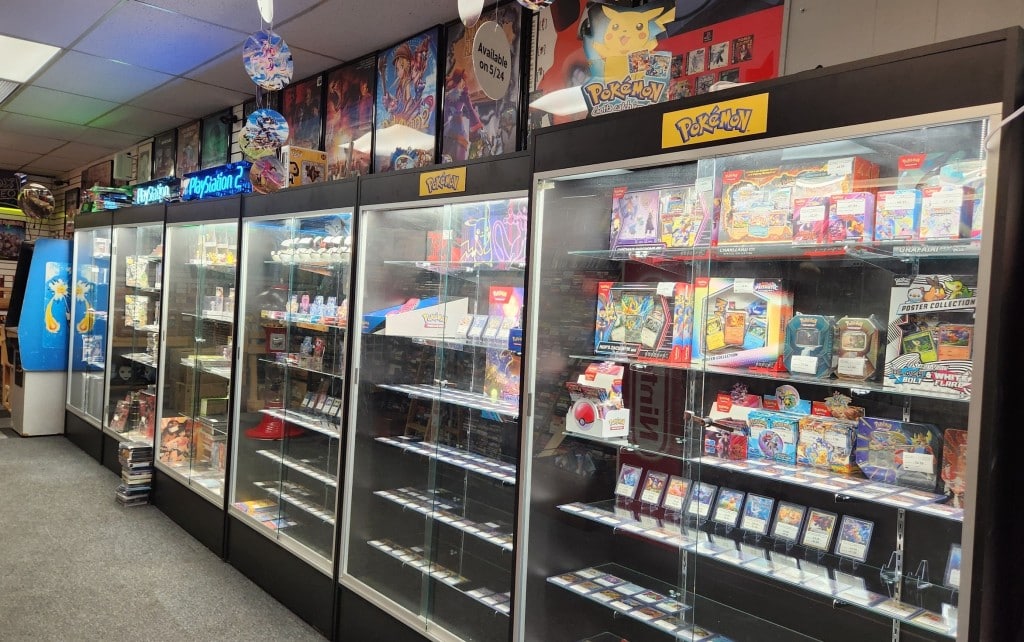
Currently, the gaming space is enmeshed with other forms of collecting, and that is both a positive and negative for retro gamers and collectors. Both common and scarce games might be on the shelves more frequently, but the prices are up, and the items actually are being moved from the front and center. The dominant source of interest seems to be Pokémon card-collecting, which has sustained for more than a 25-year period through generations (of Pokémon and people alike). Watching a number of Retro Rick’s GamePoint videos from 2025, I noticed the breadth of the new card display in cases below the store’s registers. And, if you’ve visited Video Game X-Change in recent weeks, you’ll see that Turner has moved a few of his old-school arcade cabinets to accommodate the large vertical cases lined up against the wall by the entrance—three of them now devoted to Pokémon as opposed to the one before mid-July.
While I’ve never really taken an interest in Pokémon or its Trading Card Game (TCG), it’s startling to regard something that appealed to younger millennials as being equally relevant to Generation Alpha (people born after 2010) now. All new collectibles are rooted directly in the old, especially with its increasingly avaricious parent company Nintendo, who’s released dozens of expansions and countless iterations of single and multiplayer games with their mascot characters since the mid-1980s.
As I walked a mile home from Video Game X-Change during those couple muggy summer evenings, I pondered the literal and metaphorical weight of collecting (that gradually became low-key hoarding) on my overflowing shelves. I have a decades-long and meaningful relationship to collecting; and Video Game X-Change was one of the first shops I visited in Madison after moving here 15 years ago. But I’m now at the point where I see through the thrill and personally assigned purposes of collecting; I’ve developed an aversion to the idea, and have even sold off sizable pieces of my vinyl and book collections in 2025.
Yet, more than that, beyond the price hikes and volatility, I can understand why, for some, collecting today holds a slightly different appeal than it used to. More than ever, it’s emblematic of order, control, and simplicity, when the world is throwing nothing but disorder, cruelty, and misinformation at us every day all day. Though, I don’t know if picking up a complete copy of the ubiquitous Castlevania: Symphony Of The Night (1997) in its original release version for $180, is all that worth it when it’s perfectly playable on any remotely modern console.
But, worth it. I know. It’s the most subjective thing you could say about any collectible or experience. In bringing up my own relatives’ game-hunting at weekend yard sales in the ’90s, Turner assures me you can still hop around and rummage for those same old Ataris. “Oh, you absolutely can. But there’s 40 other people doing it,” he says. Which made me think of Corey of FlippityFlip and his ilk as well as the myriad of collector-obsessed YouTube content creators. It’s more important to broadly reassess our assets without the sway of flippers—to not be so desperate to complete a collection (like Retro Rick did this year with his 676th NES game) simply for the sake of it. Rather, may you have a rewarding experience strolling down to Video Game X-Change, chatting with the most voluble Turner, and finding a few random treasures amongst his stacks that conjure something joyful or meaningful—like those loose Atari cartridges you can still nab for $10.
Editor’s note: We have included YouTubers’ full names and locations to the extent that they’re publicly known or available.
We can publish more
“only on Tone Madison” stories —
but only with your support.
Author

Related Articles
Police surveillance technology needs proper accountability
Grassroots resistance against Flock cameras are writing the blueprint for comprehensive reform.

Don’t shrink the Common Council and County Board
Madison needs more representation, not less.

Starter homes? No, we need starter apartments
As homeownership continues to be out of reach for too many Madisonians, we should build more owner-occupied, multi-family housing.