
Madison deserves better than the alders who voted to demolish Dairy Drive
Our current crises require a radical restructuring of the budget to meet the community’s needs.
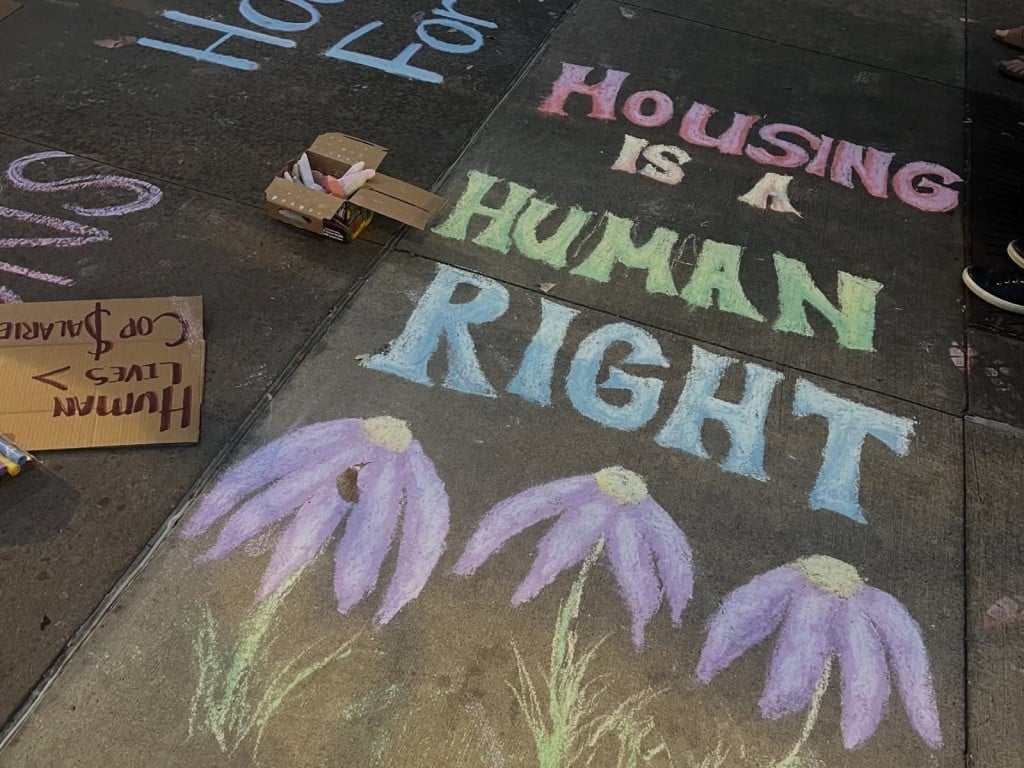
The fallout of the Common Council’s decision to demolish Dairy Drive highlights the fault lines that are emerging in Madison’s political landscape between proponents of radical change versus “business as usual.” Protestors have taken bold actions to hold the city accountable while supporting the recently evicted Dairy Drive residents. Meanwhile, the fiscally conservative half of the Common Council feigns helplessness due to budgetary constraints. As funding from the state and federal government dries up, Madison has a choice to make: either preserve what past budgets have prescribed or drastically retool the budget to meet the community’s needs.
Homelessness in Dane County has skyrocketed by at least 27% in the last two years. Madison pours millions of dollars into overcrowded temporary shelters while deprioritizing proven Housing First solutions like Dairy Drive. Nearly 80% of the residents of Dairy Drive moved into more stable housing, meaning that Dairy Drive was one of Madison’s most effective solutions to homelessness. Testimony at the September 16 Common Council meeting highlighted how preserving Dairy Drive was the financially responsible decision because it saved the city money on services like police, paramedics, healthcare, parks, and outreach. These services deal with the symptoms of homelessness rather than treating the root cause by providing permanent shelter.
The new Bartillon Drive men’s shelter being touted by the Common Council is not only unequipped to solve homelessness because it is a temporary shelter, but its full capacity is about 150 beds short of the current Porchlight shelter that will be shut down. Madison’s shelters are already overcrowded. Many unhoused people would rather sleep on the streets than visit the shelters where they are subjected to violence, discrimination, and disease. The new shelter’s downgraded capacity, the closure of Dairy Drive, and rapidly rising homelessness will guarantee even greater shelter overcrowding and more people living on the streets. At the same time, the police and park rangers are ramping up their criminalization of homelessness by issuing citations, clearing encampments, and making arrests. In fact, according to Brenda Konkel, the Executive Director of Madison Street Medicine who managed Dairy Drive, four former residents have already been arrested in the week since Dairy Drive was shut down. Madison’s housing crisis has reached a boiling point, and the Common Council’s decisions over the years have not done enough to cool it down.
The Common Council needs a reality check. A growing number of people’s lives are at stake as they slip into homelessness. Black and LGBTQ+ people are disproportionately unhoused and targets of violence. Madison’s small Black population is disproportionately unhoused, which is why Madison’s Black life expectancy is shorter than the national average. Women are disproportionately driven into homelessness by domestic violence and face disproportionate violence while unhoused. Older adults are the fastest growing homeless demographic, and many Dairy Drive residents had special needs that made them ill-equipped for traditional shelters. The Common Council’s failure to deal with this crisis is a perpetuation of systemic racism, sexism, homophobia, ageism, ableism, and, at the intersection of all these, classism. We drastically need housing safety nets like Dairy Drive to handle Madison’s homelessness crisis and create a more equitable city.
The City can’t contain skyrocketing rents unless the State Legislature legalizes rent control and inclusionary zoning or a resurgent tenant union movement forces landlord concessions. But the City does have the power to create safety nets like Dairy Drive. It’s the least they can do—to actually end the housing crisis, they should throw their full weight behind the tenant movement and organize mass pressure to be directed at the State. However, while activists hit the streets to protest the Council and protect unhoused people—and while local officials in major cities like Chicago and New York put their lives on the line to stand up to ICE—the Madison Common Council sits back and pens legislation that harms the community.
Contrary to the statements of Alders Regina Vidaver and Yannette Figueroa Cole, we do not need to choose between funding the new men’s shelter and Dairy Drive. We do not need to exceed spending limits that would take away state funding. We do not need to cut life-saving services to invest in housing safety nets. There are many potential solutions, including redirection of unused funds from unfilled municipal work positions and community fundraising. However, the elephant in the room is the Madison Police Department (MPD).
Police spending is the single largest line item in the 2025 operating budget at nearly $100 million, 22% of the entire budget. The uninspired reaction from alders about redirecting funds away from police concern Act 12, a bill passed with bipartisan support by Tony Evers and the State Legislature in 2023. Act 12 triggers a 15% cut from the state’s shared revenue if the city cuts police funding. The issue with this argument is that the state’s shared revenue to Madison is only about $8 million, while the police budget is more than 10 times that amount. A roughly $1 million cut in state funding is a drop in the bucket compared to Madison’s colossal police budget. By sacrificing about $1 million of state funding, Madison could redirect tens of millions of dollars towards desperately needed housing safety nets like Dairy Drive (which only costs under $1 million annually to run). Instead of paying MPD $100 million to criminalize homelessness, we should spend a chunk of that money to actually solve homelessness. Madison absolutely needs to change its budget priorities in the face of this unprecedented housing crisis.
Although a reconsideration vote on Dairy Drive seems unlikely now, Alders like Regina Vidaver are making a clear sunk-cost fallacy when they talk about the costs of reconsideration. They say that rebuilding what has been demolished would cost the city even more money. On the contrary, the sooner demolition is halted, the less costly rebuilding would be. Building a new facility like Dairy Drive would cost orders of magnitude more than rebuilding the few things that have been dismantled at Dairy Drive so far. If Madison wants to effectively address the housing crisis, facilities like Dairy Drive will be built anyway. We may as well preserve the infrastructure that already exists rather than demolishing it and building something new at a later date.
The Common Council may not even have needed to amend the city budget to fund Dairy Drive. Madison Street Medicine applied for Community Development Block Grant federal funds for “Dairy Drive 2.0,” but the Mayor’s proposed distribution for that request was zero. Furthermore, as Alder Davy Mayer’s September 16 resolution pointed out, funding Dairy Drive was the County Board’s prerogative. However, by voting to demolish Dairy Drive, the Council guaranteed that the County would not fund it. We should also hold the County Board accountable for using hundreds of millions of dollars for a new jail rather than solutions for homelessness. This jail will inevitably be where a large portion of Dane County’s growing homeless population ends up. The city and county governments treat homeless people more like an issue to be pushed out of sight than human beings who deserve decent shelter.
The decision to demolish Dairy Drive is not nearly as complex as Alders like MGR Govindarajan, Regina Vidaver, Derek Field, and Yannette Figueroa Cole want the public to believe. Either we do what it takes to keep people in their homes or we force them to live on the streets. Either we invest in our communities or we continue with the status quo of skyrocketing homelessness. The right choice—morally and financially—is clear as day. Madison deserves better than the 10 alders who effectively voted to demolish Dairy Drive. Alders who are not willing to stand up to their fiscally conservative colleagues, the County Board, or the State Legislature should step aside and allow a bold new generation of local government to rise to the challenge. Historic crises require historic change, and history is now.
Who has power in Madison,
and what are they doing with it?
Help us create fiercely independent politics coverage that tracks power and policy.
Author

Related Articles

Wisconsin communities face scrutiny over data center secrecy
The town of Beloit is the fifth Wisconsin community with an NDA for a possible data center.

Eyeing voting rights, liberals aim to secure Wisconsin Supreme Court through 2030
In the April election, Wisconsin liberals are hoping to expand their majority on a body that could be a critical backstop for voting rights during the next presidential race.

Police surveillance technology needs proper accountability
Grassroots resistance against Flock cameras are writing the blueprint for comprehensive reform.