
Loveblaster’s “The Way Things Work” makes the most of its silence
The duo at the heart of Madison’s newest slowcore act takes us inside their history.
The duo at the heart of Madison’s newest slowcore act takes us inside their history.
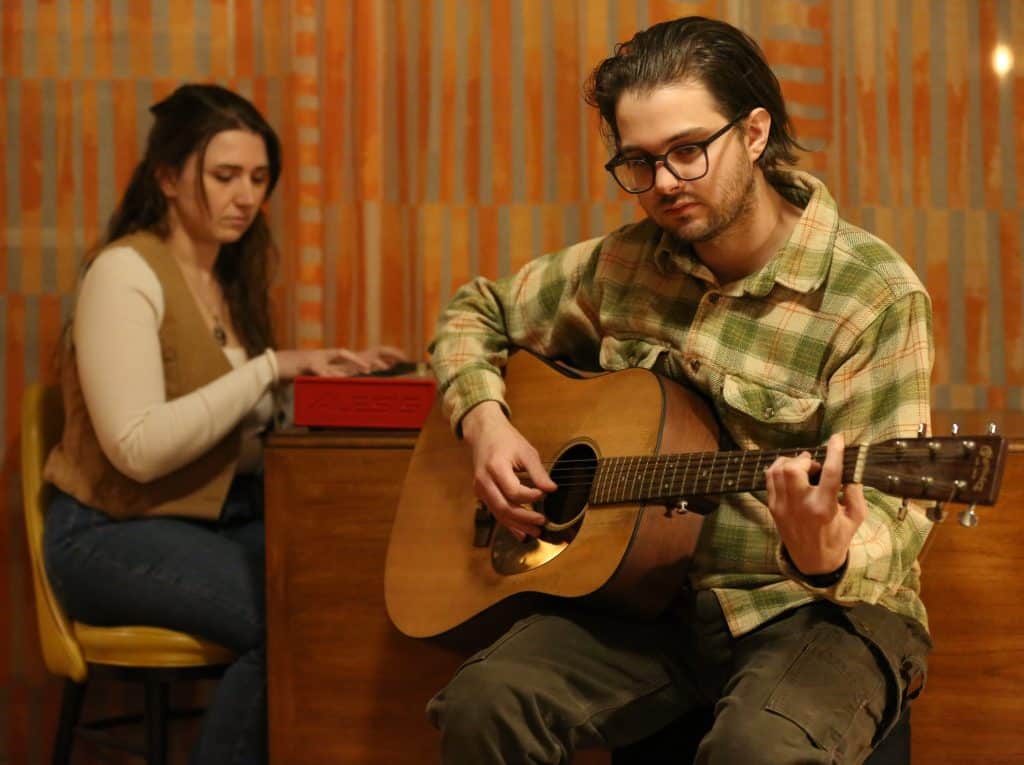
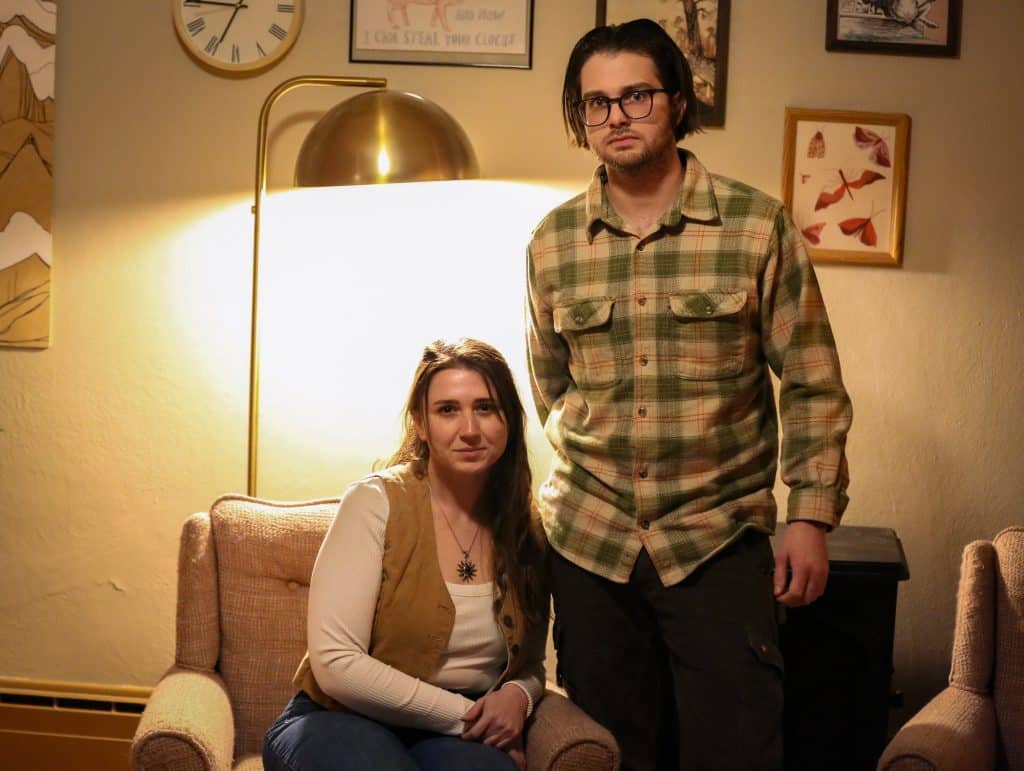
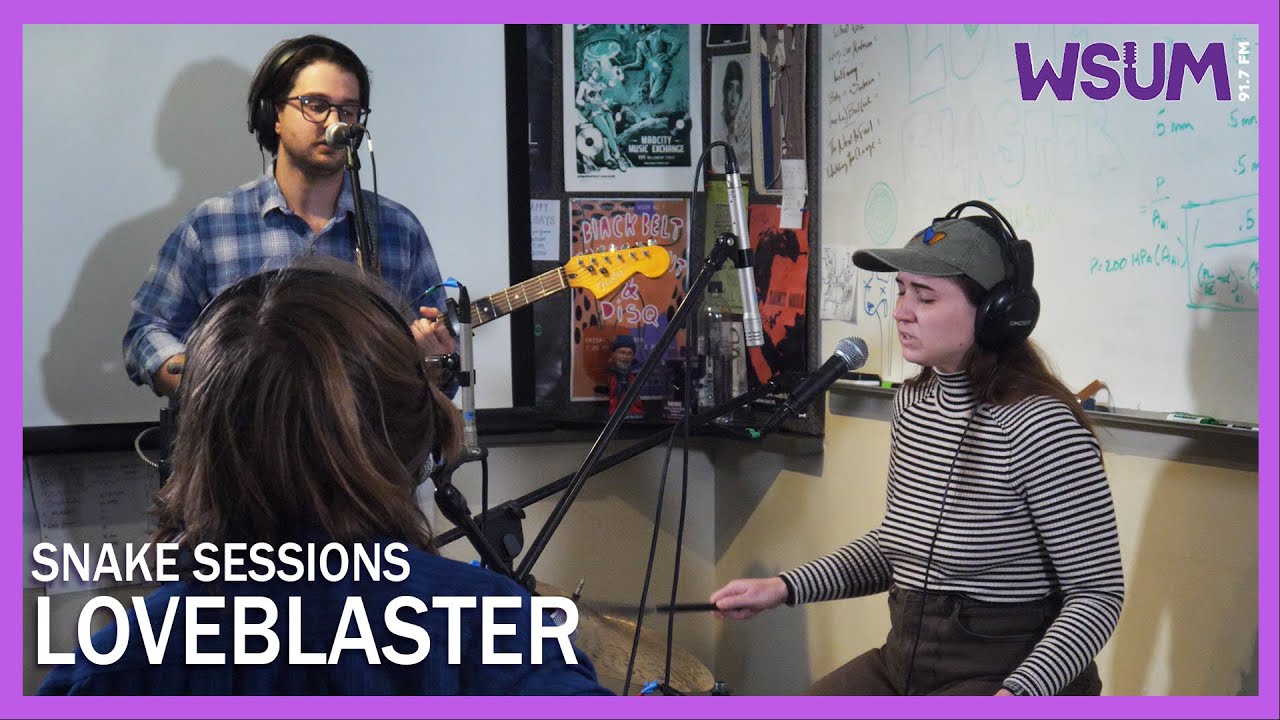
“There’s no light / To signal the dawn,” sing two voices in perfect harmony as a lone, clean guitar chord reverberates out, emphasizing a profound silence that lingers on the periphery of those notes. These are the opening seconds of Loveblaster’s knockout debut album, The Way Things Work, released during the first week of 2024. It’s an arresting introduction that sets up a run of genuinely stunning slowcore worthy of extending Low‘s unassailable legacy. Guitarist/vocalist Marley Van Raalte and his partner, drummer/pianist/vocalist Abby Self, are the beating heart of Loveblaster, which is rounded out by Combat Naps‘ Neal Jochmann on bass and backing vocals.
Both Van Raalte and Self came to Madison from small-town Illinois (Freeport and Roscoe, respectively), with Van Raalte moving to the city in 2017 and Self following suit shortly after. Some readers and listeners may recognize Van Raalte from the time he spent as a guitarist in Tim Anderson’s indie-rock project Able Baker—which also included Jochmann as a member—when the band was operating out of Madison. Over time, as Van Raalte and Self acclimated to Madison, they began contemplating playing music together, eventually using the framework of being a cover band to arrive at Loveblaster’s foray into writing original music. “We [went], ‘I don’t know if we can write songs, but we could cover stuff [and that] would be fun,'” quips Van Raalte. He then adds, “It just snowballed from there. It was a great fit.”
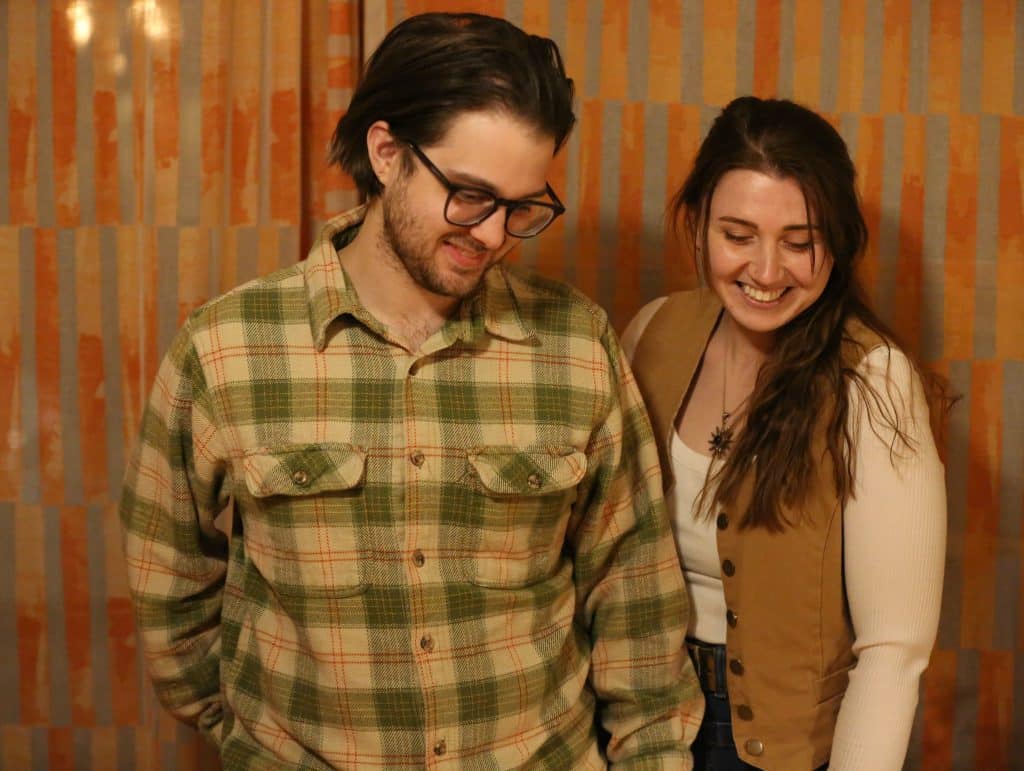
As a musical duo, Van Raalte and Self are incredibly attuned to each other, and their intimacy with each other’s instincts informs every second of The Way Things Work. This is never more apparent than in the aching hook—”No love comes without work”—that anchors standout single “Without Work.” A slew of Loveblaster’s most fascinating qualities are perfectly distilled in “Without Work”: emotional exorcism, earnest deconstruction of form, and a commitment to restraint. But that line, “No love comes without work,” is the one that will likely be seen as the one that ultimately defines not just the album, but the band itself. There is a palpable presence of love teeming throughout this album, even as various songs grapple with love’s utility and the occasionally harsh commitments love demands of its participants.
“You bet me right / You beat me all night / But some dogs never learn / The difference between / What you say and what you mean / This time / Do you mean ‘stay?'” So go the exceptionally cutting opening lines to “Baby In A Sunbeam,” which uses the parallels of a cherished pet to illustrate the fraught desires inherent to any intimate relationship. Like every song on The Way Things Work, “Baby In A Sunbeam” is wholly unafraid to embrace a tenderness that acts as a counterweight to its unmitigated explorations of the painstaking work love requires. Few Madison records in recent memory have been quite this open-hearted, and the effect can be jarring. But it never stops being substantial or rewarding.
Every held note across the album’s eight tracks seems rife with meaning, essentially forcing listeners to contend with their layered meanings by presenting them so unassumingly and so centrally. By stripping away ornate artifice in favor of something more naked, Loveblaster effectively commands the full attention of their listening audience. Where the band shines is in the payoff: each and every one of the songs they’ve released as a band has earned an instinctual, emotional, deeply contemplative response from both myself and other listeners.
Jochmann’s eventual addition to Loveblaster’s central makeup has only heightened the band’s awareness of atmospherics. Paradoxically, as Loveblaster’s membership and musical palette expanded, their songwriting has grown even more stark, with perfectly-placed minor additions (see: Self’s subdued, eerie keys work on “The Need To Fail“) calling even more awareness to the embrace of a highly-calibrated minimalism. Van Raalte acknowledges Jochmann’s presence allows Loveblaster to be more of what he refers to as “a traditional band,” with unobtrusive, resonating root bass notes serving as a springboard for the musical interplay of Van Raalte and Self’s guitar-drums-and-vocal harmonies.
Both Van Raalte and Self, along with Jochmann, excel in not overplaying their hands at any point on their respective instruments. Before Loveblaster, Self had never played drums or been in a band, something Van Raalte credits to being an absolutely foundational piece of the band’s sound:
“I think she’s a really natural drummer. And for me, all of my favorite drummers tend to be people who are not actual drummers. I think if you’re raised in the school of drumming, like myself, I have a lot of things that are really ingrained in me that I tend to wish I didn’t. And so when you get somebody outside of that universe of drums, they come out with a totally fresh take,” says Van Raalte, as he emphasizes his appreciation for the dynamic an untrained hand brings to the medium. “It holds the song up, just enough for us to sing over top of it,” he says, noting a fondness for musical simplicity that he suspects has sprung from leaning too far into maximalist tendencies as a musician in the past.
That dedication to paring down both musical construction and lyrical narrative, stripping them to a state where they’re all but naked, and making sure that the intent is painfully apparent, all serve The Way Things Work extremely well. It’s a compositional mechanic that beckons audiences in, making them inspect beyond the sum total, creating an intrinsic parallel to the band’s own approach to songwriting. It’s an exceedingly clever setup, but that cleverness never overrides its breathtaking potency. Make no mistake: The Way Things Work is a heavy album, haunted by spiders (“Halfway“), dead gardens (“(More Than) Bad Luck“), ghosts (“The Need To Fail“), and black holes (“The Low Hum“). But its significant, unfettered weight is its core appeal.
In “Without Work,” Van Raalte invokes Jesus’ martyrdom: “Made to take the neighborhood weight / You’re just like Jesus / But the martyr’s cost of the crown / And cross gets heavy.” On closer “The Low Hum,” he calls for entrance to St. Peter’s gates: “Every encounter is holy / Freeing myself / Is freeing you / To let us both into heaven.” In each instance, the band’s delivery communicates a palpable reverence and existential weight. It is, at once, heartening and bone-chilling. It’s also a perfect example of the wavelength in which Loveblaster operates, where a sense of history and a respect for the unknown collide in a way that resembles a prayer of quiet desperation. Few bands can raise goosebumps like Loveblaster, in or outside of Madison.
And for those in Madison who are interested in seeing this dynamic in action: Loveblaster’s next show is at Communication on Friday, April 12.
We caught up with Van Raalte and Self to discuss the band’s formation, how their romantic relationship heavily informs the band’s lyrics, their various musical influences, the artistic utility of silence, fixating on potentially dispiriting moments, and more.
Tone Madison: How did Loveblaster form?
Marley Van Raalte: I have been a songwriter for a long time. Abby and I started dating in March of 2020. And that kind of was a time when everything fizzled out. You know, previous projects. And we were just getting together. I was writing things that were relevant to us more than [my] previous projects. So I started showing them to Abby, who is a singer, and a piano player, traditionally. And we started playing together.
Abby Self: Yeah. I had never been in a band before. So I think I was a little slower to take to it. But once we started rolling, it kind of just worked out. Everything kind of came pretty quickly after that.
Tone Madison: Looking at a handful of live videos and at the credits on the album, it does seem as if Combat Naps’ Neal Jochmann is playing an integral part in the band. Is he an official band member at this point? How did he come to be a part of Loveblaster?
Marley Van Raalte: When [word] started coming around that me and Abby were starting a project and needing or wanting another member because it started with just the two of us, he was somebody who we [reached out to]. And he was receptive at first. He started as our saxophone player. So we were a drummer, guitar player, and a saxophone player. And he’s not really a saxophone player by trade, but he’s killer at it. He’s one of those people that can just do anything. And he shied away from that. Then we were like, “How about bass? Would you maybe take up bass?” He was more than happy to, and [that] really sealed in our sound, I think.
Live, it helped to have somebody who made us more of a traditional band, which I wanted. Personally, I really loved that the core of Loveblaster—and all the songs—is me and Abby. But live, I want to be… I want to be a part of a band, you know?
Abby Self: Yeah. I think the initial idea in the beginning was that Neil would be an auxiliary member, as well as anyone else joining us in any capacity. And then it just kind of worked out well enough that we started advertising as a three piece instead of a two piece, and I think we’re gonna keep them as long as he’ll have us.
Tone Madison. Excellent. And you said you formed in March 2020? At what point did you start writing for the album in earnest? What was the writing and recording process like?
Abby Self: I feel like you first started sharing these songs with me near the end of summer ’21. [Which] is when “Watching You Change” became a thing.
Marley Van Raalte: Yeah, the structures of some of the songs are quite old, maybe even [dating] back to 2019. A couple of them were leftover songs, riffs and ideas that I hadn’t quite figured out yet. And so there was that amorphous period where I’m kind of like, writing and collecting and showing [those ideas] to Abby, and she’s giving her input. But I think that the moment it started to actually feel like we had a record together, had to have been after the last single we dropped, “Wings Over Madison,” which was January 2022. Just realizing we had like an album, and we weren’t just collecting songs.
Prior to that, I think it felt like we were trying to figure out what our sound would be. Everything sounds a little different on those two first demos. I’m actually playing drums on them. I’m a drummer originally. And then I wanted to be a singer and a songwriter. So this is me transitioning to that. When it was coming to us making a record, I think I really wanted to make something that sounded like it all came from one session. It came from one place in time. So obviously, I can’t be on the drums and playing guitar and singing. And so Abby [went], “Well, what if I play drums?” She had never played drums before this, and just jumped right in the deep end with it. And it turned out to be amazing.
When [we started emphasizing simplicity], it was like, “Okay, this is what the sound of this [is].” It is actually a little bit of our live sound. And then stripping it all back and redoing the songs [during] that time, a couple times. Every song went through probably two dozen different versions. It was a lot of work to get to where we’re at, which is crazy when you listen to [the songs] and [you go], “Oh, it’s so simple, It’s so basic,” or whatever. But I tend to be a natural maximalist in writing. And so I’m always [going] “This, and this, and what about this?” and I appreciate having somebody else in the band like Abby [who can say], “Let’s rein it in a little bit. Let’s pick one of these things.” That practice and restraint is principal to Loveblaster. Keeping it to the basics: what will drive the point home?
Abby Self: I mean, that’s, that’s about it. Not to backtrack this far back, but I think “Wings Over Madison,” might have been January of ’23. It just seems crazy that the whole rest of the record would have come together in that one year.
Marley Van Raalte: It is crazy. But that actually might have been the case. It was [about] two solid years of writing and fumbling around in the dark. And then once that dropped, it just became [real]. Because then a couple of songs had been through many different versions, up to that point. And then [we] scrapped [around] five of them. It was like, once it clicked, we knew what to do. And laid it down really easy.
Abby Self: It was just finding time to record since we did it all here in the basement, and there’s air conditioning and furnaces all year-round.
Marley Van Raalte: Yeah. Five-minute windows to record a vocal tape before the furnace starts again.
Tone Madison: I believe you’d originally sent us “Wings Over Madison” as a contribution to our To Grow A Garden compilation in late 2022, and the music video was released in 2023. And it’s a beautiful video, with a continuous scroll peppered with hand-drawn lyrics and illustrations. How did that video come together?
Abby Self: I think the idea was always to have it at least be a partial lyric video. I remember the day we set out to film things for it. We had videos of us jumping in puddles and doing crazy jumps and stuff around the neighborhood. And then we had the idea [of using] tissues or tissue paper, writing the lyrics and then putting it in a puddle to then dissolve. And that wasn’t totally working. So then we just started writing out all the lyrics. Marley wrote all the lyrics, and doodling. I think it just started as a joke to connect them all together, because we just couldn’t figure [it] out. We thought [it could be] a slideshow-type situation, and then it wound up working out.
Marley Van Raalte: Yeah, yeah, I think it was really just a happy accident. We started with a prompt from our friend, Amelia [Soethe]. What was it, “slush?”
Abby Self: “Slush!” Yeah.
Marley Van Raalte: The prompt was “slush,” and I [went], “Alright, we’re going to make a music video out of that.” And it was funny, because the end result had nothing to do with that.
Abby Self: I’m glad you remembered that, I totally forgot.
Marley Van Raalte: So thanks to her for suggesting that. It’s my favorite thing about any good piece of art that you’re working on. It’s never the thing you set out to make. You have to keep fumbling around and going down wrong ways. Then, all of the sudden, we have 55 sheets of toilet paper with doodles all wrapped around this thing. We set up a whole rig with a camera balanced on top.
Abby Self: Oh yeah, it had a track.
Marley Van Raalte: We actually built a track and pulled it. We had one person on one end of the table, one on the other, and we were feeding it through this thing.
Abby Self: Listening through a phone speaker, to line it up.
Marley Van Raalte: It was a real DIY-type project.

Tone Madison: Listening to the record, the thematic weight of the lyrics sticks out. There’s definitely a trend towards a bleak pessimism across most, if not all, of the songs. Personally, I’ve found that I’ve been historically attracted to darker fare in a lot of forms of art, and have often tried to interrogate why that’s the case. What drives you towards exploring that specific type of subject matter?
Marley Van Raalte: I don’t know. It pulls me towards it, you know? I’ve never been much of a wildly creative person. But I can be very fixed creatively. I’ve found that I need to trust that whatever I’m working on is what’s calling me to be worked on. I write almost all the lyrics. But I have many passes through Abby to make sure things are coming out correct. I consider it to be a bit of a joint doing, because a lot of the songs on this were about the two of us. It didn’t always feel right to have it be one way without checking first.
So it was really important to me to have Abby’s input. To do things like change point-of-view in it. I’m not always the narrator. Sometimes I’m writing from what I think her point-of-view might be about me and about us. So the way I always get there is [that] I tend to write about things that are heavy moments. Emotionally heavy moments. I wish I was better at writing about positive things. But the gravity of a really intense moment is [something that’s] natural for me to want to replicate in a piece of music.
A lot of the songs come from [our relationship]. The first song on the record, “Halfway,” is almost 100% autobiographical. All of those things happened to us. And then later on, after I’ve had weeks to think about an emotionally heavy event, the songs just kind of fall into place. The lyrics kind of just come out, and you don’t realize it until you’re maybe halfway through it, or you’re totally done with it. And [you go], “Oh, man, that was about this thing.” I didn’t even realize I was channeling that moment into this song. So I tend to wait for those moments.
I can tell a song is not right if I’m using a lot of cliché and placeholder stuff. But you have to have that stuff. You have to start with all the cliché, and the placeholder, and then you start putting in little pieces of yourself. And then you start to see what the actual image is and how it relates to you and your situation. And yeah, a big shout-out to Abby, obviously, to be able to handle reading a lot of those lyrics.
Abby Self: That was another kind of slower-moving [process]. It took me a while to come around on that. Not that I was ever unwilling to do it. But it was emotionally heavy until we had conversations like this, where I could understand that writing process more. And now, obviously I know that this is an emotionally heavy record, but it still seems funny to me when I hear people describe it as depressing or bleak, because now it feels like, “Oh, no, these are all the things we have figured out a little bit!” And probably much in part to doing this.
Marley Van Raalte: Yeah, it’s really the trophy from having [gone through those moments]. To us, it feels like I’m handing Abby my book report on what we went through and being like, “I think I think I got everything. I think I got it all in there.” And then thinking about how other people might relate to it, thankfully, didn’t enter the writing process. I was super proud of myself for not thinking too much about what other people would think about it. I was trying to just make the most real thing that I could. And then us together making the most real thing that we could.

Tone Madison: I’ve always been really invested in albums that simultaneously feel like products of love and testaments to tumult. And this does bring up a point that is maybe going to be inevitable, but with the way the band’s currently set up and the way the songs are structured, it does seem like you’re headed towards a lot of comparisons to Low. But the more I’ve been listening to the record, the more I’ve been picking up Sparklehorse as an influence. Are there any artists that you’ve turned to for influence that people might be surprised by?
Marley Van Raalte: To touch on the Low thing: I think we couldn’t be more honored by that. And also be more upfront with the idea. It was like when we said, “Hey, maybe we could play music together. What’s the band we love?” And we [went], “Well, obviously, Low is one of our two favorite bands. What a great structure to try. “If they can do it, maybe we could do something like that.” It felt the most honest thing to [go]: “We want to be like them.” Cut with the other end of being big fans of Dave Rawlings and Gillian Welch. They’re a singer-songwriter duo with amazing harmonies, so that was another [instance of] “Oh, man, if we could be like that, that would be so fun to sing like [them].”
So that got us to start there. And then, obviously, there’s a million people in all directions from Mark Linkous with Sparklehorse and then Songs: Ohia. Everything Jason Molina does. Then you get into indie music and we’re both big Death Cab For Cutie fans. I think that’s what maybe sets us apart a little bit. I came of age in the 2000s MTV indie realm, and that’s my bread and butter: Death Cab For Cutie’s Plans. I like pretty much everybody’s middle record. I like it well-produced. I like a good, clean song. A great pop hook is what I’m always shooting for. On the other end of the really bare-bones structure of somebody like Low.
So, somebody [people] wouldn’t think that we would like… I’m a giant Coheed And Cambria fan. The lead singer has a side project called The Prize Fighter Inferno. I think people could maybe find some parallels with my voice in that it’s very quiet, beepy-boopy, and [rounded out with] an acoustic guitar. He has a really high falsetto voice that I was wanting to sing like for a while. So I think there is a little bit of that that actually does come through our music.
Abby Self: As the non-primary writer, I feel like it’s harder for me to really pull from many places, especially playing drums as simply as I do. In terms of listening to songs and having ideas of what I want it to sound like or what I want to go for, I really have noticed recently that I always feel like I want to bring a slinkiness element into it. Which I honest-to-god get from Glassjaw because I’m a big, huge, giant Glassjaw fan. And then Nancy Sinatra and the crooner-type women like that. Something a little teasing.
Tone Madison: This definitely goes back to the pared-down approach you both bring to Loveblaster’s instrumentation, where intuitive feel and an awareness of space is prioritized over an emphasis on showy technique. That sneakiness that you’re talking about is definitely evident in the drumming, which aligns nicely with that approach to instrumentation. There’s a sense across the album that a lot of those songs are being felt-out in a manner that’s restrained and atmospheric rather than aggressively driving, which is ultimately one of the album’s definitive elements.
Marley Van Raalte: We’ve said in practice before that we are at our best when we are as close to silence as possible. When we’re just barely touching our instruments is when everything kind of really glows and with us and lets that slinking swagger come out. We’re almost listening to the song as much as the audience might be listening to the song. And it can be hard to achieve live. Our best is really, I think, when we’re all just listening to what the song wants to be. And you have to touch it just so, delicately, which has been so difficult. Everybody’s natural [instinct is that] you want to play loud, you want to hit hard, you want to sing hard, right? And it’s been such a fun thing to learn [how to emphasize silence and restraint], because it always is so rewarding. At the end of the day, at the end of a practice, when [we can go], “Well, we did kind of take our hands off the wheel. And it really did drive itself.” It’s a fun experience.
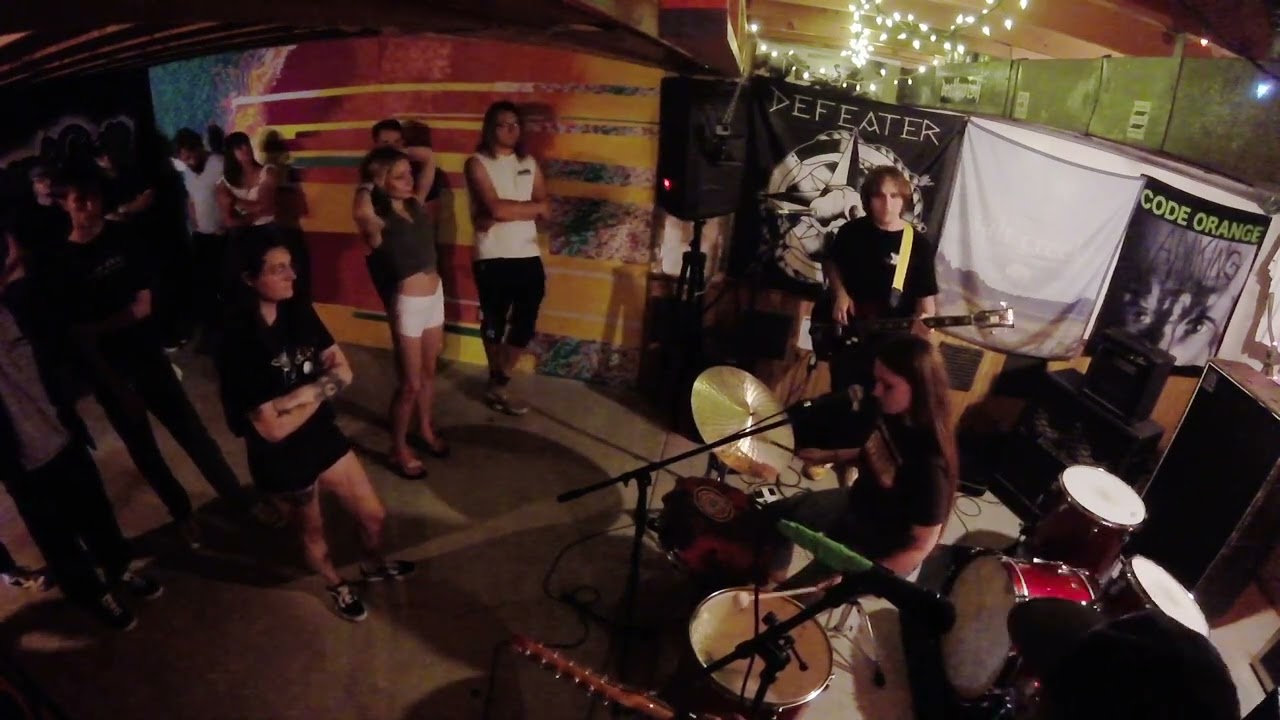
Tone Madison: I’ve always been especially interested in the general misconception that silence in art is historically reserved for moments of calm or reverence, which it often is. But it can also be used in a way that feels significantly more aggressive and violent than a really pronounced excess of stimulus. There’s a commanding nature inherent to silence that forces an audience to lean in closer or to provoke greater emotional anticipation. And I’ve repeatedly caught myself in that lean with these songs.
Marley Van Raalte: I’ve often felt like [this is the case for] a lot of the really good people you listen to, like [in] some really excellent Beatles tracks. One of my favorites, “Why Don’t We Do It In The Road?” is one of those ones where I was thinking about how it’s this rock song. It’s energetic, it’s amplified. But when you listen to it, it’s so pared down, and it’s like your brain is participating. It’s filling in all these things. But really, none of the guitars are distorted in that song. They’re all clean guitars. And it’s just that drumbeat and then the piano that really gives it so much more girth than is actually there. Your brain fills in the space.
Abby Self: You use the word “lift” earlier, which I think of frequently. It feels like the floor is gone, but everything’s still there.
Marley Van Raalte: Totally. And I think that [I’m coming at this from the perspective of] a person who has done the maximalist thing a bunch, and put every idea I can think of into a song. It took me a long time, a lot of years of listening to realize that, if you leave some space for the audience, and for the listener, it creates an even bigger experience. You’re not overwhelming them. Which is cool, too. I mean, wall-of-sound is its own thing. And I dig big, loud, stoner metal bands as much as the next person. It was just [that Loveblaster] called for some quiet space.
Tone Madison: What’s next for Loveblaster?
Marley Van Raalte: We just want to kind of take a breather. Assess what might be coming forward for us sound-wise. I don’t want to jump too immediately into something. This was such a huge undertaking that it feels like I want to take a breath. I want to appreciate what we made. But at the same time, it makes me so excited for what we could do next time that the gears are [already] turning.
Abby Self: Especially because it feels like we did a lot of the hard part as a band, whole. Just getting me on board and figuring out how we work together and what we’re going for. So a lot of that part is done. So we get it now. We get to do the fun part again.
Marley Van Raalte: We’ve built the car. I want to joyride it. Take it out for a spin. And thanks for giving us a chance. Thanks to your readers for giving us a read and a listen.
Tone Madison: Absolutely. Were there any other comments you wanted to make or things we discussed that you wanted to expand on?
Marley Van Raalte: Yeah, shout-out Graham Hunt. The Disq guys, Isaac [deBroux-Slone] and Logan [Severson], are extremely helpful. What I would like to say is that the Madison music scene has been the most welcoming, creative, positive music scene that I’ve ever been a part of. And it’s not that I haven’t known many great artists and played with many great people in different areas. But something magical, I think, is going on in Madison right now. And as non-Madison natives we feel very fortunate to get to jump in with everybody else here in this great city. And play gigs, meet people. It’s just great.
We can publish more
“only on Tone Madison” stories —
but only with your support.
Author

Related Articles
Tone Madison’s favorite records of 2025
A celebration of 20 local releases that defined the year.
Madison’s musical odds and ends of 2025
A meditation on the past year’s musical margins.
Tone Madison’s favorite songs of 2025
A sampling of the local music that helped us get through the year.