
Local open-mic cinema
Project Projection at Arts + Literature Laboratory is assembling all facets of Madison’s DIY and more professional film culture alike.

This is our newsletter-first column, Microtones. It runs on the site on Fridays, but you can get it in your inbox on Thursdays by signing up for our email newsletter.
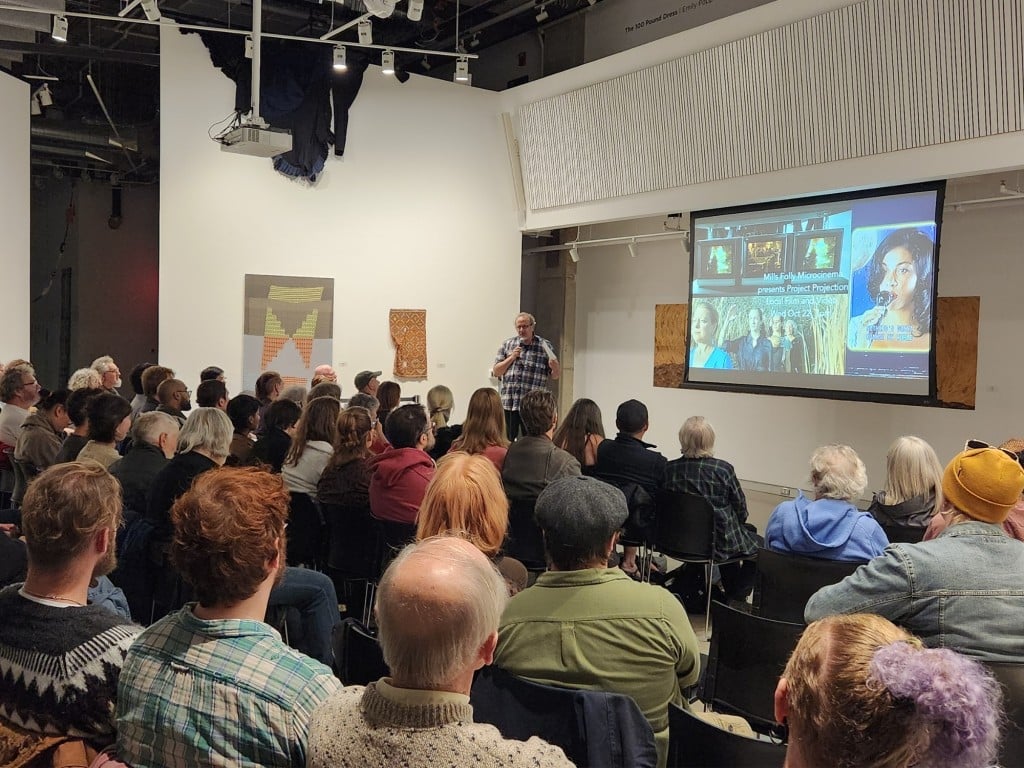
Shortly before Project Projection—the free screening series that brings together an array of local experimental film shorts and video art—was set to begin at Arts + Literature Laboratory (ALL) last Wednesday, October 22, an out-of-town viewer in the row behind me eagerly whispered to their neighbor: “I don’t think they have anything like this in Milwaukee.” This unexpected, overheard moment indicates just how much the series has become an essential part of the culture of our mid-size, Midwestern city this decade.
Madison may be best known for its university-centered program in the UW–Madison Department of Communication Arts—which presents free, open-to-the-public UW Cinematheque screenings most weekends of the year at 4070 Vilas Hall—but that’s only part of the story for several resident creatives outside that student-campus sphere. Which is where the value of the local experimental video essays, video art, documentary shorts, and music videos of Project Projection at ALL, 111 South Livingston Street, come in.
The program name, spiritually echoing the wordplay of curator Craig Baldwin’s Avant To Live series of new experimental works at San Francisco’s Other Cinema, is the closest analogue to an open mic. That’s how you might hear film programmer and ALL Public Programs Coordinator James Kreul characterize Project Projection. Since December 2018, Kreul has routinely listed calls for submissions for what have become biannual Wednesday evening showcases with multi-filmmaker Q&As—though, suspended for a couple years during the height of the pandemic. (Full disclosure: Project Projection is an extension of Mills Folly Microcinema, where I serve as a volunteer programmer.)
To those familiar with the Wisconsin’s Own section of the annual Wisconsin Film Festival, Project Projection is essentially a more unfiltered, undiluted version. The spring and fall showcases aren’t as rigid about final, polished cuts under a thematically grouped heading than they are about stirring a potpourri of disparate works, and fostering dialogue between hobbyists and professionals alike. Or, as Kreul puts it, “filmmakers at very different points on their filmmaking journey.”
The spring 2025 program on April 30 included distinctive, adventurous work by young experimentalist Sherif N. (It Dawned On Me), burgeoning video artist Meggen Heuss (Honky Tonk Angels), and versatile, travelled professional Claudia Krogmeier (Some Sugar, Unlearning). This past week, the assembled program introduced me to visual artist and essayist Gregg Williard (Sulfur Picnic), a choreographed triptych from Isthmus Dance Collective President Erica Pinigis (The Nelken Line: Three Seasons In Madison), and the droll, multihyphenate songwriting duo of Lou and Peter Berryman (Crumples).
“The whole point of Project Projection is to encourage people to make and share new work, […] to build a community of filmmakers looking for the same thing,” Kreul writes to Tone Madison via email. “I can’t think of another screening opportunity with no submission fee and our rate of acceptance so far.” As an arts incubator, Project Projection also encourages locals to ambitiously experiment and build upon their work for the inevitable next screening down the line; and that has resulted in a number of returning faces, like documentarians Gretta Wing Miller and Alfred Rasho as well as zany animator Steve Chappell. Further, the recurring seasonal dates five to six months apart spur artists to create public listings or upload projects in full, as linked above, to catalog their own development.
Over the years, when regarding the other dimensions of Madison’s film scene, that has become a nagging question. When I’ve left many Communication Arts (CA) Showcases on campus, I’ve often wondered what happens to these labor-intensive projects that students invest in. Shouldn’t the university at least keep an ongoing record somewhere, as Project Projection does? Am I just oblivious to that archive?
As has been the case for a while, the two big productions for the senior CA659/609 course (Advanced Motion Picture Production Workshop) crowd-fund for a few months before their May-December premieres at the Marquee Cinema in Union South, but then they become stranded in time. Rarely, if ever, do I see encore screenings elsewhere in town or even a public listing via Vimeo or YouTube. (Still Lake Studios for last year’s What We May Be, directed by Elizabella Rosenberg, at least has a YouTube page with a trailer.)
CA355, Introduction to Media Production, also produces some endearingly inventive or amusing work, even if it may be a little rough around the edges (in the very spirit of Project Projection). But like the more elaborately produced films, these also reach their logical transitory endpoint, and fade from view after the CA Showcases. At least some of the creators, like Saerom Lee, Elijah Pines, and Amelia Zollner of Perfect Mix, are making a Letterboxd page for these film projects; but judging by the number of viewers who’ve logged the clever four-minute short, I’ve not discovered a sign of other screenings—as part of James Runde‘s Midwest Movie Mixtape, for instance—or a video upload.
Maybe I can offer some consolation, so that, moving forward, media production students who stumble upon this article would feel comfortable submitting to Project Projection if their narrative work ventures a bit outside the norm (like, say, that of Samuel Knopes‘ Cyberphilia last week). Some would find a second home at the ALL space, and be absorbed into the local community of film culture more long-term.
And the months ahead might actually be the perfect time. While Project Projection has existed in its consistent biannual format since March 2023, it has ramped up since summer 2022 (when I ended up submitting a found-footage short), and increased visibility and awareness in the greater Madison area. Recent programs have all sprawled past the 90-minute mark, excluding 30-plus-minute Q&As with the number of artists in attendance. So, heading into 2026, Kreul made the strategic decision to move to quarterly or seasonal screenings, and curb programs to 80 minutes each. The first is already set for Wednesday, January 21, at 7 p.m., with an early submission deadline of January 2.
In those efforts, Kreul intends to “keep Project Projection in people’s minds as something that they can participate in soon.” And, as importantly, the curtailed and hard-capped durations “will help continue to build the general audience, because long programs of short films can be challenging for those without a connection to the filmmakers,” Kreul reasons.
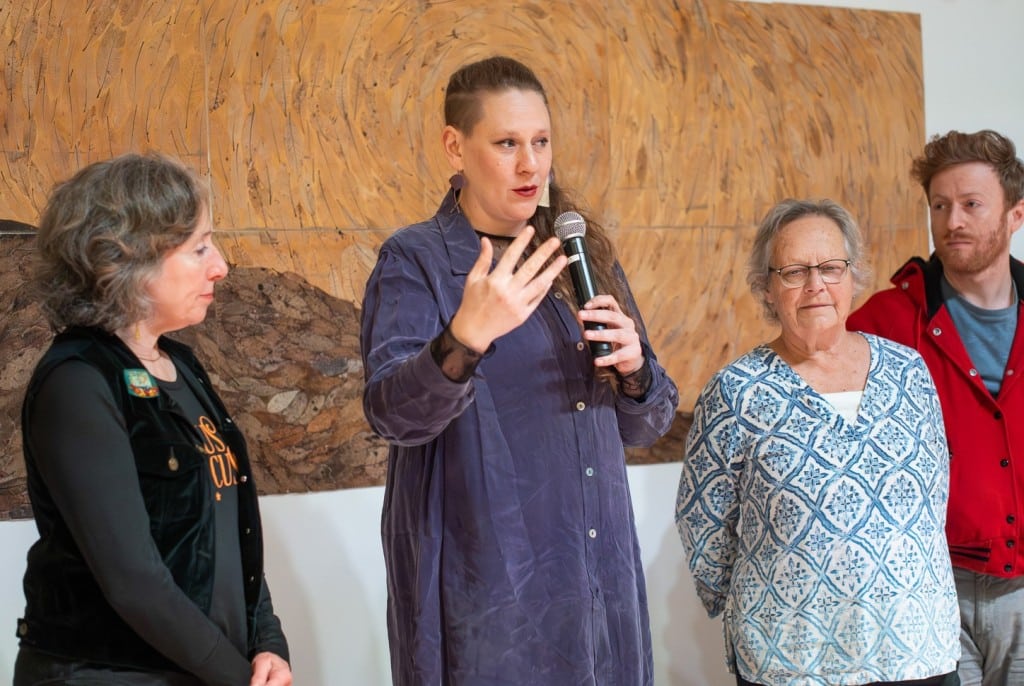
And yet, separate from that, one of the most beneficial aspects about Project Projection is the way in which Kreul has structured the Q&As to allow filmmakers to talk to one another so the dialogue is not strictly between viewers and artists. (Video artist and filmmaker Zia Anger once told me that conversations between artistic peers were “a much better use of time,” so maybe this format is a good compromise.) During the forums, Kreul, a film lecturer and video artist himself, always jumps in to ask a thoughtful question about every artist’s process. His efforts stimulate mutual interest, but also facilitate an atmosphere where anyone is comfortable sharing resources—and to stir those in the audience with an itch of an inclination to dabble in a project, whether their first or 40th.
Even with my progressive involvement here in the scene as a cinephile over the past decade, the filmmaker community often feels like it makes up a sliver of the overall Madison arts world—one that can be dominated by the gleam and signage of institutions. In the past few years, Project Projection has served an interesting role, openly inviting a cross-section of people working and skilled in different disciplines (music performance, music recording, video editing, fine arts, writing, teaching, etc). Considering the rather modest scale of Madison compared to a city like Milwaukee—where that one candid audience member seemed to hail from—the creative endeavors of our residents outperform any cursory summation.
So, come mid-January, when the wider promotion of free campus screening events prompts us all to catch a bus, drive, or take a brisk walk towards the campus epicenter, keep Project Projection at Arts + Literature Laboratory—right across the street from The Sylvee—on your radar. Kreul’s locally conceived arts incubator might conceptually outgrow the distinction of our 77 idiosyncratic square miles. But for now, we can be proud of this microcinema hub embraced by and for the experimentalists.
We can publish more
“only on Tone Madison” stories —
but only with your support.
Author
Related Articles
Achieving a broader focus through music photojournalism in 2025
The fourth installment of our live music photo essay series centers a more personal vantage point.
Madison’s musical odds and ends of 2025
A meditation on the past year’s musical margins.
Opting out of the tech-backed AI inevitability narrative
As data centers set their sights on harvesting Wisconsin’s human and natural resources, refusal and resistance starts locally.