
Leslie Damaso’s sprawling “SIRENA” is an intoxicating tapestry
The Mineral Point-based songwriter’s new multimedia work unravels powerful questions about heritage.
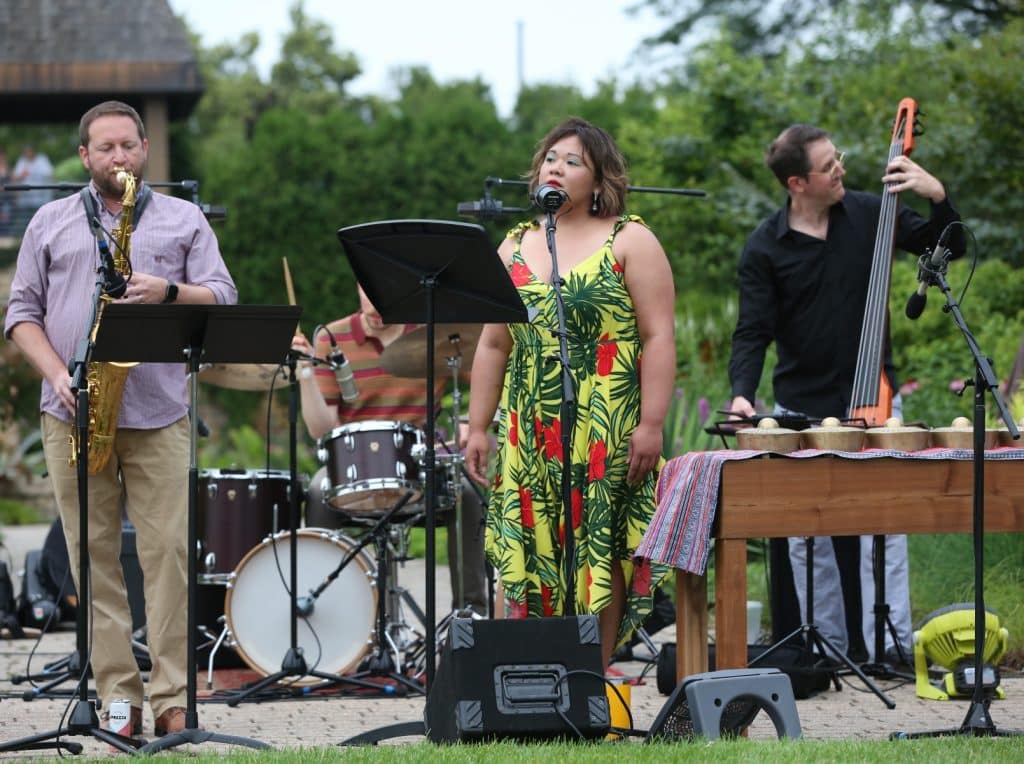
The Mineral Point-based songwriter’s new multimedia work unravels powerful questions about heritage.
Leslie Damaso’s new album and multimedia project, SIRENA, is part fairytale, part history lesson, and part spiritual exercise. Damaso’s upbringing in the Philippines enlivens the album’s startling poignancy. There are direct and indirect nods to Damaso’s home country all across SIRENA, from the incorporation of kulintang traditionals (“Ditagaunan“) to the premise at the root of the album. “I wanted to understand my humanity, to heal, to see others more deeply and to celebrate that connection,” writes Damaso at the end of the short bio for SIRENA, which is accessible via Bandcamp.
SIRENA‘s narrative base is a story about a mermaid who falls in love with the moon, in slight keeping with Filipino mythology. In a recent Madison365 piece by Rodlyn-mae Banting, Damaso revealed that she was inspired to author SIRENA‘s mermaid story after taking a poetry course from Filipino-American writer Barbara Jane Reyes. Damaso’s mermaid tale not only anchors SIRENA but suffuses the album with an unshakably mythical sensibility. The album’s investment in exploring cultural history and heritage is modestly earnest, but a genuine otherworldliness defines SIRENA‘s immediate impact. This quality also cuts through in the fusion of styles. Even Damaso isn’t sure of what genre descriptors are the most applicable for the album. Eastern-influenced progressive folk-jazz could be a start, but even that doesn’t represent the totality of the work. When entertaining the question over a video chat with Tone Madison last week, Damaso’s ultimate—and correct—conclusion was a question: “Does it really matter?”
To execute a dazzlingly wide vision, Damaso enlisted an all-star lineup of musicians. Bassist Ben Ferris, drummer Mike Koszewski, violinist Janice Lee, pianist Jason Kutz, saxophonist Jon Irabagon, and guitarist José Guzmán make up the roster alongside Damaso (who handles vocals and kulintang) on the record. Kutz, Ferris, and Koszewski also constitute the local progressive jazz-fusion trio Mr. Chair. Irabagon, Guzmán, and Lee are all Chicago-based musicians of exceptionally high caliber. Each provides potent highlights across the album’s 15 tracks and 52-minute runtime. Damaso’s kulintang work on “Binalig” is commandingly propulsive, and her interwoven “Paragraph” poems—which the album doles out in four, well-spaced parts to relay the mermaid narrative—are extremely gripping. Ferris’ bass runs on any given track are tasteful and complementary, elevating the players by his side. Koszewski’s drumming is understated and absorbing in SIRENA‘s quietest moments and jaw-dropping during the album’s splintered bursts of aggression.
Assembling the band on SIRENA took years of effort and a series of fortuitous circumstances. Damaso and Kutz were the first two to collaborate artistically. The duo released May Laya in 2018, an album of kundiman songs. They first met at one of Damaso’s earlier performances, and Kutz offered his services as a pianist after the show. Damaso accepted, and the pair began establishing their musical rapport in 2016, practicing weekly. By the time May Laya was released, Damaso and Kutz had integrated a strong artistic foundation. That foundation blossoms on SIRENA, which was released on June 30. On both albums, Damaso explores Filipino culture, American citizenship, her relationship to the histories of each country, and the tenuous definition of “home.” Damaso does this both lyrically and musically, incorporating English, Tagalog, Ilocano, and Western and Eastern musical influences.
May Laya and SIRENA both present different versions of “Bayan Ko,” a song born out of a 1929 Tagalog poem by Filipino poet José Corazón de Jesús (which itself was translated from a José Alejandrino piece that was written in the wake of the Philippine-American War). “Bayan Ko” contends with the American occupation of the Philippines, and speaks directly to the country’s perseverance: “Even the bird that is free to fly / Cage it and it cries!” The song’s defiant spirit in the face of immense difficulty connects back to SIRENA‘s darkest lines of questioning. A portion of the album’s Bandcamp bio makes it clear what Damaso is asking: “A child realizes for the first time that humans hurt each other. Despite that fact, how can we still move forward and live well?” The powerful question is firmly embedded into an equally powerful work.
SIRENA‘s grandiose scope required an expanded ensemble. Kutz’s connection to Mr. Chair made the jazz trio a natural collaborative fit. In 2018, Damaso saw the group perform for the first time and was blown away. “I was totally struck by the music they were making, and it didn’t feel like you could pin it down. I loved how maximalist it was. It was a wall of wonderful sounds and [so] exciting,” says Damaso over Zoom. “I don’t know why, but it made me [recognize] the journey of someone like me—an immigrant coming to a different country—and [the experience of] being bombarded by the new sounds. Your senses are just super heightened. And that’s what that music felt like to me.”
That performance was the genesis of the group’s artistic union. Although Kutz was the first to suggest joining forces, Damaso maintains that she was the one “channeling” the idea into existence. Koszewski joined the duo of Damaso and Kutz shortly into their own collaborative run, and Ferris became part of the group soon after. All three of the Chicago-based musicians have been past collaborators of Mr. Chair, so there was “no hesitation” in inviting them onto SIRENA, Damaso says. Guzmán’s addition was particularly important. “These Filipino songs, sometimes they’re used for something called harana, which is where you sing for a person you want to date. So we wanted the sounds of the guitar,” says Damaso.
Guzmán’s playing imbues SIRENA with an open-hearted vulnerability that is nicely complemented by Lee’s violin playing and tango-focused background. Lee’s violin figures add an essential layer of intrigue, romance, and as Damaso points out over Zoom, “wildness.” In tandem with Guzmán’s guitar playing, the effect is intoxicating.
Irabagon’s saxophone work rounds out the Chicago group’s contributions with an injection of clear-eyed tenacity. Damaso brought him into the fold over a Zoom meeting. The ideas driving the record immediately clicked with the saxophonist. Once the full group was assembled, they got to work. After shaping the record, the septet recorded SIRENA on August 17 and 18, 2023. All of the musicians’ existing familiarity with each other’s tendencies is evident on SIRENA. There is a natural ebb-and-flow to their musical interplay that is born out of a knowingness honed by repetition and mutual understanding.

Damaso produced the album with Mr. Chair, who were instrumental in arranging the album’s deceptively complex compositions. A team of engineers and artists were responsible for fine-tuning SIRENA and ensuring a sterling finished product. Audrey Martinovich was the album’s lead audio engineer, and Stephanie Benicek served as assistant engineer. SIRENA was mastered by Jett Galindo. Noah Gilfillan, Anya Kubilus, Krstina Mastilovic, Kristin Mitchell, Sarah Shumaker, and Damaso all contributed to SIRENA‘s art direction. The integration of the precolonial Philippine script baybayin into the artwork was an intentional choice to meld SIRENA‘s myriad themes together. “The story. The art. This is something,” Damaso recalls thinking upon linking in the baybayin elements.
And that “this is something” instinct was correct. SIRENA a genuinely breathtaking display of unapologetic ambition and artistic cohesion. It’s easily one of the most memorable albums released in 2024 thus far by a project from the greater Madison area. Damaso and her collaborators have achieved something monumental, pulling from a dizzying array of influences, countries, and art forms. From its first notes to its last, the album holds listeners in a mesmeric rapture, as it prods and uncoils indefatigable truths about the spirit of humanity. When people come together to pursue a common, honorable goal—even if that goal is making a singular album—everything else seems a bit brighter.
Damaso spoke with Tone Madison over a series of email exchanges and one virtual meeting last week to discuss the album, its meaning, and the history behind the work.

Tone Madison: What pushed you to make SIRENA?
Leslie Damaso: In 2017, I attended an event in the Bay Area called Undiscovered SF. I read about the inaugural event and how thousands of people attended and I just had to check it out for myself. It was the most concentrated number of Filipino artists I had ever witnessed. I actually got teary-eyed upon entering the space and talked myself out of it because everyone looked too cool. For someone like myself who moved to America at such a young age and who moved to the Midwest, I didn’t get to see that growing up.
I cried [at that festival]. The first room I went into, there was a concert happening, a jazz concert. And there was this woman with super long hair and she just sounded so beautiful. And everyone was beautiful. So I’m like, “Stop crying. Don’t cry.” And then just the feeling of, “wow. There are so many Filipino artists. And I think I am one. I want to be one. I want to be one of them. I want to contribute to the history of Filipino American artists in the United States.” And I just said, right then, “I have to do something.”
It inspired me to create something that I could share someday. In addition, I was trying to figure out what it meant to be born in the Philippines, tangled up with how I grew up, the pleasant and the not so pleasant, and how that related to the culture. I was trying to figure out what home and belonging meant. I still have feelings sometimes about not really belonging anywhere. I also simply wanted to “write” my own story and to express a moment of my life through the act of making this album.
Tone Madison: What did the recording process entail and how did the backing band on the album come together?
Leslie Damaso: We had a very short amount of time, maybe eight hours in two days, last August, to record at Audio For The Arts in Madison with Audrey Martinovich. It’s a challenge to get seven musicians with busy schedules in one room. I have never thought of the rest of the ensemble as the “backing band,” because I think everyone has been essential. There’s the core group, which is myself, Jason Kutz, Mike Koszewski, and Ben Ferris who arranged thekundiman pieces. Ben wrote the music for the interludes.
Ben, right away, dove into the story and writing music for [the album]. He was the one who [suggested] we should have a violinist. And that the violinist could [contribute work that would be representative of the story’s] mermaid figure. [There’s a] passion that comes through, from everybody. I’m really fortunate we got to merge together. Because even now, I’ve listened to this record so many times, having had to approve parts of it and check that everything was going well. And I listen to it and think “Wow, we did something really special here.”
We had three other musicians, Chicago-based Jon Irabagon, Janice Lee, and Jose Guzmán. Everyone had space to improvise, to express their own talents and personalities. Whenever I try to explain this, I just say I threw a party.

Tone Madison: Did making SIRENA shift anything in your usual creative or artistic approach?
Leslie Damaso: My creative approach is first to find something beautiful. I express or find it in various ways. After that, I think about how it makes me feel and who or what might be connected to that beauty, something real or made up. The making or assembling of SIRENA was very much closely related to who I am and how I navigate life. There are these gorgeous songs I wanted to help preserve. I also wanted to show the innate desire of human beings to tell a story, to paint a picture, to write poetry, of how we meet individuals randomly. I want to have more opportunities for connection and celebrate our shared humanity, the time to pay attention. That is love, that is beauty.
Tone Madison: How important was it to you to integrate and subvert Filipino traditionals?
Leslie Damaso: Coming to this country at a young age, the easiest way to navigate was to assimilate, that does something to an individual after so many years, the act of hiding a part of you. It makes you feel that your otherness, the part that makes you unique, is shameful. And my own history, the songs I sing in the album, tied to the history of colonization in the Philippines. It felt like I had to untangle all of it and weave them back together again.
The fact that this ensemble is made up of people from various backgrounds, that we are playing these pieces together in places where they have never been, for people who have never heard them, that feels significant. Subverting the traditional presentation of these songs was inevitable because SIRENA is tied to my own way of navigating the world and to my personal history. I like to think that the integration of everything means that this music is still alive. It is innovation and preservation in real time. Isn’t that fun?
Tone Madison: What does SIRENA mean to you and has that meaning shifted since the album’s release?
Leslie Damaso: I’m very proud of the album. The way the music sounds and how it might make people feel, I hope it can evoke and express some of the exciting moments where we have gotten to “swim” so-to-speak, the journey. The music has been featured in NY Fashion Week as a finale for a runway show, where I got to watch a collection by a Filipino designer, front and center. We are part of a year-long exhibit at the Wing Luke Museum (a Smithsonian affiliate in Seattle with the focus on the stories and art created by Asian American artists) and we got to perform for the celebration last April. Last spring we performed for a festival honoring Danny Kalanduyan, who brought the kulintang (gongs) to North America.
A really special venue was Bindlestiff Studio in San Francisco, the only theater in the US with the mission to feature Filipino artists. The project has led me to meet some amazing people, some of which have been an inspiration and have been integral to the work.
A few days leading up to the release I was very emotional about it. Nurturing this project has been equally challenging and exhilarating. There is also this nuisance called “impostor syndrome,” the release has tamed that a bit. SIRENA to me is proof that when you reach out to other human beings with the idea to create a space of celebration, it reverberates, it can move, like water. I’m just immensely grateful and proud.
We can publish more
“only on Tone Madison” stories —
but only with your support.
Author

Related Articles
Tone Madison’s favorite records of 2025
A celebration of 20 local releases that defined the year.
Madison’s musical odds and ends of 2025
A meditation on the past year’s musical margins.
Tone Madison’s favorite songs of 2025
A sampling of the local music that helped us get through the year.