
Mariano Llinás’ intensely personal, yet endlessly digressive masterwork is available to stream in three parts on MUBI.
When a director challenges their audience to an act of endurance, the film usually features something shockingly grotesque or stretches glacially paced plotting over hours of runtime. Argentinian director Mariano Llinás’ La Flor (2018) falls more into the latter category, but with a twist—over the film’s considerable 890 minutes, things are constantly happening in a series of endless digressions, making it more akin to the myriad narrative fragments of Guy Maddin’s The Forbidden Room (2015) than Bela Tarr’s Sátántangó (1994), for example. Conceived as a showcase for a quartet of lead actors (Elisa Carricajo, Valeria Correa, Pilar Camboa, and Laura Paredes), the film moves through six episodes that encompass a variety of genres linked together by the chameleonic ensemble. In La Flor, Llinás seeks to rescue formalism from itself, mostly ditching on-screen theoretical pretensions by stringing together genre exercises (with four of the six episodes involving mystery and suspense) as a celebration of his actors. The result is a cinematic masterwork with few peers.
La Flor’s episodes work largely as standalone films, starting out with a B-movie about mummies and moving further into abstraction and thematic confusion as they go on. Per a flower-shaped diagram of the film written and explained by Llinás on-camera in the opening scene, the first four episodes deliberately have no ending. The fifth, an adaptation of Jean Renoir’s A Day In The Country (1936), which doesn’t feature any of the core actors, is a complete story. The sixth episode is just an ending. Describing each episode in any amount of detail would take an unreasonable amount of space; simply, the third and fourth episodes—a nonlinear spy thriller and a metafiction-cum-supernatural mystery, respectively—are most significant, and take up roughly 60 percent of the film’s runtime.
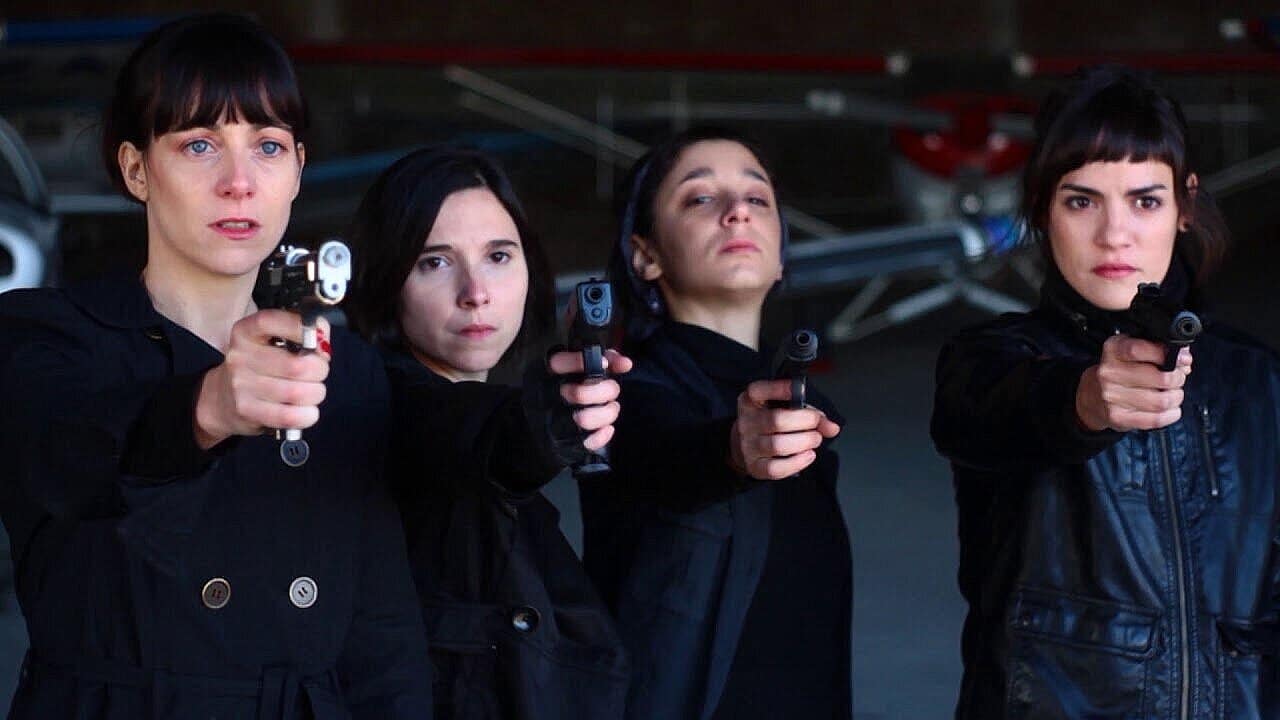
While largely narrative-focused, the third episode of La Flor is instructive in the way it presages the film’s shift to meta-narrative in the next episode. Featuring its own sub-divisions of 10 chapters, the section follows a group of four spies hiding out with a kidnapped professor, who are awaiting a confrontation with four other enemy spies who have been sent to retrieve the hostage. Each spy protagonist has a backstory, all involving the cold lives that brought them to their current mission. All the spies are very much actors themselves who highlight the film’s thematic interest in performance. Their identities have always been in flux, and their sole continuity is murderous skill as they adopt names and shift allegiances between conflicted parties.
The last of the backstory chapters, “The Mole,” concerns Agente 50 (Carricajo), formerly one of the top spies in the KGB. Functioning in a Cold War scenario where acts of war have been disaggregated to tiny exchanges of information, her job is essentially that of an office clerk, directing nameless agents to complete simple tasks. Through this atomization, Agente 50 becomes responsible for tracking down a mole in the agency who she doesn’t remember meeting. This takes her on a nine-year odyssey, a less and less methodical search, as she aimlessly rides on trains attempting to run into him. When she finally does encounter him, the point is moot. They’ve both spent years of their lives as the exhaust fumes of a war, carrying on as cogs in a machine whose operator left long ago. The timeline of Agente 50’s quixotic quest being an obvious parallel to the creation of the film itself (which took ten years to make), the exhaustion of its own concept begins to show. By the following episode, Llinás has shattered the deliberate wall he created between his real-life commentary on the film and its fictional constructs.
In the fourth episode, which is a story about Llinás struggling to make his film’s fourth episode, the film begins to adopt formal conceits more typical of the avant-garde—like liberal use of on-screen text and methodical still-image sequencing. Llinás carries with him such a love for storytelling that, even this most fussily meta-referential of episodes, he can’t help but introduce fantastical elements that contort the section somewhere between docufiction and existential mystery. Llinás’ 2018 interview with Cinemascope sheds some light on this, as well as his overarching method in creating the film:
Flaubert’s notion of the right word, finding the right word for one idea: this idea translated to cinema would result in the “right image.” Humbly, I would disagree. I don’t think we need to find the right image for each idea. We have to find the right story for each image.
This concept unspools before the camera in the fourth episode. As the fictionalized Llinás begins the fictionalized fourth episode with images (obsessively catalogued images of trees in this case), he struggles to fit a narrative around it that involves the actors. His ultimate solution for this problem is to push them out of the narrative entirely, which has dire consequences when witches (played by the four leads) cause his crew to go mad and him to disappear. In the director’s absence, a sort of detective of the supernatural named Gatto (Pablo Seijo) goes through his shooting diary, reconstructing his project to find clues to explain his disappearance. Leaving this mystery unresolved like many of the other plots, the section culminates in a series of shots of the performers posed against the landscapes he had been beleaguered by earlier in the segment. Llinás (the fictionalized and real versions now blending most seamlessly) admit(s) in voiceover that he can only give meaning to these landscapes through juxtapositions with the actors. His attempt at reflexivity proves the inflexibility of the project, and La Flor snaps back to shape.
It’s rare that a film this sprawling and complex retains such a personal focus. For all its formalist ticks, La Flor is meant to be a celebration of the versatility of its four stars. In the aforementioned interview, Llinás said the project grew from a desire “to make pictures with them a genre in itself.” With the exception of the fourth episode, movies themselves never appear in La Flor, nor are they referenced. These episodes are worlds where cinema is conspicuously absent, and cinematic forms are explored purely through practice. The protean actors are the connective tissue that draws together disparate styles and characters. It’s like an exploded inverse of Abbas Kiarostami’s Shirin (2008), where the film is experienced almost solely through images of actors watching it in a theater. For Kiarostami, these still images are enough to reflect the “magic of cinema,” so to speak; its meaning is created through its observation. But the women are still acting, embedding a story in their faces to be interpreted by the viewer. Setting aside all its Pynchonian madness, La Flor is simultaneously a more insular and populist work. With the women’s visages as building blocks, the film is a devotional that imagines cinema itself (or at least six types of it) in their image. When the four leads walk off into the horizon in the film’s final shot, they are not just characters leaving captivity, but artists shrugging off the Sisyphean weight of a majestic project.