
Kahil El’Zabar’s Ethnic Heritage Ensemble turns 50, and its world keeps expanding
The veteran percussionist and his ever-evolving outfit play February 18 at Café Coda.
The veteran percussionist and his ever-evolving outfit play February 18 at Café Coda.
Kahil El’Zabar’s career embodies so many elements of the musical landscape, so many exchanges of ideas and creative perspectives, that a listener just has to surrender to its steady but inexorable currents. This year, the Chicago-based El’Zabar celebrates the 50th anniversary of his Ethnic Heritage Ensemble, which has both navigated and influenced those currents over the ensemble’s five-decade run.
El’Zabar has played a foundational role in the more boundary-pushing corners of jazz since the early 1970s. He’s a longtime member of the Association for the Advancement of Creative Musicians, a still-vital organization that planted a new flag for forward-looking, socially conscious music with its founding in 1965. In addition to his work as a bandleader, El’Zabar has collaborated with artists across the varied continuum of jazz, people who’ve shaped the music in radically different ways at different points in history. Just the top-line overview would note his work with Dizzy Gillespie, Cannonball Adderly, Nina Simone, Archie Shepp, his long-running collaboration with saxophonist David Murray (El’Zabar and Murray have often played together in Madison over the years).
Madison gets to help mark the EHE’s 50th with a Sunday, February 18 show at Café Coda, ahead of the March 8 release of the project’s new album, Open Me, A Higher Consciousness Of Sound And Spirit.
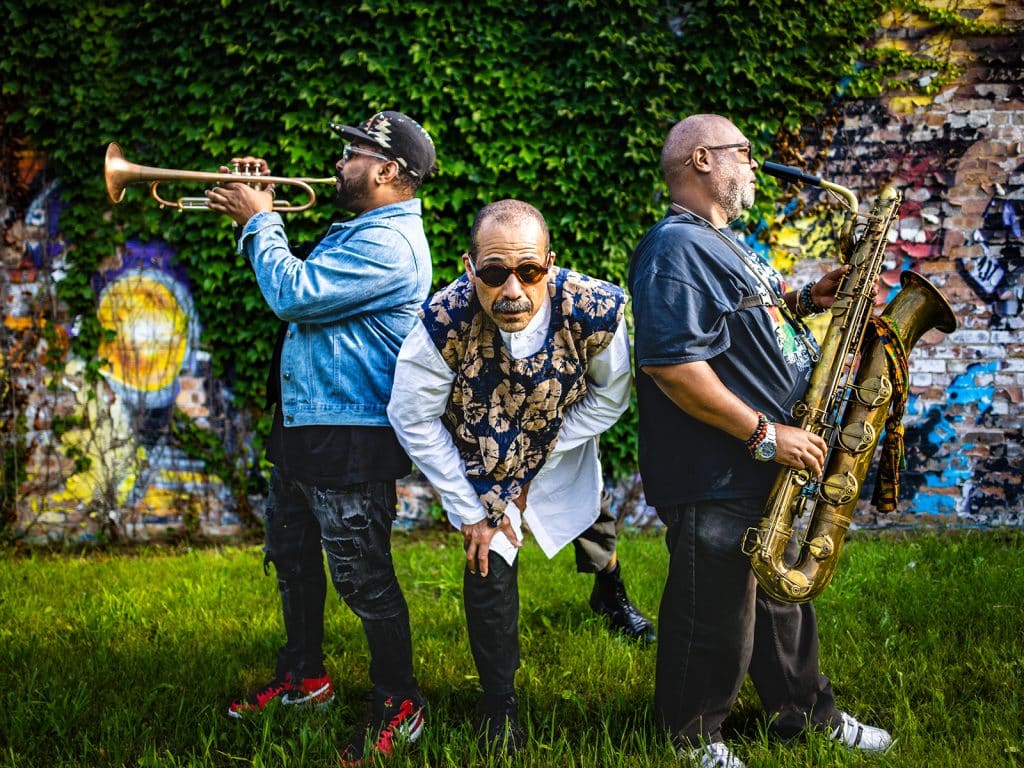
The Ethnic Heritage Ensemble has evolved through many lineups. At this show and on Open Me, it consists of El’Zabar on percussion and voice, Alex Harding on baritone sax, and Corey Wilkes on trumpet and percussion. The album also features Ishmael Ali on cello and James Sanders on viola and violin. True to its inviting title, the album plays like a series of long, deep breaths. El’Zabar uses his drumkit, thumb piano, and a range of other percussion pieces to create dynamics that burn slow.
It’s not a chill or relaxed album, but its rhythms help the listener slow down and inhabit the music, starting with the ensemble’s take on Miles’ Davis “All Blues.” Stepping back from the brisk simmer of the version Davis recorded for the monumental 1959 album Kind Of Blue, El’Zabar gives us space to appreciate why this is such an enduring composition. Davis both mastered and innovated upon well-established forms—in this case, the twelve-bar blues. That’s a process El’Zabar understands, and here he continues the conversation, often letting Sanders and Ali’s strings carry the tune’s timeless recurring melodic figures.
From there, the conversation keeps on expanding, through original compositions (some of which El’Zabar has been performing and recording for a long time), and a few key selections from other composers. The two horns swell and dip over an unhurried but tumbling groove on “Barundi,” in a performance that balances tension with—again—that generous sense of space. The strings make the solemn ache of “Can You Find A Place” all the more keen and searing. (I do hope El’Zabar comes back sometime with Sanders and Ali in tow—their contributions all over this record just give the music so much additional dimension.)
“Ornette” explores another jazz legend’s gift for mixing dissonance with grace. El’Zabar plays it with an almost celebratory thump, as Harding, Wilkes, Ali, and Sanders execute playful spirals around one another. El’Zabar ends the track with a chant of “Ornette Coleman,” and it’s hard to argue with that. A hearty thrum from Harding’s baritone launches the album’s version of pianist McCoy Tyner’s “Passion Dance.” The ensemble does more than justice to Tyner’s beautiful harmonic explosion, pushing it into borderline-volatile territory.
All sorts of moments stand out across the one hour and 20 minutes of Open Me—Wilkes’ and Harding’s tense, rippling solos on “Hang Tuff,” El’Zabar’s rugged vocal performance on a rendition of Gene McDaniels’ protest song “Compared To What,” and the fiery sprawl of “Kari,” to name a few. The album is conversant and contemporary with threads that run through the history of jazz. Sometimes it makes those reference points overt, and sometimes not. Whatever an individual listener picks up on, there’s no doubt that this music is moving tenaciously forward, with momentum powerful enough to impact contemporaries and those who will follow. Step into the current.

We can publish more
“only on Tone Madison” stories —
but only with your support.
Author

Related Articles
Achieving a broader focus through music photojournalism in 2025
The fourth installment of our live music photo essay series centers a more personal vantage point.
Tone Madison’s favorite records of 2025
A celebration of 20 local releases that defined the year.
Madison’s musical odds and ends of 2025
A meditation on the past year’s musical margins.