
It’s still a good time to shut down Line 5
Enbridge plans to reroute the aging pipeline, but that wouldn’t change the threat it poses to northern Wisconsin and Tribal communities’ watersheds.

Enbridge plans to reroute the aging pipeline, but that wouldn’t change the threat it poses to northern Wisconsin and Tribal communities’ watersheds.
“All our needs are met by this land, not by Enbridge.”
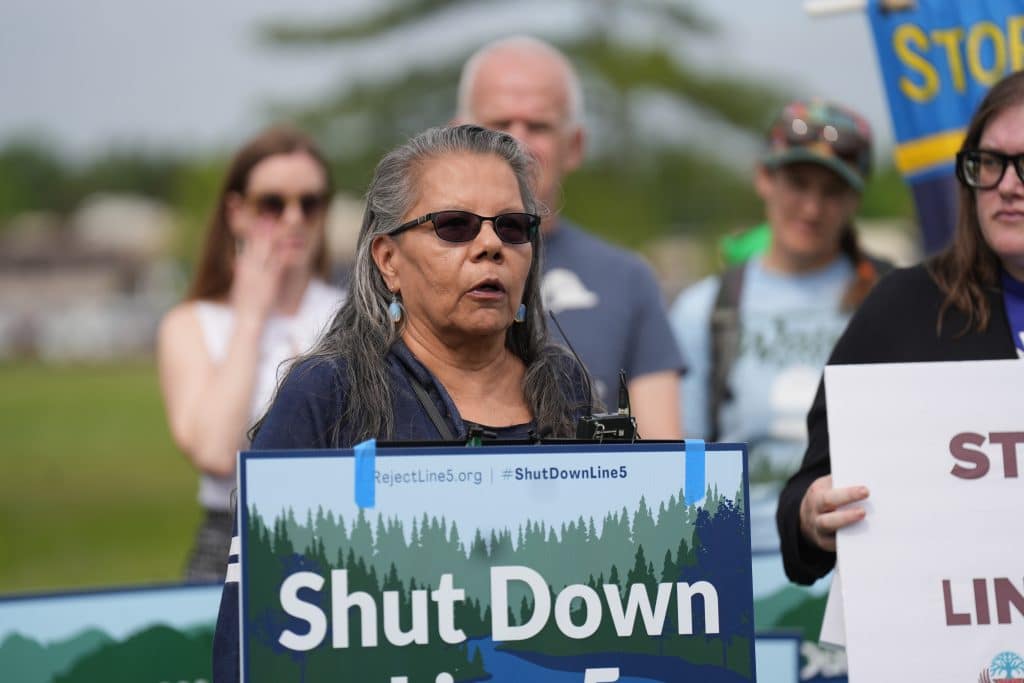
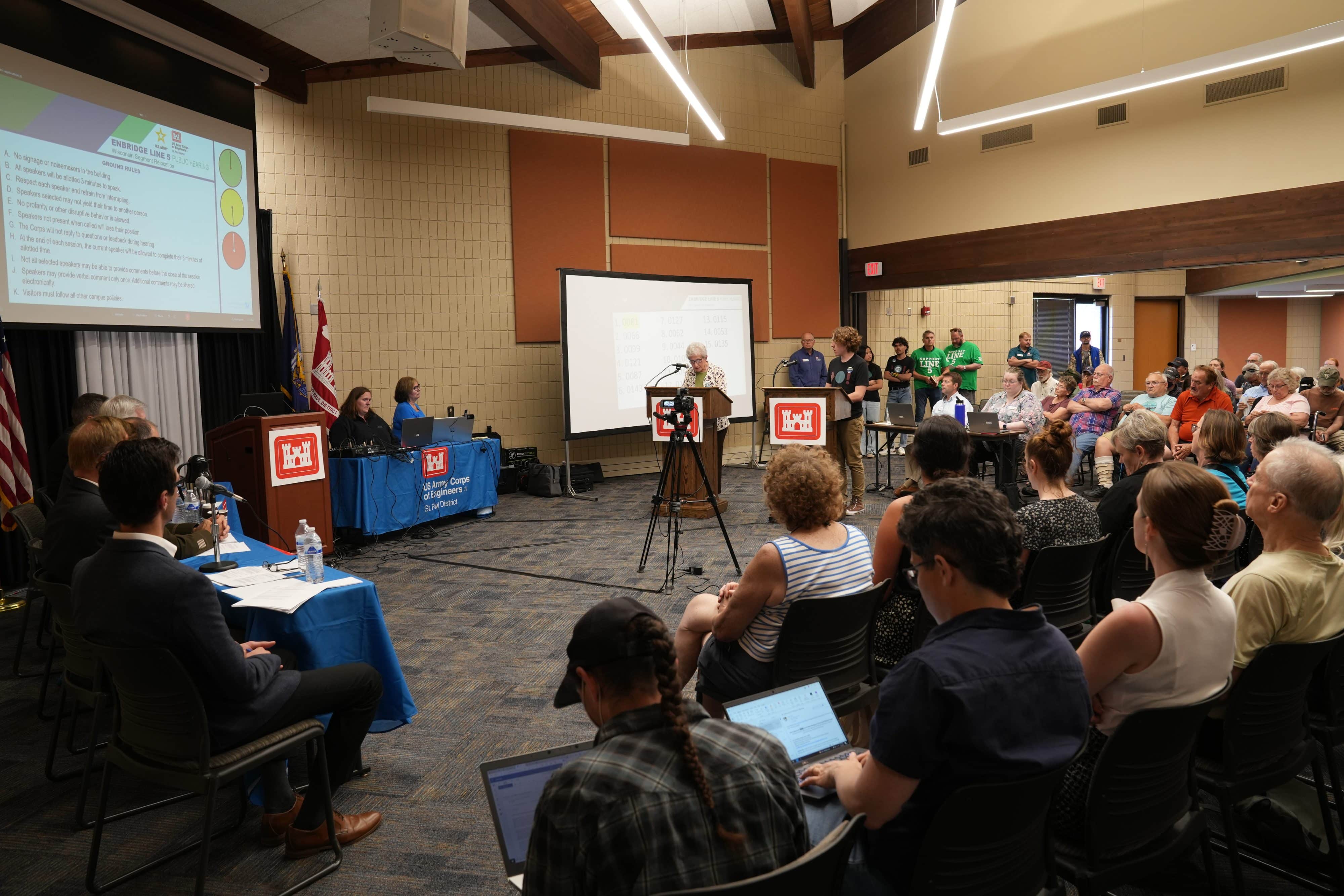
That’s what Wenipashtaabe (Sandy Gokee), an Anishinaabe water protector, told the US Army Corps of Engineers (USACE) at a June 4 public hearing in Ashland, Wisconsin about a proposal to reroute Enbridge’s Line 5 oil pipeline. Line 5 currently trespasses through the Bad River Band of Lake Superior Chippewa’s reservation in northern Wisconsin, and a federal judge last year ordered Enbridge to remove that segment of pipeline off the tribe’s land by June 2026. Enbridge’s plan is to reroute the pipeline, but the company needs approval from the USACE first.
The public hearing was hosted by the USACE after the Bad River Band and groups like the Madison-based nonprofit law firm Midwest Environmental Advocates (MEA) and Clean Wisconsin asked for the Corps to take public feedback on the proposed 41-mile alternate route that Enbridge wants to construct just outside the Bad River Reservation’s external borders. The Army Corps is currently reviewing Enbrdige’s permit application for the reroute, and the new construction’s environmental impact is the core issue in the permitting process.

At the meeting, Tribal leaders and environmental advocates from across the region voiced concern about the proposed reroute. That’s because Line 5 poses an environmental risk within Tribal boundaries—and the reroute wouldn’t change this, because it would still be located within the larger Bad River watershed. In other words, an oil spill in that area would still drain into the Bad River, endangering wetlands and groundwater along the river’s course to Lake Superior.
“We said off the watershed. You said off the reservation,” Gokee told the USACE at the public hearing.
The more than 70-year-old pipeline is 20 years past its expiration date. In some places, including the point where the pipeline intersects with a “meander” in the Bad River, it is in imminent danger of rupture.
Folks aren’t counting on Enbridge to fix this, because the Canadian energy company has a terrible track record. A rupture in another major Enbridge pipeline, 6B, caused the 2010 Kalamazoo River spill, which dumped nearly a million gallons of crude oil into the water over the course of 18 hours before Michigan authorities (not Enbridge) reported the spill. It’s one of the largest inland oil spills in US history. Construction along Enbridge’s Line 3 has caused ongoing harm in Minnesota, where Enbridge contractors released toxic fracking fluids while drilling under waterways, and destroyed wetlands.
The proposed new segment of Line 5 would cross and endanger nearly 200 bodies of water and over 100 acres of wetland as it passes through Ashland and Iron Counties. The $450 million reroute would require temporarily and permanently discharging fill material into wetlands, horizontal drilling under the White River (which flows into the Bad River), and would cause the loss or alteration of wetlands in the 30- to 50-foot wide maintenance corridor surrounding the pipeline, USACE states in an analysis of the plan.
“I can drink the water here now. Let’s keep it that way,” added Gokee at the public hearing.
Not only does Line 5 violate Tribal sovereignty—Enbridge continues to profit off its trespass on the Band’s territory—but an oil spill in the wider Bad River watershed—and an oil spill is likely—would infringe on the Bad River Band’s treaty-reserved rights to fish and otherwise harvest resources within the ceded territory of Wisconsin. That’s why Gokee emphasized at the meeting that the Band wants the pipeline off the watershed, not just off the Reservation.
Many of the speakers at the hearing urged the Corps to use their power to see the pipeline project for what it is: a chance for a foreign company to maintain its profits with little concern for the pipeline’s impact on local communities. Enbridge is simply “taking Canadian oil from Canada to Canada through my backyard,” says Pete Rasmussen, who lives in northern Wisconsin.
Anya Janssen, a staff attorney at MEA, told the Corps that federal authorities can’t “abdicate responsibility to a foreign corporation that puts profits over the concerns of communities and natural resources.”
Daniel Wiggins Jr., a Bad River Tribal Council member and deputy director of the Band’s Department of Natural Resources, said at a press conference before the public hearing: “We are here today to make another effort forward to make sure Enbridge doesn’t have the ability to walk over the Bad River Tribe or to walk over the small municipalities and communities in this region because that is exactly what they’re doing.”
Other speakers at the hearing insisted that the threat the pipeline poses to water quality goes hand-in-hand with the threat of violence to Indigenous women.
Rene Ann Goodrich, a Bad River Band Tribal Elder, representative of the Indigenous Women’s Treaty Alliance, and member of the Women’s Earth and Climate Action Network, pointed to the “broad spectrum of violence” created by the pipeline, adding that “the extraction industry, the pipeline, are direct contributing factors to our Missing and Murdered Indigenous Women.” Katherine Johnson referenced the phenomena of “man camps” where temporary workers, mostly men, are housed near pipeline construction projects. In North Dakota, Montana, and elsewhere, these camps are “known to coincide with an increase in drug and alcohol abuse, violence, racism, sexual violence, harassment, and trafficking,” Johnson said. And Indigenous women are targets of sexual violence, harrassment, and trafficking in high numbers.
A member of the Menominee Nation echoed this point, saying, “What you do is bring violence. Even when you don’t extract the resources and flood our waterways with poison, you still flood our communities with violence.”
The threat of police violence looms alongside sexual violence.
Tarah Stangler, a Madison-based activist, spoke of the harms perpetrated by the Northern Lights Task Force, a coalition that 16 county sheriff’s offices in Minnesota created to coordinate state responses to Line 3 protests in 2021. The Northern Lights’ “response” was to spray protesters with water, initiate mass arrests, target journalists, and use “less lethal” weapons against protesters, Stangler reiterated at the public hearing.
But Enbridge’s pipeline isn’t inadvertently creating these conditions. The company funded the policing of Line 3 protestors in Minnesota to the tune of $8.6 million. And the nonprofit environmental publication Grist found invoices that Enbridge “reimbursed a nonprofit organization for the cost of hotel rooms for women who had reportedly been assaulted by Line 3 workers.”
The Line 5 reroute project is a recipe for state-sanctioned violence perpetrated by non-local temporary workers backed by law enforcement and Enbridge’s deep pockets.
In light of these arguments, Enbridge’s promise to bring jobs to the area has to be seen in a different light. The Enbridge employees who attended the hearing claimed that the proposed Line 5 reroute project would create hundreds of jobs, but these are jobs that Goodrich, Johnson, Stangler, and others say compromise water quality along with their bodily safety.
Despite the Line 5 reroute not having the go-ahead, Enbridge has entered into a contract with Michels Pipeline Inc. (yes, former gubernatorial candidate Tim Michels’ company), which has already faced allegations of sexual harassment and racial descrimination.
Enbridge supporters also promulgate the lie that new construction jobs would be long-term and sustaining, when all evidence shows that the vast majority pipeline jobs are temporary and most are done by non-locals. One group in opposition to Line 5 in Michigan found that, in fact, a Line 5 decommissioning project would create more jobs than a proposed reconstruction project.
Still, Enbridge supporters turned out in numbers at the June 4 hearing. They paraded the Canadian company’s “safety” and “integrity” and lauded the purported $135 million economic boost the project would bring, including 700 “family-sustaining” and union jobs.
Evan Feinauer, an attorney with Clean Wisconsin, reflected after the meeting that Enbridge supporters “replayed” these numbers and the same set of positions. And Janssen reported that these testimonies felt “scripted.”
Pitting labor against environmental concerns is a well-worn tactic. So is fomenting fear about resource scarcity, as when Line 5 supporters made wild claims that a Line 5 shutdown would leave homes and schools without heat in the winter.
There’s no evidence that northern Wisconsin communities are using any of the crude oil or natural gas from Line 5. Folks just across the border in Michigan’s Upper Peninsula receive a fraction of a percent of their natural gas from Line 5.
All the more reason to shut down Line 5 entirely. A Michigan study found that there would be no significant cost increase for energy resources in the state if the pipeline were decommissioned. And an independent study from the consulting firm PLG released in October 2023, found that a full shutdown of Line 5 would not impact US energy markets. There are, in fact, already contingency plans in place.
But how is the public to stay informed of these facts when even established news outlets like the Milwaukee Journal Sentinel promote Enbridge’s talking points about labor and resource scarcity without question and without evidence, leave out credible evidence of Enbridge’s harm, and describe justified community outrage as nothing more than “pushback”?
Alongside good-old-fashioned misinformation is a new generation of greenwashing tactics that (erroneously and egregiously) frame Big Oil as the environment’s ally. State Representative Chantz Green (R-Grand View) said at the hearing that Line 5 is the “safest way to move oil” and that Enbridge has done its “due diligence” with the permitting process. Other speakers pointed to Enbridge’s “respect” for the environment and its safety practices.
Janssen says comments like these strike her as a new rhetorical approach from Enbridge.
As it stands, the US Army Corps of Engineers seems to be taking Enbrige at its word on the company’s environmental impacts. A draft environmental assessment released by the USACE in May says that “The Corps has preliminarily determined that the regulated activities [of pipeline construction] would have minor and short-term adverse effects on water quality.”
Feinhauer of Clean Wisconsin says examples like this are par for the course, but still a problem. Janssen says the Army Corps needs to rely more on independent analysis.
“The Army Corps mischaracterizes these significant, long-term, and even irreversible environmental impacts calling them ‘minor’ and ‘temporary’ and these mischaracterizations are based on information provided by none other than Enbridge,” Janssen says.
That’s why so many folks, like Bad River Tribal Chairman Robert Blanchard, are calling for the Corps to complete a full environmental impact statement (EIS) before making a decision on Enbridge’s permit request.
Because Enbridge is proposing to discharge materials into waters of the US, the USACE cannot issue a permit without water quality and wetland permits from the Wisconsin Department of Natural Resources and the Bad River Band. Pursuant to the Clean Water Act, both jurisdictions have to certify that the Enbridge’s proposed reroute complies with their water quality standards.
But neither the state nor the Band have completed their analyses. At the public hearing, opponents of the project complained that the USACE is entertaining Enbridge’s permit request without these two other reviews.
There’s a very real power imbalance between this $74 billion oil company and the small municipalities and tribal jurisdictions its pipelines pass through. According to the Sierra Club, Line 5 has already spilled more than 1 million gallons since its construction in 1953. These spills—and others across Enbridge’s wide, oily infrastructure—haven’t diminished the company’s power.
Yet over the eight-hour-long public hearing Elizabeth Ward, the director of the Sierra Club Wisconsin Chapter, counted more speakers in opposition to Line 5 than in support, at a roughly 2:1 ratio.
Speakers at the meeting insisted that issues of environmental contamination that are at the heart of the Corps’ permitting process are inseparable from Indigenous sovereignty, community safety, local economies, and climate change. There’s real urgency and intelligence in their responses, and an insistent hope that speaking truth to power may convince a bureaucratic agency to use its power to stop Enbridge’s new construction.
Ultimately, as Ward told me, “the solution is to have less fossil fuel,” but the reroute “just locks us in fossil fuel use.” This is simply unconscionable during an already happening climate emergency.
And, as Feinauer says, “Enbridge’s profit can’t be Wisconsin’s problem.”
The USACE is taking comments on the proposed reroute until August 30.
Thankfully, Enbridge doesn’t have the final say in the matter. Testimony by Tribal leaders, local landowners, and environmental advocates has made clear time and again that Line 5 is not welcome and not necessary in their backyards. And the data backs this up. Advocates hope the Army Corps will listen.
This story has been edited since its original publication to include Sandy Gokee’s Anishinaabe name, the USACE’s extended deadline for comments on the proposed Line 5 reroute, Devon Young Cupery’s photo credits, and to reflect that Enbridge paid for hotel rooms for women who had reported being sexually assaulted by Line 3 workers.
Who has power in Madison,
and what are they doing with it?
Help us create fiercely independent politics coverage that tracks power and policy.
Author

Related Articles
Wisconsin communities face scrutiny over data center secrecy
The town of Beloit is the fifth Wisconsin community with an NDA for a possible data center.
Eyeing voting rights, liberals aim to secure Wisconsin Supreme Court through 2030
In the April election, Wisconsin liberals are hoping to expand their majority on a body that could be a critical backstop for voting rights during the next presidential race.

Police surveillance technology needs proper accountability
Grassroots resistance against Flock cameras are writing the blueprint for comprehensive reform.