
Hippie Christmas has come and gone again. But what exactly are we celebrating?
Get some free stuff, but let’s stop putting a cutesy spin on housing instability and waste.

This is our newsletter-first column, Microtones. It runs on the site on Fridays, but you can get it in your inbox on Thursdays by signing up for our email newsletter.
First, I want to be clear that I think everyone should use second-hand items when possible. Corporate America may have latched onto the “recycle” part of the three Rs (out of its own self interest), but that was meant to be the R of last resort—reducing and reusing are far more effective for eliminating waste and making the most of our resources.
This isn’t just a theoretical value for me. I was raised in a home filled with second-hand furniture and rode bikes bought from garage sales. My first college apartment was a slumlord special, but once I moved out of there and into the apartment I’d call home for three years, as roommates came and went, their beds, couches, and chairs stayed behind. When my roommates and I first moved in, we found a clean, white pleather couch in the living room. That couch became the centerpiece of that shared space, where we did homework, watched movies, napped (it was an amazing napping couch) or just hung out.
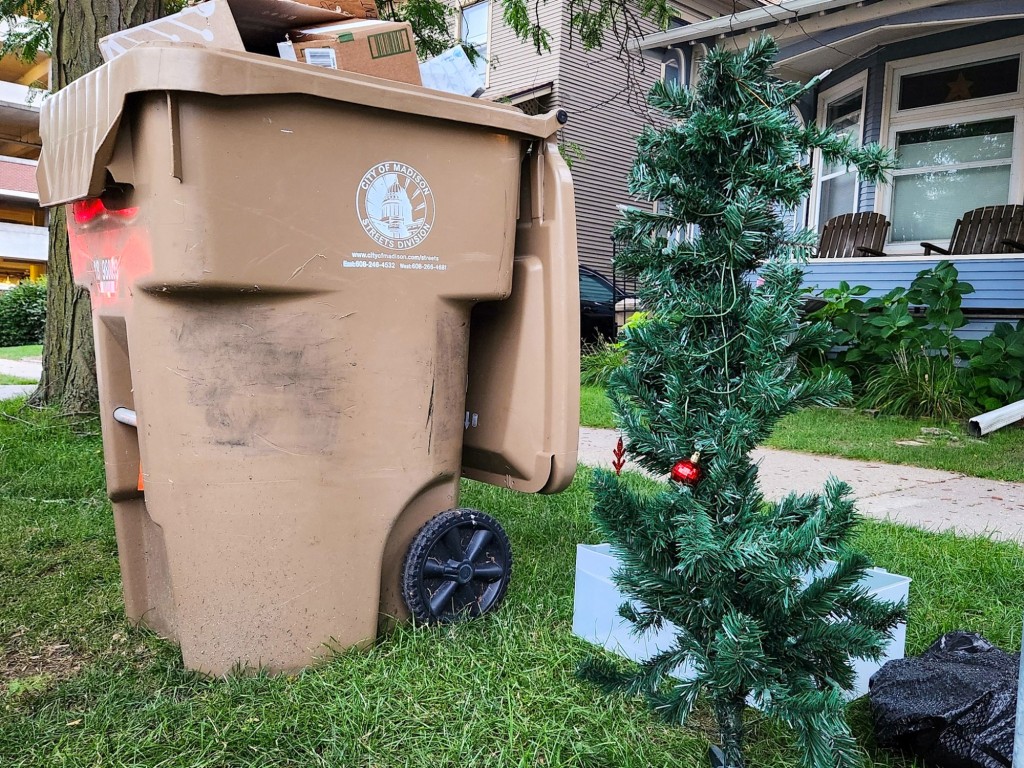
Even with those values infirmly in place and practiced, the giddiness around “Hippie Christmas” rubs me the wrong way. Every year, City officials estimate trash collectors handle over one million pounds of discarded items during August student move-out, which this year ran from August 4 to August 22. Try as the City and other organizations might to rescue and repurpose some of those items, a lot of it ends up in the landfill. As Bryan Johnson, recycling coordinator for the City of Madison, recently told Andy Moore of WORT-FM’s 8 O’Clock Buzz, “Bah Humbug.”
A universal human experience is that moving sucks. Some cope by traveling light, and some by staying in an apartment until it becomes untenable. So how is it that so many people choose to move within a two-week period, typically among the hottest of the year, and discard so many possessions along the way? How has this become not only normalized but even celebrated? Portraying abundant piles of discarded, (mostly) perfectly good items lining the streets as a quaint tradition illustrates Madison’s lack of care about housing, possessions, and waste.
People move for a variety of reasons, but at their core is hope for a better living situation. As someone who has looked every year at my options and then reluctantly decided to stay put, I can tell you that there’s extremely slim pickings in this town. All of us are being gouged out of way too much money to live in a small Midwestern city that is essentially an elevated college town/state capitol. And that’s not even getting into the slumlord conditions that we’re now supposed to accept and even see as normal—like the fact that some people end up being unhoused overnight because landlords are inflexible about lease dates. This is categorically not normal. I’ve rented in rural Nebraska, Kansas City, Chicago, and Beijing, China, and Wisconsin is the only place where landlords prorated any move-in and move-out days beyond the lease. Outside of this state, even the most slumlord-y landlords granted me a grace period of one or two days before or after any lease—a very basic courtesy—so I wouldn’t have to be unhoused overnight.
Also, not too long ago, landlords did not raise the rent every single year. My roommates and I stayed in our college apartment—a two-floor, three-bedroom, two-bath apartment—for years because the landlord only raised our rent once, by $40. After I moved out to live in China, they found another roommate and stayed there for two more years. We weren’t the only ones who benefitted from this—that was five years when the landlord didn’t have to worry about finding a new tenant. But Madison’s landlords have lost touch with reality. Instead of seeing shelters for human beings to live in (in, again, a small Midwestern city), they see commodities to exploit for maximum profit. As a result, all of us who are not homeowners (increasingly, not just students) are expected to live in unstable, overpriced, sub-par housing.
It’s also not normal to leave mountains of usable items on the curb where they can be exposed to rain, pests, and who knows what else. (As someone who’s experienced a bedbug infestation, I am begging you to please check everything carefully before you bring it home.) Maybe if everyone wasn’t moving at the same time, it would be much easier to re-home an item with friends or neighbors. But also, everywhere I’ve lived before, landlords were much more flexible about letting you leave items for the incoming tenant if they wanted them. In Wisconsin, you can’t even leave so much as a bedside table behind without risking your deposit.
(That college apartment with the nice pleather couch also had a filthy fish tank with two fish, which is pushing the limits of my argument. In the end, it was an adventure in pet ownership and a roommate bonding experience. RIP Wilber and Zippy.)
On his August 15 appearance on the 8 O’Clock Buzz, Johnson told Moore that the mountains of stuff are not as bad as they used to be, citing old photographs and the experiences of veteran operators. Johnson and Moore traded off theories as to why—maybe people are renewing leases instead of moving as often, or it could be because some of the newer apartments are furnished? Or maybe things have gotten so expensive that people aren’t being as wasteful. It could also be related to large apartment buildings offering dumpster services. Johnson points out that if that is the case, “it’s not like a mess isn’t being made, it’s just not being made out to the street, so we don’t see it as much.”
This wastefulness feels part and parcel to our instability. Not too long ago working- and middle-class adults were able to buy property which they could fill with solid-wood dining tables, bookshelves, dressers, etc. But why buy expensive, high-quality, heavy furniture when you don’t have control over your housing situation and may be forced to move? Instead, we’re in a perpetual cycle of buying cheaply-made furniture that then gets thrown out when we’ve decided it’s just not worth the hassle of moving to the next place, which then needs to be replaced with more cheap furniture. Although, given the amount of nice-looking stuff left outside to possibly be rescued (but more likely, to rot) there’s also an element of our culture’s general devaluation of objects. Instead of valuable investments to care for and maintain so they can beautify our homes, our culture treats material objects as things to acquire, wear out, then discard.
So, yes, go out and find some hidden treasures among the detritus—anything you can do to lessen the load going to the landfill. But let’s remember that we deserve to have nice things and live in quality, affordable, stable housing. None of this is necessary, much less fun and quirky. Celebrating Hippie Christmas is confusing a joyful tradition with people making the best of what’s been dealt.
Who has power in Madison,
and what are they doing with it?
Help us create fiercely independent politics coverage that tracks power and policy.
Author

Related Articles
Madison needs a wake-up call
The longer we pretend this City is a progressive haven, the more people will be harmed.

Stop spotlighting new films by known abusers
Madison boasts a dynamic movie culture, yet still needs programmers and community voices to facilitate change.
Achieving a broader focus through music photojournalism in 2025
The fourth installment of our live music photo essay series centers a more personal vantage point.