
Hidden Housing Histories: Joyce Funeral Home
Living in a 100-year-old ex-funeral home, I uncovered an unusual and dark piece of Madison history.
Script and sources
PAGE 1
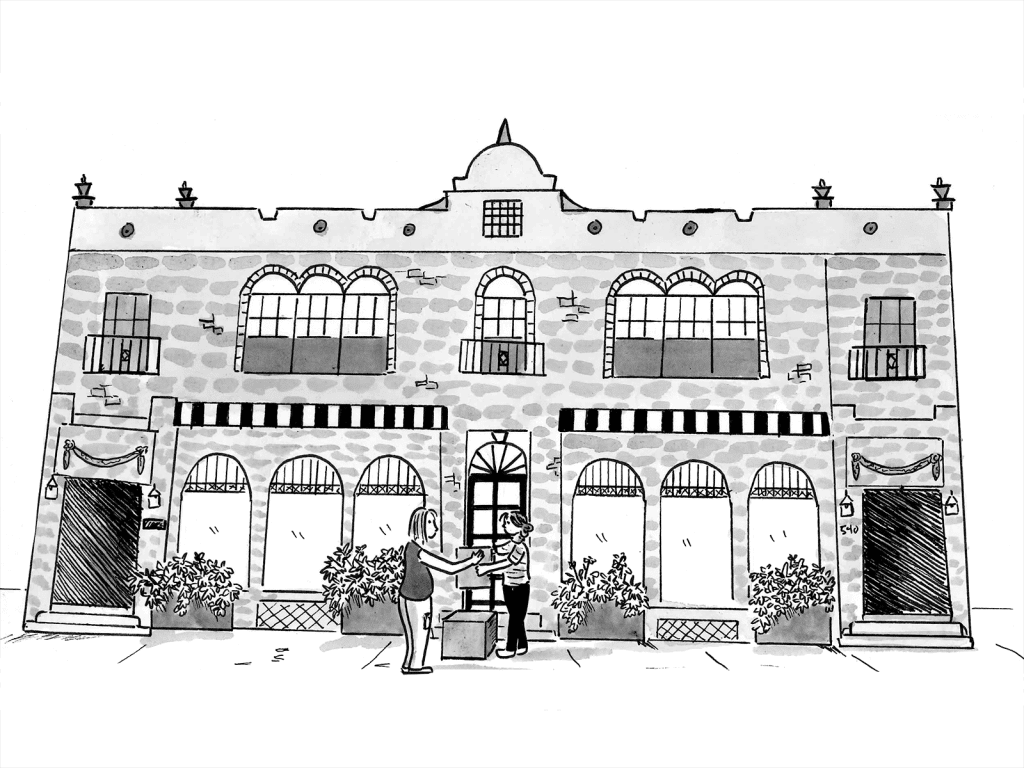
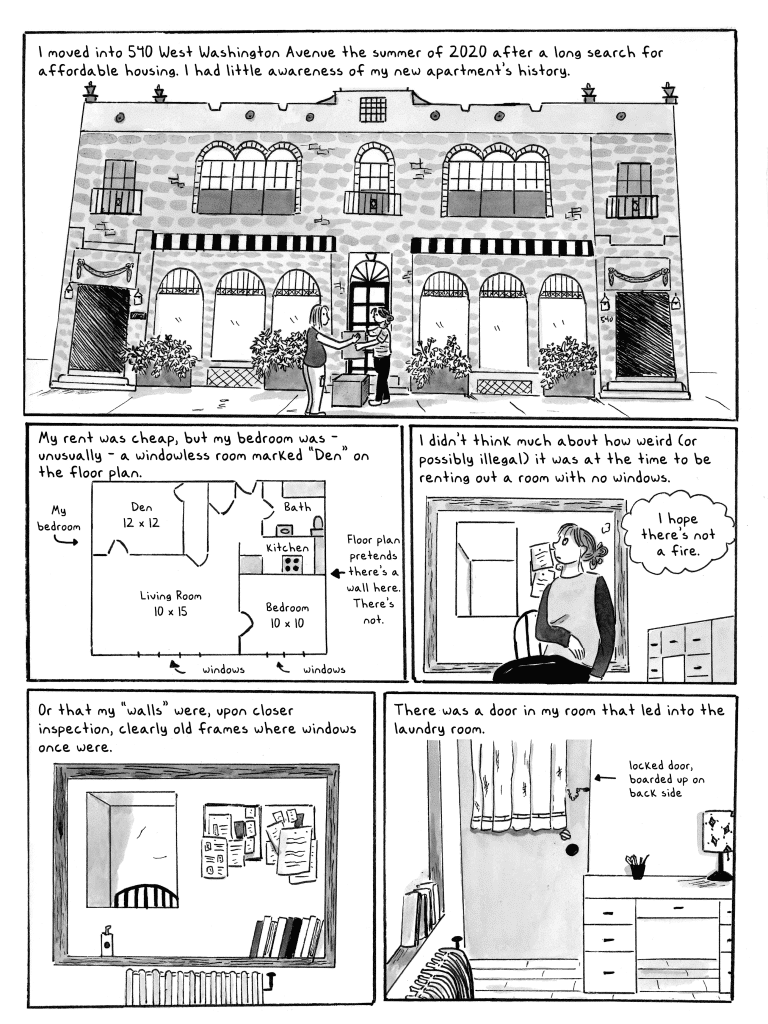
Panel 1: I moved into 540 West Washington Avenue, the summer of 2020 after a long search for affordable housing. I had little awareness of my new apartment’s history.
Image: I am outside of 540 West Washington Avenue. I am moving things in through the front door with friends.
Panel 2: My rent was cheap, but my bedroom was—unusually—a windowless room marked “den” on the floor plan.
Image: I show a drawing of the official floor plan that my landlord posts on his website. The floor plan shows that there are two rooms, one being the bedroom (by a window), the other being a “den” with no window. In reality, the room marked “bedroom” is just an extension of the kitchen, not a bedroom. The windowless “den” is the true bedroom.
Panel 3: I didn’t think much about how weird (or possibly illegal) it was at the time to be renting out a room with no windows.
Image: I am in my windowless room, staring at the walls. One of the walls looks like a covered up window.
Panel 4: Or that my “walls” were, upon closer inspection, clearly old frames where windows once were.
Image: I zoom in on the wall where the window used to be but is now a hole covered by plaster.
Panel 5: There was a door in my room that led into the laundry room.
Image: Door that goes into the laundry room from the bedroom
PAGE 2
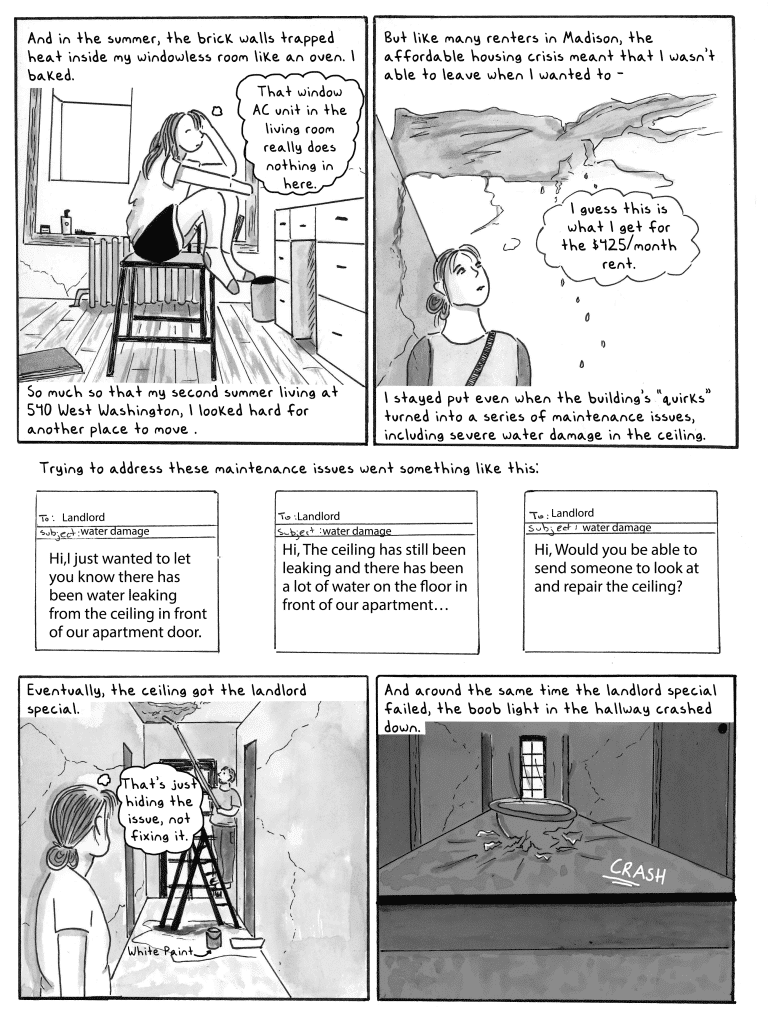
Panel 6: And in the summer, the brick walls trapped heat inside my windowless room like an oven. I baked.
Image: I curl up on the floor of my room thinking “That window AC unit in the living room really does nothing in here.”
So much so that my second summer living at 540 West Washington, I looked hard for another place to move.
Panel 7: But like many renters in Madison, the affordable housing crisis meant that I wasn’t able to leave when I wanted to –
Image: I look up at a brown patch on the ceiling. Pieces of plaster fall down and water drips heavily down the wall. I think to myself “I guess this is what I get for the $425/month rent.”
I stayed put even when the building’s “quirks” turned into a series of maintenance issues, including severe water damage in the ceiling.
Panel 8: Trying to address these maintenance issues went something like this:
Image: examples of emails I sent to my landlord:
“Hi, I just wanted to let you know there has been water leaking from the ceiling in front of our apartment door…“
“Hi, The ceiling has still been leaking and there has been a lot of water on the floor in front of our apartment…”
“Hi, Would you be able to send someone to look at and repair the ceiling?”
Panel 9: Eventually, the ceiling got the landlord special.
Image: The maintenance guy paints white over the leaking brown patch of ceiling. I think to myself “that’s just hiding the issue, not fixing it.”
Panel 10: And around the same time the landlord special failed, the boob light in the hallway crashed down.
Image: The light on the ceiling falls due to excessive water damage, and shatters on the floor.
PAGE 3
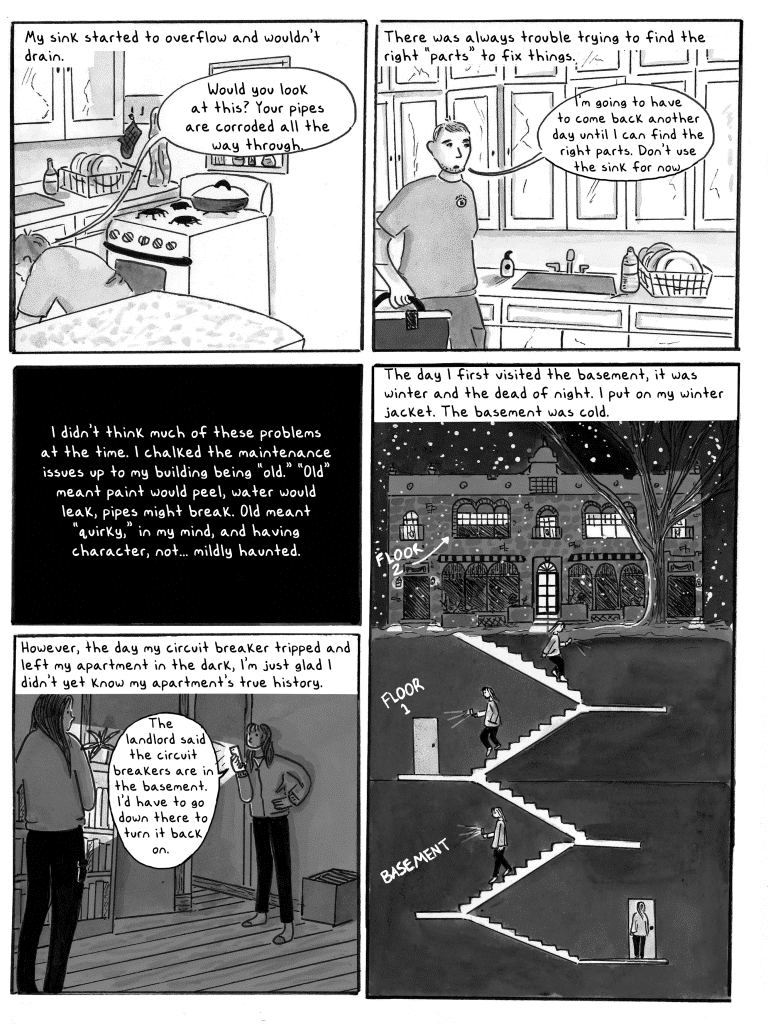
Panel 11: My sink started to overflow and wouldn’t drain.
Image: The maintenance guy is in my apartment. He looks under the sink. He mutters to himself “Would you look at this. Your pipes are corroded all the way through.
Panel 12: There was always trouble trying to find the right “parts” to fix things.
Image: An image of my broken pipe. The maintenance guy says “I’m going to have to come back another day until I can find the right parts. Don’t use the sink for now.”
Panel 13: (narration text only) I didn’t think much of these problems at the time. I chalked the maintenance issues up to my building being “old.” “Old” meant paint would peel, water would leak, pipes might break. Old meant “quirky,” in my mind, and having character, not… mildly haunted.
Panel 14: However, the day my circuit breaker tripped and left my apartment in the dark, I’m just glad I didn’t yet know my apartment’s true history.
Image: I talk to my roommate, holding a flashlight because the apartment is completely dark. I tell my roommate, “The landlord said the circuit breakers are in the basement. I’d have to go down there to turn it back on.”
Panel 15: The day I first visited the basement, it was winter and the dead of night. I put on my winter jacket. The basement was cold.
Image: A wide shot schematic image of my apartment building. The front of the building is stripped away so you can see me walking down the stairs into the basement, holding a flashlight.
PAGE 4
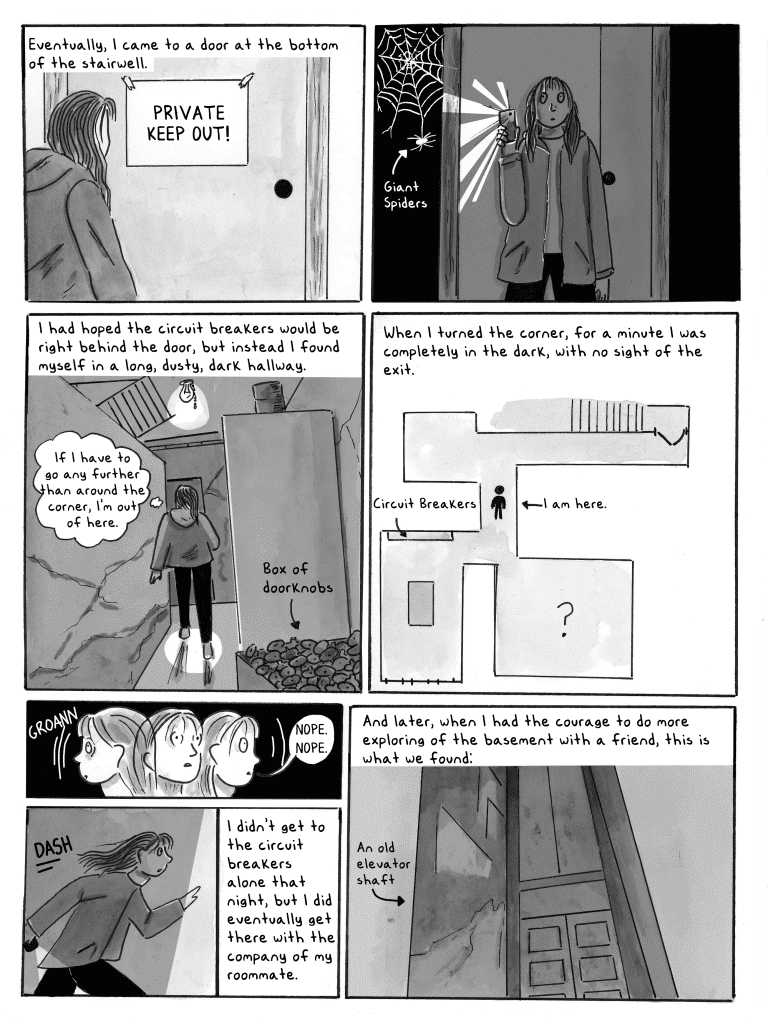
Panel 16: Eventually, I came to a door at the bottom of the stairwell.
Image: I stop in front of the door at the bottom of the stairwell. There is a sign on it that says “private, keep out.” An arrow points to the sign indicating this is actually what it said.
Panel 17: (no narration text)
Image: I open the door. I stand in the doorway with my phone flashlight pointed forward, looking spooked. There is a spider on the wall in the left corner.
Panel 18: I had hoped the circuit breakers would be right behind the door, but instead I found myself in a long, dusty, dark hallway.
Image: I am standing in the hallway, looking into the dark. There are random boxes of things like doorknobs and other apartment “parts” scattered on the floor. I think to myself “If I have to go any further than around the corner, I’m out of here.”
Panel 19: When I turned the corner, for a minute I was completely in the dark, with no sight of the exit.
Image: An aerial shot shows a schematic of my basement. It shows that I’ve made it down the hallway and around the corner but that I still have a ways to go before I reach the circuit breakers in another room.
Panel 20: (no narration text)
Image: Something creaks and I whip my head around rapidly. I say “nope,” and then run out of the hallway and toward the door.
Panel 21: I didn’t get to the circuit breakers alone that night, but I did eventually get there with the company of my roommate.
Panel 22: And later, when I had the courage to do more exploring of the basement with a friend, this is what we found:
Image/text: an old elevator shaft
PAGE 5
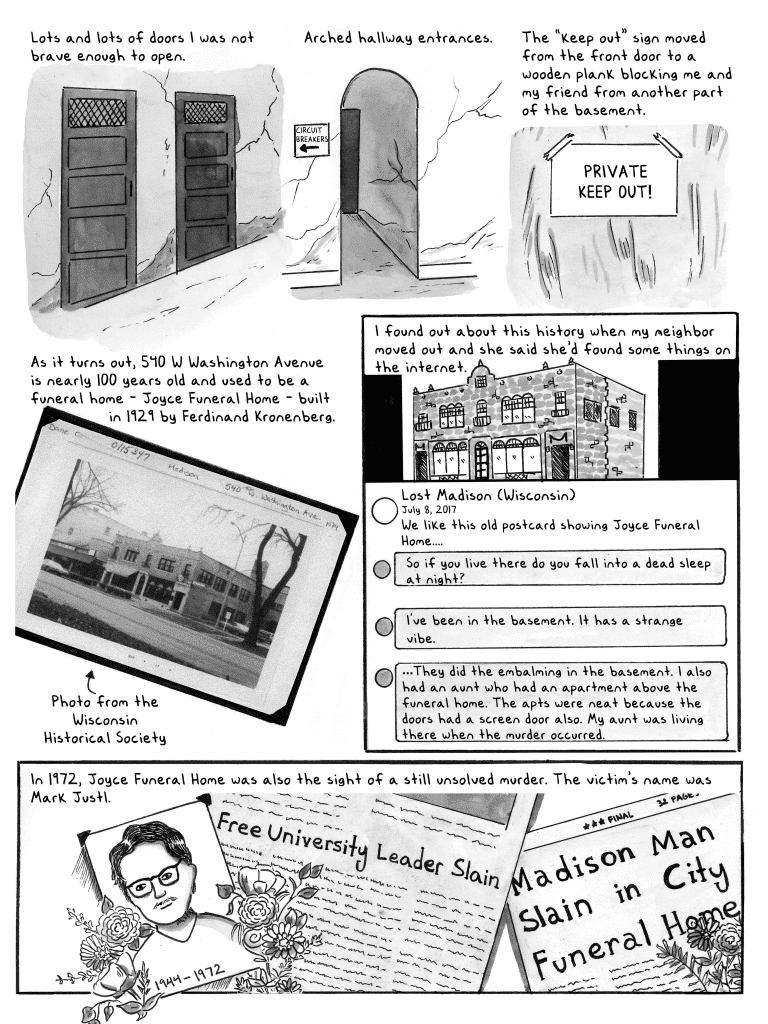
Panel 23: Lots and lots of doors I was not brave enough to open.
Image: A room with 6 doors with mesh panels.
Panel 24: Arched hallway entrances
Image: Arched hallways entrances.
Panel 25: The “keep out” sign moved from the front door to a wooden plank blocking me and my friend from another part of the basement.
Image: A schematic shows where this sign used to be and now where it has been moved. I draw a question mark in the room behind the “keep out” sign that I was never able to explore. The schematic also shows the location of the elevator shaft and circuit breakers.
Panel 26: As it turns out, 540 West Washington Avenue is nearly 100 years old and used to be a funeral home—Joyce Funeral Home—built in 1929 by Ferdinand Kronenberg.
Image: A photo of Joyce Funeral Home from the Wisconsin Historical Society.
Panel 27: I found out about this history when my neighbor moved out and she said she’d found some things on the internet.
Image: I scroll through Facebook comments on a post in a “Lost Madison” history page. Comments read:
“I had a friend who grew up in the depression living upstairs there .. I remember her telling me they were so poor they had to eat lard sandwiches ..”
“I’ve been in the basement. It has a strange vibe.”
“So if you live there do you fall into a dead sleep at night?”
Panel 28: In 1972, Joyce Funeral Home was also the sight of a still unsolved murder. The victim’s name was Mark Justl.
Image: A memorial page for Mark, with florals surrounding his photo, and newspaper clippings and headlines from 1972.
PAGE 6
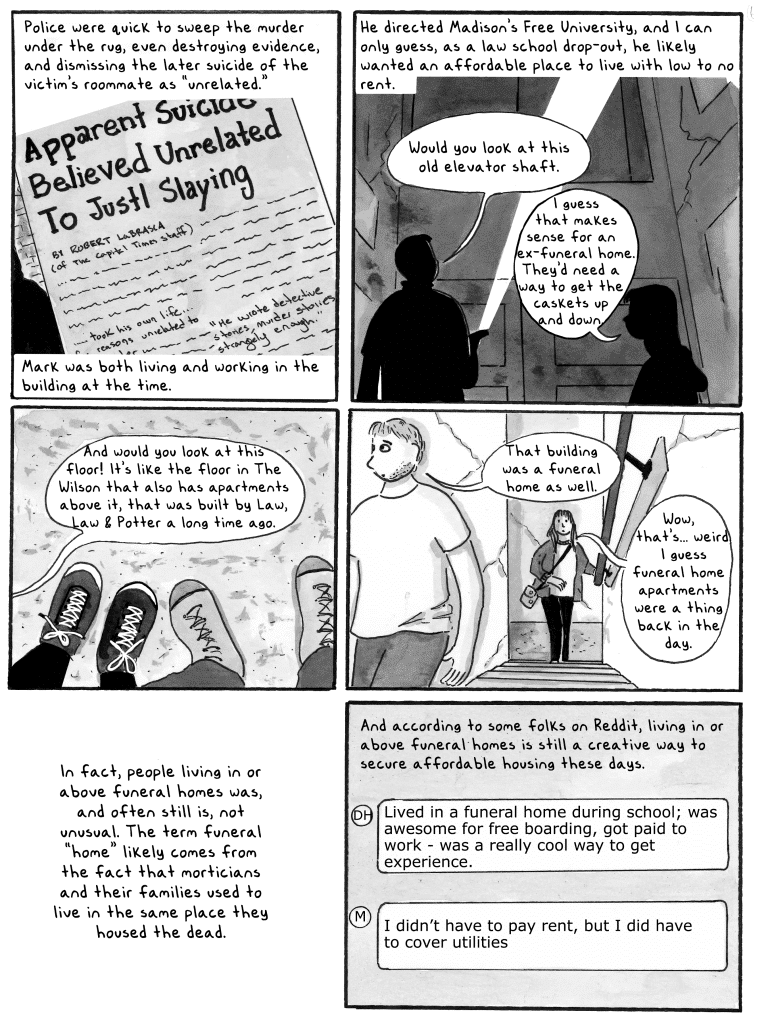
Panel 29: Police were quick to sweep the murder under the rug, even destroying evidence, and dismissing the later suicide of the victim’s roommate as “unrelated.”
Image: A newspaper clipping from The Capital Times with the headline “Apparent Suicide Believed Unrelated to Justl Slaying”. Text is highlighted where the detective states the roommate’s death has “no significance to our investigation.”
Mark was both living and working in the building at the time.
Panel 30: He directed Madison’s Free University, and I can only guess, as a law school drop-out, he likely wanted an affordable place to live with low to no rent.
Image: Me and my friend stand in the basement, at the bottom of the abandoned elevator shaft. My friend looks up, and says “Would you look at this old elevator shaft.” I say, “I guess that makes sense for an ex-funeral home. They’d need a way to get the caskets up and down.”
Panel 31: (no narration text)
Image: My friend points at the speckled stone floor. “And would you look at this floor,” he says. “It’s just like the floor in The Wilson that also has apartments above it, that was built by Law, Law & Potter a long time ago.”
Panel 32: (no narration text)
Image: My friend continues talking as we exit the basement and climb back up the stairs. He states, “That building used to be a funeral home as well.”
I respond, “Wow, that’s… weird. I guess funeral home apartments were a thing back in the day.”
Panel 33: In fact, people living in or above funeral homes was, and often still is, not unusual. The term funeral “home” likely comes from the fact that morticians and their families used to live in the same place they housed the dead.
Panel 34: And according to some folks on Reddit, living in or above funeral homes is still a creative way to secure affordable housing these days.
Image: People on Reddit claim they’ve been able to rent out funeral home apartments either for free if they work there, or very low rent, as low as just a couple hundred dollars a month.
“Lived in a funeral home during school; was awesome for free boarding, got paid to work—was a really cool way to get experience.”
“I didn’t have to pay rent, but I did have to cover utilities.”
PAGE 7
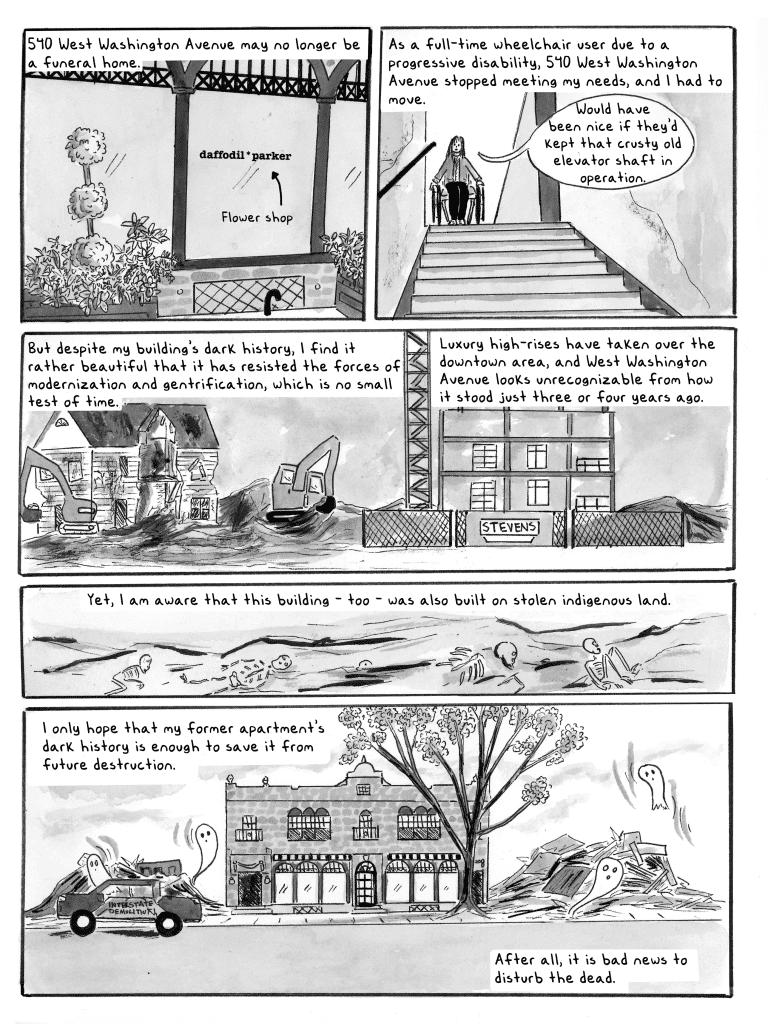
Panel 35: 540 West Washington Avenue may no longer be a funeral home.
Image: An image of Daffodil Parker Flower Shop with beautiful trees shading it, now inhabiting the once empty section of the building where Mark Justl was murdered.
Panel 36: As a full-time wheelchair user due to a progressive disability, 540 West Washington Avenue stopped meeting my needs, and I had to move.
Image: Me in a wheelchair at the top of the stairs thinking “would have been nice if they’d kept that crusty old elevator shaft in operation.”
Panel 37: But despite my building’s dark history, I find it rather beautiful that it has resisted the forces of modernization and gentrification, which is no small test of time.
Image: Bulldozers raze practically every single wooden house on my street to make way for new high-rises.
Panel 38: Luxury high-rises have taken over the downtown area, and West Washington Avenue and many other streets look unrecognizable from how they stood just three or four years ago.
Image: The new high-rises crop up on the bones/destruction of old houses.
Panel 39: Yet, I am aware that this building—too—was also built on stolen indigenous land.
Image: Beneath the bones/destruction of old houses are human bones/skeletons
Panel 40: I only hope that my former apartment’s dark history is enough to save it from future destruction.
Image: My building stands alone amidst a landscape of broken houses and bulldozers, ghosts reemerging from the rubble.
After all, it is bad news to disturb the dead.
Who has power in Madison,
and what are they doing with it?
Help us create fiercely independent politics coverage that tracks power and policy.
Author

Related Articles

Small Bites: How I make bread
Meditating on the process, flour, flavor, time, and place.
Three video artists tap into personal histories in the 150 Artists x 150 Years exhibition
Chele Isaac, Toby Kaufmann-Buhler, and Aaron Granat reveal the creative depths of their works, which are on display through February 28 at Central Library.
Stop spotlighting new films by known abusers
Madison boasts a dynamic movie culture, yet still needs programmers and community voices to facilitate change.